
1. Background
The prevalence of obesity is considered as a risk factor for cardiovascular diseases and chronic diseases. The increase in LDL, total cholesterol, and triglyceride and their accumulation in arteries causes atherosclerosis and hypertension, which can be said an important risk factor for coronary artery disease in obese females (1). This is directly related to factors such as age, gender, inactivity, and diet. Owing to the direct relationship between lipids and cardiovascular diseases, blood lipids level is perceived as an important factor in health so that non-pharmacological methods, such as exercise training, are recommended for losing weight and fat (2). Evidence suggests that AT could help improve metabolic and cardiovascular factors (2, 3).
On the other hand, GT is an important source of a polyphenolic flavonoid, called catechin, which is extracted from camellia. Extract of GT prevents the activity of the catecholamine-O-methyl transferase (COMT) enzyme, which reduces noradrenaline and increases energy intake and fat oxidation, and reduces body fat mass by regulating sympathetic activity and lipolysis (4).
Although the relationship between GT consumption and risk factors for cardiovascular diseases and also, the positive effects of exercise on stimulating fat and carbohydrate oxidation have been subject to extensive epidemiological studies, the results of these studies are contradictory. Some studies have reported positive effects on blood pressure, dyslipidemia, and blood glucose (5, 6). Most studies have explored the effect of exercise and GT separately (2, 3, 5, 6) and their simultaneous effects have been less often considered. An advantage of the present study was the simultaneous examination of AT and GT.
Similarly, in animal studies, when the use of GT was accompanied by exercise, the body fat of rats showed greater decrease than when they were applied individually (7, 8). Overall, some studies have confirmed the effect of GT consumption on fat oxidation, blood glucose, and body composition (9-13), yet others have not (14, 15).
Overall, research on the positive role of exercise and dietary supplements emphasize the importance of these two factors in weight loss programs and cardiovascular diseases and their metabolic risks, especially considering the difficulty of exercise and individuals’ willingness to use medicinal herbs (3, 11). In this respect, studies differ in supplement type, dosage (8, 15), and exercise design, particularly in terms of intensity and duration (8, 16) and also, have reported contradictory findings (6, 15). Furthermore, the contradictions in relevant research are explored and an effective approach is suggested for weight loss and health enhancement in the society. Thus, the objective of the present study was to explore the impact of AT and GT supplement on body composition and cardiovascular risk factors of overweight and obese females.
2. Objectives
The aim of this study was to explore the effect of AT and green tea supplementation on cardio metabolic risk factors in overweight and obese females.
3. Methods
3.1. Subjects
Out of 50 volunteers, 39 overweight and obese inactive females (mean ± SD: age, 28.11 ± 6.50 years and weight, 85.47 ± 11.22 kg) were randomly divided to three groups: AT with green tea (AT + GT), AT, and control (C). The subjects in the control group did not take part in sports activities and only performed their daily activities. They were recommended to observe a constant diet.
The sample size seemed sufficient considering previous studies (17, 18). Participant recruitment was started in June and ended in August 2016. The study duration was eight weeks. Before the training protocol was conducted, the participants were invited to a gym to fill out the forms of personal characteristics, medical record, and consent. To control the diet, they were asked to record their daily food consumption in special forms for 72 hours (one weekend and two weekdays). The researchers suggested that appropriate food items could be added to their dietary regimen and junk food items could be removed.
The inclusion criteria were being a healthy female. Also, exclusion criteria were the presence of cardiovascular and joint diseases. The research was approved by Human Studies Review Committee of Islamic Azad University in advance by IR.IAU.RASHT.REC.1395.25 number and was registered at IRCT with reference number IRCT20150531022498N17.
3.2. Measurements
The participants’ height and weight were measured using a digital height and weight scale (SECA, Germany). The BMI was calculated as the body weight (kg) divided by the square of height. Three points subcutaneous fat was estimated by a SAEHAN caliper (SH5020, South Korea) in triceps brachia, quadriceps, and thigh. Body fat percentage was calculated using the Siri equation.
The resting blood pressure of the participants was measured in sitting position, after a minimum five-minute rest by a blood pressure device (ALPK2, model 300-V-EU, Japan). Waist circumference (WC) was measured at a point midway between the lowest rib and the iliac crest with the participant in standing position.
At the beginning and end of the study, 5 mL of subject’s blood was taken from the elbow vein after 12 hours of fasting. Blood sampling was performed from 8 to 10 am.
Baseline blood glucose hemostasis tests included Fasting Blood Sugar (FBS) (mg/dL).
Blood glucose test was carried out with a bio system kit (Spain), using glucosidase/peroxidase method and with an auto-analyzer (Hitachi, Japan) using a full automation procedure.
Blood lipid tests, such as high-density lipoprotein (HDL), LDL, total cholesterol (TC), and triglycerides were performed using the photometric method and by Pars Azmoon kit (Iran).
3.3. Exercise Protocol and Supplements
Aerobic progressive training composed of eight weeks of 80 - 90-minute sessions (three time/week), in which training intensity was started with 40% to 50% of target heart rate (THR) and was finished with 70% to 80% of THR (19). The THR was calculated by the Karvonen formula. Heart rate was measured during the work with a polar heart rate meter.
Participants in GT supplement group received three capsules daily (Giah Essans Pharmaceutics Company, Iran), after their main meals.
Each capsule contained 33 mg d-1 of GT. The GT pills were delivered every seven days to better control the subjects. Each volunteer received eight packs of GT tablets at the end of eight weeks. During the work, the consumption of the pills was pursued regularly using social networks and SMS. To prepare the capsules, the GT pills containing the main polyphenols of GT were powdered and then, the capsules were filled with them.
Dietary intake was individually prescribed by a three-day recall technique before and during the research. The participants were asked to report the kinds and amounts of food and beverage items that they consumed both at home and away from home on a three-day recall basis so that appropriate food items could be added to their dietary regimen and junk food items could be removed. Since the food regimen was influential on the research variables, the three groups were recommended to use a certain diet, from which harmful material had been removed. In spite of the recommendations of diet, the quantity of food intake was unknown. Therefore, it is recommended to control diet in future works.
Mean daily intake for total energy was 1900 kcal (20). This research used a diet including carbohydrates, protein, fat, fruits, and vegetables. Reduced fat spread (not polyunsaturated) was the most commonly consumed fat spread. The total consumption of vegetables was about 186 grams per day (20). These items were given as a brochure, in which the values of the indexes were mentioned (Table 1).
Table 1.
The Range of Nutrient Intake of Obese and Overweight Femalesa
| NDNS | |
|---|---|
| Energy, kcal | 1900 |
| Fat, %E | 35 |
| Protein, %E | 18 |
| Carbohydrate, %E | 47 |
Abbreviations: %E, percentage of energy intake; NDNS, national diet and nutrition survey (Ruston et al 2003).
aData from females aged 19 to 64 years.
3.4. Statistical Analyses
Normal distribution of the data was checked using the Kolmogorov-Smirnov test and since they were found to be normally distributed, parametric statistics were used. Data were analyzed by multi-group covariance (ANCOVA) test amongst the groups. The LSD test was applied for the pairwise comparison of the groups. Data were statistically analyzed with the SPSS software package (ver. 22). Significance level of the hypotheses was set at P < 0.05.
4. Results
Fifty overweight and obese females were assessed for eligibility before the intervention. Thirty-nine female participants were randomly assigned to either AT (n = 13), AT + GT (n = 13), or C (n = 13) group.
Baseline characteristics of the participants are reported in Table 2. There was no significant difference in anthropometrics, blood pressure, and biochemical variables between the groups.
The results of covariance analysis showed that body weight, body fat percentage (BF%), and body mass index, triglyceride, LDL, and cardiovascular parameters were significantly different between the groups (P < 0.05; Table 2), yet there were no significant differences in other parameters (P < 0.05).
Table 2.
Baseline Characteristics of the Study Participants and Results of Measuring Parameters Related to Body Composition and Biochemical Parameters at Pre and Post Intervention (n = 39)
| Aerobic + Green Teaa (n = 13) | Aerobic Traininga (n = 13) | Controla (n = 13) | Sig | ANCOVA | ||
|---|---|---|---|---|---|---|
| F | P Valueb | |||||
| Age, y | 0.1 | - | - | |||
| Pre | 28.14 ± 7.48 | 27.12 ± 6.50 | 28.13 ± 6.54 | |||
| Post | - | - | - | |||
| Weight, kg | 0.2 | 13.60 | < 0.001* | |||
| Pre | 85.46 ± 11.65 | 84.50 ± 11.22 | 85.46 ± 11.65 | |||
| Post | 81.69 ± 11.17 | 82.41 ± 10.52 | 87.84 ± 13.87 | |||
| BMI, kg.m-2 | 0.4 | 14.18 | < 0.001* | |||
| Pre | 33.44 ± 3.78 | 32.77 ± 5.42 | 33.87 ± 4.25 | |||
| Post | 31.96 ± 3.59 | 31.91 ± 5.12 | 33.87 ± 4.25 | |||
| Body fat, % | 0.5 | 33.07 | < 0.001* | |||
| Pre | 39.90 ± 2.11 | 38.81 ± 2.47 | 39.89 ± 2.27 | |||
| Post | 36.90 ± 1.99 | 36.80 ± 2.28 | 40.21 ± 2.70 | |||
| WHR, cm | 0.07 | 0.76 | 0.4 | |||
| Pre | 0.86 ± 0.05 | 0.85 ± 0.09 | 0.85 ± 0.08 | |||
| Post | 0. 82 ± 0.04 | 0.81 ± 0.07 | 0.86 ± 0.08 | |||
| WC, cm | 0.6 | 0.64 | 0.9 | |||
| Pre | 85.8 ± 12.0 | 85.9 ± 12.1 | 86.9 ± 12.2 | |||
| Post | 82.8 ± 11.2 | 77.00 ± 8.26 | 86.8 ± 12.0 | |||
| FBS, mg.dL-1 | 0.06 | 0.11 | 0.8 | |||
| Pre | 81.53 ± 7.55 | 81.8 ± 10.0 | 85.23 ± 11.00 | |||
| Post | 76.92 ± 9.35 | 77.00 ± 8.26 | 85.23 ± 11.00 | |||
| LDL, mg.dL-1 | 0.7 | 2.57 | 0.02* | |||
| Pre | 113.62 ± 13.4 | 117.85 ± 14.8 | 109.93 ± 14.1 | |||
| Post | 86.53 ± 11.7 | 98.15 ± 12.1 | 109.27 ± 14.7 | |||
| TC, mg.dL-1 | 0.8 | 1.61 | 0.2 | |||
| Pre | 213.69 ± 18.92 | 210.66 ± 18.92 | 188.92 ± 16.70 | |||
| Post | 201.61 ± 17.73 | 194.08 ± 17.28 | 188.30 ± 16.68 | |||
| TG, mg.dL-1 | 0.2 | 0.66 | 0.04* | |||
| Pre | 135.0 ± 15.3 | 129.15 ± 13.7 | 133.3 ± 14.1 | |||
| Post | 128.26 ± 14.9 | 106.38 ± 16.5 | 133.27 ± 15.18 | |||
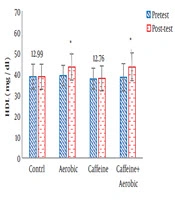
| HDL, mg.dL-1 | 0.1 | 0.09 | 0.9 | |||
| Pre | 39.23 ± 2.61 | 38.58 ± 2.84 | 40.92 ± 3.90 | |||
| Post | 40.53 ± 2.53 | 40.33 ± 1.87 | 40.84 ± 3.86 | |||
| Rest heart rate | 0.09 | 53.23 | < 0.001* | |||
| Pre | 78.92 ± 11.44 | 77.50 ± 10.99 | 77.50 ± 10.99 | |||
| Post | 72.46 ± 9.31 | 71.00 ± 8.80 | 78.92 ± 9.75 | |||
| SBP, mmHg | 0.1 | 4.11 | 0.02* | |||
| Pre | 127.69 ± 6.95 | 127.91 ± 6.98 | 113.84 ± 6.17 | |||
| Post | 108.84 ± 5.82 | 106.66 ± 4.92 | 113.80 ± 6.16 | |||
| DBP, mmHg | 0.9 | 2.56 | 0.04* | |||
| Pre | 72.30 ± 3.88 | 71.20 ± 3.10 | 77.30 ± 4.83 | |||
| Post | 72.30 ± 3.88 | 71.20 ± 3.10 | 77.30 ± 4.83 | |||
Abbreviations: BMI, body mass index; DBP, diastole blood pressure; FBS, fasting blood sugar; HDL, high density lipoprotein; LDL, low density lipoprotein; SBP, systole blood pressure; TG, tri glyceride; WHR, waist to hip ratio.
aValues are expressed as mean ± SD.
bP value calculated from ANCOVA test (* P ≤ 0.05).
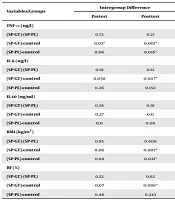
The LSD test revealed that there was a significant difference in weight, body mass, subcutaneous fat, triglyceride, LDL, and cardiovascular parameters between the C group and AT and AT + GT (Table 3). Significant differences were observed between groups 1 and 3 and between groups 2 and 3, yet groups 1 and 2 did not differ significantly. It can be suggested that exercise was effective but green tea was ineffective.
Table 3.
Between Group Comparisons of Study Variables at the End of the Interventiona
| Variable | Mean Difference | P Valueb |
|---|---|---|
| Weight, kg | ||
| Between groups 1 and 2 | 1.62 | 0.10 |
| Between groups 1 and 3 | 5.57 | < 0.001* |
| Between groups 2 and 3 | 4.15 | 0.002* |
| BMI, kg.m-2 | ||
| Between groups 1 and 2 | 0.61 | 0.10 |
| Between groups 1 and 3 | 2.24 | < 0.001* |
| Between groups 2 and 3 | 1.62 | < 0.001* |
| Body fat, % | ||
| Between groups 1 and 2 | 0.81 | 0.10 |
| Between groups 1 and 3 | 3.40 | < 0.001* |
| Between groups 2 and 3 | 2.58 | < 0.001* |
| LDL, mg.dL-1 | ||
| Between groups 1 and 2 | 4.33 | 0.90 |
| Between groups 1 and 3 | 38.75 | 0.02* |
| Between groups 2 and 3 | 24.33 | 0.04* |
| TG, mg.dL-1 | ||
| Between groups 1 and 2 | 4.03 | 0.80 |
| Between groups 1 and 3 | 43.3 | 0.03* |
| Between groups 2 and 3 | 38.33 | 0.03* |
| Rest heart rate | ||
| Between groups 1 and 2 | 0.20 | 0.70 |
| Between groups 1 and 3 | 6.46 | < 0.001* |
| Between groups 2 and 3 | 6.71 | < 0.001* |
| SBP, mmHg | ||
| Between groups 1 and 2 | 4.53 | 0.90 |
| Between groups 1 and 3 | 17.80 | 0.04* |
| Between groups 2 and 3 | 18.33 | 0.04* |
| DBP, mmHg | ||
| Between groups 1 and 2 | 5.98 | 0.80 |
| Between groups 1 and 3 | 14.98 | 0.03* |
| Between groups 2 and 3 | 15.33 | 0.04* |
Abbreviations: BMI, body mass index; DBP, diastole blood pressure; FBS, fasting blood sugar; HDL, high density lipoprotein; LDL, low density lipoprotein; SBP, systole blood pressure; TG, tri glyceride; WHR, waist to hip ratio.
aGroup1: aerobic + green tea; Group2: aerobic training; Group 3: control.
b * P ≤ 0.05
However, in C group, no change was observed in parameters between the pretest and posttest.
5. Discussion
Results of the present study showed that AT reduced body fat percentage, triglyceride, low-density lipoprotein, blood pressure, and HR in eight weeks. However, no significant changes occurred in FBS, HDL, TC, and WHR (P > 0.05). These findings are consistent with that of Cardoso et al. (8), Contro et al. (21), Lee et al. (22), Taghizadeh et al. (23), and Martin et al. (24), and inconsistent with Zhou et al. (14) and Narayani et al. (2).
In a study by Contro et al. on different AT regimen in overweight adults, reductions were reported in TG and LDL (21). Another study on a four-week intake of GT diet supplemented with resistance training reported that GT consumption with resistance training reduced triglyceride reserves (8). In contrast, a study on the effect of GT on overweight females showed no significant differences in LDL and HDL (23).
Also, Martin et al. (24) examined the short-term effect of GT on insulin and plasma glucose in sedentary males and revealed no significant influence on blood glucose levels. These studies are consistent with the current study. In contrast, a study by Zhou et al. showed a reduction in blood glucose concentrations after GT consumption (14). These studies are inconsistent with the current study, which is likely to be related to differences in participants’ gender (females in the current study versus males in Zhou’s study), GT consumption dosage, intervention duration (two months versus six months), study designs, and forms.
While the mechanisms underlying the effect of exercise on the lipid profile are unclear, exercise appears to enhance the ability of skeletal muscles to utilize lipids as opposed to glycogen, thus reducing plasma lipid levels. Skeletal muscle is the most important regulator of fat oxidation and can have a positive impact on fat-mass balance (22).
On the other hand, cardiovascular parameters, such as HR and blood pressure, were improved significantly, which is inconsistent with the study of Roberts et al. (10) yet in agreement with Nogueira et al. (3), Potenza et al. (11), and Eichenberger et al. (25). An experiment on the effect of green tea consumption and trainings with ergometer bike on male athletes showed a significant reduction in HR (3). Another study by Broeder et al. (26) showed a significant reduction in peak heart rate after exercise.
Aerobic training reduces HR by increasing the power of the heart pump in each shot, dilating the vessels, and reducing the resistance to blood flow from the heart. It has been shown that active and trained people with high physical fitness have a lower HR. This is usually ascribed to their higher parasympathetic activity and/or lower sympathetic activity. However, the venous return and high systolic volumes in people with better endurance have been implicated as the likely reasons for their lower HR.
Roberts et al. (10) investigated the impact of four-week GT consumption on males, who exercised irregularly and did not show any significant differences in blood pressure between the two groups. It can be said that the differences in the current study compared with that of Roberts et al. lie in longer interventions, gender, and distinct way of exercise training.
The probable mechanism by which aerobic exercise and green tea could decrease blood pressure may be the fact that blood pressure could be regulated by nitric oxide and prostanoid systems, which are substances for blood vessel dilation and can be influenced by aerobic exercise training (27) and green tea (28). Besides, improving insulin sensitivity may be another potential mechanism of AT on blood pressure reduction (28).
The effect of GT on body composition has been evaluated in different studies by various methods. In some studies, the supplementation of exercise training with GT consumption has changed body composition (10, 13), whilst some have not observed any significant changes (15, 17). Another study showed that the consumption of GT plus exercise reduced body fat in rats as compared to green tea consumption or exercise alone (29).
In the current study, the researchers witnessed a significant difference in body composition by AT after eight weeks. This finding is inconsistent with the study of Chen et al. (9), which may be caused by high-dose GT and exercise design, such as long duration in their study (12 weeks). According to the results, it could be concluded that even AT alone has a modest effect on weight loss. The mechanism of the effect of AT on body fat can be attributed to the increased fat oxidation by the increase in β-oxidation enzymes and, eventually, the increase in fat metabolism (29).
Limitations of this research were the lack of close examination of the participants’ diet. Thus, it is recommended to use accurate dietary measurements in similar studies.
5.1. Conclusion
Overall, findings of this study demonstrated that the AT was effective in alleviating cardiovascular risk factors, e.g. hypertension, HR, triglyceride, and low-density lipoprotein. However, GT addition was not effective. Considering Iranians’ high tendency towards the consumption of plant materials, this finding needs further investigation.