
1. Background
Coronary artery atherosclerosis is among the most common causes of death in developed and developing countries, including Iran (1-3). Almost all older adults have a relative disorder in the blood circulation of the vessels around the heart, the most common of which is atherosclerosis. Primary lesions of atherosclerosis manifest themselves as fatty streaks. These primary lesions probably result from the focal accumulation of lipoproteins and cholesterol under the arterial endothelium. The result is the formation of atherosclerotic plaques that entirely or partially obstruct the blood flow by protruding into the vessel lumen (4).
Research shows that the rate of coronary artery disease has increased between 20% and 45% in recent years. Previous research emphasizes a wide range of risk factors for coronary atherosclerosis, including smoking, high blood pressure, diabetes, hyperlipidemia, family history, obesity, lifestyle, diet, and inflammatory factors. These inflammatory factors include increased levels of C-reactive protein (CRP), elevated levels of lipoprotein A, and elevated levels of homocysteine in the blood (5-7). The harmful impacts of drugs include the mobilization of inflammatory factors and disruption of the coagulation process (1). It should be noted that inflammatory factors' role in atherosclerosis development has been proven. In the study conducted by Asgari et al., it was found that drug addicts had a significantly increased risk of cardiovascular diseases, such as glycosylated hemoglobin, lipoprotein A, CRP, aPOB, and liver enzymes (1). In addition, some studies have reported that increased fibronectin levels lead to the initiation or exacerbation of atherosclerosis. Also, the chronic use of drugs is associated with increased substance P and calcitonin, adenosine, and adenyl cyclase (3).
Moreover, the literature states that these substances have adverse effects on heart function, but in cases where the Kappa receptor is stimulated by drug use, the effects will be different (8). Aitchison et al. showed that stimulating Kappa-opioid receptors worsens myocardial perfusion (9). In addition, Coles et al. showed that the blockade of Kappa-opioid receptors leads to the exacerbation of arrhythmia (10). In many studies, the positive effects of morphine on cardiovascular events have been reported. However, chronic use of such substances has been identified as a risk factor. Roohafza et al. in Isfahan, Iran, reported that drugs did not increase the risk of cardiovascular diseases, and the death and survival of patients after a heart attack did not increase (11).
Marmor et al. showed that coronary artery diseases are less common in methadone and other opiate users than in people with no history of opium use. However, other studies have introduced opium use as a risk factor for cardiovascular diseases (12). In addition, one of the widespread beliefs in our society today is the effect of drug use in preventing coronary artery diseases by reducing blood lipids. Drug addiction is a social issue (13). Addiction is the cause of many social harms and family and individual disorders. The increasing prevalence of drug dependence and addiction, particularly to emerging substances, threatens the family and society. This is due to its negative impact on mental, moral, and social well-being, leading to harmful behaviors such as strained family dynamics and, in severe cases, deviant sexual behavior. Therefore, it is considered one of the most critical social issues in the world today. Drug addiction is one of the challenging problems in Iranian society. The prevalence of opium abuse in Iran has been reported between 1.2% and 20% of the population, depending on age and socioeconomic status. It can be said that approximately a quarter of the world's population has used drugs, and 15% have contracted diseases caused by drug use (14). Also, in a study conducted on death cases referred to one of the forensic medicine centers, 4.39% of the referred cases had drug poisoning (15). Death rates due to drugs and psychotropic substances differ in studies of different countries. In a study conducted in Washington in 2009, the number of people who died due to drugs was reported to be 1668, giving a rate of 4.6 deaths per 100 people per year. Also, the total number of poisonings increased more than three times from 1999 to 2006 (16). In some studies conducted in Iran, drug abuse has been a risk factor for cardiovascular diseases (17, 18).
However, some beneficial aspects and medicinal uses of these substances should not be ignored (19). For example, morphine, as one of the derivatives of narcotics (opium), plays a vital role in treating cardiovascular diseases such as acute pulmonary edema, cardiac ischemia, and acute myocardial infarction (20, 21). Considering the high prevalence of opium addiction in our country, which is reported to be between 3% and 5%, and the high prevalence of opium in heart attack patients, which is over 7.25% (22), identifying risk factors and at-risk groups plays a significant role in prevention and control programs. It is crucial to know the factors that play a role in the development of the disease because by controlling them, the disease development can be prevented, or the severity of the disease can be reduced. Therefore, the current research was designed to identify the factors contributing to coronary artery atherosclerosis, including the consumption or abuse of narcotics and psychotropics and the specific substances consumed.
2. Objectives
We tried to provide a comprehensive assessment of this issue by macroscopic studies, measuring heart weight and dimensions, assessing valve status, evaluating microscopic vascular occlusion, determining atherosclerosis status, and calculating the percentage of blockage in each artery in the Forensic Medicine Department of Birjand city.
3. Materials and Methods
All autopsy files from the South Khorasan forensic autopsy room during the study period were selected, indicating a history of narcotic and psychotropic drug use/abuse. The results of the toxicological tests also indicated the use or abuse of narcotic and psychoactive drugs in the sample. Then, the cases whose autopsy included taking a heart sample were included in the study as the case group. Demographic information and other studied variables were extracted from the review of the available documents and recorded in the relevant form, along with the preliminary results of cardiological pathology and toxicology. In order to complete the variables considered by the researchers, samples of the existing tissue were prepared to determine the necessary pathological parameters of the heart tissue. After the slide preparation and staining with the hematoxylin-eosin method, the slides were examined by a pathologist, and the final results were recorded.
The control group included the deceased ones referred to this center during this research with no history of substance abuse. Both case and control groups were examined for other known risk factors of coronary artery disease, such as smoking, family history, underlying coronary artery disease, history of hypertension, and diabetes mellitus. Also, patients with a history of kidney disease, liver disease, anemia, malabsorption, hemochromatosis, chronic infections, or immunological and inflammatory disorders and patients with congenital heart failure were excluded from the study.
3.1. Data Collection
This case-control study derived the data from the records of the dead bodies referred to the forensic medicine, including the information from organizational interview forms completed by the relatives of the deceased, toxicology report forms (using the LLE extraction method and GC/MS analysis), and the pathology reports (i.e., macroscopic description, slides, hematoxylin-eosin staining, and microscopic examinations).
3.2. Sampling Method and Sample Size Calculation
In this study, a convenience sampling method was adopted. The control group, consisting of individuals with non-substance abuse and non-cardiac problems causing death, was matched with the case group regarding other conditions and risk factors.
3.3. Data Analysis Methods
The collected data were analyzed using SPSS software (version 22) and performing descriptive statistics (central and dispersion indices) and inferential statistics (chi-square, Mann-Whitney, and Spearman correlation coefficients). The significance level of all tests was set at a P-value of 5%.
4. Results
In this case-control study, of the 193 cadavers, 126 were in the drug abuse group and 67 in the control group. The average age of these people was 41.82 ± 16.84 years. The results of the Mann-Whitney test showed that the average age was not significantly different between the two groups (case group 42.06 ± 16.69 years and control group 41.39 ± 17.24 years, P = 0.622). None of the subjects had a family history of heart disease. Also, 80.3% (155) of the examined corpses were male. Specifically, 87.3% (110 people) in the case group and 67.2% (45 people) in the control group were men, and the chi-square test showed a significant difference. The two groups had no significant difference regarding a history of hypertension and diabetes (Table 1).
The Mann-Whitney test showed that the heart weight was significantly higher in the case group than in the control group (325.70 ± 81.87 g in the case group and 291.16 ± 26.75 g in the control group, P = 0.018) (Table 1). Those people had used methadone (73 people), morphine (68 people), tramadol (13 people), amphetamine (8 people), and methamphetamine (4 people). In some cases, two or three of these substances were used simultaneously.
There was no stenosis in any of the vessels in 17 corpses. Other results include 19 people without stenosis in RC and LC and 17 without stenosis in CX and LAD. In some cases, the stenosis was less than 20%: 18 people had stenosis of less than 20% in CX, LC, and RC vessels, and 17 people had stenosis of less than 20% in LAD. The stenosis results showed a mean RC of 49.52, LC of 97.55, CX of 84.61, and LAD of 90.69.
The Mann-Whitney test showed that the mean dimensions of the heart were 13 × 10 × 7 in the case group and 13 × 9 × 6 in the control group; the difference in one of the dimensions was significant (P = 0.014) (Table 1). The results showed a significant difference in atherosclerosis between gender groups (Table 2).
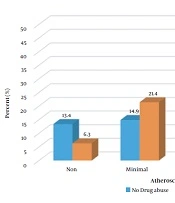
As seen in Figure 1, atherosclerosis was more in drug abuse patients, but it is not statistically significant. (P-value = 0.079).
Table 1.
Comparison of Demographic and History of Diseases Between Two Groups a
| Variables | Drug Abuse | No Drug Abuse | P-Value |
|---|---|---|---|
| Age | 41.39 ± 17.24 (39.5 [51 - 28]) | 42.06 ± 16.69 (38 [28 - 46]) | 0.622 |
| Sex (male) | 110 (87.3) | 45 (67.2) | 0.001 b |
| Hypertension | 22 (17.5) | 7 (10.4) | 0.194 |
| Diabetes | 3 (2.4) | 1 (1.5) | 0.680 |
| Family history | 0 | 0 | - |
| Smoking | 112 (88.9) | 0 | < 0.001 b |
a Data are presented as frequency (%), mean ± SD, and median [Q1-Q3]
b Statistically significant
Table 2.
Comparison of Heart and Coronary Status Between Two Groups a
| Variables | Drug Abuse | No Drug Abuse | P-Value |
|---|---|---|---|
| Weight of heart | 319 [368 - 268] | 295 [335 - 245] | 0.018 b |
| Size of heart | |||
| Length | 13 [14 - 12.38] | 13 [14 - 13] | 0.569 |
| Width | 10 [10 - 9] | 9 [10 - 8.5] | 0.057 |
| Height | 7 [7 - 6] | 6 [7 - 6] | 0.014 b |
| Severity of CAD | 0.076 | ||
| Normal | 34 (27) | 19 (28.4) | |
| Single vessel disease | 14 (11.1) | 10 (14.9) | |
| Two-vessel disease | 14 (11.1) | 15 (22.4) | |
| Three-vessel disease | 64 (50.8) | 23 (34.3) |
a Data presented as frequency (%), mean ± SD, median [Q1-Q3]
b Statistically significant
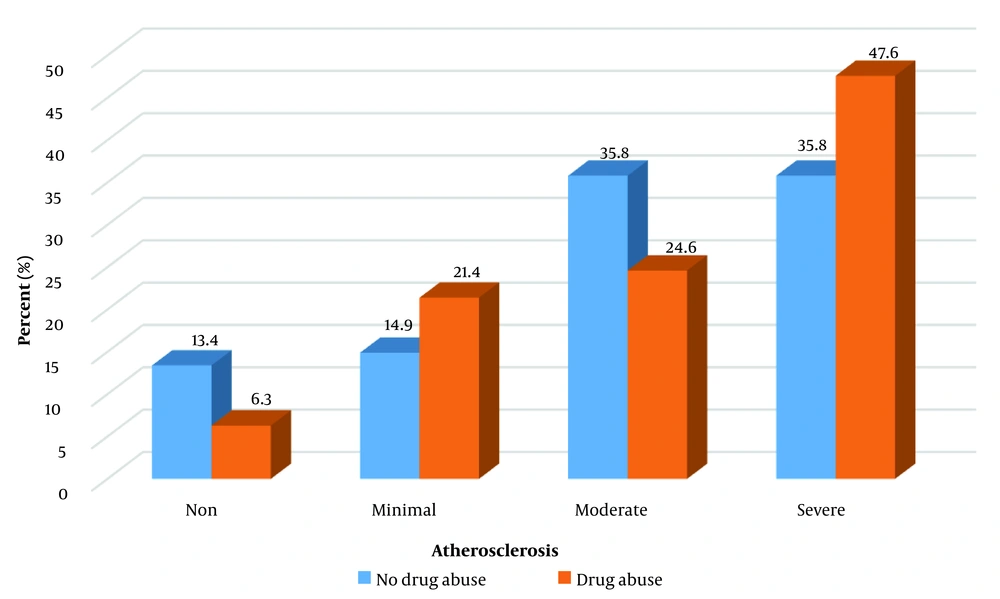
Figure 1.
Comparison of coronary atherosclerosis between two groups
5. Discussion
The present study examined the heart condition of corpses with a history of drug use referred to the General Directorate of Forensic Medicine in Birjand from 1990 to 1997. The study showed drug use could be a risk factor for cardiovascular diseases and coronary atherosclerosis.
According to the results of the present study, there was a direct relationship between substance abuse and coronary atherosclerosis. Asgari et al. investigated the inflammatory factors and the role of narcotics in increasing them and examined the effects of drug abuse on the development of coronary atherosclerosis (1). The adverse effects of the drugs on the heart were already confirmed by other studies (8-10), highlighting the drug's effects on Kappa brain receptors. The role of chronic drug use in the development of cardiovascular diseases, including coronary atherosclerosis, was also explored by another study (3). Furthermore, significant factors responsible for the adverse effects of the drugs on the heart were discussed in various articles, all suggesting the effects of drugs on cardiovascular diseases, which was in line with our study results. However, the studies by Marmor et al. (12) and Roohafza et al. (11) showed that the drugs not only affect cardiovascular diseases but also play a role in reducing their occurrence. Although several studies have emphasized the role of drugs in cardiovascular diseases, including coronary atherosclerosis, further cause-and-effect studies are required to explain the debate in this regard. Even though there is a direct relationship between drug use and cardiovascular diseases, this relationship was insignificant in the present study. The present study found a higher prevalence of atherosclerosis in men and significant differences among the corpses regarding age. The frequency difference between the two sexes in this study may have been attributed to the small number of females in the sample. According to our study results, there was a significant difference between the case and control groups regarding heart weight, indicating that the heart weight was higher in the corpses with drug use. The mean dimensions of the heart differed between the case and control groups, and the difference was significant in one of the dimensions.
The results indicate the effects of drug abuse on heart characteristics, possibly due to cardiovascular problems in these people. Since there are few or no studies in this field, additional investigations are necessary. The present study showed that drugs can be a risk factor for coronary artery occlusion. These results are consistent with the study conducted by Hosseini et al., which demonstrated that drug use, along with other risk factors such as diabetes and hypertension, is a significant contributor to coronary artery disease stenosis (23). A review study conducted by Kim and Park highlighted the inconsistency of the results obtained regarding the long-term effects of drug use on cardiovascular diseases. Furthermore, individuals with other risk factors for cardiovascular disease were found to be more susceptible to the detrimental effects of drug abuse. Narcotics can cause vascular spasms (24).
Nevertheless, it seems that additional studies are necessary in this field. The present study showed that the most consumed substances in the case group were methadone and morphine. In a review study by Mokri et al. on drug abuse in Iran, opium, heroin, and syrup were reported as the most commonly consumed drugs, in sequence, with a pattern of lifetime use (25). Heroin is a drug derived from morphine and methadone from opioids.
5.1. Limitations
The most important limitation was the small sample size and the study's retrospective nature.
5.2. Suggestions
It is suggested that future prospective studies collect a detailed history of the duration, type, amount, and manner of drug use. Also, in a large sample size, it is possible to compare groups with different gender, age, and the duration of drug use.
5.3. Conclusions
The study showed drug use can be a risk factor for cardiovascular diseases and coronary atherosclerosis. Further studies must investigate the effect of drug use on coronary artery disease development and the factors intensifying these effects.