
1. Background
Digital games are games played online or offline using computers, mobile phones, televisions, and video game consoles (1, 2). In 2019, the World Health Organization (WHO) recognized gaming disorder (online and offline) in the international classification of diseases (ICD) and the addictive behavior disorder category (3-5). Therefore, in recent years, the use of digital addiction has been popularized as an emerging field of cyberpsychology, described by excessive obsession and compulsion to play digital games (2, 4).
These conditions make gamers have little control over the game. According to them, playing has priority over other interests in life and continues despite its negative social and emotional consequences (3-7). Among different age groups, adolescents are more vulnerable to digital game addiction because they usually lack effective self-regulation, engage in less physical activity, have monotonous free time, and have more risk-taking and impulsivity (5-9).
Assortments of studies have shown that about 75 - 90% of school-age adolescents use computer games (1, 10). It sounds like the effects of digital games differ based on motivation and level of use (1). Some motives for using these games are to pass the time, avoid stress, escape from everyday life, and forget worries (1, 7, 11). Although these games have positive features such as being educational and filling free time, playing too much brings much harm, such as aggression and violence, obesity and inactivity, poor social relations, academic failure, and addiction (1, 5, 10, 12, 13).
Chen et al. (14) stipulate that the problem of adolescents’ digital game addiction in adolescents is related to individual characteristics and the influence of the family environment. In Throuvala et al.'s (5) study, family and parents were mentioned as the only social category associated with risk or protective factors against game addiction in adolescents (5, 14). In this area, factors such as attachment and parental attitude (acceptance vs. rejection), parenting styles, and parental bonds have been investigated (1, 9, 11, 12, 14). The research results suggested a significant relationship between parental mental health, particularly the anxiety status of their children (15).
The strength of social-emotional growth is rooted in the quality of the relationship with the mother. On the other hand, it increases the concerns about the children’s mental distress, causing the mother’s anxiety and increasing her cognitive avoidance.
In order to control, change, or avoid unbearable thoughts and feelings related to children's distress, parents, particularly mothers, may behave in controlling ways, such as over-supervising their children's activities in order to reduce their inner distress and overcome their anxiety (15). Sometimes, parents try to use avoidance strategies, such as not facing their emotions and feelings in parenting, to experience less negative emotions (11-14).
Cognitive avoidance strategies are the basis of personality aspects and a dynamic form of self-regulation that helps mothers avoid cognitive and emotionally threatening content and thus experience less psychological distance and negative experiences (16, 17).
Studies conducted by Masoumi and Ebrahimi (18), and Atadokht et al. (17) indicate that cognitive avoidance, by creating illogical and ineffective thoughts (17, 19) and impaired self-regulation behavior (20), creates anxiety in mothers (21). However, the simultaneous occurrence of mother and child anxiety has caused researchers to hypothesize that mothers' anxiety would be transmitted to adolescents (15, 22). Adolescent anxiety behaviors increase due to parental avoidance strategies and lead the adolescent to isolation and use digital games (23).
On the other hand, various researchers have pointed out that anxiety can act as a driving force for a person to become addicted to digital games in order to eliminate these negative emotions (24). In addition, it increases the concerns about the children’s mental distress, causing the mother’s anxiety and increasing her cognitive avoidance (25). Adolescent anxiety behaviors increase due to parental avoidance strategies and lead the adolescent to isolation and use digital games. Anxiety and avoidance have been found to be positively associated with the activation of maladaptive metacognitions and, in turn, with the problem of digital games. Results showed that avoidance of mothers and anxiety of adolescents were directly associated with digital game addiction.
According to Askarian et al.'s study, anxiety may decrease real communication and take refuge in digital games (25). Cai et al.'s research findings also indicate that individuals with severe anxiety often seek recreational activities to relieve their stress; therefore, when anxious, they turn to online activities such as digital games (26). In a similar study, Throuvala et al. indicated that students use online games as a coping strategy to reduce tension and improve mood (5). Zandi Payam and Mirzaeidoostan have stipulated that digital gaming disorder is a relatively new concept and that not enough information has been collected about its causative factors from the general population (11). Despite the research gaps, the adverse effects of digital games have become an undeniable fact, and the recognition of digital games disorder by the WHO can provide the basis for further research (4, 20).
Accordingly, parents, particularly mothers, play a role in transmitting and intensifying adolescent anxiety. A mother's cognitive avoidance can lead to anxiety in children and provide the ground for further isolation by disturbing the parent-child relationship. In this regard, the present study was conducted to investigate the mediating role of anxiety in the relationship between mothers' cognitive avoidance and adolescents' digital addiction.
2. Objectives
The present study was conducted to investigate the direct and indirect effects of mothers' cognitive avoidance and its components on adolescents' digital game addiction based on the mediating role of adolescent anxiety.
3. Materials and Methods
3.1. Sample
The current research was descriptive-correlational using the structural equation modeling method.
The participants consisted of 398 people (199 adolescents and 199 mothers) selected with the multi-stage cluster sampling in the city of Zahedan, Sistan, and Baluchestan province, Iran, between 2020 and 2021. Kline’s (27) sample size determination method was used to estimate the sample size. Based on this method, the number of questions for the minimum and maximum sample size was multiplied between 2.5 to 5. Therefore, 199 students were selected using the multi-stage cluster sampling method as the sample size. The sampling error in this study was 6.1%. The student subjects were selected based on the inclusion criteria, including studying in the seventh to tenth grades, being in the age range of 12 to 15 years, willingness to participate in the study, and having the ability to read and write in Persian; mothers were also selected based on living with a child, willingness to participate in the study, and having the ability to read and write in Persian.
Exclusion criteria included a history of psychiatric disorders (bipolar disorder or major depression and psychosis) or neurological disorders and taking antidepressants and other psychiatric medications during the study.
3.2. Research Tools
3.2.1. The Ethical Satisfaction Questionnaire
The ethical satisfaction questionnaire included explaining the research application objectives to the audience and assuring them of the data confidentiality. If the audience accepted the conditions, they would participate in the research process.
3.2.2. The DASC
The DASC is a self-report tool containing 25 items. This scale was created in 2019 based on nine DSM-5 diagnostic criteria. This scale showed good reliability and validity in a sample of 822 participants (α = 0.936). The results of confirmatory factor analysis also indicated the good fit of the data obtained from this scale (6).
3.2.3. The CAQ
The CAQ was created and validated for the first time by Sexton and Dagas in 2008. This questionnaire contains 25 statements and five subscales and examines five types of cognitive avoidance strategies. This questionnaire was translated for the first time in Iran by Bassak-Nejad et al. (28) and validated on the student population. They found the reliability coefficient of this scale to be 0.91 for the total score of cognitive avoidance using Cronbach's alpha method, 0.90 for thought suppression, 0.71 for thought substitution, 0.89 for distraction, 0.90 for avoiding threatening stimuli, and 0.84 for converting ideas into thoughts.
The validity coefficient of this tool was obtained equal to 0.48 through the correlation coefficient using the white bear thought suppression inventory, with the significance level of P < 0.01.
3.2.4. The YAM-5
This scale consists of two parts; the first part assesses the symptoms of the major anxiety disorders for DSM-5, and the second part consists of five subscales. In Pirzad and Ahi's (29) research, the reliability of the questionnaire was calculated with a sample of 300 students aged 12 to 18 years old in Birjand, Iran, through the internal consistency of Cronbach's alpha coefficient and the test-retest method. The structural validity of the exploratory factor analysis and criterion validity using the correlation coefficient was used for the validity of the questionnaire. The internal validity of the first part of the anxiety questionnaire for children and adolescents was in the range of 0.71 to 0.90, and for the second part, it was 0.65 to 0.91. The criterion validity of the questionnaire using the anxiety screening scale related to emotional disorders of children and adolescents indicated a positive and significant correlation between the DSM-5 questionnaire and the components of the anxiety screening scale for children and adolescents in the range of 0.12 to 0.74. Finally, internal consistency validity indicated that the correlation between the five components of each section ranged from 0.38 to 0.56.
3.3. Procedure
After completing the procedures, obtaining permission from the university, and collecting primary data with the coordination of education officials of the city of Zahedan, 5 schools were selected from among the high schools, and three classes were selected from each school. Then, the questionnaire link was provided to the students and their parents after completing the ethical questionnaire. Among the first participants (216 students were accompanied by their mothers), 17 people were excluded from the study due to defects in completing the questionnaires or choosing patterned answers.
3.4. Data Analysis
Statistical methods for data analysis were descriptive statistics, including frequency, mean, standard deviation, minimum and maximum, and correlation between variables, as well as path analysis to measure direct and indirect effects with the assistance of SPSS-26 software. Structural equation modeling tests were performed using both SPSS-26 and AMOS-24 software. For the utilization of structural equation modeling, the initial model of the research was first developed in the AMOS-24 software (Figure 1).
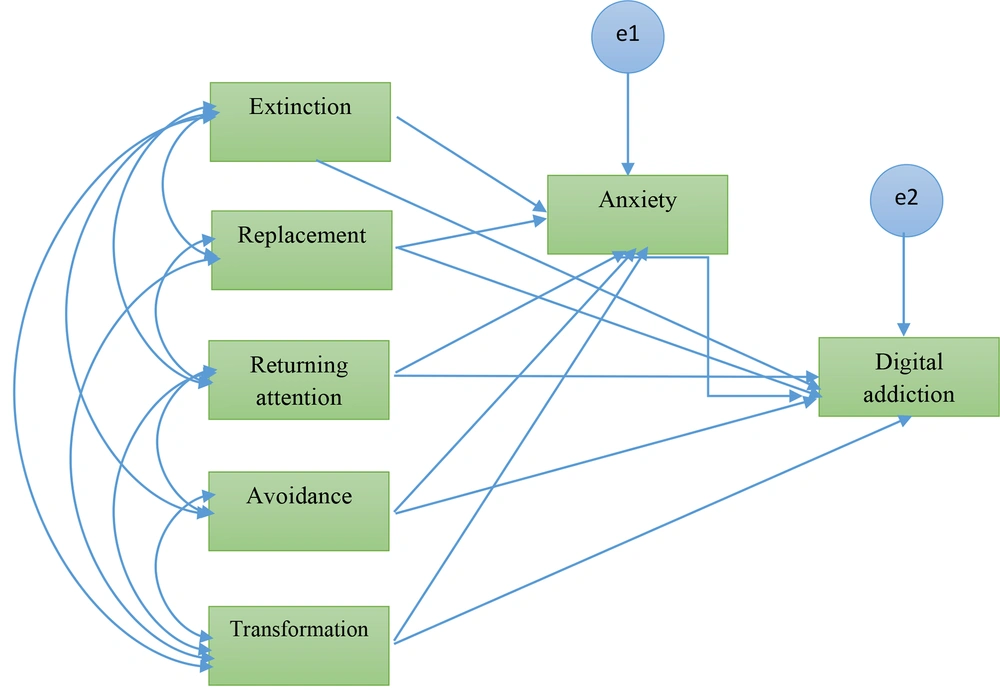
Figure 1.
Proposed research model
4. Results
The sample of the present study included 199 teenagers from seventh to tenth grades along with their mothers (aged 30 to 50 years). The highest frequency of educational level and age range of mothers was related to diploma and associate's degrees and 40 to 49 years (24/48) (Table 1). The mean and standard deviation of research variables are shown in Table 2. In order to check the assumptions of the path analysis test, multiple co-linearity between research variables was checked using the tolerance factor and the variance inflation factor (VIF). The results indicated that both the tolerance index and VIF were within the acceptable range. Therefore, there was no multiple-collinearity between research variables (Table 3).
Table 1.
Demographic Characteristics of the Investigated Sample
| Variables | Frequency (%) |
|---|---|
| Mothers' education | |
| Elementary school and junior high school | 17 (8.54) |
| Certificate of junior high school completion | 43 (21.61) |
| High school diploma and associate's degree | 64 (31.16) |
| Bachelor's degree | 48 (24.12) |
| Master's degree and higher | 27 (13.57) |
| Mothers' age (y) | |
| 30 - 39 | 75 (37.69) |
| 40 - 49 | 96 (48.24) |
| 50 - 59 | 28 (14.07) |
| Adolescents' educational level | |
| Seventh | 56 (28.14) |
| Eighth | 49 (24.62) |
| Ninth | 59 (29.65) |
| Tenth | 35 (17.59) |
| Total | 398 (100) |
Table 2.
Mean and Standard Deviation of Research Variables
| Variables | Mean/Average ± Standard Deviation |
|---|---|
| Mothers’ cognitive avoidance | |
| Extinction | 12.36 ± 4.58 |
| Replacement | 11.50 ± 4.35 |
| Returning attention | 12.93 ± 5.11 |
| Avoidance | 12.66 ± 5.10 |
| Transformation | 12.11 ± 4.22 |
| Adolescents’ digital game addiction | 44.71 ± 18.56 |
| Adolescent anxiety | 106.88 ± 32.42 |
Table 3.
The Results of Multiple Collinearity Analyses of Mothers’ Cognitive Avoidance Indices and Adolescent Anxiety
| Predicting Variables | Multiple Collinearity Indicators | |
|---|---|---|
| Tolerance Statistics | Variance Tolerance | |
| Extinction | 0.437 | 2.290 |
| Replacement | 0.357 | 2.803 |
| Returning attention | 0.274 | 3.649 |
| Avoidance | 0.379 | 2.640 |
| Transformation | 0.432 | 2.314 |
| Adolescent anxiety | 0.652 | 1.533 |
The results of Pearson's correlation test to review the relationship between variables and digital game addiction indicated a significant positive relationship between adolescents’ digital game addiction and mothers’ cognitive avoidance dimensions, including suppression (r = 0.37), substitution (r = 0.38), and return attention (r = 0.45), avoidance (r = 0.29), transformation (r = 0.42) and adolescent anxiety (r = 0.39). In addition, adolescent anxiety was significantly and positively associated with suppression (r = 0.49), substitution (r = 0.54), return attention (r = 0.50), avoidance (r = 0.51), and transformation (r = 0.44) (P > 0.001) (Table 4). The proposed research model is shown in Figure 1, and the fitted model is also shown in Figure 2.
Table 4.
Correlation Coefficients Between Research Variables
| Variables | 1 | 2 | 3 | 4 | 5 | 6 | 7 |
|---|---|---|---|---|---|---|---|
| 1. Extinction | - | ||||||
| 2. Replacement | 0.65 a | - | |||||
| 3. Returning attention | 0.71 a | 0.76 a | - | ||||
| 4. Avoidance | 0.62 a | 0.69 a | 0.73 a | - | |||
| 5. Transformation | 0.63 a | 0.63 a | 0.70 a | 0.66 a | - | ||
| 6. Digital addiction | 0.37 a | 0.38 a | 0.45 a | 0.29 a | 0.42 a | - | |
| 7. Adolescent anxiety | 0.49 a | 0.54 a | 0.50 a | 0.51 a | 0.44 a | 0.39 a | - |
a P < 0.001.
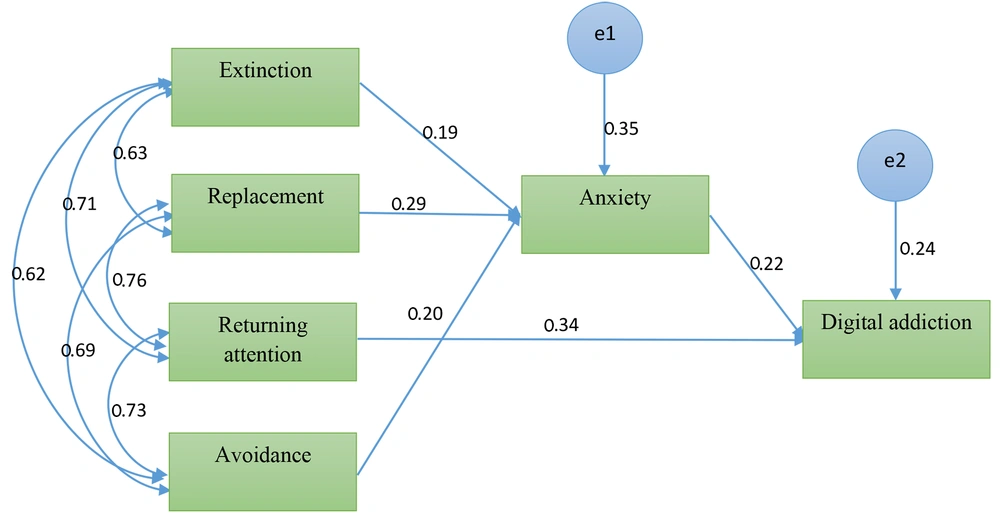
Figure 2.
Diagram of paths fitted with the standard model
In this way, the model was modified by removing non-significant paths. Also, the transformation component was removed from the model because it was not significantly related to any of the variables in the model. According to the indicators obtained in the presented model (2/df = 2.873, CFI = 0.969, GFI = 0.994, AGFI = 0.966, RMSEA = 0.014, NFI = 0.994), the model is a good fit.
In order to test the research hypothesis based on the bootstrap method, the unstandardized and standardized estimation coefficients of the model paths are reflected in Table 5. According to the results of the path analysis test of the model presented in Table 5, the direct effects of mothers’ cognitive suppression (P < 0.05, β = 0.19), cognitive substitution (P < 0.001, β = 0.29), and cognitive avoidance (P < 0.05, β = 0.20) on adolescent anxiety are significantly positive.
Table 5.
Summary of the Path Analysis Test Findings
| Paths | Unstandardized Estimate | Standard Error | Critical Value | Standardized Estimate |
|---|---|---|---|---|
| Suppressing the mother → adolescent anxiety | 1.312 | 0.551 | 2.379 a | 0.19 |
| Mother’s replacement → adolescent anxiety | 2.135 | 0.631 | 3.382 b | 0.29 |
| Mother's avoidance → adolescent anxiety | 1.265 | 0.535 | 2.364 a | 0.20 |
| Adolescent anxiety → digital game addiction | 0.127 | 0.041 | 3.103 c | 0.22 |
| Returning mother's attention → digital game addiction | 1.232 | 0.259 | 4.749 c | 0.34 |
a P < 0.05.
b P < 0.01.
c P < 0.001.
Also, the direct effect of adolescent anxiety (P < 0.01, β = 0.22) on digital addiction is significant. Other findings indicate the significant direct effect of mothers’ return attention (P < 0.001, β = 0.34) on digital addiction. The results of the path analysis test of the model presented in Table 6 indicate the significant indirect effects of substitution (β = 0.06), avoidance (β = 0.04), and mothers’ cognitive suppression (β = 0.04) on digital addiction with the mediator of adolescent anxiety.
Table 6.
Standard Coefficients of the Indirect Effects in the Proposed Research Model
| Paths | Indirect Effect | Explained Variance |
|---|---|---|
| Digital addiction | 0.24 | |
| Extinction | 0.04 a | |
| Replacement | 0.06 a | |
| Returning attention | 0.00 | |
| Avoidance | 0.04 a |
a P < 0.05.
These findings indicated that anxiety indirectly affected the relationship between mothers’ cognitive avoidance and adolescents' digital addiction. In addition, the analysis results in Table 6 indicate that mothers' cognitive avoidance and adolescent anxiety explain 24% of the variance of digital addiction.
In order to review the mediating role of anxiety, the bootstrap method was used in the Macro Preacher and Hayes program. The confidence range of the path for the mediating role of anxiety in the relationship between suppression, replacement, and cognitive avoidance of mothers with adolescents’ digital addiction at the confidence level and the number of bootstraps re-sampling 5000 for cognitive suppression 0.2892 (lower limit) to 0.8510 (upper limit), cognitive substitution was 0.2972 (lower limit) to 0.9976 (upper limit) and cognitive avoidance was 0.3483 (lower limit) to 0.9365 (upper limit).
Since zero is not placed between the upper limit and the lower limit, anxiety is mediated in the relationship between mothers' cognitive avoidance and adolescents' digital addiction.
5. Discussion
The findings of the present study indicated the significant direct effect of mothers’ cognitive avoidance dimensions, including suppression, substitution, and avoidance, on children's anxiety. Also, the indirect effect of mothers' cognitive avoidance on adolescents' digital game addiction was significant through children's anxiety. These findings are compatible with theoretical perspectives and the literature.
As expressed above, Throuvala et al. stipulated the presence of gaps in examining the role of the family and its relationship with digital game addiction (5); also, the role of mothers' cognitive avoidance concerning anxiety and digital game addiction has not been investigated. Nevertheless, some studies have carried out titles and goals close to the research title. Studies conducted by Emerson et al. and Cheron et al. (as cited by Emerson et al.) indicate that experiential and cognitive avoidance significantly predict child anxiety and that experiential avoidance is important in creating and maintaining anxiety in adults and children. In addition, parents who reported higher levels of experiential avoidance in their daily lives faced more experiential avoidance in their parenting style and were more likely to experience anxiety themselves (15). The results of these studies are consistent with the present study’s findings. In explaining these findings, it can be mentioned that although cognitive avoidance strategies are apparently effective, in the long run, they produce a contradictory effect and the formation of a vicious cycle that leads to an increase in distraction, the occurrence of worrying thoughts, careless behaviors, depression, less positive effect, decrease in psychological adaptation, and mothers’ physical health, and finally it results in increasing anxiety in mothers.
Although the mechanisms of transmission of anxiety from mothers prone to anxiety to children are not well understood (21), research has shown that appropriate parenting behavior and practices help reduce the anxiety of parents and children (15, 22). A family is a unit in which common experiences, issues, and challenges are shared. Mothers' cognitive avoidance in the family environment causes anxiety to be shared between mother and child (29). Parents cope with avoidance and suppression as a means to relieve their discomfort in dealing with difficult parenting experiences, and in this process, it is possible to remove the child from the stressful situation, deprive him/her of the opportunity to learn to confront problems and make this type of adolescent more vulnerable to anxiety. Therefore, mothers’ cognitive avoidance may provide the ground for digital game addiction by shaping irrational beliefs and ineffective behaviors (14), influencing her behavioral responses, and also modeling for children in the field of dealing with anxiety. In other words, adolescents go to digital games to compensate for these deficiencies, escape from problems, and meet their social needs, and due to the attractive environment of these games and the possibility of interacting with different people, their relationship to continue playing the game increases (11).
The findings also indicated the positive and significant direct effect of anxiety (P < 0.01, β = 0.22) on digital game addiction. This finding is consistent with the studies by Zhu et al. (8), Askarian et al. (25), Throuvala et al. (5), and Noori and Sadeghyan (22). Also, the research results of Singh and Singh indicate that some individuals, such as those suffering from anxiety and depression, turn to digital media to deal with the lack of emotional support to meet their needs and are prone to digital addiction (2). In explaining these findings, it is possible to refer to a study whose purpose was to describe the different motivations of 6761 Finnish adolescents for digital games, in which the two main motivations for digital game addiction are instrumental motivation (learning new things and procedures, etc.) and ritualized motive (relaxation entertainment, escape from everyday life, forgetting worries) (1).
Based on the balance theory, digital games may be a new tool to deal with and manage adolescents’ mood and emotional balance and replace other methods of dealing with anxiety (1, 18). In this regard, the findings of studies by Feng et al. (20) and Throuvala et al. (5) indicate that adolescents who experience anxiety and other negative emotions may turn to digital games to relieve or eliminate these emotions and gradually spend more time playing. In other words, these adolescents choose avoidance as an ineffective coping strategy, and playing, in this case, acts as a psychological retreat and temporary escape and reduces distress or emotional turmoil (5, 8, 20).
Gaming platforms can be fun, but they can also act as short-term therapy and a sad outlet to escape the challenges of real life and experience the "ideal virtual self" (3, 5). Conflictual relationships with parents can also lead to digital addiction.
Considering that gaming disorder is also considered a special form of Internet addiction disorder (3, 14), despite the findings of the present study, in Jung et al.'s study, coping with styles related to anxiety as an independent variable that may influence the development of the Internet addiction were investigated and no strong correlation was observed between the variables (3). In explaining this finding, it can be mentioned that addiction arises from a combination of a genetic predisposition and repeated exposure to a specific substrate (13), and this inconsistency may be related to the difference in the measurement tool or the statistical population. The cycle of digital addiction covers the three trigger, action, and reward components. The behavioral manifestation of digital addiction includes academic avoidance, preoccupation with the content of the Internet or digital media, decreased face-to-face interactions, fear of being isolated from the group, avoidance of interactions with parents, and excessive online spending.
These behaviors are primarily manifested because of pre-existing mental health concerns about the role of parents: Neglect or violence and avoidance, control, and anxiety.
5.1. Conclusions
Despite the importance of mothers' cognitive avoidance strategies in adolescent anxiety, this issue has been neglected in previous studies on digital game addiction. The findings of the present study comply with the hypothesis of the importance of family factors in adolescents’ digital game addiction. Conducting such research can provide important practical approaches concerning prevention and intervention by providing essential information on the role of individual and family factors in the occurrence of digital addiction.
However, this study has limitations because the conditions of the coronavirus disease 2019 (COVID-19) outbreak and the closure of schools were among the main limitations of this research. Self-expression of the questionnaire, sampling method and selection bias, and increased possibility of recall bias in studies using self-report data were other limitations. Also, the lack of a rich background on the effect of mothers' cognitive avoidance on digital game addiction challenges the comparison and conclusion of research findings. It is recommended that additional tools such as interviews, observations, and comprehensive personality tests be used in future studies. In addition, considering the possible relationship between cognitive avoidance and parenting style and its effect on children's anxiety, it is suggested that these variables be examined.