
1. Background
Marijuana stands as the most commonly used federally illegal drug in the United States. Approximately 48.2 million people, or about 18% of Americans, used it at least once in 2019 (1-5). Marijuana is considered one of the most dangerous drugs due to its high potential for abuse and the strong likelihood of causing physical and psychological dependence (6). Although global statistics indicate a rising trend in marijuana use worldwide, precise and regular statistics on marijuana use within specific countries are often unavailable. However, some studies have shown an increase in marijuana use among young people, particularly students. A study by Nazarzadeh et al. estimated that the prevalence of marijuana use among students is 4% (7).
The pattern of substance use and its associated factors is very diverse, and one of the key motivating factors for individuals, particularly in the context of marijuana use, is their positive attitude toward it. People’s initial intentions to use drugs are often influenced by their attitudes toward drug use (8). Attitudes play a crucial role in shaping people’s behaviors, and stable attitudes can serve as guides for their actions. Consequently, to gain insight into human behavior, especially substance use behavior, it is essential to examine their attitudes toward drugs. Any efforts to plan preventive measures in the field of substance use must include a study of factors influencing consumption, such as attitudes.
Numerous studies have explored the prevalence of marijuana use and its correlation with attitudes. A study conducted by Barnes et al. found that parents who had a positive attitude toward substance use were more likely to have children who engaged in substance abuse (9). Similarly, a study conducted in Scandinavian countries to investigate the prevalence and attitudes of people toward marijuana found that 15% of Scandinavian students reported using marijuana. Among these students, the prevalence was higher among males than females. Additionally, 38% of the surveyed students expressed agreement with the legal release and sale of marijuana, with a higher percentage of males endorsing this view compared to females (10).
Another study conducted in 2018 focused on the prevalence of marijuana use among medical students. The lifetime prevalence of marijuana use in this study was 31%, with the highest prevalence observed among American students (48%) and lower prevalence among Asian students (11). The results of a study by Nazarzadeh et al. (7), which investigated the prevalence and determinants of marijuana use among Iranian students, reported a lifetime prevalence of marijuana use at 4%. The prevalence of use was higher among male and university students compared to their female and non-university counterparts. According to the United Nations, a significant proportion of major crimes involve young people who use marijuana (12). In another study conducted in Iran by Dolatshahi et al. (13) involving 1340 students of the University of Tehran, the results showed that 80% of the participants had a negative attitude toward substance use, while 20% had a positive attitude. Men had a more positive attitude toward drug use compared with women, and public university students had a more positive attitude than their non-government university counterparts. Additionally, the study highlighted that many students lacked an understanding of the consequences associated with marijuana use.
By assessing attitudes, misconceptions can be identified and addressed, allowing for tailored messaging that emphasizes the severe risks associated with drug use. Furthermore, interventions focused on attitude change have proven effective in reducing the initiation and use of substances (such as tobacco) and alcohol. If programs can successfully shift social norms and attitudes to be less favorable toward drugs, they could have the potential to significantly impact overall drug use and addiction rates. Considering the profound health and social consequences of drug use, even small reductions in its prevalence could translate to the improvement or even saving of thousands of lives, as well as millions of dollars in savings within health care, criminal justice, and lost productivity sectors. Specifically, cannabis use has been associated with impairments in various cognitive functions, including learning, memory, attention, and decision-making, and an increased risk of psychiatric disorders, such as psychosis and addiction. Moreover, global statistics show the increasing trend of drug use, particularly marijuana, among young people (2, 4). This trend significantly contributes to motor vehicle accidents and accidental injuries. At the population level, greater availability and use of cannabis are linked to adverse educational outcomes, unemployment, and poorer mental and physical health across different age groups. Consequently, preventing the initiation and use of cannabis through educational efforts and attitude change could yield substantial benefits for both individuals and society.
The debate surrounding drug policy is multifaceted, with some advocating for drug legalization, highlighting potential advantages such as eradicating black markets, generating tax revenues, and enabling regulated environments to mitigate harm. Others promote harm reduction strategies, including decriminalization, establishment of safe injection sites, and shift toward treatment over incarceration, all aimed at minimizing the risks associated with drug abuse. Conversely, there are proponents of maintaining or intensifying criminalization measures to deter drug use, protect public health and safety, and uphold moral values (14).
2. Objectives
This study comprehensively assessed attitudes by having students rate their agreement levels with statements related to the risks, benefits, addictiveness, and motivations associated with cannabis consumption. Statistical tests were used to assess if significant gender-based differences exist in attitudes toward cannabis use, also what is the prevalence of marijuana consumption among students? Does the frequency of marijuana consumption differ between male and female students?
3. Materials and Methods
The present study is a cross-sectional survey that examines the attitudes of students from public universities in Tehran City toward marijuana consumption. This study was conducted between June 2021 and January 2022. Due to the closure of in-person classes for students because of the coronavirus pandemic, mandatory sampling was chosen using the convenience method. To determine the sample size, Cochran’s sample size estimation formula was employed, which uses a 0.05 standard error and a 95% CI. According to this formula, the sample size was estimated to be 385 people. However, to account for potential sample dropouts, 538 samples were initially collected. After removing problematic samples, the final sample size for analysis consisted of 401 individuals.
The marijuana consumption attitude questionnaire was designed using purposive sampling and distributed among students through the social networks of Tehran and Shahid Beheshti universities. Students were invited to participate in the study and complete the questionnaire voluntarily.
Inclusion criteria were being a student at one of the universities in Tehran and between the ages of 18 and 24. Exclusion criteria included having symptoms of psychosis, using psychiatric drugs (as reported by participants), and not completing all questionnaire items. For ethical reasons, no personal identity information was collected from individuals, and participants completed the questionnaire anonymously. The data were analyzed using descriptive methods, such as frequency and percentage, as well as inferential statistical methods, including the chi-2 test in SPSS software.
3.1. Instruments
The Marijuana Attitude questionnaire is a 24-item questionnaire rated on a 4-point Likert scale ranging from “never” to “always,” covering knowledge, use, addictiveness, negative side effects, benefits, sources of information, and reasons for using marijuana.
This questionnaire was originally prepared by Ekhtiari for the student population and was previously used in the study by Shirafken et al. (unpublished thesis at USWR) (15). The reliability of this questionnaire was reported as 0.89 through the test-retest method with a 30-day interval. In the current study, the Cronbach’s alpha coefficient for this questionnaire was calculated as 0.87.
4. Results
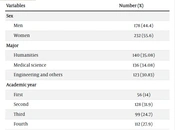
In this study, 44% of the participants were male, and 56% were female. A total of 401 people participated in this study. Descriptive statistics revealed an average age of 21.88 years for the participants (Table 1).
Table 1.
Demographics
| Variables | Number (%) |
|---|---|
| Sex | |
| Men | 178 (44.4) |
| Women | 232 (55.6) |
| Major | |
| Humanities | 140 (35.08) |
| Medical science | 136 (34.08) |
| Engineering and others | 123 (30.83) |
| Academic year | |
| First | 56 (14) |
| Second | 128 (31.9) |
| Third | 99 (24.7) |
| Fourth | 112 (27.9) |
The lifetime consumption of marijuana was estimated to be 17.5%, with 25% of men and 10.37% of women reporting use. Table 2 presents students’ attitudes regarding the addictive nature of marijuana use. It was found that 78% of men and 92% of women believed that the use of this substance is addictive, with men significantly less likely to consider marijuana as addictive (χ2 = 17.06; P < 0.05). No significant differences were observed in students’ attitudes toward the addictiveness of marijuana based on their field of study and years of study (χ2 = 0.8, P < 0.05).
Table 2.
Students’ Attitudes About the Addictive Nature of Marijuana Use a
| Variables | No | Yes | χ2 | P-Value |
|---|---|---|---|---|
| Sex | ||||
| Male | 21.35 | 78.65 | 17.06 | 0.001 |
| Female | 7.17 | 92.83 | ||
| Major | ||||
| H | 13.6 | 86.4 | 0.34 | 0.8 |
| M | 14.7 | 85.3 | ||
| E | 12.1 | 87.9 | ||
| Academic year | 3.08 | 0.37 | ||
| First | 19.6 | 80.4 | ||
| Second | 10 | 90 | ||
| Third | 14 | 86 | ||
| Fourth | 14.28 | 85.72 |
a Values are presented as (%).
In Table 3, the answers of the students regarding the management and control of marijuana use have been discussed, and 86% of the students believed that the use of this substance could be controlled. Forty-two percent of men and 26% of women considered it possible to control and manage this substance. In this case, men significantly believed more than women that consumption could be controlled (χ2 = 10.8; P < 0.05). A significant difference was not seen in the attitude of students toward the management and control of cannabis consumption according to the field of study and years of study (χ2 = 2.72; P < 0.05).
Table 3.
Management and Control of Marijuana Use a
| Variables | No | Yes | χ2 | P-Value |
|---|---|---|---|---|
| Sex | ||||
| Male | 57.42 | 42.58 | 10.08 | 0.00 |
| Female | 74 | 26 | ||
| Major | ||||
| H | 62.9 | 37.1 | 2.72 | 0.2 |
| M | 66.1 | 33.9 | ||
| E | 72.35 | 27.64 | ||
| Academic year | ||||
| First | 69.65 | 30.35 | 1.1 | 0.77 |
| Second | 68 | 32 | ||
| Third | 62.63 | 37.37 | ||
| Fourth | 67.86 | 32.14 |
a Values are presented as (%).
In this research, the addictive intensity of marijuana was also examined. The majority (29%) evaluated its addictiveness as moderate, while 27% considered the consumption of this substance to be highly addictive. In this case, once again, men underestimated the addictiveness of this substance compared to women. None of the items related to the assessment of addictive intensity in attitudes toward marijuana showed a significant difference between academic fields and academic years (χ2 = 14.2; P < 0.05).
Table 4 presents the attitudes toward the side effects of marijuana. Overall, 93% of the students believed that this substance had complications, while 6.5% believed that marijuana use is without complications. There was no significant difference in attitudes toward the side effects of this substance between men and women (χ2 = 3.3; P < 0.05). Similarly, there was no significant difference in attitudes toward the side effects of marijuana based on different academic fields and academic years (χ2 = 0.04; P < 0.05).
Table 4.
Attitudes Toward the Side Effects of Marijuana a
| Variables | No | Yes | χ2 | P-Value |
|---|---|---|---|---|
| Sex | ||||
| Male | 8.9 | 91.1 | 3.3 | 0.1 |
| Female | 4.4 | 95.6 | ||
| Major | ||||
| H | 6.5 | 93.5 | 0.04 | 0.9 |
| M | 6.6 | 93.4 | ||
| E | 6.5 | 93.5 | ||
| Academic year | ||||
| First | 7.1 | 92.9 | 14.7 | 0.5 |
| Second | 6.8 | 93.2 | ||
| Third | 7 | 93 | ||
| Fourth | 6.5 | 93.5 |
a Values are presented as (%).
The attitude toward the severity of marijuana complications was also investigated, with the majority (41%) estimating the side effects of cannabis use to be very high. Specifically, 43% of women and 36% of men reported that the side effects of using this substance were too severe (χ2 = 3.3; P < 0.05). In terms of gender, women consistently perceived the side effects of marijuana use as more severe (χ2 = 14.2; P < 0.05). However, when considering academic fields and years of study, there was no significant difference in the perceived severity of marijuana side effects.
Some study participants who answered yes to the complications of marijuana use were asked to specify the most common side effects they associated with it. The results revealed that the most frequently mentioned side effects were as follows: (1) memory impairment 65%; (2) family problems 42%; (3) respiratory disease 39%. On the other hand, sexual problems and infertility were reported by only 18% as the least common complications of marijuana use.
Table 5 shows the results of student’s attitudes toward the benefits of using marijuana.
A total of 30% of all students considered marijuana use to be beneficial, with 39% of men and 28% of women holding this belief. A significant gender difference was observed in their attitudes toward the usefulness of marijuana use, with men more likely to view the substance as beneficial (χ2 = 9.8; P < 0.05). However, there was no significant difference in the attitude toward the usefulness of marijuana consumption when considering academic fields and academic years (χ2 = 4.9; P < 0.05).
Students who perceived marijuana use as beneficial were asked to select the specific benefits they associated with the substance from among the available options. The results showed that the most commonly mentioned benefits of using marijuana were as follows: Feelings of happiness (53%), stress and anxiety reduction (50%), and improved concentration (38%).
Table 5.
Results of Students’s Attitudes Toward the Benefits of Using Marijuana a
| Variables | No | Yes | χ2 | P-Value |
|---|---|---|---|---|
| Sex | ||||
| Male | 56.1 | 39.4 | 9.8 | 0.00 |
| Female | 71.4 | 28.6 | ||
| Major | ||||
| H | 57.85 | 42.15 | 4.9 | 0.08 |
| M | 67.65 | 32.35 | ||
| E | 69.2 | 30.8 | ||
| Academic year | ||||
| First | 59 | 41 | 4.4 | 0.5 |
| Second | 54.8 | 45.2 | ||
| Third | 58.3 | 41.7 | ||
| Fourth | 62.1 | 37.9 |
a Values are presented as. (%).
Students were questioned about their attitudes regarding the reasons for young people’s marijuana consumption. They were asked, “In your opinion, what is the reason for young people’s use of marijuana?” According to the students, the most frequently cited reasons for consumption were as follows: (1) fun (78%), (2) curiosity (64%), and (3) spending time (54%).
5. Discussion
The results of our study showed that approximately 17.5% of the students had consumed marijuana at least once in their lifetime. The ratio of marijuana use was significantly higher in men compared to women (χ2 = 15.6; P < 0.05). However, there was no difference in the level of knowledge about marijuana between male and female students. Male students reported having more friends who used marijuana (χ2 = 22.4; P < 0.05), and they had significantly more experiences of being recommended to use marijuana (χ2 = 29.5; P < 0.05), as well as a greater desire to use it (χ2 = 12.3; P < 0.05).
Several cultural factors may contribute to these differences in attitudes and behaviors. Gender norms, peer influences from male social circles, media portrayals of marijuana use among males, feelings of invincibility in young men, and tendencies toward rebelliousness and skepticism of authority can all play a role in shaping more positive attitudes toward the addictiveness of marijuana among male students compared to their female counterparts. These social influences may downplay health risks and normalize recreational use (16).
Our results indicate that marijuana consumption among Iranian students is higher than the global average (4% in 2010) but lower than that reported in American society (42% in 2012) (11). According to the report from the Anti-Drug Administration, global statistics indicate an increase in marijuana use. While precise data on marijuana use in Iran may be lacking, it appears that a substantial proportion of drug use in Iran is associated with marijuana.
The results of the present study showed that 17.5% of students reported a history of marijuana use. In a 2018 study conducted by Papazisis et al. (11) on European, African American, and South American medical students, marijuana use was estimated to be as high as 31%. In contrast, American students had a much higher marijuana consumption rate of 48%, while Asian students had lower rates, and male students exhibited a greater tendency to use marijuana than female students (8).
Our findings appear to be consistent with Papazisis et al.’s study, as marijuana use among Iranian students was relatively low, similar to Asian students. Furthermore, our study reflects Papazisis et al.’s findings, demonstrating that female students in our sample exhibited a lower tendency to use marijuana compared to their male counterparts. Our results are also consistent with a study by Nazerzadeh et al. in 2015 (7), which examined Iranian students and reported a marijuana use prevalence of 4%. This suggests that marijuana consumption in Iran is lower than in European and American countries when comparing the results of these studies.
Additionally, in a study by Andreas et al. (17) on Norwegian students, the prevalence of drug use among Norwegian students was estimated at 15%. Their study, similar to ours, found that the number of male marijuana users was higher than that of female students. Attitudes toward marijuana use often correlate with demographics such as age, political affiliation, and religiosity. Younger individuals tend to view marijuana more favorably, while older generations often retain more conservative views (18). Regional and cultural norms also play a significant role in shaping acceptance, with marijuana use being more prevalent and accepted in some states (like Colorado) compared to others with stricter laws. Mass media and social influences, including celebrity and peer behavior, can normalize marijuana use for certain groups over others. Additionally, underlying values related to freedom, health, morality, and government regulation contribute to differing perspectives (19).
In the second part of the research, we investigated students’ attitudes toward the addictiveness of marijuana. As previously mentioned, the results showed that men tend to perceive marijuana as less addictive than women do. Additionally, female students were more likely to believe that marijuana use cannot be managed compared to male students. These findings suggest that female students generally have a more positive attitude toward the addictiveness of marijuana than male students, while males are less likely to view marijuana as addictive and more inclined to believe that its use can be controlled.
To explain the more positive attitude of men toward marijuana use, as well as their greater desire to use it, it may be relevant to consider the influence of personality characteristics, family dynamics, and cultural factors. Men may exhibit higher tendencies and excitement-seeking compared to women. Additionally, in Iranian culture, boys often have more freedom to express their emotions, and emotional behaviors may be more easily accepted by families and society. Consequently, families may inadvertently reinforce excitement-seeking behaviors in men(12). This could contribute to men’s attraction to adventurous and risky behaviors such as drug use.
Regarding students’ attitudes toward the benefits of using marijuana, our study showed that men tended to perceive more advantages and benefits associated with marijuana use compared to women.
Considering that students mentioned the most significant benefits of using marijuana as increased happiness, reduced stress, alleviation of anxiety and depression, and enhanced concentration, it appears that the existence of these beliefs among students may increase the likelihood of marijuana use. Believing that marijuana can reduce anxiety, depression, and stress while improving concentration and academic performance can potentially lead to increased use of marijuana.
It is essential to address and correct such misconceptions about the perceived benefits of marijuana use. It is crucial to educate students about the psychological and physical harm associated with marijuana use, given that marijuana is a highly dangerous drug with substantial potential for abuse and the ability to induce physical and psychological dependence (17).
The results of the present study regarding the side effects of marijuana use showed that women and men considered the side effects of marijuana use equally. According to all of them, marijuana use has side effects, but regarding the number of side effects caused by marijuana use, men reported fewer side effects than women. These findings are consistent with the study conducted by MacDonald et al. (20). In their study, the majority of marijuana users reported negative effects across various cognitive domains, impacting their careers, social lives, and physical and mental health.
The positive attitude toward marijuana use and the perception of fewer side effects among men compared to women may be linked to men’s greater desire to use marijuana (21, 22). Numerous studies have shown a relationship between a positive attitude toward drug use and the desire to use it. In a study by Nazarzadeh et al. (7), it was reported that Iranian men exhibited a greater tendency to use marijuana than women. These findings are consistent with the results of the present study and the study conducted by Andreas (17), which also indicated a higher prevalence of marijuana consumption among male students compared to female students, with women showing a greater likelihood of marijuana use than men.
Regarding the reasons for marijuana use from the student’s perspective, the results of the present study showed that the studied group mentioned entertainment, curiosity, spending leisure time, and coping with mental and family problems as the most common motivations for young people to use marijuana. These findings are consistent with the study conducted by Lee et al. (23). In their study, the primary reasons reported for marijuana use included seeking pleasure and enjoyment, followed by experimentation and curiosity.
Moreover, as suggested by previous studies, it appears that some students turn to marijuana use as a means to escape from problems, and feelings of failure in life and to cope with painful feelings (8, 24).
In conclusion, the key findings of this study are as follows: (1) the prevalence of lifetime marijuana use among university students was 17.5%, with significantly higher rates among male students compared to females. (2) male students generally had more positive attitudes toward marijuana use, perceiving it as less addictive and more manageable. Conversely, female students’ more negative views were associated with lower usage rates. (3) while acknowledging the negative health effects of marijuana, some students still perceived benefits in reducing stress and anxiety. Men also reported experiencing fewer side effects than women.
To address these findings effectively, it is necessary to implement targeted educational interventions to address misconceptions and correct overly positive views, especially among male students. Policymakers should promote evidence-based prevention programs that consider the role of gender and cultural context. Longitudinal studies and qualitative analyses are needed to explore how attitudes form and change over time.
5.1. Conclusions
The research findings indicate a notable increase in marijuana consumption among students in recent years, with men being at a higher risk of consumption. Furthermore, a positive attitude toward marijuana use was found to increase the likelihood of consumption. Consequently, the development of prevention and awareness programs could play a pivotal role in managing and reducing marijuana consumption.
5.2. Limitations
The study has several limitations, including potential generalization bias due to the sampling method, a restricted sample from one city’s universities across various fields of study, a need for larger sample sizes consisting of students from across the country, reliance on self-report questionnaires with the potential for false reporting, and limited generalizability beyond Iranian students and diverse cultural contexts.