
1. Background
Substance use disorders (SUD) in the physician community pose significant risks to physicians and compromise patient and public trust in healthcare providers. It is estimated that as many as 14% of doctors have the potential to suffer SUD (1). Substance use disorders representation is not evenly distributed across specialties. A survey conducted in 1980-2008 in the United States (USA) showed that anaesthesiologists had the highest risk, especially during the early career stages (2).
In 2005, from 111 anesthesiology residency programs in the US, 80% of programs had records of residents with SUD, especially opioids. As many as 19% of residency programs reported at least one death due to overdose or suicide in the period 1991 - 2001 (1). The substance use disorder incidence among anesthesiology residents is estimated at 1.6% (2).
The increasing prevalence of SUD among anaesthesiologists is influenced by several risk factors, including genetic predisposition, psychological vulnerability, mental health disorders, family history of addiction and mental illness, early age trauma, problems with social relationships, and pressure due to a significant workload. Anaesthesiology residents suffer great stress due to the large didactic and clinical components of anaesthesiology training. Daily exposure to and access to controlled substances are also factors that exacerbate SUD in the workplace (3).
Considering parenteral opioid use and its availability in routine anesthesia practice are the primary sources of controversy surrounding this issue, and because SUD is one of the most significant occupational health and safety threats among anesthesiology residents, there has been insufficient evidence, particularly on the prognosis for subsequent recovery in affected residents when they return to anesthesia clinical practice (4).
Out of 180 confirmed cases of SUD among anaesthesiology residents in the US, a 1990 study uncovered that the majority of the survivors experienced challenges staying abstinent. As a result, residents with a history of parenteral opioid use disorders had to transfer to another specialty other than anesthesiology. This study also showed that 7% of anaesthesiology residents were found dead due to hypoxic brain injury by the time of diagnosis. Moreover, 66% will experience a recurrence, and mortality when returning to work increases up to 25% (5).
Active prevention of SUD is an effective strategy. This strategy includes expanding knowledge regarding SUD, effective and efficient substance accountability policy to prevent/detect anesthetic substances diversification in the workplace, and improving the skills of each anesthesiology resident in detecting SUD’s symptoms and random toxicology examination to detect SUD in each anesthesia provider (6).
2. Objectives
Currently, there are no epidemiological reports regarding the prevalence of SUD among physician in Indonesia and anaesthesiologists in particular. The purpose of this study was to estimate the occurrence of SUD among anaesthesiology and intensive care medicine (ICM) residents in Indonesia and recognize the SUD prevention strategy implemented in each teaching hospital.
3. Materials and Methods
This survey-based observational study used a three-part questionnaire developed by the investigators. It consisted of 20 binary questions. Those 3 items pertained to the sociodemographic details and the occurrence and prevention of SUD in each resident’s residency program. Face validity was established by the investigators. Content validation was established using a modified Delphi process.
The participants in this study were recruited from 16 anaesthesiology and ICM residency programs, with a total of 1 127 active residents registered at the Indonesian College of Anaesthesiology and Intensive Care registry as of January 2023. In June 2023, a link directed to the online survey platform and a cover letter were sent to each registered resident. All returned surveys were reviewed and scored by hand. The data were compiled and analyzed. This study was approved by the Research Ethics Committee of Hasanuddin University, Indonesia (approval number: 162/UN4.6.5.31/PP36/2023). The study survey was anonymous; therefore, the requirement to obtain informed consent was exempted by the Institutional Review Board of Hasanuddin University.
In total, 353 (31.3%) respondents completed the entire survey. No study size estimation was conducted. Only residents who voluntarily participated were included in the survey. The data were analyzed descriptively with numbers and percentages.
4. Results
Returned surveys from 353 residents yielded a 31.3% response rate. The first set of questions aimed to record respondents' sociodemographics. Table 1 presents the breakdown of respondents' locations. Residents from 13 out of 16 registered anaesthesiology and ICM residency programs in Indonesia participated in this survey.
Table 1.
Distribution of Respondents’ Location
| Location | Total, No. (%) |
|---|---|
| Bali | 37 (10.5) |
| Banda Aceh | 19 (5.4) |
| Bandung | 51 (14.4) |
| Banjarmasin | 12 (3.4) |
| DKI Jakarta | 20 (5.7) |
| Makassar | 87 (24.6) |
| Malang | 24 (6.8) |
| Manado | 6 (1.7) |
| Medan | 25 (7.1) |
| Pekan Baru | 9 (2.5) |
| Purwokerto | 16 (4.5) |
| Solo | 20 (5.7) |
| Surabaya | 27 (7.6) |
| Total | 353 (100.0) |
A closer inspection of Table 2 shows that the majority of respondents who participated in this study were aged between 30 - 40 years (47%), male (57.5%), married (67.9%), had children (60.3%), and level 1 competency level (41.9%). From the assessment of workload, 56.4% had more than 5 mandatory night shifts per month, and 56.4% reported having 5 to 7 hours of sleep at night. As many as 71.4% of respondents did not have a fixed income and did not receive any financial support during residency.
Table 2.
Sociodemographics of Respondents
| Variables | No. (%) |
|---|---|
| Age, y | |
| 21 - 30 | 131 (37.1) |
| 31 - 40 | 222 (62.9) |
| Gender | |
| Male | 259 (73.4) |
| Female | 94 (26.6) |
| Marital | |
| Married | 236 (66.9) |
| Not married | 117 (33.1) |
| Children | |
| No | 149 (42.2) |
| Yes | 204 (57.8) |
| Competency level | |
| Level 1 | 164 (46.5) |
| Level 2 | 79 (22.4) |
| Level 3 | 110 (31.2) |
| Scholarship | |
| Scholarship | 83 (23.5) |
| No financial support | 270 (76.5) |
| Income | |
| Yes | 83 (23.5) |
| No | 270 (76.5) |
| Night shift, shifts/month | |
| < 5 | 50 (14.2) |
| ≥ 5 | 303 (85.8) |
| Hours of sleep/day, h | |
| < 5 | 146 (41.4) |
| 5 - 7 | 203 (57.5) |
| > 7 | 4 (1.1) |
Of the 353 respondents who completed the survey, only 9 respondents (2.5%) reported that they had self-administered controlled substances independently, not as indicated, and 2 residents self-reported routinely using controlled substances independently; therefore, the occurrence of SUD among anaesthesiology and ICM residents in Indonesia was 0.5%. (Figure 1)
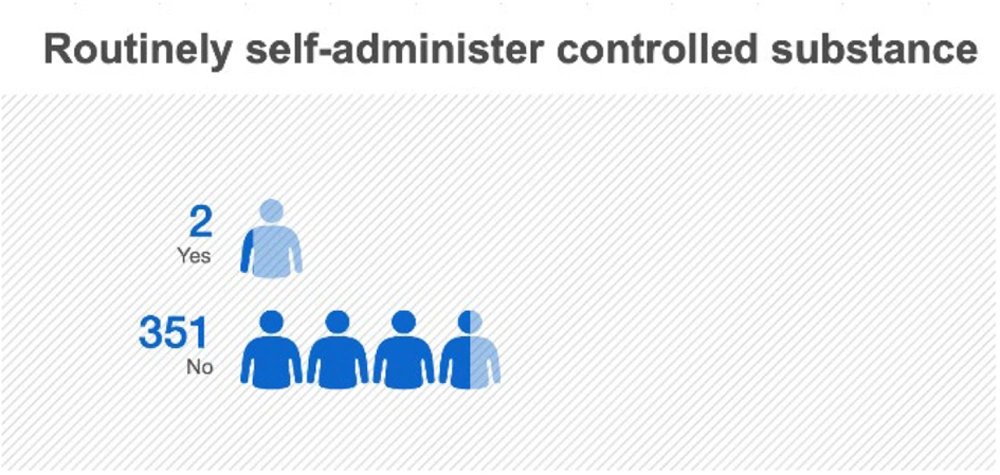
Figure 1.
Occurrence of Substance use disorders among anaesthesiology and intensive care medicine residents in Indonesia
In the final part of the survey, the respondents were asked about SUD prevention strategy measures implemented in their teaching hospital comprising knowledge regarding SUD/addiction and routine random toxicology examination to ensure the early detection of SUD in each anesthesia provider. A total of 294 (83.3%) respondents stated that the SUD module was not part of the mandatory or elective curriculum in their residency program. Prevention strategy measures regarding regular toxicological screening of all personnel who handle controlled substances showed that 273 (77.3%) respondents have never had toxicological screening, and 64 (18.2%) respondents were not aware of any routine toxicology screening in their residency program.
5. Discussion
This study determined the occurrence of SUD among anaesthesiology and ICM residents and prevention strategies in each teaching hospital in Indonesia (7).
The occurrence of self-reported SUD among anaesthesiology and ICM residents is 0.5%. Moreover, the prevalence of SUD in anaesthesiologists will increase with risk factors, including genetic predisposition, psychological vulnerability, mental health disorders, family members' history of addiction and mental illness, trauma at an early age that is not resolved properly, disharmonious social relations, and significant workload pressure (6). Workload pressure when providing anesthesia services and the availability of major opioids create a very high-risk work environment for anaesthesiology residents who have a tendency toward SUD (2). The majority of respondents in this study had at least one risk factor for developing SUD.
As SUD is a chronic disease that progresses in stages, the signs and symptoms of individuals with anesthesia SUD generally go unnoticed (8). Individuals with SUD might already be experiencing severe dysfunction by the time they are identified or diagnosed (6). Substance use disorder active prevention strategies include improving residents’ skills in recognizing SUD and random toxicology screening to detect SUD on any spectrum.6 The absence of SUD/addiction active prevention strategies in the majority of training settings in Indonesia raises concerns about safe working environments for residents/trainees.
5.1. Conclusions
This study demonstrated that the majority of anaesthesiology and ICM residents in Indonesia have risk factors for developing SUD. There is increasing evidence of the impact of intervention and management in cases of SUD, and early identification will improve the outcomes of SUD sufferers (5, 6). The need for policies, training, education, and SUD prevention strategies must be immediately addressed.
5.2. Limitations
This study has several limitations. The survey method was only used for data collection, and it was impossible to confirm statements from respondents. The authors recommend further studies with a larger number of participants and a mixed-method approach to amplify the power of the obtained findings.