
1. Background
Digital games have been recognized as effective tools for eliciting emotions through the use of diverse sensory stimuli, such as visuals, audio, and storytelling (1). Emotion-evoking games (EVGs) have previously been used in research to provoke and measure a range of emotional responses, including arousal, boredom, stress, fear, dominance, valence, happiness, anger, and frustration (1-5). Different genres of games, such as racing, puzzles, virtual reality, and survival horror, have served to evoke and analyze gamers' emotions (6). These games provide researchers with a structured method to examine the elements that influence emotions and to develop precise digital models (7). In such studies, all variables are usually controlled except for the one under investigation (e.g., speed (1) or range of motion (8)). However, there has been no definitive research determining which variables most significantly impact the intensity of emotions and their perception. Emotion Evoking Games typically utilize two main approaches for inducing and identifying emotions: The discrete model, which categorizes emotions into specific labels like surprise, anger, happiness, sadness, and disgust (9, 10), and the dimensional model, which positions emotions within a three-dimensional space defined by arousal, valence, and dominance (11). The dimensional model is more commonly applied in EVGs than the discrete model (1, 8, 12, 13).
Nevertheless, it is important to acknowledge that emotions experienced during gameplay might be affected not just by the game's features but also by the individual traits of the gamers. One such trait is gaming dependency, which categorizes gamers into three types: Those with gaming disorder (GD), problematic gaming (PG), and healthy gaming (HG) (14, 15).
Gaming disorder is categorized in the 11th Revision of the International Classification of Diseases (ICD-11) as a pattern of gaming behavior marked by a lack of control over gaming, prioritizing gaming to the extent that it takes precedence over other interests and daily activities, and continuation or escalation of gaming despite the occurrence of negative consequences (16, 17). Problematic gaming refers to gaming behaviors that lead to some issues in a gamer's life but do not fulfill the diagnostic criteria for GD (15, 18). Studies suggest that individuals with GD display a unique emotional response pattern to digital games, distinct from that of other groups, which may influence their gaming behaviors and experiences (19, 20).
2. Objectives
The primary goals of this study were to explore the combined effects of varying game speed and range of motion within an emotion-evoking game (EVG) on gamers' emotional experiences, utilizing the dimensional model of emotions. By analyzing these variables together, our aim was to provide new insights into the complex relationship between game design elements and emotional responses. Furthermore, we intended to comprehensively understand how changes in game speed, range of motion, or their combination impact emotional reactions among individuals with different levels of gaming dependency, including those identified with GD, PG, and HG. These objectives collectively advance our understanding of emotional dynamics in gaming and offer significant contributions to game design and emotional research.
3. Methods
3.1. Study Design
This study was conducted in two stages: Game design and research among different gamer groups. It utilized a cross-sectional experimental design to assess how changes in game speed and range of motion affect participants' emotional responses.
3.2. Ethical Considerations
Participants were informed about the voluntary and anonymous nature of their participation. Detailed information regarding data anonymization and confidentiality was provided. Informed consent was secured from all participants, confirming their agreement to partake in the study. The research protocol was approved by the Ethics Committee of Tehran University of Medical Sciences in Iran (Ethics Committee No. IR.TUMS.MEDICINE.REC.1399.347), ensuring compliance with ethical standards throughout the research process.
3.3. Designing Game
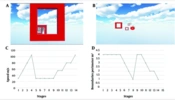
The research team created a 14-stage hyper-casual racing game using Unity software and the C# programming language. The game was designed with a theoretical basis, incorporating graphical elements similar to the boundary avoidance task (BAT) as introduced by Faller et al. (1, 3). Consequently, a 3D platform game featuring pilot-induced oscillations (PIO) was selected as the model (Figure 1A and B). A fixation point was displayed at the center of the screen during gameplay to maintain the gamer's focus. This point briefly turned red for half a second to signal to the gamer a collision with the boundaries, ensuring awareness of the mistake.
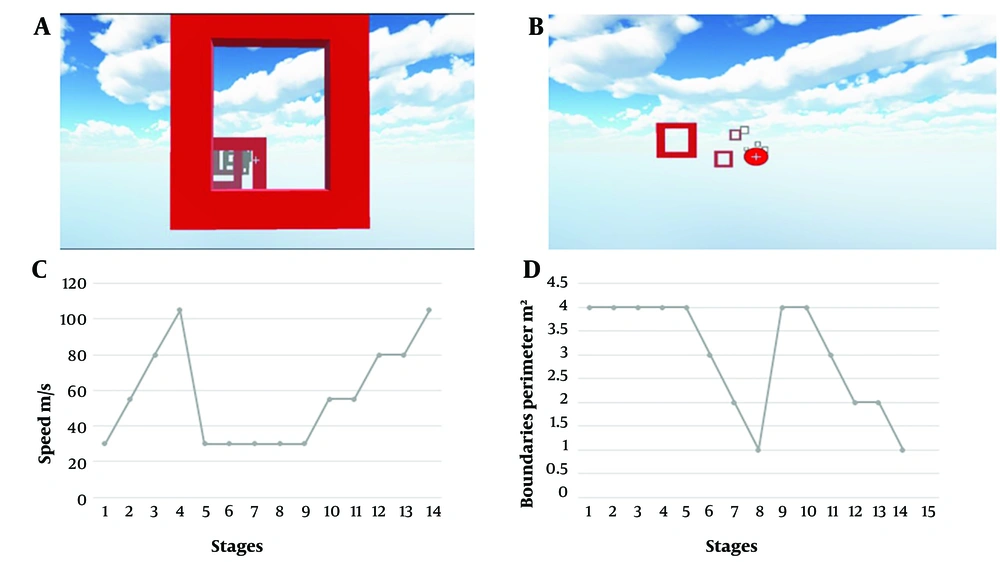
Figure 1.
A, game interface of stage 1 vs. B, the game interface of stage 14; C, the fourteen stages' speed (m/s); D, the fourteen stages' boundaries size (m2)
During the game design phase, we carefully considered several factors to maintain the study's validity. Our primary goal was to develop a hyper-casual game that players could easily learn, thus eliminating learning difficulty as a confounding factor. Additionally, we meticulously controlled all potentially interfering variables, focusing solely on our main interest variables: The manipulation of speed and range of motion. Consequently, the game featured three distinct modes: In the first 4 stages, the boundary sizes and other factors were kept constant while speed gradually increased; in the next 4 stages, speed and other factors were constant, but the boundary sizes decreased, necessitating more precise mouse movements (thus increasing the range of motion); and in the final 6 stages, both speed and range of motion were varied, with all other factors remaining constant. To further engage players, we adopted a first-person viewpoint in the game. These deliberate design choices aimed to provide a controlled and immersive gaming experience, ensuring the reliability and validity of the study's findings.
3.4. Study Procedure
The study targeted gamers aged 15 to 35 who engaged in gaming for at least one hour per week, following the DIREC standard (21) from December 2022 to March 2023. To achieve a homogenous sample for meaningful and reliable results, twenty participants were pilot-recruited to navigate through red boundaries using a mouse. During the study, participants were classified based on their gaming dependency using the IGDT-10 test, differentiating between GD, PG, and HG. Recruitment was conducted by sharing a game access link through social media channels, with instructions for participants to play the game without hitting or crossing the boundaries.
3.5. Sampling
The study began with recognition from the Iran Computer and Video Games Foundation, which reported that there are 32 million gamers in Iran (22) who play for a minimum of one hour a week. To determine the appropriate sample size, we used a sample size calculator aiming for a 95% confidence level. Based on the expectation of observing a significant change of at least 10% in the sample group across different task phases due to perceived emotional arousal, the study necessitated a minimum of 139 participants with a confidence interval of ± 5%. The study targeted participants aged 15 to 35 who engaged in gaming for at least one hour per week, focusing on a specific demographic and gaming frequency. Exclusion criteria were applied to those who did not meet the inclusion criteria or failed to complete the questionnaires, ensuring a concentrated and representative sample while upholding data completeness and quality.
3.6. Tool
To measure gamers' emotions using the dimensional model, we utilized the standardized Self-Assessment Manikin (SAM) test (23). Participants evaluated valence (1 to 9, from "very unpleasant" to "very pleasant"), arousal (1 to 9, from "very calm" to "very excited"), and dominance (1 to 9, from "feeling overwhelmed by emotions" to "feeling in full control of emotions") at each stage of the game. Difficulty levels were gauged by tracking collisions with boundaries, with the stage registering the most hits deemed the most challenging.
To categorize participants according to GD criteria from the Diagnostic and Statistical Manual of Mental Disorders (DSM-5), we employed the 10-item Internet Gaming Disorder Test (IGDT-10) (24). Based on their scores, participants were classified into three groups: Healthy gamers (HGs), problematic gamers (PGs), and those with GD. The questionnaire, standardized in Iran by the Iranian National Center for Addiction Studies, was chosen to ensure its suitability for the local population (24).
3.7. Statistical Analysis
The statistical analysis in this study was carried out through several steps. Descriptive statistics summarized participants' demographic details and gaming habits. Initially, we assessed the normality of the data using the Kolmogorov-Smirnov test, which determines whether the data distribution is normal. Inferential statistical analyses were then performed to evaluate the impact of speed and range of motion on emotions. Again, the Kolmogorov-Smirnov test assessed data normality, and nonparametric Friedman tests were applied to identify differences in emotional responses across the 14 game stages among the different gamer groups. Post-hoc analysis aimed to discern differences between speed and mixed mode or distance and mixed mode. Correlation analyses, including Pearson's coefficient, were utilized to explore the relationships between gameplay variables and emotions at each stage. A significance level of P < 0.01 was adopted, and SPSS 25 served as the statistical software for analysis and output generation.
4. Results
Initially, 179 gamers were recruited for the study, but due to incomplete data, some participants were excluded, resulting in 146 gamers completing the study. This group comprised 58 women (mean age: 21.52 ± 4.32) and 88 men (mean age: 24.73 ± 6.12), achieving an 81% response rate. According to the IGDT-10, 7.5% of the participants were classified as having GD, 34.2% as PGs, and 58.2% as HGs (Table 1). Within the GD group, 81.8% reported gaming more than 7 hours per week, compared to 38% in the PG group and 2.4% in the HG group. The study found a higher number of male gamers, with males also more likely to be diagnosed with GD compared to females (Table 1). Additionally, there was a significant correlation between the weekly duration of gaming and GD score, indicating that those with GD tend to game for more hours than others (r = 0.679, P < 0.001).
Table 1.
Demographic Information of Participants Including Gamers’ Classification and Gaming Time (n = 146)
| Variables | Values a |
|---|---|
| Gender | |
| Female | 58 (39.7) |
| Male | 88 (60.3) |
| Gamers classification | |
| HG (n = 85) | |
| Female | 38 (26.0) |
| Male | 47 (32.1) |
| PG (n = 50) | |
| Female | 18 (12.3) |
| Male | 32 (21.9) |
| GD (n = 11) | |
| Female | 2 (1.3) |
| Male | 9 (6.1) |
| Gaming time per week (h) | |
| 1 - 2 | 67 (45.9) |
| 2 - 7 | 49 (33.6) |
| 8 - 14 | 24 (16.4) |
| > 14 | 6 (4.1) |
| Age (y) | |
| 15 - 20 | 66 (45.2) |
| 21 - 25 | 35 (24.0) |
| 26 - 30 | 18 (12.3) |
| 31 - 35 | 27 (18.5) |
| Total | 146 (100.0) |
Abbreviations: GD, gaming disorders; PG, problematic gamers; HG, healthy gamers.
a Values are expressed as No. (%).
The results from the SAM test showed a significant relationship between game difficulty and emotional responses. As game difficulty increased, so did levels of valence, arousal, and hits, indicating a more positive emotional experience, while dominance levels significantly decreased (P < 0.01). Stages 4, 12, and 13 were identified as the most emotionally engaging, whereas the baseline stages 1, 5, 9, 2, and 6 elicited lower emotional responses (Figure 2 and Table 2). Furthermore, when comparing the average counts of hits among the GD, PG, and HG groups, it was observed that individuals with GD had lower hit counts than PG players, and PG players had fewer hits compared to HG players (Table 2). These findings imply that individuals with GD may have a higher skill level in digital games, underscoring the potential influence of gaming proficiency on emotional engagement.
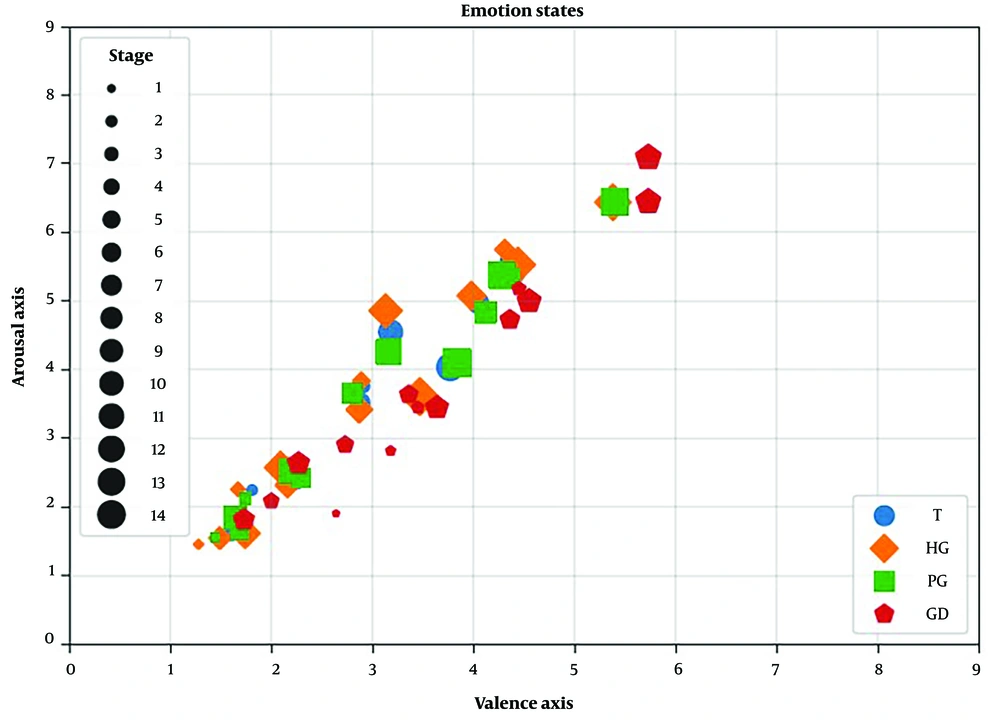
Figure 2.
Arousal and valence for 14 stages based on subgroups
Table 2.
The Mean of Valence, Arousal, Dominance, and Hits in 14 Stage for Gamer Groups a
| Stage | Valence | Arousal | Dominance | Hit | ||||||||||||
|---|---|---|---|---|---|---|---|---|---|---|---|---|---|---|---|---|
| T | HG | PG | GD | T | HG | PG | GD | T | HG | PG | GD | T | HG | PG | GD | |
| 1 | 1.44 (.88) | 1.28 (.45) | 1.44 (.57) | 2.64 (2.5) | 1.53 (.68) | 1.46 (.52) | 1.56 (.64) | 1.91 (1.51) | 8.55 (.55) | 8.49 (.57) | 8.6 (.53) | 8.73 (.46) | 4.10 (4.66) | 4.92 (5.04) | 3.14 (3.87) | 2.09 (3.75) |
| 2 | 1.81 (.99) | 1.67 (.66) | 1.74 (.66) | 3.18 (2.48) | 2.25 (.90) | 2.26 (.78) | 2.12 (.77) | 2.82 (1.83) | 8.30 (1.05) | 8.16 (1.29) | 8.52 (.54) | 8.36 (.50) | 11.10 (11.68) | 13.08 (12.49) | 9.12 (10.21) | 4.73 (7.63) |
| 3 | 2.91 (.94) | 2.89 (.88) | 2.82 (.82) | 3.45 (1.63) | 3.76 (1.0) | 3.84 (.92) | 3.70 (.99) | 3.45 (1.57) | 5.25 (1.23) | 5.31 (1.14) | 5.16 (1.18) | 5.18 (2.04) | 21.08 (18.21) | 23.51 (19.11) | 18.94 (16.09) | 12 (17.56) |
| 4 | 4.34 (1.18) | 4.31 (1.08) | 4.38 (1.29) | 4.45 (1.5) | 5.58 (1.07) | 5.75 (.89) | 5.36 (1.24) | 5.18 (1.32) | 1.73 (1.04) | 2.41 (.77) | 1.60 (.85) | 3.18 (2.4) | 36.92 (22.07) | 39.16 (21.64) | 36.36 (21.69) | 22.09 (23.27) |
| 5 | 1.60 (1.23) | 1.49 (1.13) | 1.68 (1.37) | 2.00 (1.34) | 1.63 (1.03) | 1.55 (1.04) | 1.66 (.96) | 2.09 (1.3) | 8.71 (.45) | 8.67 (.47) | 8.72 (.45) | 9 (.01) | 6.82 (7.38) | 8.26 (7.61) | 5.12 (6.73) | 3.36 (5.92) |
| 6 | 2.25 (1.13) | 2.16 (1.1) | 2.30 (1.11) | 2.73 (1.48) | 2.40 (.97) | 2.32 (.92) | 2.42 (.92) | 2.91 (1.44) | 7.90 (.68) | 7.88 (.66) | 7.82 (.69) | 8.45 (.68) | 13.51 (15.83) | 15.87 (16.11) | 11.5 (16.02) | 4.45 (5.97) |
| 7 | 2.88 (1.1) | 2.87 (1.04) | 2.80 (1.03) | 3.36 (1.74) | 3.52 (1.07) | 3.42 (1.03) | 3.66 (1.11) | 3.64 (1.12) | 4.00 (1.2) | 4.35 (1.09) | 3.96 (1.35) | 4.18 (1.47) | 18.86 (17.98) | 21.49 (17.97) | 16.56 (17.91) | 9 (14.54) |
| 8 | 4.05 (1.23) | 3.98 (1.11) | 4.12 (1.4) | 4.36 (1.36) | 4.97 (1.1) | 5.08 (.96) | 4.84 (1.14) | 4.73 (1.73) | 2.48 (1.04) | 2.61 (.90) | 2.38 (.78) | 3.45 (2.3) | 31.90 (16.84) | 34.78 (16.72) | 30.42 (15.87) | 16.45 (13.63) |
| 9 | 1.71 (1.11) | 1.74 (1.09) | 1.64 (1.08) | 1.73 (1.48) | 1.72 (1.05) | 1.62 (.97) | 1.86 (1.06) | 1.82 (1.53) | 8.87 (.33) | 8.84 (.37) | 8.92 (.27) | 8.91 (.3) | 3.81 (6.8) | 4.99 (8.33) | 2.32 (3.31) | 1.45 (3.26) |
| 10 | 2.14 (.98) | 2.09 (.97) | 2.20 (.96) | 2.27 (1.19) | 2.56 (1.1) | 2.58 (.89) | 2.52 (.93) | 2.64 (1.91) | 6.44 (1.31) | 6.44 (1.25) | 6.44 (1.35) | 6.45 (1.63) | 12.75 (15.22) | 15.29 (16.08) | 10.16 (14.05) | 4.91 (8.09) |
| 11 | 3.18 (1.04) | 3.13 (.99) | 3.16 (.88) | 3.64 (1.8) | 4.55 (1.61) | 4.86 (1.67) | 4.26 (1.41) | 3.45 (1.92) | 6.35 (1.45) | 6.31 (1.46) | 6.38 (1.38) | 6.55 (1.75) | 20.66 (19.09) | 24.73 (21.26) | 16.62 (17.2) | 7.64 (9.19) |
| 12 | 4.39 (1.07) | 4.44 (1.0) | 4.28 (1.05) | 4.55 (1.69) | 5.44 (1.08) | 5.53 (1.03) | 5.38 (1.06) | 5.00 (1.48) | 5.60 (1.09) | 5.66 (.89) | 5.54 (1.07) | 5.36 (2.2) | 43.09 (23.15) | 47.59 (23.19) | 40.02 (20.92) | 22.27 (20.64) |
| 13 | 5.41 (1.35) | 5.38 (1.33) | 5.40 (1.34) | 5.73 (1.67) | 6.44 (1.31) | 6.44 (1.25) | 6.44 (1.35) | 6.45 (1.63) | 3.77 (2.25) | 3.33 (2.13) | 3.88 (2.07) | 6.64 (1.91) | 66.22 (23.26) | 70.33 (22.66) | 65.36 (19.09) | 38.36 (27.28) |
| 14 | 3.77 (1.87) | 3.47 (1.74) | 3.84 (1.91) | 5.73 (1.67) | 4.04 (2.19) | 3.61 (2.02) | 4.10 (2.02) | 7.09 (1.92) | 1.97 (1.49) | 1.64 (.92) | 1.74 (1.06) | 5.64 (1.85) | 92.38 (22.77) | 96.66 (24.32) | 88.66 (19.77) | 76.18 (11.12) |
Abbreviations: T, total sample; GD, gaming disorders; PG, problematic gamers; HG, healthy gamers.
a Values are expressed as mean (SD).
In the comparative analysis of the 14 stages among the gamer groups, the most significant differences were noted in stages 13 and 14. Specifically, stage 14, identified as the most challenging based on the number of hits, showed a notable decline in mean valence and arousal for both the HGs and PGs groups (Figure 2 and Table 3, P < 0.01).
Table 3.
Paired t-test Analysis of 13 vs. 14 Stages Between the Game Groups
| Variables | Paired Differences | t | df | P-Value (2-Tailed) | |||
|---|---|---|---|---|---|---|---|
| Mean ± SD | Std. Error of Mean | 95% Confidence Interval of the Difference | |||||
| Lower | Upper | ||||||
| HG | |||||||
| Stage 13-stage 14 | |||||||
| Valence | 1.906 ± 1.817 | 0.197 | 1.514 | 2.298 | 9.672 | 84 | 0.000 a |
| Arousal | 2.824 ± 2.054 | 0.223 | 2.381 | 3.267 | 12.674 | 84 | 0.000 a |
| Dominance | 1.694 ± 2.310 | 0.251 | 1.196 | 2.192 | 6.763 | 84 | 0.000 a |
| PG | |||||||
| Stage 13-stage 14 | |||||||
| Valence | 1.560 ± 2.062 | 0.292 | 0.974 | 2.146 | 5.350 | 49 | 0.000 a |
| Arousal | 2.340 ± 2.255 | 0.319 | 1.699 | 2.981 | 7.337 | 49 | 0.000 a |
| Dominance | 2.140 ± 2.295 | 0.325 | 1.488 | 2.792 | 6.594 | 49 | 0.000 a |
| GD | |||||||
| Stage 13-stage 14 | |||||||
| Valence | 0.000 ± 2.000 | 0.603 | -1.344 | 1.344 | 0.000 | 10 | 1.000 |
| Arousal | -0.636 ± 1.433 | 0.432 | -1.599 | 0.327 | -1.472 | 10 | 0.172 |
| Dominance | 1.000 ± 0.775 | 0.234 | 0.480 | 1.520 | 4.282 | 10 | 0.002 a |
Abbreviations: T, total sample; GD, gaming disorders; PG, problematic gamers; HG, healthy gamers.
a P < 0.01.
However, the GD group did not exhibit significant differences in valence and arousal (Figure 2). This suggests that the difficulty of stage 14 substantially affected the emotional experiences of HGs and PGs, whereas the GD group experienced no significant changes in valence and arousal.
Significant positive correlations were found between valence, arousal, and hit counts for all participants, including within the subgroups (GD, PG, and HG). In contrast, the relationship between these factors and dominance was significantly negative.
To assess the impact of different variables on gamers' emotions, such as speed, range of motion (distance), and the combined effect of speed and range of motion, we measured the average valence, arousal, and dominance scores of gamers across various stages: The first 4 stages for speed mode, the next 4 stages for distance mode, and the last 6 stages for mix mode (speed × range of motion).
The adjustments made to speed, distance, and their combination significantly influenced gamers' valence (Figure 3 P < 0.01) and arousal (Figure 3 P < 0.01). Particularly in the mix mode, where both speed and distance were varied, there was a significant increase in the levels of valence and arousal compared to modes where only one of these factors was altered (P < 0.01). Post-hoc analysis indicated significant differences between the speed and mix modes, as well as between the distance and mix modes, in terms of valence and arousal (Figure 3A and B).
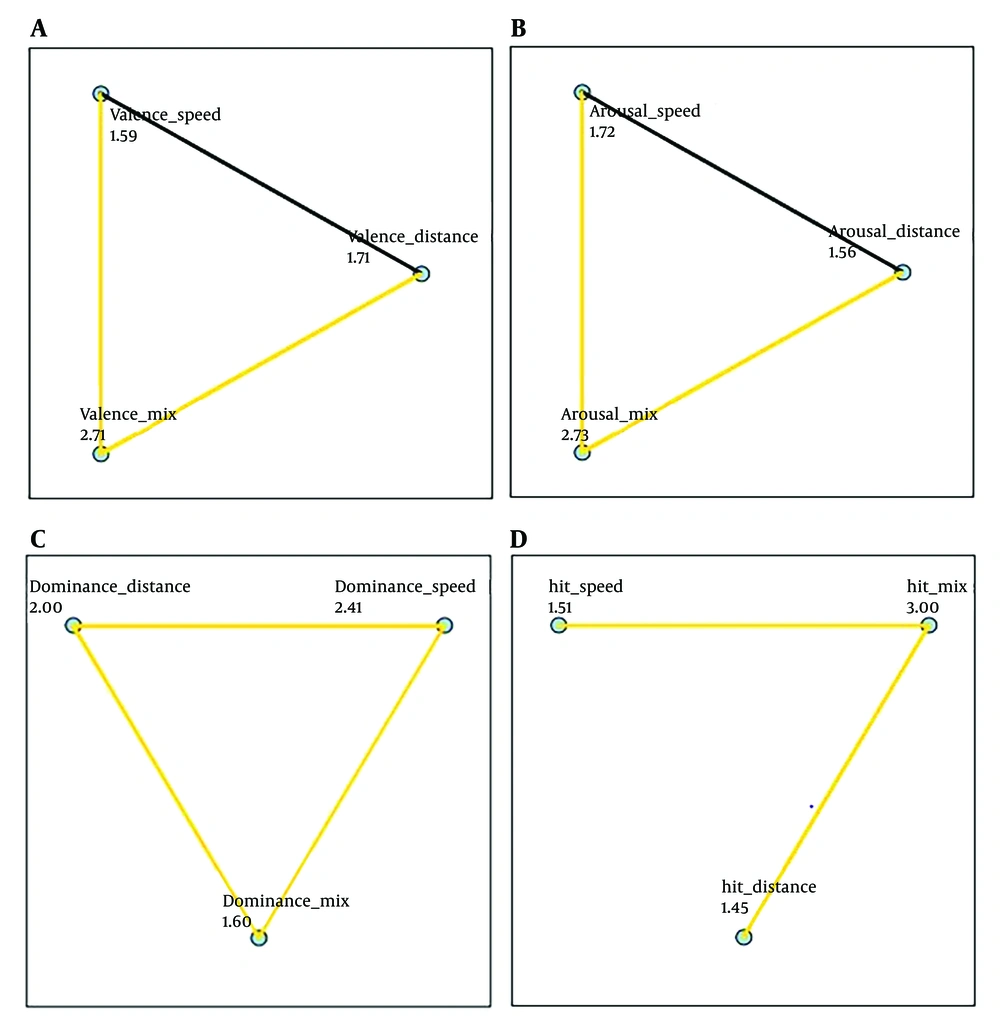
Figure 3.
Pairwise comparison of 3 modes (speed, distance, mix) for A, valence; B, arousal; C, dominance; and D, hits.
Across the GD, PG, and HG groups, the game was significantly enjoyed in all three modes (P < 0.01). However, the GD group did not experience significant changes in arousal levels across the different modes (P = 0.178). For the PG and HG groups, the mix mode resulted in a significant increase in both valence and arousal compared to the speed or distance modes (P < 0.01). Within the GD group, only the difference between the speed and mix modes was significant (P < 0.01), with other comparisons not showing significant differences in valence and arousal.
Additionally, the dominance level of gamers was significantly affected by all three modes (Figure 3 P < 0.01). Specifically, in the mix mode, the dominance level was lower than in the distance mode, which, in turn, was lower than in the speed mode. As the number of hits increased and the game's difficulty rose, a notable decrease in gamer dominance was observed, particularly in the mix mode (Figure 3D).
In the PG and HG groups, there was a significant difference in dominance among the three modes (P< 0.01), while the GD group showed no significant change (P = 0.142). Post-hoc analysis indicated that, except in the GD group, the difference between the mix mode and other modes was significant in all groups (P < 0.01). The difference in dominance between the speed mode and distance mode was apparent among all HG and the total groups. However, the PG group did not show a clear difference between these two modes (P = 0.162).
5. Discussion
The primary aim of this study was to develop an EVG to assess how changes in both speed and range of motion affect gamers' emotions, utilizing the dimensional model of emotions and accounting for individual differences in gaming dependency levels.
The results indicate that, with increasing game difficulty, there was a uniform increase in levels of valence and arousal among the majority of participants. This implies that gamers generally felt more positive emotions and greater excitement as the game's challenges became more demanding. This outcome is consistent with prior research that noted a similar link between game difficulty, arousal, and positive affect (25, 26).
An intriguing exception was noted in the most difficult stage, where HGs and PGs experienced a drop in valence and arousal levels. In contrast, the GD group had a different reaction, with stage 14 prompting the highest levels of valence and arousal. Moreover, gamers with GD exhibited greater dominance and significantly fewer hits in this stage compared to the other groups. These observations suggest that surpassing the optimal level of difficulty may enhance excitement and enjoyment for individuals with GD, whereas for healthy and problematic gamers, exceeding this level led to reduced arousal and valence, potentially diminishing the overall gaming experience. This phenomenon indicates that high levels of valence and arousal are typically experienced when individuals are deeply and actively engaged in a task (13, 27-29).
Thus, our findings underscore the significance of customizing game complexity to match participants' gaming skills to enhance their gaming experience and support effective emotional regulation interventions. The study suggests that expert gamers, like those with GD, may prefer higher complexity levels that provide challenging and rewarding experiences, thereby increasing their engagement and satisfaction. Conversely, novice gamers might benefit from simpler or progressively challenging complexity levels to maintain accessibility and avoid frustration. These insights highlight the need to adjust game complexity in accordance with players' gaming proficiency, aiming to optimize their gaming experience and emotional reactions. By acknowledging individual differences in gaming skills, preferences, and learning capacities, game developers and researchers can devise evidence-based tools for interventions that accurately detect and adjust emotions based on suitable complexity levels. This strategy not only improves the gaming experience but also supports emotional well-being (30).
Moreover, PGs and HGs demonstrated similar patterns of arousal, valence, and dominance across various game modes, with noticeable emotional shifts corresponding to changes in gameplay style. In contrast, GDs showed a unique emotional pattern marked by stability, exhibiting no significant changes in arousal and dominance across different modes. GDs consistently showed higher average levels of dominance, arousal, and valence throughout the game compared to other groups, pointing to a distinct emotional experience for GD participants. This observation aligns with previous research suggesting that individuals with GD may have a deeper emotional connection to gaming (31, 32). Such a strong emotional investment might lead to amplified emotional experiences and an overvaluation of gaming rewards.
These findings highlight the critical importance of striking the ideal balance in game difficulty to enrich the emotional experiences of diverse gamer demographics, offering practical insights for game developers and researchers. Moreover, comprehending the emotional patterns of gamers could aid in the creation of preventative and therapeutic approaches for managing GDs and problematic gaming behavior. The game emerges as a promising instrument for emotion detection, offering an interactive and engaging platform that allows individuals to express and experience their emotions, thereby providing real-time feedback and tailored experiences to foster emotional awareness and regulation (33). Through gathering and analyzing extensive datasets, the game facilitates the uncovering of patterns and correlations between emotions and gameplay dynamics, paving the way for data-driven intervention strategies (34, 35). Nonetheless, further research and validation are essential to verify the tool’s effectiveness, reliability, and ethical considerations. It calls for collaborative efforts among researchers, game developers, psychologists, and clinicians to fully leverage the game's potential as an emotion detection tool.
Furthermore, despite efforts to control for confounding variables, it's important to recognize the limitations of this study. These include the relatively small sample size, the reliance on self-report measures, and the specific demographic of young Iranian gamers. Future research is needed with larger, more diverse samples, objective measures, and a wider variety of gaming contexts to validate and expand upon these findings. Additionally, future studies should consider including a broader range of factors such as game mechanics, visual and auditory stimuli, and individual gaming preferences to gain a more comprehensive understanding of how game design, emotions, gaming behavior, and gamers' dependency levels interrelate.
5.1. Conclusions
This study was dedicated to the development of an EVG and examined how varying levels of game difficulty affect gamers' emotions, taking into account individual differences in gaming dependency. It was observed that positive emotions increased with the escalation of game difficulty, particularly among individuals with GDs, who demonstrated emotional stability and enhanced engagement. While the EVG shows potential as a tool for emotion detection, further research and validation are imperative. Despite its limitations, the findings offer meaningful insights for game developers, researchers, and clinicians focused on addressing issues related to gaming.