
1. Background
Obsessive-compulsive disorder (OCD) is a disabling condition with a lifetime prevalence of approximately 2 - 3% in the general population (1). According to the World Health Organization (WHO), it is among the ten disorders causing the most disability in the world (2). Furthermore, OCD leads to impaired social functioning (3), reduced quality of life (QoL) (4), individual distress (5), and higher personal and social costs (1). Therefore, OCD is a serious mental health issue that requires efficacious interventions.
Aiming to test the benefits of cognitive therapy (CT) techniques, some studies have added the cognitive component along with exposure and response prevention (ERP). Several meta-analyses investigating the differential effectiveness of ERP vs. CT + ERP consistently support the finding that the cognitive component does not significantly improve the efficacy of the behavioral model (6-8). By incorporating the cognitive component into behavioral therapy, increased ERP efficacy is not observed; indeed, a higher effect size for ERP compared to ERP+CT has been reported in some studies (7).
Such inconsistent findings raise questions regarding the significance of adding CT to ERP. One way to enhance current OCD treatment models is to consider novel psychological models, which focus on causal factors operating at higher levels of mental processing, such as the metacognitive model. However, the advantages of the metacognitive approach compared to ERP + CT need further investigation.
Numerous empirical studies point to obsessive thinking styles and metacognitive beliefs as key determinants of OCD (9, 10). Emerging support for the efficacy of metacognitive therapy (MCT) for OCD has been found in various studies, including Fisher and Wells with eight patients (11); Simons et al. in a study of ten children and adolescents (12); Fisher and Wells with four patients (13); Rees and van-Koesveld with nine patients (14); Moritz et al. who used internet therapy on eighty-six patients (15); Fitt and Rees delivering OCD treatment via videoconference (16); Shareh et al. with sixteen patients (17); and Andouz et al. with six patients (18).
Although the two approaches have been compared in terms of efficacy for other psychiatric disorders, to the best of our knowledge, no previous studies have comprised CBT and MCT for adult OCD. Simons et al. compared MCT and ERP in children. Notwithstanding some methodological problems, MCT was demonstrated to be an appropriate alternative to ERP (12). Narrative reviews by Fisher (19) and Rees and Anderson (20) suggest increased research and practice interest in this area, which intensifies the need for comparing these approaches.
In conclusion, a re-evaluation of CBT efficacy based on more stringent measures of clinical significance contradicts previous findings. Furthermore, to the best of our knowledge, to date there has been no comparison of MCT and CBT for treating OCD
2. Objectives
Therefore, this paper aims to compare the efficacy of MCT and CBT in improving OCD symptoms using clinical and statistical significance criteria in an Iranian treatment sample. In addition to the severity of obsessions, the efficacy of the two approaches is evaluated in the recovery of secondary symptoms of the disorder, including anxiety, depression, difficulties in emotion regulation (ER), as well as QoL and functional levels among patients.
3. Materials and Methods
3.1. Trial Design
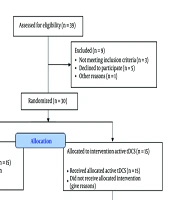
This paper presents an experimental study conducted individually with group-level comparisons. Using a parallel design, participants were randomly assigned to either CBT or MCT. The study was conducted in the psychiatric clinic of Imam Hossein Hospital in Tehran, Iran, between April 2019 and December 2019. This study was registered with and approved by the Iranian Registry of Clinical Trials (IRTC) under the number IRCT2015012220728N1 and was also approved by the Ethics Committee of the Shahid Beheshti University of Medical Sciences (No.13599). All participants were recruited from the outpatient psychiatry clinic of Imam Hossein Hospital.
Three primary inclusion criteria were considered: (1) a diagnosis of OCD based on DSM-5; (2) being 18 to 55 years of age; and (3) being stabilized on medication (at least four months after starting medication treatment for OCD). The second round involved moderate OCD symptom severity as the inclusion criterion to prevent bias toward very low or very high scores. Yale-Brown Obsessive Compulsive Scale (Y-BOCS) scores ranging from 19 to 29 were considered, one standard deviation greater than the cutoff point (Persian cutoff: 9) and the reliable index of 10. The exclusion criteria for this round were comorbid diagnoses of psychotic disorders, major depressive disorder, bipolar disorder, or neurological disorders that lead to OCD-like symptoms, as well as substance, alcohol, or drug abuse, and borderline and antisocial personality disorders. The diagnostic interviews were conducted by four psychiatrists, independently of the author.
3.2. Procedure
Sixty-minute individual sessions were held in the outpatient clinic on a weekly basis. Each patient attended 10 sessions between May and September 2019. One- and three-month follow-ups were conducted for all patients. One week after their evaluation, patients who were accepted into the study began to receive interventions, being treated with either CBT (Group A) or MCT (Group B). In this study, the manuals following the models of Clark and Wells were applied.
3.3. Interventions
To monitor and assess the therapist's competent adherence to the protocols, all sessions were recorded. Moreover, to ensure full compliance with the treatment protocols, several forms summarizing each session’s agenda, practiced techniques, and assigned homework were prepared by the therapist and used in a self-monitored manner. The therapist encouraged patients to complete their assigned homework by explaining the rationale. Additionally, patients were given translated versions of worksheets that complied with the treatment protocols.
3.4. Measures
3.4.1. Yale-Brown Obsessive Compulsive Scale
The Y-BOCS is a clinical rating scale used to determine the severity of obsessions and compulsions. It comprises a symptom checklist with 58 items and a severity scale with 10 items (21). The severity scale is highly sensitive to post-treatment changes (22). The instrument has been reported to have high reliability and validity in numerous studies and cultures (21, 23, 24), including Iran (25). The cutoff score for the Persian version is 9 (25).
3.4.2. Beck Anxiety Inventory
The Beck Anxiety Inventory (BAI) is a 21-item multiple-choice inventory used to measure clinical anxiety in the present study. Each item is rated on a four-point scale ranging from 0 to 3, resulting in a maximum score of 63. The reliability and validity of the instrument have been demonstrated in many languages (26), including Persian (27).
3.4.3. Beck Depression Inventory
The Beck Depression Inventory (BDI-II) is a multiple-choice inventory consisting of 21 items intended to detect depression. Answers are given on a Likert scale ranging from 0 to 3, resulting in a maximum score of 63. It displays adequate psychometric properties in various populations (28), including Iran (29).
3.4.4. Difficulties in Emotion Regulation Scale (DERS)
It is a 36-item self-report questionnaire designed to assess clinical difficulties in the regulation of emotions. Answers are given on a five-point Likert Scale, with higher scores indicating more difficulties. The instrument has high validity and reliability (30), both of which have been demonstrated in Iran (31).
3.4.5. WHO Quality of Life-BREF
It is an instrument composed of 26 items across four subscales: (1) physical health, (2) mental health, (3) social relationships, and (4) environment. Each item is rated on a four-point Likert Scale, resulting in a total score ranging from 0 to 100. The psychometric properties of the instrument have been assessed and verified in various countries (32), including Iran (33).
3.4.6. Obsessive Beliefs Questionnaire
The Obsessive Beliefs Questionnaire (OBQ-44) is a self-report questionnaire in which respondents are asked to rate each item on a scale of 0 to 7. The total score may vary between 0 and 308. The instrument has been shown to have high reliability and validity (34) and demonstrates excellent psychometric properties in Iran (35).
3.4.7. Metacognitions Questionnaire
This questionnaire comprises 30 items and 5 scales concerning various metacognitive components. Answers are given on a Likert Scale of 1 to 4, resulting in a total score ranging from 30 to 120. The psychometric properties of the original instrument have been confirmed (36), and it has been reported to exhibit adequate properties in Iran (37).
3.4.8. Statistical Methods
A total of 24 patients were considered in a repeated measures two-factorial design. To determine the sample size, three parameters were considered: (1) a power of 0.8, (2) α of 0.05 to detect a moderate effect size (approximately 0.25), and (3) d of 0.5 on the Y-BOCS between the two treatment groups, CBT versus MCT, using G*Power. As shown in Table 1, means and standard deviations were calculated for all descriptive variables. For all pre-test assessments, group differences were analyzed using a MANCOVA. The study’s hypothesis was tested with a 2 × 4 repeated measures MANCOVA (2 variables: CBT versus MCT) by time (pre-post- and 2 follow-up measures) with pre-test measures used as covariates. Analysis of the main group (CBT versus MCT) and interaction effects of the two conditions was carried out using MANCOVA. Effect sizes (ESs) were calculated within the treatment conditions using Cohen's d formula to determine the clinical significance of the impact of treatments on outcomes. Changes in clinical significance were reported according to the methodology proposed by Jacobson and Truax for clinical efforts.
4. Results
4.1. Demographics
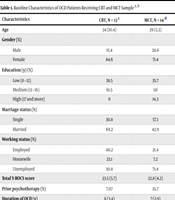
The demographic characteristics of the participants are shown in Table 1. None of these findings were statistically significant. The trends indicated that participants in the CBT group were older, and there was a higher history of prior therapy in the MCT group. Completers of the two trials were compared with those who dropped out on all relevant demographic and clinical variables measured at pre-test, and no differences were found.
| Characteristics | CBT, N = 13 c | MCT, N = 14 d | Statistics | P-Value | Total, N = 27 e |
|---|---|---|---|---|---|
| Age | 34 (10.4) | 29 (5.3) | t = 1.76 | 0.09 | 31.37 (8.51) |
| Gender (%) | χ 2 = 0.41 | 0.67 | |||
| Male | 15.4 | 28.6 | 22.2 | ||
| Female | 84.6 | 71.4 | 77.8 | ||
| Education (y) (%) | χ2 = 0.13 | 2.03 | |||
| Low (0 - 12) | 38.5 | 35.7 | 37 | ||
| Medium (13 - 16) | 61.5 | 50 | 55.6 | ||
| High (17 and more) | 0 | 14.3 | 7.4 | ||
| Marriage status (%) | χ2 = 3.84 | 0.14 | |||
| Single | 30.8 | 57.1 | 44.4 | ||
| Married | 69.2 | 42.9 | 55.6 | ||
| Working status (%) | χ2 = 0.1 | 4.5 | |||
| Employed | 46.2 | 21.4 | 33.3 | ||
| Housewife | 23.1 | 7.2 | 14.8 | ||
| Unemployed | 30.8 | 71.4 | 51.6 | ||
| Total Y-BOCS score | 23.5 (5.7) | 22.8 (4.2) | t = 0.35 | 0.72 | 23.2 (4.9) |
| Prior psychotherapy (%) | 7.07 | 35.7 | χ2 = 3.06 | 0.08 | 22 |
| Duration of OCD (y) | 6 (3.4) | 7 (2.9) | t = -1.1 | 0.25 | 7 (3.2) |
Abbreviation: Y-BOCS, Yale-Brown Obsessive Compulsive Scale.
a Values are expressed as mean ± SD unless otherwise indicated.
b Statistics were chi-square for dichotomous and independent t-tests for continuous variables.
c N, for treatment level; data missing, 1.
d N, for treatment level; data missing, 2.
e N, for treatment level; data missing, 3.
None of these findings were statistically significant. The trends indicated that participants in the CBT group were older, and there was a higher history of prior therapy in the MCT group. Completers of the two trials were compared with those who dropped out on all relevant demographic and clinical variables measured at pretest, and no differences were found.
Table 2.
Simple Effect Sizes of Each Group
| Measures | Pre-post Treatment | Pre-one Month Follow Up | Pre-three Months Follow Up | ||||||
|---|---|---|---|---|---|---|---|---|---|
| CBT | MCT | F | CBT | MCT | F | CBT | MCT | F | |
| Y-BOCS | 1.66 a | 3.28 b | 7.85 a | 0.2 | 2.84 a | 12.07 a | 0.01 | 2.55 a | 13.90 a |
| BDI-II | 2.91 b | 2.5 b | 6.29 | 3.28 b | 1.12 | 8.07 | - c | - c | - c |
| BAI | 2.66 a | 5.17 b | 5.62 b | 1.12 | 2.12 | 16.07 | - c | - c | - c |
| WHODAS 2.0 | 2.39 b | 4.95 | 84 a | 0.84 | 2.45 b | 103.88 a | - c | - c | - c |
| WHO-QoL-Brief | 2.6 b | 5.17 b | 55.91 | 0.62 | 0.66 | 64 | - c | - c | - c |
Abbreviations: Y-BOCS, Yale-Brown Obsessive Compulsive Scale; BDI-II, Beck Depression Inventory; BAI, Beck Anxiety Inventory; WHOQOL, WHO Quality of Life-BREF.
a P ≤.05.
b P ≤ .001.
c Not assessed.
Table 2 presents the means, standard deviations, and ES for Y-BOCS, OBQ, MCQ, BDI-II, BAI, DERS, WHO-QoL-Brief, and WHODAS 2.0 at pre-test, post-test, and one-month follow-up within each treatment group (CBT and MCT).
Table 3.
Interactive Effect Sizes of CBT and MCT Groups a
| Measures | Pretreatment | Post-treatment | 1 Month Follow up | 3 Month Follow up | |||||||
|---|---|---|---|---|---|---|---|---|---|---|---|
| CBT | MCT | CBT | MCT | ES | CBT | MCT | ES | CBT | MCT) | ES | |
| Y-BOCS | 2.32 (0.59) | 2.22 (0.41) | 1.79 (0.64) | 1.06 (0.69) | 0.97 b | 1.78 (0.71) | 0.88 (0.65) | 1.5 c | 1.79 (0.71) | 82 (0.68) | 1.15 c |
| BAI | 17.43 (8.66) | 9.50 (3.85) | -6.57 (4.72) | 21.13 (1.46) | 0.59 | 8.14 (4.41) | 0.63 (0.74) | 1.40 b | - | - | - |
| BDI-II | 25.82 (10.21) | 21.17 (10.55) | 16.45 (7.42) | 10.25 (7.30) | 0.20 | 15.36 (7.26) | 8.33 (7.81) | 0.35 | - | - | - |
| WHODAS 2.0 | 1.98 (0.63) | 1.34 (0.46) | 1.59 (0.53) | 0.47 (0.28) | 1.37 c | 1.62 (0.55) | 0.36 (0.25) | 1.74 b | - | - | - |
| WHOQOL- Br | 3.25 (0.46) | 3.00 (0.67) | 2.66 (0.43) | 1.60 (0.33) | 1.63 b | 2.63 (0.44) | 1.50 (0.33) | 0.35 | - | - | - |
| OBQ | 4.54 (0.85) | 3.83 (1.02) | 3.80 (0.77) | 3.60 (0.95) | 1.31 b | 3.62 (0.78) | 3.51(0.93) | 0.74 | - | - | - |
| MCQ | 2.69 (0.42) | 2.52 (0.45) | 1.90 (0.37) | 1.33 (0.21) | 0.87 | 1.84 (0.44) | 1.31(0.29) | 0.20 | - | - | - |
| DERS | 2.92 (0.61) | 2.35 (0.49) | 2.69 (0.41) | 2.32 (0.33) | 0.41 | 2.70 (0.41) | 2.16 (0.41) | NA | - | - | - |
Abbreviations: Y-BOCS, Yale-Brown Obsessive Compulsive Scale; BDI-II, Beck Depression Inventory; BAI, Beck Anxiety Inventory; WHOQOL, WHO Quality of Life-BREF.
a Values are expressed as mean (SD).
b P ≤ 0.05.
c P ≤ 0.001.
As shown in Table 3, the ES for the interaction of MCT and CBT at post-test (ES = 0.97), first follow-up (ES = 1.5), and second follow-up (ES = 1.15) reveal that the decrease in OCD severity is more pronounced in MCT compared to CBT.
| Treatment | Pre–post-treatment | Pre–one Month Follow up | Pre–three Months Follow up | |||||||||
|---|---|---|---|---|---|---|---|---|---|---|---|---|
| Deteriorated | No Change | Improved | Recovered | Deteriorated | No change | Improved | Recovered | Deteriorated | No change | Improved | Recovered | |
| CBT | 0 (0) | 83.3 (10) | 0 (0) | 16.7 (2) | 0 (0) | 83.3 (10) | 0 (0) | 16.7 (2) | 0 (0) | 83.3 (10) | 0 (0) | 16.7 (2) |
| MCT | 0 (0) | 25 (3) | 8.3 (1) | 66.7 (6) | 0 (0) | 16.7 (2) | 0 (0) | 83.3 (10) | 0 (0) | 16.7 (2) | 0 (0) | 83.3 (10) |
a Values are expressed as No (%).
bYale-Brown Obsessive Compulsive Scale P ≤ 14 / CI = 10.
According to Table 4, at post-test, of the 24 participants, 8 were classified as recovered (CBT = 2, MCT = 6), while the number increased to 12 at the one- and three-month follow-ups (CBT = 2, MCT = 10).
Table 5.
Percentage of Asymptomatic Criteria for Patients (Yale-Brown Obsessive Compulsive Scale P ≤ 7) at Post-treatment and Two Follow-ups a
| Treatment | Pre-post-treatment | One Month Follow up | Three Months Follow up | |||
|---|---|---|---|---|---|---|
| Symptomatic | Asymptomatic | Symptomatic | Asymptomatic | Symptomatic | Asymptomatic | |
| CBT | 100 (12) | 0 (0) | 100 (12) | 0 (0) | 100 (12) | 0 (0) |
| MCT | 58.3 (3) | 41.7 (5) | 58.3 (7) | 41.7 (5) | 41.7 (5) | 58.3 (7) |
a Values are expressed as No (%).
According to Table 5, patients with Y-BOCS scores of 7 or lower are considered asymptomatic. In the CBT group, none of the participants met this condition at post-test or follow-ups. In contrast, in the MCT group, five individuals were asymptomatic at post-test, and seven were asymptomatic at follow-up.
5. Discussion
The findings indicate significant differences with high interaction ES at post-test and follow-ups for both MCT and CBT. Accordingly, MCT was found to be more efficacious in reducing symptom severity on the Y-BOCS scale at post-test and both follow-ups. Although both MCT and CBT displayed large ES, the effect size for MCT was significantly higher at all three stages of measurement. The results show an increasing, albeit statistically insignificant, trend at these stages.
According to Jacobson and Truax’s criteria (38), 'No Change' patients were most frequent in CBT, while 'Recovered' patients were most frequent in MCT. MCT and CBT resulted in equivalent and significant decreases in anxiety and depression at post-test, while neither approach affected ER scores. Compared to MCT, a more significant reduction in O-C cognitions was observed in CBT. In contrast, the change in metacognitions was higher, although not clinically significant, in MCT. MCT was associated with a significant rise in functioning and QoL compared to CBT.
The fact that a difference in efficacy exists between MCT and CBT for OCD is consistent with the results of the latest published meta-analysis on OCD. In his meta-analysis, Normann found higher efficacy for MCT (39). Although no study to date has compared the efficacy of the two OCD treatment models, in this paper, we conducted a comparison of reported ES in existing RCTs for the metacognitive and cognitive-behavioral models. Various explanations may be offered for our findings as follows.
First, OCD is a neurological-psychiatric syndrome (40). Structural and functional studies have shown that the functions of the orbitofronto-striatal circuit and subcortical regions are particularly impaired in OCD patients. These functional disorders create a distinct pattern of executive function (EF) deficits (41, 42). More recently, EF deficit has been proposed as the distinctive endophenotype of OCD (43), which includes cognitive control and the supervisory attentional system (44).
Second, in a cognitive challenge, through evidence collection techniques, the therapist strives to convince the client of the irrationality of their fears and doubts and to design rational alternatives. However, in MCT, any response to thoughts is presumed to be ineffective and to exacerbate the disorder (45).
Third, CBT is founded on the premise that patients are oblivious to the irrationality of their thoughts; however, OCD patients often state otherwise (46), noting that they unconsciously and instinctively feel the need to respond to these thoughts regardless of their irrationality. Therefore, by allotting a large portion of therapy time to challenging the irrational content of obsessive thoughts, CBT overlooks the main characteristic of OCD, which does not help to increase insight.
Fourth, since metacognitions are higher-level processes that monitor cognitions (45), MCT is able to indirectly invalidate dysfunctional cognitions. In contrast, CBT does not modify different thinking styles in patients. Thus, dysfunctional metacognitions, as monitors of thoughts, are predicted to persist subsequent to CBT and result in relapse. By contrast, in MCT, a new style of thinking is introduced (45), causing mental changes to develop even after the completion of therapy and at follow-up.
Fifth, conclusive evidence confirming the mediating role of cognitions in predicting OCD is lacking (47), whereas metacognitions have been found to correlate more strongly with O-C symptoms (34, 48). Therefore, by targeting metacognitions as opposed to cognitions, patients can derive greater benefit from therapy.
Moreover, the therapy was not supervised by Wells or other developers of MCT, making it impossible to evaluate the therapist’s level of skills and introducing likely deviations from the original MCT. Mechanisms of change in response to MCT and CBT were merely studied theoretically, without assessment of these concepts during therapy.
5.1. Conclusions
It is strongly recommended that future studies measure neuropsychological changes, including EF modification and synaptic plasticity, during OCD treatment. Furthermore, compared to CBT, the response to treatment was more heterogeneous for MCT; in other words, inter-individual differences were higher in response to MCT compared to CBT, an issue that requires further investigation.