Fulltext
Full text is available in the PDF.
IJ Psychiatry and Behavioral Sciences
IJPBS is the Official Journal of Mazandaran University of Medical Sciences
Image Credit:Iran J Psychiatry Behav Sci
Authors
Objective: The present study aimed to compare the effectiveness of metacognitive therapy (MCT) and cognitive-behavior therapy (CBT) in treating Iranian patients with major depressive disorder (MDD).
Methods: Thirty three outpatients meeting DSM-IV-TR criteria for MDD without any other axis I and II disorders were randomly assigned to one of three treatment conditions, i.e. MCT, CBT and pharmacotherapy. The Beck Depression Inventory-II-Second Edition (BDI-II), Beck Anxiety Inventory (BAI), Ruminative Response Scale (RRS) and Dysfunctional Attitude Scale (DAS) were administered for pre-treatment, posttreatment and follow-up. Data were analyzed by repeated measures analysis of variance (ANOVA).
Results: Based on repeated measures ANOVA, all the participants demonstrated improvement in depression, anxiety, dysfunctional attitude and ruminative response. Based on percentage results, all the patients in MCT and CBT groups showed significant improvement at post-treatment phase.
Conclusions: MCT and CBT were more effective than pharmacotherapy alone In treatment of MDD.
Declaration of interest: None.
Citation: Ashouri A, Kazem Atef-Vahid M, Gharraee B, Rasulian M. Effectiveness of meta-cognitive and cognitive-behavioral therapy in patients with major depressive disorder. Iran J Psychiatry Behave Sci 2013; 7(2): 24-34.
© 2013, Author(s). This open-access article is available under the Creative Commons Attribution 4.0 (CC BY 4.0) International License (https://creativecommons.org/licenses/by/4.0/), which allows for unrestricted use, distribution, and reproduction in any medium, provided that the original work is properly cited.
Farahmand V, Hassanzadeh R, Mirzaian B, Fayyazi Bordbar MR, Feizi J. The Efficacy of Group Metacognitive Therapy on Self-Esteem and Mental Health of Patients Suffering from Major Depressive Disorder. Iran J Psychiatry Behav Sci. 2014;8(2):. doi:
Mami S, Sharifi M, Mahdavi A. Effectiveness of Metacognitive Therapy in Reducing psychological and MetaCognitive factors in Patients with Major Depressive Disorder in a Military Hospital. Ann Mil Health Sci Res. 2015;13(3):e59953. doi:
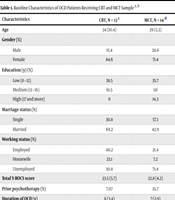
Rajezi S, Ansari P, Yaghubi H, Fata L, Hassanabadi H, et al. Metacognitive Therapy Versus Cognitive Behavioral Therapy for OCD: A Randomized Controlled Trial. Int J High Risk Behav Addict. 2024;13(2):e145235. doi: https://doi.org/10.5812/ijhrba-145235
Abolghasemi A, Gholami H, Narimani M, Gamji M. The Effect of Beck’s Cognitive Therapy and Mindfulness-Based Cognitive Therapy on Sociotropic and Autonomous Personality Styles in Patients With Depression. Iran J Psychiatry Behav Sci. 2015;9(4):e3665. doi: https://doi.org/10.17795/ijpbs-3665
Sotodeh Asl N, behnamfar B, Ghorbani R. Effects of cognitive therapy, drug therapy and combined therapy in improvement of major depression. koomesh. 2011;13(1):e152497. doi:
Last Update: 2 weeks ago
Last Update: 2 weeks ago
Last Update: 2 weeks ago
Last Update: 5 days ago
Last Update: 1 day ago
Last Update: 3 days ago