Fulltext
Full text is available in the PDF.
IJ Psychiatry and Behavioral Sciences
IJPBS is the Official Journal of Mazandaran University of Medical Sciences
Image Credit:Iran J Psychiatry Behav Sci
Authors
Objective: Although treatments with demonstrated efficacy exist for Obsessive-compulsive disorder (OCD); researches on the effectiveness of combined treatment versus psychotherapy or drug treatment are controversial. The aim of this study was to compare the efficacy of Metacognitive therapy (MCT), fluvoxamine and the combination of MCT with fluvoxamine treatment in treating patients with OCD.
Methods: Twenty-one outpatients meeting DSM-IV-TR criteria for OCD without any other axis I and II disorder were randomly assigned to one of three treatment conditions for 10 weeks of treatment: MCT, fluvoxamine, and combined treatment group. The Yale-Brown Obsessive-compulsive scale (Y-BOCS), Beck depression inventory-II-second edition (BDI-II), and Beck anxiety inventory (BAI) were administered at pretreatment and post-treatment. Group differences were examined using chi-square (for gender and marital status), one-way analysis of variance (ANOVAs) and one-way analysis of covariance (ANCOVAs) statistical procedures on each of the outcome measures using the SPSS-16 statistical package.
Results: Nineteen patients completed this study. All patients in MCT and combined treatment groups showed significant improvement at post-treatment. ANCOVA results showed that MCT and combined treatment lead to a more significant improvement in the severity of OCD symptoms (p<0.001), depression (p<0.001), and anxiety (p<0.001) than fluvoxamine treatment. There were no significant differences between MCT and combined therapy (all p>0.05).
Conclusion: It seems that adding drugs to treatment does not increase the efficacy of metacognitive therapy.
Declaration of interest: None.
© 2010, Author(s). This open-access article is available under the Creative Commons Attribution 4.0 (CC BY 4.0) International License (https://creativecommons.org/licenses/by/4.0/), which allows for unrestricted use, distribution, and reproduction in any medium, provided that the original work is properly cited.
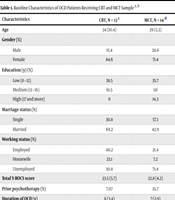
Rajezi S, Ansari P, Yaghubi H, Fata L, Hassanabadi H, et al. Metacognitive Therapy Versus Cognitive Behavioral Therapy for OCD: A Randomized Controlled Trial. Int J High Risk Behav Addict. 2024;13(2):e145235. doi: https://doi.org/10.5812/ijhrba-145235
Vakili Y, Gharaee B, Habibi M. Acceptance and Commitment Therapy, Selective Serotonin Reuptake Inhibitors and Their Combination in the Improvement of Obsessive-Compulsive Symptoms and Experiential Avoidance in Patients With Obsessive-Compulsive Disorder. Iran J Psychiatry Behav Sci. 2015;9(2):-. doi: https://doi.org/10.17795/ijpbs845
Ashouri A, Atef-Vahid M, Gharaee B, Rasoulian M. Effectiveness of Meta-Cognitive and Cognitive-Behavioral Therapy in Patients with Major Depressive Disorder. Iran J Psychiatry Behav Sci. 2013;7(2):. doi:
Vakili Y, Gharraee B, Habibi M, Lavasani F, Rasoolian M. The Comparison of Acceptance and Commitment Therapy with Selective Serotonin Reuptake Inhibitors in the Treatment of Obsessive-Compulsive Disorder. Zahedan J Res Med Sci. 2014;16(10(suppl)):. doi:
Davoudi M, Pourshahbaz A, Dolatshahi B, Nazeriastaneh A, Poshtmashhadi M. Network Analysis for Predicting Treatment Response in Patients with Obsessive-Compulsive Disorder. Iran J Psychiatry Behav Sci. 2023;17(4):e137119. doi: https://doi.org/10.5812/ijpbs-137119
Last Update: 1 month ago
Last Update: 1 month ago
Last Update: 1 month ago
Last Update: 5 days ago
Last Update: 23 hours ago
Last Update: 2 days ago