Cover image of the article: Suicide in Iranian Children: An Alarming Note for a Progressive and Silent Epidemic

Image Credit:Int J High Risk Behav Addict

Suicide in Iranian Children: An Alarming Note for a Progressive and Silent Epidemic

Authors

Somayeh Nazari1, Hamed GhazviniHamed Ghazvini ORCID2, Seyedeh Masoumeh Seyedhosseini TamijaniSeyedeh Masoumeh Seyedhosseini Tamijani ORCID3, Raheleh RafaieeRaheleh Rafaiee ORCID2,*
1School of Advanced Technologies in Medicine, Mazandaran University of Medical Sciences, Sari, IR Iran
2Department of Neuroscience, School of Advanced Technologies in Medicine, Mazandaran University of Medical Sciences, Sari, IR Iran
3Psychiatry and Behavioral Sciences Research Center, Addiction Institute, Mazandaran University of Medical Sciences, Sari, IR Iran
*Corresponding Author: Department of Neuroscience, School of Advanced Technologies in Medicine, Mazandaran University of Medical Sciences, Sari, IR Iran. Email: rachel.rafaie@yahoo.com

International Journal of High Risk Behaviors and Addiction:Vol. 14, issue 1; e157337
Published online:Feb 22, 2025
Article type:Rapid Communication
Received:Oct 26, 2024
Accepted:Feb 08, 2025
How to Cite:Nazari S, Ghazvini H, Seyedhosseini Tamijani SM, Rafaiee R. Suicide in Iranian Children: An Alarming Note for a Progressive and Silent Epidemic. Int J High Risk Behav Addict. 2025;14(1):e157337. doi: https://doi.org/10.5812/ijhrba-157337

Suicide represents one of the predominant etiological factors contributing to mortality on a global scale, and the incidence of fatalities attributed to suicide is exhibiting an upward trajectory over time. The phenomenon of suicide attempts is increasingly prevalent among children and adolescent populations. In 2019, approximately 8,327 children aged 10 - 14 died by suicide globally, with a mortality rate of 1.30 per 100,000. Rates ranged from 0.05 in South Africa to 7.49 in Greenland (1). A study highlighted that youth suicide rates are notably higher in Central-Eastern Europe, with the Russian Federation reporting 10.2 per 100,000 males. The highest age-standardized suicide rates were reported in the USA, 15.5/100,000 males, with an annual increase of 3.8% (2). According to data provided by the World Health Organization (WHO), suicide ranks as the fourth most prevalent cause of death among individuals aged 15 to 19 years (3).
In the United Arab Emirates, an alarming 54% of adolescents disclosed experiences of suicidal behavior, with anxiety and feelings of isolation recognized as critical risk determinants (4). Within the context of Syrian refugee minors in Jordan, 27.7% indicated the presence of suicidal ideation, with bullying and depressive symptoms serving as significant predictors (5). In Iran, child suicide is particularly problematic, showing rates that exceed those of other countries in the Middle East region (6). In Tehran, a comprehensive investigation revealed that the incidence of suicide among individuals under the age of 18 was markedly elevated, with poisoning identified as the predominant modality (42%) and hanging also being widespread, especially among male subjects (7).
Numerous empirical investigations have indicated that the fundamental determinants associated with suicide encompass personality characteristics (including aggression), psychological and physiological disorders (such as depression, chronic pain, and disability), significant life events (such as bereavement of friends or family members), social seclusion, socioeconomic conditions, accessibility to methods of suicide, substance dependence, marital status, demographic density, birth rates, urban population metrics, per capita income levels, unemployment statistics, educational attainment, and religious affiliation (8, 9).
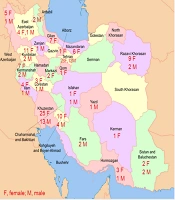
The current study was conducted in August 2024. This research analyzed Iranian news websites focusing on the phenomenon of suicide among Iranian children, employing Google search engines to explore Persian equivalents of keywords (e.g., suicide, children, Iran, and adolescent). The findings showed that Iranian news agencies documented the number of suicides among children/adolescents as 25 news items in 2019, 23 in 2020, 24 in 2021, 19 in 2022, 42 in 2023, and 4 in June 2024. Of these, 72.1% were girls and 27.9% were boys. The children's mean (± SD) age was 14.90 (± 1.87) years. Detailed information about the distribution of suicide is presented in Figure 1.
Distribution of suicides of children/adolescents based on news reports published from 2019 to 2024 in different provinces of Iran.
Figure 1.
Distribution of suicides of children/adolescents based on news reports published from 2019 to 2024 in different provinces of Iran.
Suicidal tendencies among children and adolescents should be regarded as a critical concern within the framework of public health policy initiatives (10). Issues related to educational environments significantly contribute to the prevalence of suicide among the youth, and numerous individuals who ultimately take their own lives are characterized by their relatives, peers, and other familiar persons as experiencing profound sadness and depression (7).
The determinants contributing to suicidal tendencies in children and adolescents encompass impulsivity, social seclusion, discontent with body image, the existence of mental health disorders, participation in asphyxiation games, miscommunications with peers, victimization, the impact of digital media, dissolution of interpersonal relationships, inadequate academic performance, absence of a well-defined family structure and functionality, as well as familial history of depression and suicide (7). Medical literature indicates that familial conflicts represent the primary impetus for both completed suicides and suicide attempts among children in Iran.
Children and adolescents living in economically disadvantaged situations have been inadequately addressed in the health care system. Compared to their typically developing peers, children and adolescents from disadvantaged backgrounds face distinct challenges. The healthcare infrastructure concerning children and adolescents, particularly within lower-middle-income regions, warrants significant attention.
Acknowledgments

Footnotes

  • Authors' Contribution: Somayeh Nazari designed the study, was involved in planning and wrote the draft of the manuscript. Raheleh Rafaiee supervised and worked on the manuscript. Hamed Ghazvini and Seyedeh Masoumeh Seyedhosseini Tamijani revised and commented on the manuscript. All authors contributed to the final version of the manuscript.

  • Conflict of Interests Statement: The authors declare that they have no conflicts of interest.

  • Data Availability: The dataset presented in the study is available on request from the corresponding author during submission or after publication.

  • Funding/Support: The present study was not supported by any specific fund.

References

  • 1.
    Michalek IM, Koczkodaj P, Michalek M, Caetano Dos Santos FL. Unveiling the silent crisis: global burden of suicide-related deaths among children aged 10-14 years. World J Pediatr. 2024;20(4):371-91. [PubMed ID: 38238639]. [PubMed Central ID: PMC11052841]. https://doi.org/10.1007/s12519-023-00781-z.
  • 2.
    Bertuccio P, Amerio A, Grande E, La Vecchia C, Costanza A, Aguglia A, et al. Global trends in youth suicide from 1990 to 2020: an analysis of data from the WHO mortality database. EClinicalMedicine. 2024;70:102506. [PubMed ID: 38440131]. [PubMed Central ID: PMC10911948]. https://doi.org/10.1016/j.eclinm.2024.102506.
  • 3.
    Alrisi K, Alnasif N, Nazeer A, Shareef J, Latif F. Risk of suicide in children and adolescents in the emergency department-is universal screening the answer? Arch Dis Child. 2023;108(12):970-4. [PubMed ID: 36927622]. https://doi.org/10.1136/archdischild-2022-325122.
  • 4.
    Vally Z, Helmy M. The prevalence of suicidal behaviour and its associated risk factors among school-going adolescents resident in the United Arab Emirates. Sci Rep. 2023;13(1):19937. [PubMed ID: 37968503]. [PubMed Central ID: PMC10651901]. https://doi.org/10.1038/s41598-023-47305-3.
  • 5.
    Dehnel R, Dalky H, Sudarsan S, Al-Delaimy WK. Suicidality Among Syrian Refugee Children in Jordan. Community Ment Health J. 2024;60(2):224-32. [PubMed ID: 37481688]. [PubMed Central ID: PMC10821978]. https://doi.org/10.1007/s10597-023-01160-8.
  • 6.
    Khadem Rezaiyan M, Jarahi L, Moharreri F, Afshari R, Motamedalshariati SM, Okhravi N, et al. [Epidemiology of Suicide Attempts in Khorasan Razavi Province, 2014-2015]. Iran J Epidemiol. 2017;13(2):128-35. FA.
  • 7.
    Forouzesh M, Barzegar A, Mahdavi SA, Ghadipasha M, Mousavi SS, Kordrostami R, et al. The Rate of Suicide and its Reasons in Children Under the Age of 18 Years. International Journal of Medical Toxicology and Forensic Medicine. 2022;12(2). https://doi.org/10.32598/ijmtfm.vi.35084.
  • 8.
    Seghatoleslam T, Farzaneh E, Rezaee O, Sajadfar F, Mehrpour O. Factors related to suicide attempts by poisoning in Iranian children. Indian J Forensic Med Toxicol. 2013;7:129-32.
  • 9.
    Rehkopf DH, Buka SL. The association between suicide and the socio-economic characteristics of geographical areas: a systematic review. Psychol Med. 2006;36(2):145-57. [PubMed ID: 16420711]. https://doi.org/10.1017/S003329170500588X.
  • 10.
    Silva L. Suicídio entre crianças e adolescentes: um alerta para o cumprimento do imperativo global. Acta Paulista de Enfermagem. 2019;32(3):III-VI. https://doi.org/10.1590/1982-0194201900033.

Copyright

Copyright © 2025, Nazari et al. This is an open-access article distributed under the terms of the Creative Commons Attribution 4.0 International License (CC BY 4.0) (https://creativecommons.org/licenses/by/4.0/) which permits unrestricted use, distribution, and reproduction in any medium, provided the original work is properly cited.

Similar Articles

15
Mar
2016
Factors Associated With Suicidal Attempts in Iran: A Systematic Review

Factors Associated With Suicidal Attempts in Iran: A Systematic Review

Mitra Hakim Shooshtari,
Seyyed Kazem Malakouti,
Leili Panaghi,
Shohreh Mohseni,
Naghmeh Mansouri,
Afarin Rahimi Movaghar

Hakim Shooshtari M, Malakouti SK, Panaghi L, Mohseni S, Mansouri N, et al. Factors Associated With Suicidal Attempts in Iran: A Systematic Review. Iran J Psychiatry Behav Sci. 2016;10(1):e948. doi: https://doi.org/10.17795/ijpbs-948

11
Aug
2021
Risk Factors of Suicide in Zanjan- Iran Population

Risk Factors of Suicide in Zanjan- Iran Population

Farhad Taremian,
Reza Moloodi,
Seyedeh Kiana Zamani,
Soghrat Faghihzadeh,
Mazaher Rezaei

Taremian F, Moloodi R, Zamani SK, Faghihzadeh S, Rezaei M. Risk Factors of Suicide in Zanjan- Iran Population. Int J High Risk Behav Addict. 2021;10(3):e111973. doi: https://doi.org/10.5812/ijhrba.111973

30
Jun
2014
Prevention of Physicians’ Suicide

Prevention of Physicians’ Suicide

Fatemeh Sheikhmoonesi,
Mehran Zarghami

Sheikhmoonesi F, Zarghami M. Prevention of Physicians’ Suicide. Iran J Psychiatry Behav Sci. 2014;8(2):. doi:

15
Aug
2005
Epidemiologic study on suicide attempt in affiliated hospitals of Semnan University of medical sciences

Epidemiologic study on suicide attempt in affiliated hospitals of Semnan University of medical sciences

Mohammad Bagher Saberi-Zafarghandi,
ShahRokh Mosavi,
Raheb Ghorbani

Saberi-Zafarghandi MB, Mosavi S, Ghorbani R. Epidemiologic study on suicide attempt in affiliated hospitals of Semnan University of medical sciences. koomesh. 2005;6(4):e152072. doi:

19
Jun
2005
Frequency of Self-Immolation in the Attempted Suicide Patients in Islam Abad Gharb(1997-2003)

Frequency of Self-Immolation in the Attempted Suicide Patients in Islam Abad Gharb(1997-2003)

AR Ahmadi

Ahmadi A. Frequency of Self-Immolation in the Attempted Suicide Patients in Islam Abad Gharb(1997-2003). J Kermanshah Univ Med Sci. 2005;9(1):e81517. doi:

More by these authors

Somayeh NazariPubMedScholar
Hamed GhazviniPubMedScholar
Seyedeh Masoumeh Seyedhosseini TamijaniPubMedScholar
Raheleh RafaieePubMedScholar
Share
Cited by
Metrics
Indexed in