


1. Background
The internet has drastically transformed human communication and entertainment channels (1). In recent years, the internet has become a ubiquitous, high-speed tool deeply integrated into daily life (2). However, this ubiquity comes with inevitable negative effects. One such emerging issue is addiction to internet games (3). While internet video games offer engaging entertainment, their pervasive adoption by many children and adolescents raises concerns (4). Despite the positive developmental role that games can play, excessive and uncontrollable internet game use can lead to mood and social problems, which are characteristic of addiction to these games. Cognitive issues, such as difficulties with concentration and attention, alongside behavioral challenges like hyperactivity (5), aggression (6), and negative emotions (1), contribute to a loss of control over the normal duration of gaming.
In 2018, the World Health Organization (WHO) classified internet gaming disorder (IGD) as a disease. The disorder is characterized by a behavioral pattern associated with video games, marked by a weakened capacity for self-regulation. This behavioral pattern involves excessive engagement with and prioritization of gaming, often to the detriment of other responsibilities. According to the 11th edition of the international classification of diseases (ICD-11), a diagnosis of this disorder requires at least one year of excessive mental preoccupation with gaming, indicating addictive behavior. In the fifth edition of the diagnostic and statistical manual of mental disorders (DSM-5), internet addiction falls under the category of impulse control disorders not otherwise specified (7), with internet game addiction described as obsessive, extreme, and uncontrollable behavior with detrimental effects on both physical and mental well-being (8).
Addiction to internet games leads to a range of emotional and psychological problems, including aggression, violence, obesity, inactivity, loneliness, and physical injuries (9). Research indicates that approximately 700 million individuals worldwide engage in online gaming, with 75 to 90 percent of children and adolescents participating. Prevalence rates of online game addiction range from 2.7 to 11.7 percent (10). Notably, studies show that 8.5% of American adolescents who play internet games exhibit symptoms of game addiction (11), along with 10.3% of Chinese adolescents (12), 8% of Australian adolescents (12), 9.9% of adolescents in Singapore (11), 11.9% of German adolescents (13), and 7.5% of adolescents in the UK (14). According to Young (15), accurately estimating the prevalence rate of video game addiction is challenging, as around 90% of American adolescents engage with video and computer games, with approximately 15% meeting the criteria for addiction. In Iran, internet accessibility surged from about 11% in 2005 to over 53% in 2012 (16). In a study conducted by Forghani and Alizadeh in 2008, which investigated high school students' inclination towards online gaming, it was found that 80.7% of participants played internet games, with about 46% engaging in gameplay daily. The study highlighted influences and motivations such as escaping real-life limitations and peer pressure as significant factors shaping participants' gaming behavior.
Overall, individuals who use new media platforms show a heightened inclination toward computer games (17). It is important to emphasize that internet game addiction disorder has emerged as a significant mental health issue over the past decade, associated with various challenges such as sleep disturbances, depression, mood problems, anxiety, fatigue, and academic underachievement (18). This phenomenon has garnered increasing attention from experts in the field (19). Research by Lam indicates that internet game addiction affects the lives of many children and adolescents, resulting in detrimental effects on families (20). Furthermore, the physical health of affected individuals is severely compromised, impacting their social skills, fostering isolation, and contributing to academic difficulties.
The decline in educational performance in recent years has emerged as a major concern for parents and experts regarding internet game addiction disorder among adolescents. In the contemporary landscape, a prominent challenge posed by emerging communication technologies is the pervasive addiction to internet gaming. Experts across various disciplines, such as psychologists, sociologists, and mental health professionals, have raised concerns about the repercussions of this phenomenon. Consequently, exploring the epidemiology of internet game addiction disorder and identifying the demographic factors associated with it are of significant importance (21). Conversely, investigations in Iran have yet to yield reliable research on the prevalence of internet game addiction disorder.
2. Objectives
The objective of the present study was to examine the prevalence of IGD among adolescents aged 12 to 18 years in Tehran.
3. Materials and Methods
The current study employed a descriptive cross-sectional design. The statistical population comprised adolescents aged 12 to 18 years in Tehran city in 2022, estimated to total approximately 2,000,000 individuals. To determine the sample size, the Cochran formula was applied, resulting in a minimum sample size of 708 participants, which accounted for an alpha level of 0.05 and a z-score of 1.96 corresponding to a 95% confidence level, along with a 10% anticipated dropout rate. The estimated prevalence of IGD in certain populations was noted as P = 0.15, with a margin of error set at d = 0.04.
Participants were selected based on established eligibility criteria, which included residency in Tehran, age between 12 and 18 years, the capacity to understand questionnaire items, the absence of cognitive impairment (verified by enrollment in regular schools), no self-reported psychiatric disorders, and no history of using psychoactive or addictive substances. A total of 708 adolescents (176 females and 532 males) within the specified age range were recruited from various districts in Tehran, adhering to these inclusion criteria. The mean age of the participants was 15.16 years, with a standard deviation of 1.72. For male participants, the mean age was 15.59 ± 1.67 years, while female participants had a mean age of 12.15 ± 1.83 years. Data collection occurred between mid-August and mid-November 2022 through the administration of research questionnaires. The CONSORT diagram of the study participants is shown in Figure 1.
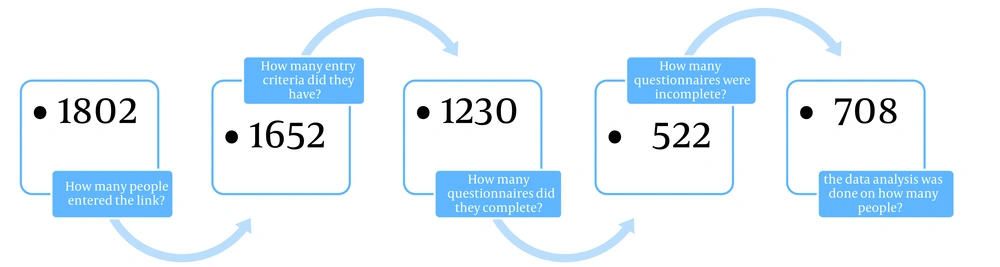
Figure 1.
CONSORT flowchart
Figure 1 illustrates that a total of 1802 participants accessed the study via the provided link, comprising 1375 boys and 427 girls. However, 150 participants were excluded from the study due to non-compliance with the entry criteria, which included approximately 120 boys and 30 girls. This resulted in a final sample of 1652 participants who met the specified criteria, consisting of 1255 boys and 397 girls. Among these, 422 participants were further excluded due to incomplete questionnaires, which included 340 boys and 82 girls. Consequently, the number of participants who completed the questionnaire totaled 1230, with a gender distribution of approximately 915 boys and 315 girls. Of the completed questionnaires, 522 were excluded due to incompleteness, comprising 383 boys and 139 girls. Ultimately, data analysis was conducted on a final sample of 708 participants who provided valid and complete data, including 532 boys and 176 girls.
Following the approval of the research proposal and the acquisition of ethics code IR.USWR.REC.1401.112 from the University of Rehabilitation Sciences and Social Health, the questionnaires were developed in a controlled press-line setting, with the inclusion criteria questions incorporated. Subsequently, the invitation for study participation was disseminated across virtual platforms (Instagram, Telegram, LinkedIn, ResearchGate, WhatsApp) and various groups. Upon obtaining voluntary consent from interested individuals, the research objectives were explained via text message, and the questionnaire link was shared. Ultimately, out of the initial 1802 individuals who accessed the questionnaire links, 708 participants (176 females, 532 males) who satisfied the entry requirements and completed the questionnaires were included in the study. Data collection comprised the utilization of both a demographic information questionnaire and an internet game addiction questionnaire.
3.1. Demographic Information Questionnaire
The questionnaire developed by the researchers for this study was designed to systematically collect personal attributes of the participants. It consists of two sections focused on adolescents. The first section gathers demographic information, including age, gender, and educational level (primary high school and secondary high school). The second section assesses daily sleep duration, categorized as follows: (1) Less than 5 hours, (2) between 5 - 7 hours, (3) between 7 - 9 hours, and (4) more than 9 hours. Additionally, the questionnaire collects information pertaining to the parents, including economic status (categorized as low, medium, and high), family size, employment status, and parental educational levels, which are assessed across four categories: Illiterate, primary elementary school, diploma/associate degree, and bachelor’s degree and above. It also examines family economic status and parental educational levels, categorizing economic status into three classes and parental education into four distinct levels to explore potential correlations with IGD. These categories were selected to encompass a broad range of educational experiences, from no formal education to advanced degrees. Understanding parental education levels is critical, as they may influence parenting styles, resource availability, and support for adolescents, which, in turn, may impact the development of IGD.
3.2. Internet Game Addiction Questionnaire
The questionnaire used in this study was adapted from Young's Internet Addiction Questionnaire, originally developed by Young (22). It consists of 20 items, each rated on a five-point Likert scale, ranging from 1 to 5, corresponding to the frequency categories: Rarely, occasionally, frequently, often, and always. The total score for the Internet Gaming Addiction Questionnaire is calculated by summing the individual item scores, resulting in a total score that can range from 20 to 100. Scores between 20 and 49 indicate average online game users who occasionally engage in extended gaming sessions but maintain control over their gaming behavior. Scores ranging from 50 to 79 suggest that individuals experience occasional difficulties with gaming usage, whereas scores from 80 to 100 reflect individuals who face significant challenges in their lives due to excessive gaming. Whang and Chang (23) reported a Cronbach's alpha coefficient of 0.90 for this instrument. In a 2016 study, Zandi Payam et al. (24) found a Cronbach's alpha coefficient of 0.95, indicating high internal consistency among the components of the questionnaire. To assess convergent validity, the correlation between the scores of this questionnaire and those from an established internet addiction questionnaire was calculated. A significant correlation (P = 0.001, r = 0.71) was observed between the two instruments.
The components of the questionnaire are classified into two distinct patterns of internet gaming addiction: One focusing on emotional and social issues, and the other on academic and occupational implications. The first pattern addresses how excessive gaming impacts an individual's emotional well-being and social interactions, potentially leading to feelings of isolation, anxiety, or depression related to gaming habits. The second pattern assesses how such behaviors may interfere with educational performance or job responsibilities. Together, these categories provide a comprehensive understanding of the multifaceted effects of internet gaming addiction on various aspects of an individual's life (24). In this study, individuals were classified as having internet gaming addiction if they scored 80 or higher on the Internet Gaming Addiction Questionnaire, which facilitated the determination of the prevalence of this condition among online users.
3.3. Data Analysis
The data were input into the statistical software SPSS version 26 for analysis. Descriptive indices were examined using the chi-square test, and the Welch test was utilized to evaluate the prevalence of IGD among adolescents and to compare them based on academic degree.
4. Results
Table 1 presents the frequency and percentage of adolescents enrolled in the primary and secondary levels of high school in relation to their engagement in internet gaming.
Table 1.The Frequency and Percentage (%) of Adolescents Across Different Educational Levels Among the Groups
| High School | Normal Users (Score < 80) | Users with IGD |
|---|---|---|
| First phase | 227 (34) | 12 (30.14) |
| Second phase | 441 (66) | 28 (69.86) |
| Total | 668 (94.4) | 40 (5.6) |
Abbreviation: IGD, internet game disorder.
Table 1 provides a detailed overview of the frequency and percentage of adolescents categorized by their educational level across two stages of high school, delineating the distinction between normal users (defined as those scoring 80 or below) and individuals exhibiting signs of IGD. In the first stage of high school, there were 227 normal users, representing 34% of the group, while 12 adolescents demonstrated signs of IGD, accounting for 30.14%. In contrast, the second stage of high school showed an increase in the number of normal users, rising to 441, which corresponds to 66% of the group. During this stage, the number of adolescents identified with IGD also increased to 28, comprising a significant 86.36% of the group. Overall, a total of 668 adolescents were surveyed, with 628 categorized as normal users, representing 94% of the total sample, and 40 identified with IGD, constituting 5.6% of the total.
To compare the demographic characteristics of high school students with and without IGD, a chi-square test was employed. Additionally, to assess the demographic characteristics of parents —including economic status and the educational levels of both fathers and mothers—another chi-square test was conducted among adolescents with and without IGD (Table 2).
Table 2.Comparisons of Demographic Characteristics Between Adolescents with and Without Internet Game Disorder a
| Subjects and Demographic Characteristic | Without IGD | With IGD | Chi-square Test |
|---|---|---|---|
| Adolescents | |||
| High school | 0.78 | ||
| First phase | 227 (34) | 12 (30.14) | |
| Second phase | 441 (66) | 28 (69.86) | |
| Sleep duration (h) | 15.98 b | ||
| < 5 | 7 (1) | 2 (5) | |
| 5 - 7 | 301 (45) | 12 (30) | |
| 7 - 9 | 334 (50) | 21 (52) | |
| > 9 | 28 (4) | 5 (13) | |
| Parents | |||
| Economic status | 10.56 c | ||
| Medium low | 66 (10) | 7 (15) | |
| Medium | 428 (64) | 18 (46) | |
| Medium high | 174 (26) | 15 (39) | |
| Fathers | |||
| Education level | 8.8 d | ||
| Illiterate | 27 (4) | 2 (6) | |
| Elementary | 113 (17) | 3 (8) | |
| Diploma/associate | 260 (39) | 13 (33) | |
| Bachelor/ above | 268 (40) | 22 (53) | |
| Mothers | |||
| Education level | 7.45 | ||
| Illiterate | 27 (4) | 2 (6) | |
| Elementary | 107 (16) | 4 (10) | |
| Diploma/associate | 361 (54) | 18 (46) | |
| Bachelor/above | 173 (26) | 16 (38) |
Abbreviation: IGD, internet gaming disorder.
a Values are expressed as No. (%).
b P < 0.001.
c P < 0.01.
d P < 0.05.
Table 2 provides a comparative examination of the demographic characteristics of high school students with and without IGD, emphasizing significant differences in sleep duration. Among the high school participants, the group without IGD was larger compared to the group with IGD (12.3% versus 8.9%), although this difference was not significant (P = 0.78). In terms of sleep duration, a marked disparity was observed: Only 1% of students without IGD reported sleeping less than 5 hours, whereas a significantly higher 21% of students with IGD fell into this category (P < 0.001). For those sleeping between 5 to 7 hours, 63% of students without IGD reported this duration compared to only 40% of students with IGD, indicating a significant difference (P < 0.01). Additionally, in the category of students sleeping more than 9 hours, 4% of those without IGD reported this duration compared to 10% of those with IGD, also reflecting a significant difference (P < 0.001). Overall, the data suggest that adolescents with IGD exhibit significantly poorer sleep patterns compared to their peers without the disorder, while no significant differences in high school stage were observed between the two groups.
In terms of economic status, 10% of parents of adolescents without IGD are classified as medium-low, whereas 15% of parents with IGD fall into this category. Additionally, 40% of parents without IGD are categorized as medium, compared to 53% among parents of adolescents with IGD, with this difference being statistically significant (P < 0.01). Regarding paternal education levels, the percentage of illiterate fathers is similar at 4% for both groups. However, there are notable distinctions in higher educational attainment: Nine percent of fathers of adolescents without IGD hold diplomas compared to 6% of fathers of the group with IGD, and 40% of fathers of the group without IGD have bachelor's degrees or higher, while 53% of fathers of the group with IGD do. These findings indicate a significant difference (P < 0.05). For maternal education, 4% of mothers without IGD are illiterate, compared to 2% for those with IGD. Within the diploma-holding category, 40% of mothers without IGD possess a diploma, versus 53% of mothers with IGD. Furthermore, 55% of mothers without IGD have a bachelor's degree or higher compared to 47% of mothers with IGD, both of which show significant differences (P < 0.05). In summary, the analysis reveals significant disparities in both economic status and educational attainment among parents of adolescents with IGD compared to those without the disorder.
To examine and compare two patterns of internet addiction associated with emotional/social concerns and academic/occupational factors, the Welch test was utilized, as outlined in Table 3.
Table 3.The Results of Welch Test to Compare Two Patterns of Internet Addiction Among Adolescents Categorized by Their Educational Level a
| High School | Emotional/Social Pattern | Welch Test | Academic/Occupational Pattern | Welch Test |
|---|---|---|---|---|
| First stage | 22.72 ± 7.95 | -1.72 | 25.16 ± 7.52 | -1.99 b |
| Second stage | 24.28 ± 7.68 | 26.86 ± 7.10 |
a Values are expressed as mean ± SD.
b P < 0.05.
Table 3 presents the results of a Welch test that examines two patterns of internet addiction among adolescents, categorized by educational levels. The data are divided into two stages: "First" and "Second" high school levels, allowing for a focused comparison. The findings suggest notable differences in the emotional and social aspects of internet addiction between the two educational categories. Notably, the Welch test for the academic/occupational pattern indicates statistical significance based on educational attainment.
5. Discussion
The study aims to determine the prevalence of IGD among adolescents in Tehran city, assessing the extent of this issue within this demographic. It specifically examines two patterns of addiction: Emotional/social problems and academic/occupational problems, with a focus on differences based on high school level. Furthermore, the research seeks to identify and analyze correlations between the severity of IGD and the students' grade level, particularly distinguishing between first-stage and second-stage high school students. Additionally, it investigates demographic factors such as sleep duration, paternal education level, and family financial status that may be associated with the presence of IGD. By comparing its findings with similar studies from other countries, the research highlights common factors that influence the development of IGD among adolescents. Ultimately, the study advocates for further research and the implementation of preventive strategies to address and mitigate the incidence of IGD in Tehran's adolescent population.
The first finding showed that the overall prevalence of IGD in the sample was 5.6%, which is consistent with findings from previous research. For example, a systematic review and meta-analysis by Macur and Pontes reported a global prevalence of IGD among adolescents at 8.8% (25). Additionally, another meta-analysis indicated an average prevalence rate of approximately 12.0% within the general population in Iran (26). A noteworthy finding is the considerable increase in the percentage of adolescents with IGD, rising from 30.14% in the first high school stage to 86.36% in the second stage. This substantial increase necessitates careful examination and further investigation. Several factors may contribute to this rise: (1) Increased accessibility to gaming devices and internet connectivity over time; (2) the development of more engaging and potentially addictive gaming content; (3) possible changes in academic pressures or social dynamics between the two stages of high school; and (4) the ongoing COVID-19 pandemic, which may have increased reliance on digital entertainment (27). While the overall prevalence of 5.6% in this study is lower than some global estimates, it still represents a significant portion of the adolescent population. For instance, a study by Yang et al. reported IGD prevalence rates ranging from 2.5% to 17% across seven European countries (28).
The second finding highlights the critical examination of high school students with and without IGD, specifically regarding sleep duration. The data revealed significant differences in sleep patterns, indicating a clear association between IGD and poorer sleep quality among adolescents. A particularly concerning trend is observed in sleep duration among students with IGD, with 21% reporting less than 5 hours of sleep per night, compared to just 1% of those without IGD. This finding is consistent with existing literature that links excessive gaming to sleep deprivation and its related health risks. Research indicates that adolescents with IGD frequently engage in prolonged gaming sessions, which disrupt their sleep patterns. Sleep deprivation can exacerbate cognitive deficits, emotional instability, and various health issues, underscoring the necessity for interventions aimed at improving sleep hygiene (29). Furthermore, only 40% of students with IGD reported sleeping between 5 to 7 hours per night, in contrast to 63% of their peers without IGD. This suggests that adolescents with IGD not only experience shorter sleep durations but also fail to achieve adequate sleep for their developmental needs. The connection between sleep duration and academic performance is particularly relevant; insufficient sleep can adversely affect concentration, memory retention, and overall academic achievement (30). Consequently, academic engagement among students with IGD may decline, potentially leading to increased gaming as a maladaptive coping mechanism for poor sleep outcomes.
The comparative analysis of the demographic characteristics of parents of adolescents diagnosed with IGD versus those without the disorder reveals significant disparities in economic status and educational attainment. These findings are crucial for understanding the broader context of IGD and its potential risk factors. The data indicate that a greater proportion of parents of adolescents with IGD are classified as belonging to the medium-low economic status category (15%) compared to their counterparts without IGD (10%). Additionally, 53% of parents of adolescents with IGD fall within the medium economic category, in contrast to 40% of parents of adolescents without IGD. This difference suggests a potential association between lower economic status and an increased risk of IGD among adolescents. Previous research has indicated that socioeconomic status can significantly influence access to resources, parental supervision, and engagement in healthy activities, which may contribute to the development of IGD (31). For instance, adolescents from lower socioeconomic backgrounds may have reduced access to extracurricular activities and supervision, potentially leading to increased gaming as a primary leisure activity. Notable differences are also observed in the educational attainment of fathers and mothers in the two groups. The percentage of fathers with bachelor’s degrees or higher is significantly higher among parents of adolescents without IGD compared to those with IGD, indicating a disparity in educational attainment. Similarly, for mothers, 55% of those without IGD hold a bachelor’s degree or higher, while only 47% of mothers of adolescents with IGD have attained this level of education. These findings are consistent with literature suggesting that higher parental education levels are associated with improved outcomes for adolescents, including lower rates of behavioral disorders such as IGD (25). Educated parents may be better equipped to provide guidance and support, fostering healthier coping mechanisms and activities for their children.
The findings present a comparative analysis of internet addiction patterns among adolescents at different educational levels, specifically examining the emotional/social and academic/occupational dimensions of internet addiction. The results indicate significant variations in these patterns, suggesting that educational attainment is a critical factor influencing both the prevalence and nature of internet addiction among adolescents. The data reveal a notable difference in the emotional/social dimension of internet addiction between the two educational levels, with first-stage high school students exhibiting lower mean scores compared to their second-stage high school counterparts. This substantial increase implies that as adolescents progress in their education, they may face heightened emotional and social challenges associated with their internet use. This observation aligns with existing literature, which suggests that increased levels of internet usage can exacerbate feelings of isolation and anxiety, particularly among adolescents who may already struggle with offline social interactions (32).
Furthermore, the standard deviations for the first-stage high school group were greater than those for the second-stage high school group, indicating variability in how internet addiction manifests across different educational stages. Although specific values for the academic and occupational dimensions of internet addiction were not detailed, the data imply a significant influence of educational level on internet use related to academic and occupational activities. Adolescents at higher educational levels may utilize the internet more frequently for academic purposes, which can yield both advantageous and detrimental outcomes. For example, while the internet serves as a valuable resource for research and academic collaboration, excessive engagement can lead to procrastination and adversely affect academic performance (33).
Future research should continue to investigate these relationships to inform the development of effective prevention and intervention strategies aimed at fostering healthier lifestyles among adolescents.
The study's sample size, consisting of a few hundred students from Tehran city, limits its representativeness and generalizability concerning demographic diversity and socioeconomic status. Its cross-sectional design restricts the analysis of causal relationships, while self-report measures may introduce bias. The focus on emotional/social and academic/occupational problems may overlook other relevant patterns of addiction. Additionally, cultural factors unique to Tehran city and unaccounted confounding variables, such as mental health and family dynamics, may influence the findings. The COVID-19 pandemic's influence on the increased reliance on digital entertainment should also be considered as a potential exacerbating factor for IGD.
Future research should prioritize larger, more diverse samples to improve the generalizability of IGD findings. Longitudinal studies can clarify causal links between gaming behavior, academic performance, and mental health. Examining peer relations, mental health, and parental involvement, along with qualitative methods, will enhance understanding and inform effective prevention and treatment strategies for IGD.
5.1. Conclusions
The results of the current study indicate that the prevalence of IGD in Tehran aligns with findings from both industrialized and developing regions. These results provide valuable insights for technology researchers, suggesting that efforts should not only focus on enhancing product quality but also on strategically mitigating gaming addiction by implementing time restrictions within gaming interfaces. Such measures could effectively help reduce addictive behaviors. Furthermore, the study's findings are significant for educators and psychologists, as they shed light on the impact of internet gaming addiction on adolescents' academic performance and social-emotional well-being. This understanding equips professionals to identify key factors associated with IGD and facilitates early intervention strategies aimed at preventing these issues from extending into adulthood.

