
1. Background
Alcohol consumption among young people is a major public health problem associated with injuries, traffic accidents, risky sexual practices, and impaired decision-making (1). Behavioral economics has shown that consumption decisions are not entirely rational (2, 3) but instead rely on cognitive shortcuts, or heuristics, among which anchoring is prominent. This heuristic describes the process by which people make numerical judgments based on prior information (eg, how much to drink or how much to pay), starting from an initial value, the “anchor” (4).
A common paradigm for studying anchoring effects uses a 2-question sequence. First, the anchor is presented as part of a comparative question. A second question then asks participants for an absolute estimate. Typically, participants’ estimates shift in the direction of the anchor value (5, 6). Most studies use the classic 2-step paradigm (5), followed by a measure of individual susceptibility (7). Existing explanations of the anchoring effect have been discussed (8), and the Skew Index (SI), proposed by Strack and Mussweiler (9), can be used to measure asymmetry in responses when only 1 anchor, usually a high anchor, is available.
The use of anchoring in alcohol-consumption research (7, 10, 11) has shown that consumers form estimates close to the number of glasses of alcohol presented as an anchor and report intentions to drink less alcohol when exposed to an anchoring condition. Interventions incorporating low anchors in text messages have also been shown to reduce the quantity of alcohol consumed and estimates of future consumption among heavy drinkers (12). Given that anchoring heuristics can influence drinking behavior in young people (13, 14), integrating numerical anchors into brief interventions may offer a promising, low-cost approach to reducing episodes of heavy drinking and their consequences.
2. Objectives
The present study examined whether estimates of future heavy alcohol consumption decreased after the presentation of an anchoring heuristic intended to reduce alcohol consumption among young people. We hypothesized that estimated future consumption would be lower after the presentation of the anchor.
3. Material and Methods
3.1. Research Design and Participants
A descriptive, cross-sectional, self-report design was used. The sample consisted of 535 young people (67% female and 33% male) aged 18 - 29 years (M = 20.14, SD = 2.0), selected using random, non-probabilistic sampling in Chiapas State, Mexico. Data were collected over a 2-month period using a digital instrument. Participants completed a Google Forms survey distributed via social networks in approximately 13 minutes.
3.2. Instruments
3.2.1. Alcohol Consumption
Alcohol consumption was assessed using 4 questions addressing age at onset of alcohol consumption; frequency of alcohol use during the previous month (from never to daily); quantity of alcohol consumed per occasion (number of drinks consumed per occasion); incidence of heavy alcohol drinking (5 or more glasses per occasion; from never to daily); and the number of drinks participants believed they needed to become intoxicated (number of glasses per occasion) (15).
3.2.2. Anchoring Heuristic
We adapted the task used by Jacowitz and Kahneman (7) to measure the quantity of alcohol consumed in an anchoring context. Using an open-question format, participants were first asked about the quantity of alcohol they proposed to consume. The questionnaire used in this study had previously been tested in studies in Mexico (14). Consistent with the typical anchoring procedure, the first question presented participants with a hypothetical anchoring task involving the quantity of alcohol they proposed to consume. This initial activity served as the “anchor.” Immediately afterward, all participants were asked, “The next time you drink alcohol, how many standard glasses of alcohol would you like to drink?”
3.3. Data Analysis
Data were analyzed using descriptive statistics for alcohol consumption. The Skew Index was used to verify the anchoring effect. The anchoring index score was calculated as follows:
where:
E = estimated response of the participant under the anchor condition
P0 = actual mean value or unanchored value (control)
A = value presented as a reference
Plausible values of the anchoring index range from 0 (no anchoring effect) to 1 (the median estimates of anchored participants coincide with the anchors presented). We considered the 15th and 85th percentiles as the lower and upper anchors, respectively, based on estimates of alcohol consumption (10). To measure the movement of the median estimate of anchored participants toward the anchor to which they were exposed, percentage displacement was calculated as follows:
In this study, the control was defined as the median of the estimates in the condition without an anchor. Data normality was assessed using the Shapiro-Wilk test. Because the drinking pattern did not had a normal distribution, nonparametric tests were used. Differences in drinking behavior between the anchor condition and future drinking were assessed using the Wilcoxon matched-pairs signed-rank test. Mann-Whitney U tests were used to determine differences in drinking behavior between the low- and high-anchor groups. In addition, linear regression modeling was performed to assess the effect of anchoring on future drinking. Throughout the analyses, P ≤ 0.05 was interpreted as statistically significant. Effect sizes for nonparametric data were reported as r (r = z/√n).
4. Results
Among participants, 61.7% reported consuming alcohol, with a mean age at initiation of 16.56 years (SD = 3.0). The frequency of consumption was 39.8% per month. On a monthly basis, 25% of participants reported excessive alcohol consumption (> 5 glasses on a single occasion). The number of drinks consumed per occasion ranged from 1 to 25 (M = 3.58; Md = 3.0; SD = 3.5). The reported mean number of glasses considered necessary for binge drinking was 6.1 (Md = 5.0; SD = 4.9). In addition, participants reported consuming a mean of 3.1 standard drinks on their most recent drinking occasion (Md = 2.0; SD = 3.5).
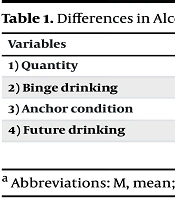
Differences between the estimated anchored value and alcohol-consumption indicators were assessed using the Wilcoxon test. Table 1 shows statistically significant differences in reported quantity (W = 18127.500; rB = 0.57) and excessive consumption (W = 37383.500; rB = 0.23) relative to the anchor condition. The estimate of future consumption was significantly lower than the quantity presented in the anchor condition (W = 71359.500; rB = 0.85). Finally, estimated future consumption was significantly lower than the reported mean usual consumption (W = 26675.000; rB = 0.39). Regarding percentage displacement, the greatest changes were observed for future consumption and binge drinking.
Table 1.
Differences in Alcohol Consumption and Anchor Condition a
| Variables | M | Md | SD | D | Pair Test | Z | P-Value |
|---|---|---|---|---|---|---|---|
| 1) Quantity | 3.53 | 3.00 | 3.5 | 33% | 1 vs 3 | -9.87 | < 0.001 |
| 2) Binge drinking | 6.15 | 5.00 | 4.8 | 66% | 2 vs 3 | -3.97 | < 0.001 |
| 3) Anchor condition | 4.94 | 4.00 | 2.8 | 33% | 3 vs 4 | -14.52 | < 0.001 |
| 4) Future drinking | 2.80 | 2.00 | 2.8 | 100% | 1 vs 4 | -5.97 | < 0.001 |
a Abbreviations: M, mean; Md, median; SD, standard deviation; D, percentage displacement.
Table 2 shows significant differences between the high- and low-anchor conditions in alcohol quantity (U = 536.500, Z = -7.85, P < 0.001, rB = 0.60), excessive drinking (U = 543.50, Z = -6.93, P < 0.001, rB = 0.54), and future drinking (U = 791.50, Z = -7.87, P < 0.001, rB = 0.61). Values in the low-anchor condition had a greater effect on reducing the estimated number of drinks consumed relative to the anchor value presented. For the Skew Index, the greatest influence was observed for binge drinking under the high-anchor condition, and the second greatest effect was the reduction in future consumption under the low-anchor condition.
Table 2.
Alcohol Consumption Compared by High and Low Levels of Anchoring a
| Variables | Low M | Low Md | Low MR | Low SI | High M | High Md | High MR | High SI |
|---|---|---|---|---|---|---|---|---|
| Quantity | 1.08 | 1.00 | 38.44 | -0.2 | 6.26 | 5.00 | 92.62 | 0.2 |
| Binge drinking | 2.80 | 2.00 | 37.56 | -0.1 | 9.24 | 7.50 | 82.95 | 0.4 |
| Future drinking | 0.91 | 0.00 | 47.49 | -0.3 | 5.38 | 5.00 | 102.61 | 0.2 |
a Abbreviations: M, mean; Md, median; MR, mean rank; SI, Skew Index.
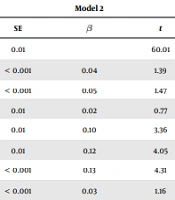
Finally, stepwise multiple linear regression was performed to examine the effect of anchoring on future consumption while controlling for previous alcohol consumption. The model was significant, F(2, 451) = 339.20, P < 0.001, R2 = 0.60. The anchor value significantly predicted future consumption (β = 0.23, t = 7.14, P < 0.001), even after controlling for previous intake (β = 0.65, t = 19.93, P < 0.001).
5. Discussion
The results of this study extend previous evidence on the anchoring heuristic (4) to estimates of future alcohol consumption among young Mexicans. Specifically, comparisons of means revealed three key findings. First, a significant difference was observed between the amount of alcohol participants proposed consuming in the anchor condition and their reported usual average consumption. Second, the amount proposed in the anchor condition was significantly lower than the amount young people considered necessary for binge drinking, suggesting that the anchor value used, based on the 85th percentile of reported consumption, was perceived as a moderate or low benchmark relative to risky consumption. Third, and most importantly, estimated future consumption was significantly lower than both the anchor amount and average consumption. These results suggest that the magnitude of the anchoring stimulus influences judgments about alcohol consumption, future consumption, and excessive alcohol consumption (6, 8, 14).
Consistent with anchoring theory (4), participants adjusted their estimates toward the reference value presented. The observed effects on the amount of alcohol consumed and binge drinking suggest that judgments about one’s own drinking behavior are particularly susceptible to the immediate numerical context, consistent with previous studies showing that estimates of personal consumption can be influenced by explicit or implicit anchors (11). The marked decline in estimated future consumption supports the hypothesis and provides evidence of an anchoring effect in reducing alcohol consumption, consistent with previous studies that applied this heuristic to modify consumption intentions (6, 12).
An important finding was that the low anchor had a greater effect on reducing the estimated number of drinks consumed relative to the anchor value presented. This finding supports the notion that low anchors can function as restrictive reference points (10), inducing more pronounced downward adjustments in habitual alcohol consumption (10, 11). From an applied perspective, this effect is particularly relevant because it suggests that low anchors can be used strategically in brief interventions to modify individual consumption norms or expectations (6).
Regarding the Skew Index, the results indicate different patterns depending on the type of behavior evaluated. The greatest influence was observed for the high anchor in binge drinking, suggesting that this behavior, characterized by extreme episodes, may be more sensitive to high anchors that implicitly normalize risky levels of consumption. This finding is consistent with research indicating that high anchors tend to amplify judgments in contexts of high ambiguity and limited objective feedback, as in excessive alcohol consumption among adolescents and young adults (9). The second effect observed was a reduction in future consumption under the low-anchor condition, reinforcing the hypothesis that anchoring affects not only retrospective estimates but also subsequent behavioral expectations and projections. This finding is consistent with recent evidence showing that interventions based on anchoring heuristics can modify future consumption intentions even when no explicit persuasive messages are presented (12).
Our research contributes to the prevention of excessive alcohol consumption by demonstrating the applicability of the anchoring heuristic as a simple strategy to influence alcohol consumption intentions. These findings are relevant to the design of brief, low-cost public health interventions aimed at reducing excessive alcohol intake among young people, a highly vulnerable group in Mexico (12, 14).
5.1. Conclusions
The anchoring heuristic significantly influenced young people’s estimates of future alcohol consumption, resulting in a reduction in the desired amount of intake. The marked decline in estimated future consumption relative to the anchor condition provides evidence of a reduction anchoring effect. These results suggest that nudge-based interventions could be promising strategies for public prevention policies (14).