
1. Background
In both the world's poorest and richest countries, unsafe sex is one of the top ten risk factors for disease, disability, or death (1). Fertility and sterility significantly affect health-related quality of life for both men and women (2). Adolescents are at risk of poor sexual and reproductive health outcomes, often due to a combination of early, unprotected, or coerced sex, as well as a lack of appropriate sexual and reproductive health services (3). These outcomes include unintended pregnancies, abortions, and sexually transmitted infections (STIs), such as HIV (4). The main cause of HIV infection and transmission among adolescents is often linked to engaging in unprotected sex or inconsistent condom usage (5).
Studies have primarily examined adolescent decision-making processes from two theoretical perspectives: Affective decision-making, based on emotions, and pragmatic decision-making, based on facts and information (6). Both are influenced by personality traits.
Condom use with a new sexual partner has been shown to be an effective method of HIV prevention in both poor and developed countries (7). Sexual risk-taking is typically assessed by looking at condom use with a new sexual partner. A recent meta-analysis found that personality traits correlated with sexual risk-taking are similar to those for physical activity. Higher levels of extraversion are associated with lower condom use, with smaller positive effects seen for conscientiousness and agreeableness (8).
Recent findings indicate that high levels of extraversion are associated with high-risk sexual encounters, while low levels of agreeableness are moderately associated with high-risk sex, multiple partners, and unprotected sexual conduct. Unprotected sex is also associated with greater caution. However, the relationship between neuroticism and risky sexual conduct is uneven and weak (9). Openness to experimentation is associated with sex without condoms, initiation of sex at an early age in men, and childbearing at an early age, according to a report by the University of California (10).
Extraversion is the most common personality trait in sexual behavior, according to a systematic review of personality and risky sexual conduct (number of lifetime sexual partners, participation in casual sex, marital infidelity, condom use, male and female sexual dysfunction, sexual coercion, and sexual harassment). Neuroticism, agreeableness, and conscientiousness are also linked to these outcomes (11). The results on personality characteristics are somewhat mixed, likely due to differences in study design, and further exploratory studies are recommended to address potential bidirectional associations. Further investigation is also required in adolescent samples.
2. Objectives
Based on the personality characteristics of the Big Five, we will investigate the likelihood of condom use in Iranian adolescents' sexual relationships.
3. Methods
This descriptive-analytical study was conducted cross-sectionally among Iranian adolescents who are internet users. Convenience sampling was used to attract participants. The questionnaires were made available online, and their links were sent to the participants. The subject matter of the study and the anonymity of responses were discussed in several lines and sent to the students as part of the questionnaires. Seven individuals were excluded from the study because they did not meet the inclusion criteria: Being an adolescent (age 12 to 17), the ability to read and write, and having access to the internet. Out of 220 participants who completed the questionnaires, 213 were included in the final analysis.
3.1. Ethical Approval
The research proposal was approved by the Religion and Health Research Center at Shahid Beheshti University of Medical Sciences (Grant No. 27829) with ethics code IR.SBMU.RETECH.REC.1400.436. Before participating in the research, all participants filled out informed consent forms and were informed about this research and any ethical considerations relevant to the study.
3.2. Big Five Scale-Short Version (BFI-10)
This scale is the short version of the Big Five Inventory that Ramstad and John prepared to measure personality dimensions (12). The BFI-10 has five subscales with two bidirectional items for each Big Five personality factor. The items are rated on a five-point Likert Scale, with responses ranging from "strongly disagree" to "strongly agree." In Iran, Mohammad Zadeh and Najafi used the retest method to estimate reliability, which was reported at 0.88 after one month (13).
3.3. Condom Use
To measure condom use, the following question was designed by the researchers: "How often do you use condoms in your sexual relationships?" The response options were: Always, most of the time, usually, never. For data analysis, "Always" was scored as one, and the other options were scored as zero.
3.4. Statistical Analysis
Data were analyzed at both descriptive and inferential levels. At the descriptive level, the mean and standard deviation were reported for each variable. The dependent variable (condom use) was categorized dichotomously as present or absent. Hierarchical binary logistic regression was used to examine the predictive relationship between personality (Big Five) and condom use. All analyses were carried out using the statistical package for social sciences (SPSS) version 24.
4. Results
The demographic characteristics of the sample are presented in Table 1. The final sample included 213 adolescents with a mean age of 16.23 years (SD = 1.17). Among them, 29.1% (n = 62) were female, and 70.9% (n = 151) were male. Additionally, 89.2% of participants lived in families with a monthly income of 10 - 15 million Toman or less.
Table 1.
Demographic Characteristics of the Sample
| Demographic Characteristics | Mean ± SD or No. (%) |
|---|---|
| Age | 16.23 ± 1.17 |
| Gender | |
| Female | 62 (29.1) |
| Male | 151 (70.9) |
| Income | |
| 1 - 5 million Toman | 50 (23.5) |
| 5 - 10 million Toman | 96 (45.1) |
| 10 - 15 million Toman | 44 (20.7) |
| 15 - 20 million Toman | 12 (5.6) |
| More than 20 million Toman | 11 (5.2) |
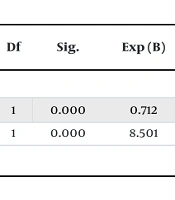
A binary logistic regression analysis was conducted to identify the best predictors of condom use. The results are reported in Table 2. As evident from Table 2, the regression model involved one step. Based on the standard coefficients in the final model, openness to experiences was the predictor.
Table 2.
Binary Logistic Regression Analysis for Predicting Condom Use
| Variables in the Equation | B | S.E. | Wald | Df | Sig. | Exp (B) | 95% C.I. for EXP (B) | Nagelkerke R Square | |
|---|---|---|---|---|---|---|---|---|---|
| Lower | Upper | ||||||||
| Step 1 a | 0.603 | 0.840 | 0.122 | ||||||
| Openness | -0.340 | 0.084 | 16.252 | 1 | 0.000 | 0.712 | |||
| Constant | 2.140 | 0.561 | 14.553 | 1 | 0.000 | 8.501 | |||
a Variable(s) entered on step 1: Openness.
In this step, openness was entered into the model (β = -0.34, P < 0.001) and accounted for 12.2% of the variance in condom use. The final model implies that adolescents with higher scores on openness tend to use condoms less frequently in their sexual relationships.
5. Discussion
People who seek variety outnumber those who prefer the usual routine and are comfortable in their contact with familiar people and issues because of this characteristic. People who are always looking for new and exciting experiences score high in openness to experience. They enjoy trying new food items at restaurants or exploring new and exciting places to eat, for example (14). On the other hand, people who are less open to new experiences stick to familiar topics and activities that they know they will enjoy. Those who score high in openness to experience tend to question traditional values, while those who score low tend to support traditional values and maintain a rigid lifestyle. In summary, people who are open to new things tend to like variety (14).
Adolescence is characterized by increased peer interactions (15), such as relying on peer feedback to form identity and self-evaluation (16). Although parents remain significant in socialization during this period, peers become the primary source of social and emotional support, providing a framework for thinking and acting (17). Studies have shown that adolescents' behavior is similar to that of their peers (18, 19). Research indicates that when children notice their peers are sexually active, they are more likely to become sexually active themselves (20). Agreeableness, openness, and extraversion were positively related to the number of close friends in a cross-sectional and longitudinal study aiming to establish the correlation between the Big Five personality traits and the self-reported number of close friends.
It should be noted that in the present study, the Big Five questionnaire was used to measure personality characteristics, with each personality dimension investigated using two questions. Given the complexity of personality dimensions and the challenges of replicating such traits in adolescence, it is possible that conflicting results or a lack of significance in other personality dimensions are attributed to this.
5.1. Limitations
Although our study provides new insights regarding condom use among Iranian adolescents, several limitations should be considered when interpreting the findings. First, the cross-sectional design of the current study limits any causal conclusions. A longitudinal design is needed to evaluate the causal relationship between study variables. Second, many factors can influence the decision to use condoms among adolescents, so further studies are recommended to examine broader factors such as the role of family and friends in this area.
5.2. Conclusions
The findings of the current study indicate that openness to experiences could predict condom use among Iranian adolescents. Our study expands the current literature by investigating the role of personality on condom use among adolescents in a non-Western culture. More studies are needed to investigate protective factors against risky sexual behaviors in Iranian adolescents.