
1. Background
In recent years, the expansion of social media and the widespread use of communication technologies have contributed to the emergence of a hidden and persistent form of aggression referred to as cyberbullying perpetration (CP) (1, 2). CP is defined as actions in which individuals or groups use online spaces to harass, demean, or threaten others (3). This phenomenon not only causes serious psychological and social harm to victims but has also prompted increasing attention to the psychological processes related to perpetrators. Empirical evidence suggests associations between problematic online behavior and childhood trauma experiences, including childhood emotional abuse (CEA) (4), as well as between these experiences and risky online behaviors, such as CP (5).
Emotional abuse, which can manifest through behaviors such as humiliation, rejection, threats, and emotional neglect (6), has been associated with aggressive online conduct through disruptions in emotion regulation and cognitive processing (7). Research has indicated that various factors, including impulsivity and weak self-control (8), hostile aggression and low empathy (9), and experiences of different forms of childhood maltreatment (10), such as CEA (11, 12), can predict CP (8). CEA involves any nonphysical behavior or attitude used to dominate, discipline, control, or isolate another individual through fear or humiliation (12). This form of abuse may include verbal aggression, control, isolation, ridicule, or the exploitation of personal information to cause harm (13). Six types of emotional abuse have been identified, including rejection (6), ignoring, terrorizing (14), isolation, corrupting (15), and exploitation (16). Because CEA often lacks immediate and clearly observable outcomes, except in cases involving impaired growth, its effects may remain unrecognized for long periods. However, CEA should not be viewed as a temporary childhood crisis; its effects are strong and long-lasting, and this form of maltreatment has been shown to undermine adjustment more severely than other types of abuse (15). The General Aggression Model (GAM) is considered one of the most comprehensive theoretical frameworks for explaining aggressive behaviors (10, 16). Recent research has extended this model to cyberbullying, suggesting that early adverse experiences, such as emotional abuse, may be associated with online aggressive behaviors by shaping maladaptive cognitive patterns and negative emotional responses.
Studies indicate that childhood trauma experiences reinforce inefficient and negative cognitive patterns, gradually shaping a worldview in which social interactions are perceived as threatening or hostile (17, 18). These cognitive patterns represent cognitive structures that develop when information is processed inefficiently and interpreted in a biased manner (19). Cognitive distortions stem from incomplete or flawed cognitive processing and are often attributed to beliefs or schemas formed during childhood or developed later in life (20). In addition to affecting specific situations, these distortions influence broader judgments and evaluations, thereby affecting multiple aspects of life (21, 22). This inflexible schema includes several aspects, such as interpersonal rejection, unrealistic expectations of relationships, and interpersonal misunderstandings (22, 23).
Based on these perspectives, it can be assumed that experiences of CEA are associated with the development of ICD and IU, which, in turn, play key roles in the emergence of online aggressive behaviors. CEA has also been related to IU. Studies suggest an association between adverse childhood environments, which are unstable and unpredictable (24), and negative evaluations of uncertainty, which are central to IU (25, 26). Such experiences may undermine individuals' capacity to cope with ambiguity and foster enduring negative beliefs that the future is uncontrollable (27). These biases also emerge in offline interactions. In online spaces, individuals with low IU tend to exhibit hostile and aggressive behaviors, such as CP, when they interpret ambiguous messages and interpersonal disagreements as threatening (28, 29). Accordingly, it can be assumed that experiences of CEA are associated with the development of ICD and IU, which, in turn, contribute to the emergence of online aggressive behaviors.
From an innovation perspective, the present study integrates 2 distinct theoretical frameworks, the GAM and the Metacognitive Model of Anxiety, to provide a comprehensive perspective on the cognitive and emotional mechanisms underlying CP. Although previous research has addressed the relationship between CEA and CP, these studies have primarily focused on general emotional and behavioral outcomes. Consequently, the concurrent roles of specific cognitive processes, particularly ICD and IU, have been largely overlooked. This constitutes a significant gap in the literature, as it remains unclear how adverse emotional experiences are associated with online aggression through interactions between cognitive and metacognitive mechanisms. Elucidating these pathways may contribute to the theoretical understanding of the long-term cognitive consequences of childhood maltreatment and provide a foundation for designing targeted cognitive-behavioral interventions and educational programs aimed at reducing cyberbullying. These findings are particularly important in collectivist cultural contexts, where interpersonal dynamics may play a significant role in the formation and manifestation of online aggression.
2. Objectives
This study aimed to investigate whether ICD and IU mediate the relationship between CEA and CP in active Iranian social media users aged 18 to 35 years.
3. Materials and Methods
3.1. Design and Participants
This study used a descriptive-correlational design with an SEM approach. The statistical population comprised Iranian individuals aged 18 to 35 years who were actively engaged on social media platforms. Based on the methodological recommendations proposed by Kyriazos and Poga-Kyriazou (30) for SEM, 375 active users were selected via online convenience sampling, meeting the recommended sample size range for path analysis (300 - 450). A post hoc power analysis indicated an approximate statistical power of 80% to detect small to moderate correlations (r ≈ 0.14, α = 0.05), suggesting sufficient power.
3.2. Instruments
3.2.1. Childhood Trauma Questionnaire-Short Form
The 28-item Childhood Trauma Questionnaire-Short Form (CTQ-SF) was developed by Bernstein et al. (31) as a self-report instrument designed to assess childhood trauma experiences in 5 dimensions: Emotional neglect, CEA, physical neglect, physical abuse, and sexual abuse. Of the items, 25 assess trauma experiences, and 3 address denial/minimization. Responses are scored on a 5-point Likert scale ranging from 1 (never true) to 5 (always true), with higher scores reflecting greater severity of childhood trauma. The questionnaire had test-retest reliability coefficients between 0.79 and 0.86 and Cronbach alpha values ranging from 0.79 to 0.94, and factor analysis supported its 5-factor structure (31). The Persian version of the questionnaire was validated in the Iranian population by Laghaei et al. (32), who demonstrated strong internal consistency (0.81 - 0.97), and model fit indices indicated acceptable fit. In the present study, the Cronbach alpha coefficient for the entire questionnaire was 0.90.
3.2.2. Cyberbullying Perpetration Questionnaire
The Cyberbullying Perpetration Questionnaire (CPQ) was developed by Wright and Li (33) and consists of 13 items assessing individuals' involvement in online harassing behaviors. Items are scored on a 5-point scale from 1 (never) to 5 (always). The total score represents the overall level of CP (score range, 13 - 65), and higher scores indicate more frequent engagement in abusive online behaviors. In the original version, the instrument demonstrated strong internal consistency, with a Cronbach alpha of 0.88 and excellent model fit indices. The Persian version of this questionnaire (34) had a Cronbach alpha of 0.85, test-retest reliability of 0.67, and good fit indices. In the present study, the Cronbach alpha coefficient for the total scale was 0.84.
3.2.3. Interpersonal Cognitive Distortions Scale
The Interpersonal Cognitive Distortions Scale (ICDS) was designed by Hamamci and Büyüköztürk (22) and contains 19 items measuring 3 subscales: Rejection in relationships, unrealistic expectations, and interpersonal misinterpretation. Responses are scored on a 5-point Likert scale ranging from strongly disagree to strongly agree. Higher scores reflect greater ICD. The original study confirmed the 3-factor structure and reported correlations with automatic thoughts and irrational beliefs ranging from 0.45 to 0.53. The Persian version showed strong internal consistency of 0.85 for the total scale and 0.79 to 0.82 for the subscales. Confirmatory factor analysis confirmed the 3-factor structure, and the 3 factors together explained 47% of the variance. In the present study, the Cronbach alpha coefficient for the total scale was 0.88.
3.2.4. Intolerance of Uncertainty Scale
The Intolerance of Uncertainty Scale (IUS) was designed by Carleton et al. (35) and includes 12 items assessing 2 dimensions: Prospective intolerance of uncertainty and inhibitory intolerance of uncertainty. Responses are scored on a 5-point scale from strongly disagree to strongly agree. Higher scores indicate greater difficulty in dealing with ambiguous situations. In the original version, the total scale demonstrated a Cronbach alpha of 0.91 and test-retest reliability of 0.74. The Persian version of this scale was validated in Iran by Rashtbari et al. (36), who reported a total Cronbach alpha of 0.89, ranging from 0.81 to 0.84 for the subscales, and acceptable fit indices. In the present study, the Cronbach alpha coefficient for the total scale was 0.89.
3.3. Procedure
The questionnaires were distributed online via the Porsline platform. The questionnaire link was shared across various social media groups, including Instagram, Telegram, and X, and participants voluntarily entered the study by clicking the link. Before responding, participants viewed an information page describing the research objectives, confidentiality conditions, and informed consent information. The average time to complete the questionnaires was approximately 15 minutes.
4. Results
4.1. Sample Characteristics and Social Media Use
The analytic sample included 375 participants (66.9% women and 33.1% men), with a mean age of 21.16 years (SD = 3.29). Most participants (80.0%, n = 300) held a diploma, followed by bachelor’s (9.9%, n = 37), master’s (6.9%, n = 26), and doctoral (3.2%, n = 12) degrees.
Participants reported active engagement across several social media platforms. Telegram was the most frequently used service (85.9%), followed by Instagram (65.6%) and YouTube (16.3%). Other platforms, including WhatsApp, TikTok, Twitter, Pinterest, and unspecified other sites, were used by fewer than 3% of respondents. Most participants reported spending 3 - 5 hours per day on social media.
4.2. Preliminary Data Screening and Assumption Testing
Before hypothesis testing, the data were screened for normality and multicollinearity. Skewness and kurtosis values for all observed variables were within the acceptable ± 2 range (37), supporting univariate normality. Collinearity diagnostics showed tolerance values > 0.40 and variance inflation factors < 10, indicating no multicollinearity concerns. These results confirmed that the data met the assumptions for subsequent analyses. Descriptive statistics and zero-order correlations among the study variables are presented in Table 1.
Table 1.
Descriptive Statistics and Correlations Among Study Variables
| Variables | Mean ± SD | 1 | 2 | 3 | 4 |
|---|---|---|---|---|---|
| 1. Cyberbullying Perpetration | 27.97 ± 6.76 | 1 | |||
| 2. Interpersonal cognitive distortions | 50.78 ± 12.21 | 0.314 a | 1 | ||
| 3. Intolerance of uncertainty | 35.93 ± 9.65 | 0.189 a | 0.686 a | 1 | |
| 4. Childhood Emotional Abuse | 7.79 ± 3.82 | 0.377 a | 0.449 a | 0.377 a | 1 |
a P < 0.01.
4.3. Psychometric Properties of the Instruments
Before testing the main hypotheses, we evaluated the reliability and convergent validity of all instruments using the current sample data. As shown in Table 2, Cronbach alpha coefficients for CP, ICD, IU, and CEA were 0.84, 0.88, 0.89, and 0.90, respectively, indicating excellent internal consistency. Composite reliability (CR) values ranged from 0.80 to 0.90, and average variance extracted (AVE) values ranged from 0.56 to 0.68; all exceeded the recommended thresholds (CR > 0.70; AVE > 0.50). These findings support adequate reliability and convergent validity of the instruments in the present sample. Because this study used path analysis with observed variables (total scale scores), factor loadings from a measurement model (confirmatory factor analysis) were not applicable and therefore were not reported.
Table 2.
Internal Consistency, Composite Reliability, and Average Variance Extracted for All Instruments in the Current Sample a
| Variables | α | CR | AVE |
|---|---|---|---|
| Cyberbullying perpetration | 0.84 | 0.80 | 0.68 |
| Interpersonal cognitive distortions | 0.88 | 0.87 | 0.58 |
| Intolerance of uncertainty | 0.89 | 0.89 | 0.56 |
| Childhood emotional abuse | 0.90 | 0.90 | 0.67 |
a Abbreviations: α, Cronbach alpha coefficient; CR, composite reliability; AVE, average variance extracted.
4.4. Structural Model Analysis and Hypothesis Testing
Path analysis was conducted to examine the direct and indirect paths. The results are presented in Figure 1 and in the tables summarizing the direct and indirect paths.
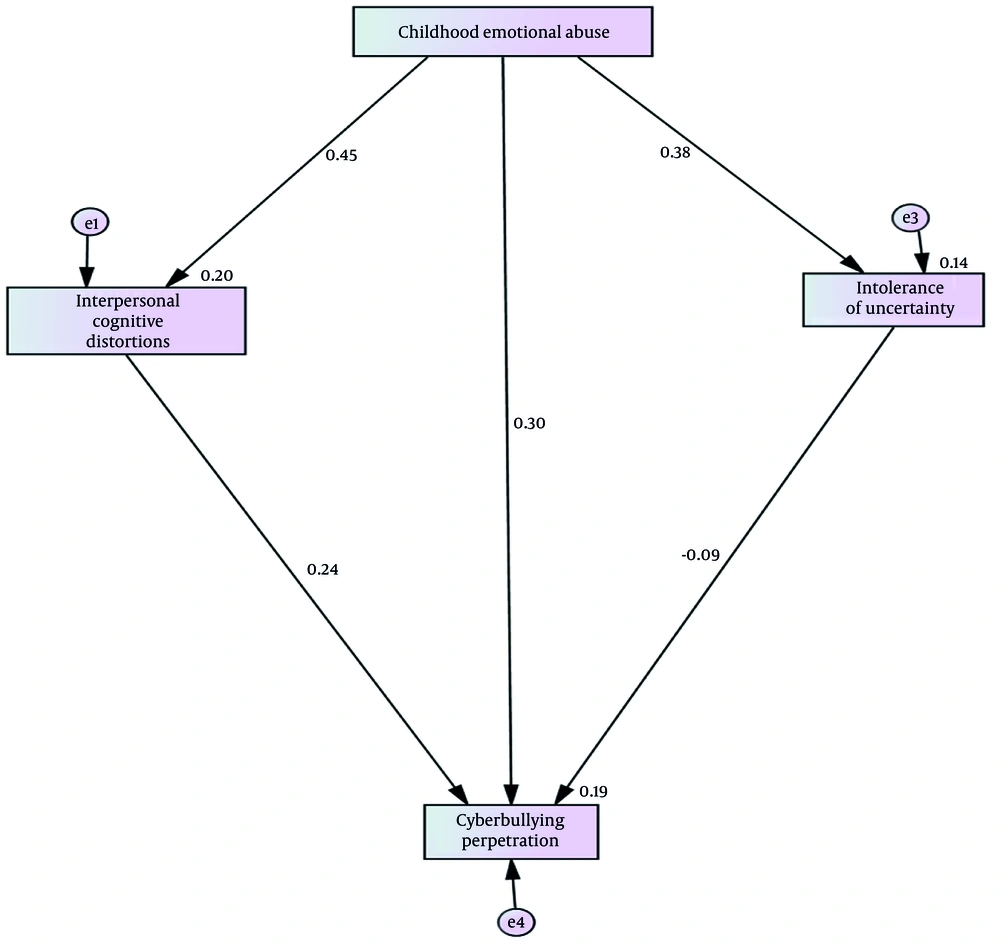
Figure 1.
Conceptual model of the relationships among childhood emotional abuse, interpersonal cognitive distortions, intolerance of uncertainty, and cyberbullying perpetration
4.5. Model Fit Indices
The fit indices of the conceptual model are presented in Table 3. For the final path model, we initially tested a full model including both mediators, ICD and IU. However, the path from IU to CP was not statistically significant (P > 0.05). Therefore, we removed this non-significant path to obtain a more parsimonious model; the revised model demonstrated satisfactory overall fit. Absolute and incremental fit indices were used to evaluate model adequacy. The RMSEA and SRMR were the primary absolute indices, with optimal fit indicated by RMSEA values < 0.10, preferably < 0.08, and SRMR values < 0.08. Incremental indices, including CFI, TLI, and IFI, exceeded the conventional threshold of 0.90, indicating acceptable fit, whereas values > 0.95 reflected excellent model performance.
Table 3.
Model Fit Indices for the Conceptual Model a
| Fit Indices | Chi-Square | Chi-Square/df | RMSEA | SRMR | CFI | IFI | TLI | GFI |
|---|---|---|---|---|---|---|---|---|
| Conceptual model | 1.873 | 1.873 | 0.048 | 0.015 | 0.998 | 0.998 | 0.987 | 0.998 |
a Abbreviations: RMSEA, root mean square error of approximation; SRMR, standardized root mean square residual; CFI, Comparative Fit Index; IFI, Incremental Fit Index; TLI, Tucker-Lewis Index; GFI, Goodness-of-Fit Index; χ2/df, chi-square to degrees of freedom ratio.
The results indicated significant positive associations between CEA and CP (β = 0.300, P < 0.001) and between ICD and CP (β = 0.236, P < 0.001). In contrast, the direct association between IU and CP was not significant (β = -0.088, P = 0.079). Childhood emotional abuse was also significantly associated with both ICD (β = 0.449, P < 0.001) and IU (β = 0.377, P < 0.001).
4.6. Indirect Associations of Variables With Cyberbullying Perpetration
To estimate the indirect effects, we applied the bootstrap method with 5000 resampling iterations. The analysis showed a statistically significant indirect association between CEA and CP through ICD (b = 0.189; 95% CI, 0.088 to 0.321; P = 0.001). By contrast, the indirect association through IU was not significant (b = -0.059; 95% CI, -0.148 to 0.021; P = 0.151), as the confidence interval included zero (Tables 4 and 5).
Table 4.
Direct Paths Among Study Variables in the Research Model a
| Independent/Dependent Variables | b | β | SE | t | P-Value |
|---|---|---|---|---|---|
| Childhood emotional abuse/cyberbullying perpetration | 0.538 | 0.300 | 0.099 | 5.424 | < 0.001 |
| Interpersonal cognitive distortions/cyberbullying perpetration | 0.132 | 0.236 | 0.029 | 4.532 | < 0.001 |
| Intolerance of uncertainty/cyberbullying perpetration | -0.062 | -0.088 | 0.036 | -1.755 | 0.079 |
| Childhood emotional abuse/interpersonal cognitive distortions | 1.435 | 0.449 | 0.148 | 9.709 | < 0.001 |
| Childhood emotional abuse/intolerance of uncertainty | 0.952 | 0.377 | 0.121 | 7.865 | < 0.001 |
a Abbreviations: b, unstandardized coefficient; β, standardized coefficient; SE, standard error.
Table 5.
Indirect Paths Among Study Variables in the Research Model a
| Independent/Mediator /Dependent Variable | b | 95% CI Lower | 95% CI Upper | P-Value |
|---|---|---|---|---|
| Childhood emotional abuse/intolerance of uncertainty/cyberbullying perpetration | -0.059 | -0.148 | 0.021 | 0.151 |
| Childhood emotional abuse/interpersonal cognitive distortions/cyberbullying perpetration | 0.189 | 0.088 | 0.321 | 0.001 |
a All indirect effects were estimated using 5000 bootstrap samples. Abbreviations: b, unstandardized indirect effect; CI, confidence interval (bias-corrected bootstrap 95% confidence interval).
5. Discussion
The results indicated that ICD, unlike IU, was significantly associated with the relationship between CEA and CP. Theoretically, this pattern highlights the importance of social interpretation and attribution processes in the development of CP. In other words, early experiences involving rejection, humiliation, or emotional control are associated with distorted social information processing, in which others are perceived as threatening, hostile, or untrustworthy (38, 39). These distorted perceptions provide cognitive justification for aggressive behaviors in virtual spaces. This finding extends the GAM by emphasizing the role of interpersonal cognitive processing, rather than purely affective or situational factors, in predicting CP. It suggests that cognitive interpretation biases may serve as proximal mechanisms linking early adverse experiences to later aggressive behaviors in digital contexts.
The mediating role of ICD also illustrates how maladaptive relational patterns may contribute to offline-to-online transfer. In individuals with a history of CEA, mechanisms such as generalized hostility, negative intent attribution, and external blame tendencies may be associated with persistence or escalation in the anonymous and low-supervision environment of cyberspace. These results are consistent with Crick and Dodge's social information processing model (40) and cyberbullying cognitive frameworks (41, 42), which emphasize distortions in the encoding and interpretation of social cues.
The results also demonstrated that IU, despite being directly associated with CEA, did not significantly relate to the indirect path toward cyber aggression. This result is consistent with the existing literature, which links this factor more closely to generalized anxiety, rumination, and cognitive avoidance than to direct aggressive behaviors (43-45). Conceptually, ICDs are directly related to social interpretation and behavioral responses, whereas IU primarily reflects internalized uncertainty and avoidance tendencies. Thus, although both constructs involve maladaptive cognition, only ICDs are behaviorally expressed in social situations characterized by perceived threat or hostility, such as online interactions. Individuals with IU are more likely to respond internally through excessive worry or avoidance rather than through external reactions, such as aggression. Therefore, IU may act as a mediator in anxiety-based or control-focused behaviors rather than in externally expressed actions (46).
Overall, the findings indicate that, unlike ICDs, which are directly involved in social processing, intent attribution, and the interpretation of others' motives, the intrapersonal variable of IU has an indirect or marginal effect. In online settings characterized by anonymity and a lack of face-to-face feedback, hostile interpretations of social messages and misperceived intentions are more strongly associated with CP than IU. Therefore, preventive and therapeutic interventions focused on correcting social interpretive biases and on interpersonal cognitive restructuring may be more effective. Interventions such as training programs that enhance recognition of others' intentions, reduce hostile attributions, and strengthen moral reasoning in digital interactions may be associated with reduced cyber-aggressive behaviors among individuals with a history of emotional trauma. These insights can inform the development of psychoeducational programs targeting adolescents and young adults with histories of emotional maltreatment. Interventions focused on modifying interpersonal cognitive schemas and enhancing emotion regulation skills may reduce vulnerability to cyber-aggressive behaviors. Moreover, digital literacy training could promote more accurate interpretations of online social cues, thereby reducing the misattributions that often trigger hostility.
Overall, the findings underscore the pivotal role of cognitive interpretation patterns in translating CEA into CP, suggesting that targeting these cognitive pathways may hold promise for both prevention and intervention efforts.
5.1. Limitations and Future Research
Several limitations should be considered when interpreting these findings. Reliance on self-report data may have biased the results because of social desirability or self-presentation effects. Integrating additional methods would strengthen future findings. The sample consisted only of Iranian participants; therefore, the results should not be automatically generalized to other cultural contexts. Future studies should test this model in different cultures. In addition, the cross-sectional design cannot establish cause and effect and can only identify associations. Longitudinal or experimental studies are needed to clarify the temporal order and effects of these factors. Finally, variables such as depression and aggression were not controlled, and these factors may have influenced cyberbullying behavior.
5.2. Conclusions
This study offers an innovative perspective on the associations between early emotional trauma and aggressive behavior in cyberspace. The results show that ICD is centrally associated with CEA and CP. This pattern indicates that early trauma experiences, by shaping distorted cognitive processing in social contexts, are related to a higher likelihood of hostile online behaviors. In contrast, the pathway through IU was not significant, suggesting that this intrapersonal factor alone is not strongly associated with aggressive actions. Intolerance of uncertainty is more closely related to anxiety and avoidance than to aggression. Therefore, CP appears to be primarily related to interpersonal interpretive processes and distortions in judging others' intentions. These findings highlight the importance of cognitive-social interventions in preventing hostile online behaviors. Focusing on restructuring interpretive biases, moderating hostile attributions, and enhancing moral judgment in online interactions may be associated with reductions in CP.