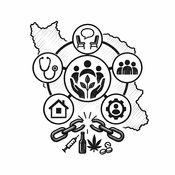

People with a substance use disorder usually cannot achieve recovery through only one type of assistance. In addition to pharmacotherapy, long-term recovery depends on psychological and social support that continues over time rather than being limited to a brief period (1, 2). Iran's assistance system in this area was not designed with this need in mind. Two parallel institutions, each with its own achievements but never fully integrated into a single system, form the basis of this structure: the Ministry of Health and Medical Education (MOHME) and the State Welfare Organization (SWO). Analyses of the system have described it as a "chaotic response or a synergistic diversity" (3). After approximately 15 years of operation, both descriptions may still apply, depending on the specific sector of the system used by the patient.
The system has important achievements that should be acknowledged. Over the past 20 years, MOHME has expanded outpatient care for patients with opioid use disorder at a pace that is unusual in the region. Opioid agonist maintenance therapy with methadone and buprenorphine is now widely available through specialized clinics in Iran. Distance and cost, two major barriers to treatment, have become less significant. Compared with neighboring countries, Iran has developed an extensive network of medication-assisted treatment in the Middle East. The history of this system demonstrates substantial institutional development in addiction treatment rather than neglect of the issue (3). This achievement should be recognized before considering the system's remaining limitations.
However, reach does not necessarily equal depth, and this is where limitations become apparent. MOHME's model is based on a medical approach involving physician licensing, dosage protocols, electronic patient registries, and supervision by medical universities. Together, these elements form a highly standardized infrastructure, arguably one of the most standardized components of Iran's addiction treatment system. Nevertheless, the framework remains relatively narrow. A standard visit focuses primarily on medication, whereas counseling, when provided, is generally treated as a supplementary element of care. This approach does not fully align with the current international evidence base. Systematic reviews of psychosocial interventions provided alongside opioid agonist treatment indicate that the combination can improve treatment retention, even when effects on substance use itself are modest (4, 5). Retention, rather than abstinence alone, is particularly important for sustaining fragile recovery during the first year.
The SWO addresses another gap through a different model. Residential mid-term centers, recovery programs, and reintegration services are based on the principle that stabilization with medication is not equivalent to helping a person rebuild family life, social functioning, and income. The SWO also oversees much of Iran's harm-reduction infrastructure, including drop-in centers, shelters, and outreach programs for people who are not in treatment and are unlikely to enter it. These services are consistent with harm-reduction strategies recommended by international organizations to reduce the risks of infection and social isolation among people who use drugs (6). Life-skills training, family support, and vocational rehabilitation, which are elements of recovery that a purely medical clinic may overlook, are among the SWO's most valuable contributions to the overall system.
Policy analyses of Iran's treatment system repeatedly identify a similar pattern: services have expanded for public health, political, and institutional reasons (3, 7, 8), but insufficient attention has been given to mechanisms that allow different sectors to work from the same information (9, 10). A patient stabilized on methadone in a MOHME clinic and subsequently entering an SWO program may encounter different records, case files, and treatment approaches. This situation should not be interpreted as a complete absence of cooperation, because referral pathways and informal communication exist in many provinces, but rather as fragmentation and a lack of structural integration: a gap in mechanisms rather than intention (3, 7-9). Continuity of care, which is essential for maintaining treatment gains during the first year of everyday life, is precisely what is threatened by such fragmentation. A recent multisite study tracking patients across different Iranian treatment settings for 12 months showed divergent outcomes by treatment modality (11). A broader analysis of transitions between hospital and community addiction care reached a similar conclusion: patients are particularly vulnerable to being lost to follow-up during transitions between systems (12).
Various health systems illustrate how medical and psychosocial care can be integrated. For example, psychosocial support is a required component of the regulation of opioid substitution therapy in Germany (13). Case management, which provides a coordinated care plan and a single point of contact when patients move between services, is supported by evidence showing consistent positive effects on engagement and linkage to care, although findings regarding substance use outcomes vary (14). In the United Kingdom, shared-care approaches enable general practitioners, specialist drug and alcohol treatment teams, and mental health services to work according to a single care plan for the patient (15). Although none of these health systems is without limitations, they begin from an assumption that Iran currently lacks: medical and psychosocial care should function as one coherent service rather than as two adjacent systems that interact only when individual clinicians make contact.
Iran's position can therefore be stated clearly. In terms of access, the country has developed substantial treatment capacity and, in some respects, has been a regional leader (3, 7-10). In contrast, structural integration and continuity of care remain less developed (3, 7-10). The role of psychology within the system has never been clearly established. There are no requirements for minimum psychotherapy provision in MOHME clinics or SWO centers, no mandatory protocol for psychosocial assessment, and no standardized method for evaluating psychosocial outcomes. When psychotherapeutic support is available, it is often because individual clinicians choose to provide it rather than because it is structurally required. The presence of a clinical psychologist within the treatment team should be considered a basic component of an evidence-based integrated-care model rather than an optional addition (4, 5). Iran has trained psychologists who could contribute to this work; the remaining challenge is to incorporate them systematically into the treatment structure.
Another issue concerns what the two institutions are expected to measure. Supervisory processes in MOHME and SWO centers emphasize process measures, such as the number of registrations, completion of documentation, and compliance with operational policies. Outcome measures, including treatment adherence, relapse rates, employment, and family functioning, are assessed less consistently. Iranian health-services researchers examining the same system have similarly identified outcome measurement as a major policy gap (7-9). A system that gives greater attention to paperwork than to outcomes is likely to produce better documentation rather than better long-term recovery.
These observations do not imply that the existing system should be dismantled. Instead, they support deliberate integration. Three changes could produce much of the required alignment. First, MOHME and SWO should establish structured interaction through shared patient data, joint referral protocols, or joint case conferences so that a patient's history and treatment plan move with the patient rather than being recreated at each point of access. Second, a minimum mandatory care package should include psychosocial care delivered by licensed clinical psychologists, rather than treating such care as an optional service available only when time and resources permit. Third, outcome measures should be incorporated into current supervisory processes so that licensing and funding reflect recovery outcomes as well as administrative activity.
These changes do not require the creation of a new institution. Iran does not lack infrastructure; it lacks coordination among existing components of the system. MOHME's medical reach and the SWO's social mandate are not competing models of care but rather two components of a single model that developed over two decades without corresponding investment in coordination (3). Countries that have reduced similar gaps have not necessarily created entirely new systems; instead, they have incorporated integrated care into the responsibilities of existing services rather than leaving patients to navigate between them independently. Sequencing may matter more than scale: shared referral protocols and joint case conferences could first be introduced in a limited number of provinces during the current budget cycle, and broader standards could then be adopted after pilot implementation identifies practical points of friction.
The first and more difficult part of this reform has already been accomplished in Iran: treatment access has been delivered at scale across two different institutional cultures. The second, more focused task is to ensure that these two components operate according to the same coherent approach. Sustainable recovery requires not only medication but also social support, coordinated as part of a single service. Iran has the necessary components; what it needs is stronger coordination among them.