
1. Background
Elite athletes are subject to continuous performance evaluation, demanding training schedules, and intense competitive pressures. Although these conditions may foster athletic development, they can also affect athletes’ health, ethical decision-making, and well-being. Among sport-related risky behaviors, doping remains a major concern because it threatens athlete welfare, fair competition, and the integrity of organized sport (1).
Doping has important medical, ethical, and social consequences. The use of prohibited substances may harm athletes’ health and undermine fairness and integrity in organized sport. Although anti-doping organizations have strengthened surveillance and testing systems, doping persists in elite sport. Prevalence varies by sport type, assessment methods, and reporting conditions, with estimates ranging from approximately 10% to more than 20% (2). Therefore, doping is a multifactorial behavior associated with individual, social, cultural, and moral factors, rather than a simple personal choice (3).
Early explanations of doping behavior were largely based on biomedical and rational-choice perspectives, suggesting that athletes weigh the expected benefits of prohibited substances against their potential risks (2). However, these approaches cannot fully explain why some athletes consider doping despite awareness of its consequences. Accordingly, recent research has emphasized psychosocial and cognitive processes involved in ethical decision-making, including psychological mechanisms that may link individual characteristics to maladaptive behavior (4).
Social Cognitive Theory suggests that moral self-regulation can be weakened through cognitive processes known as moral disengagement, allowing individuals to justify behaviors that conflict with their moral standards.
In sport contexts, moral disengagement has been associated with unethical behaviors, including aggression, rule violations, and doping intention (5). Competitive pressures may foster cognitive justifications that make prohibited behaviors more acceptable. Social influences, including perceived norms, others’ expectations, and fear of failure, have also been associated with stronger doping intentions (6, 7).
Previous studies suggest that the sporting environment is associated with athletes’ attitudes toward prohibited performance-enhancing substances. In highly success-oriented contexts, performance-focused norms may be associated with greater acceptance of unethical behaviors and moral justifications that conflict with sporting regulations (3).
From an ethical perspective, doping violates fundamental values of organized sport, including fairness, honesty, respect, and integrity. Therefore, doping should be considered not only a regulatory violation but also a behavior associated with psychological, cognitive, and social factors, including moral self-regulation. Although anti-doping programs have expanded testing and prevention strategies, doping remains a challenge in elite sport, underscoring the need to understand psychological factors associated with doping intentions. Personality characteristics may help explain differences in athletes’ responses to competitive demands. Perfectionism is an important personality construct in sport psychology, characterized by high personal standards, self-evaluation, and concerns about mistakes or perceived imperfections (8). Contemporary research distinguishes between adaptive and maladaptive forms of perfectionism (9). Adaptive perfectionism is associated with achievement striving and personal development, whereas maladaptive perfectionism involves excessive self-criticism, fear of failure, and performance concerns (10). Recent evidence from an Iranian student population suggests that negative perfectionism may be associated with maladaptive cognitive patterns, with rumination indirectly related to these associations (11).
Research comparing athletes and non-athletes has identified psychological well-being, happiness, and life satisfaction as relevant dimensions of psychological functioning in athletic populations (12). Perfectionistic characteristics may also be related to unethical behavioral intentions through cognitive processes such as moral disengagement, which enables individuals to justify actions inconsistent with moral standards (9). Perfectionistic concerns have also been linked to psychological distress and tendencies toward moral disengagement (13).
Although research on perfectionism, moral disengagement, and doping has increased, the cognitive-moral processes underlying doping intention remain insufficiently understood. Therefore, the indirect association of moral disengagement between perfectionism and doping intention warrants further investigation. This gap is important because maladaptive perfectionistic tendencies may be linked to unethical behavioral intentions through cognitive processes related to moral justification. Moreover, less is known about these relationships among athletes in non-Western settings. Studying elite Iranian athletes may therefore provide further insight into the psychological pathways associated with doping intention.
From a theoretical perspective, the proposed model is based on Social Cognitive Theory, which highlights cognitive self-regulatory processes in ethical judgment and behavior. This perspective suggests that personality characteristics may be associated with behavioral intentions through cognitive processes related to moral evaluation. Perfectionistic concerns may be associated with greater psychological pressure and cognitive justifications that reduce moral self-sanctions. Therefore, moral disengagement may be an important cognitive factor in the relationship between perfectionism and doping intention (13).
2. Objectives
Despite the growing body of research on perfectionism, moral disengagement, and doping, limited evidence has examined these constructs simultaneously within a single theoretical model, particularly among elite athletes in non-Western settings (11). Therefore, the present study examined the indirect association between perfectionism and doping intention via moral disengagement among elite Iranian athletes. Specifically, it investigated whether perfectionism was associated with doping intention both directly and indirectly via moral disengagement.
Based on Social Cognitive Theory and the empirical literature, four hypotheses were formulated. Perfectionism was hypothesized to be positively associated with doping intention (H1) and moral disengagement (H2). Moral disengagement was hypothesized to be positively associated with doping intention (H3) and to represent an indirect pathway linking perfectionism to doping intention (H4).
H1: Perfectionism is positively associated with doping intention among elite Iranian athletes.
H2: Perfectionism is positively associated with moral disengagement among elite Iranian athletes.
H3: Moral disengagement is positively associated with doping intention among elite Iranian athletes.
H4: Moral disengagement is indirectly associated with the relationship between perfectionism and doping intention among elite Iranian athletes.
3. Materials and Methods
3.1. Study Design and Participants
This cross-sectional correlational study examined associations among perfectionism, moral disengagement, and doping intention in elite Iranian athletes. Elite athletes were defined as current or recent national team members, national championship medalists, or athletes who had won medals in recognized national or international competitions. Eligibility criteria included age ≥ 18 years and meeting the elite athlete criteria at the time of data collection. Athletes who were not actively engaged in competitive sport, did not meet the eligibility criteria, declined participation, or had more than 10% missing responses were excluded.
To ensure geographic diversity, four provinces representing different regions of Iran (Golestan, Kerman, Razavi Khorasan, and Hamadan) were selected. Because recruitment used convenience sampling, the sample reflects geographic diversity rather than national representativeness. The target population comprised 2,685 elite athletes. Demographic and sport-related information, including age, sex, competitive level, sport discipline, and training background, was collected. The sample size was determined based on the complexity of the proposed PLS-SEM model and its structural relationships. Three latent variables (perfectionism, moral disengagement, and doping intention) were specified as reflective constructs, with construct-level scores used as indicators rather than individual questionnaire items. Parameter stability was assessed using 5,000 bootstrap resamples. Data collection occurred from winter 2024 to summer 2025 (Iranian calendar years 1403 - 1404). Of 275 athletes approached, 14 questionnaires were excluded because of substantial missing data, leaving 251 completed questionnaires for analysis. No retained questionnaire required item-level imputation.
3.2. Measures
Data were collected using three standardized questionnaires.
Doping Intention Questionnaire. Developed by Beiranvand et al. (2020), this questionnaire consists of 72 items assessing individual, psychological, financial, legal, managerial, performance, social-cultural, structural, and media-related factors. Items are rated on a 5-point Likert scale. Total scores were calculated according to the developers' scoring procedure, with higher scores indicating stronger doping intention and susceptibility. The questionnaire demonstrated satisfactory content, face, and criterion validity, with a reported Cronbach alpha of 0.83.
Perfectionism Questionnaire. Perfectionism was assessed using the questionnaire developed by Mirkamali and Erfanizadeh in 2015. The instrument consists of 45 items across six dimensions, rated on a 5-point Likert scale. Total scores were calculated by summing item responses, with higher scores indicating greater perfectionistic tendencies. Although the questionnaire includes multiple dimensions, the overall construct score was used in the structural model in accordance with the study framework. Content validity was confirmed by experts in the field, and internal consistency was reported with a Cronbach alpha of 0.79.
Moral Disengagement Questionnaire. Moral disengagement was measured using the standardized questionnaire developed by Rubio-Garay et al. (14). The instrument consists of 29 items assessing three dimensions (dehumanization, diffusion of responsibility, and rationalization) based on Bandura's framework. It assesses cognitive justifications of unethical actions relevant to moral processes related to doping in sport. Responses were rated on a Likert scale, with higher scores indicating greater moral disengagement. The overall construct score was used in the structural model. The questionnaire demonstrated acceptable reliability, with Cronbach alpha coefficients exceeding 0.74 (14).
All instruments were administered in their validated Persian versions. Before data collection, experts in sport psychology and behavioral sciences reviewed the Persian versions for linguistic clarity, cultural appropriateness, and conceptual equivalence. A pilot assessment identified ambiguities in item interpretation and administration. Participants completed the questionnaires anonymously, and missing responses were handled according to predefined criteria. Questionnaires with substantial missing data were excluded, whereas minor missing values were managed according to the instrument scoring instructions. To minimize common-method bias and social desirability, anonymity and confidentiality were emphasized, and participants were informed that their responses would not be disclosed to coaches, teams, or sport organizations. Questionnaires were completed individually, without coaches or team officials present. Given the sensitivity of doping-related attitudes, participants were encouraged to respond honestly. No separate social desirability scale was administered; therefore, socially desirable responding remains a potential limitation.
3.3. Statistical Analysis
Descriptive statistics (means, standard deviations, frequencies, and percentages) were calculated for participant characteristics and study variables. Normality was assessed using skewness and kurtosis to justify Pearson correlation analysis; PLS-SEM used nonparametric bootstrapping and does not require multivariate normality.
Construct validity was assessed using PLS-SEM in SmartPLS. The measurement model was evaluated using indicator loadings, Cronbach alpha, composite reliability (CR), rhoA, average variance extracted (AVE), the Fornell-Larcker criterion, and the heterotrait-monotrait ratio (HTMT). Because all variables were self-reported, Harman's single-factor test was used as a preliminary assessment of common-method bias. Although no single factor explained most of the variance, this test cannot completely exclude common-method variance. Bootstrap confidence intervals were calculated for HTMT estimates. Indicators with low loadings were considered for deletion based on theoretical relevance and statistical performance. The hypotheses and cross-sectional indirect associations were examined using PLS-SEM. Given the cross-sectional design, mediation was interpreted as an indirect statistical association rather than evidence of temporal or causal mechanisms. All three constructs were specified as reflective latent variables, with construct-level scores entered into the structural model.
Bootstrapping with 5,000 resamples was used to estimate the significance and confidence intervals of direct, indirect, and total effects. Two-tailed tests were conducted at P < 0.05. Indirect associations were evaluated using bootstrapped estimates and confidence intervals. Partial mediation was considered when both direct and indirect associations remained significant after including the mediator. Given the cross-sectional design, this pattern was interpreted as an indirect statistical association rather than evidence of causal mediation. The PLS algorithm used the path weighting scheme, with a maximum of 300 iterations and a stop criterion of 10-7. Because questionnaires with > 10% missing responses were excluded and no retained questionnaire required item-level imputation, missing-data replacement was not applied. The sign-change option followed the SmartPLS default configuration. Analyses were performed using SPSS version 20 and SmartPLS.
3.4. Ethical Considerations
The study protocol was approved by the Research Ethics Committee of Islamic Azad University, Babol Branch (Approval No. IR.IAU.BABOL.REC.1404.050) and followed the Declaration of Helsinki. Written informed consent was obtained from all participants before data collection.
4. Results
4.1. Participant Characteristics
Of the 251 participants, 148 (59.0%) were male and 103 (41.0%) were female. Participants were recruited from four provinces (Razavi Khorasan, n = 80; Hamadan, n = 65; Golestan, n = 60; Kerman, n = 46). The age distribution is presented in Table 1. The sample was not nationally representative. Skewness and kurtosis indicated acceptable distributional characteristics. Pearson correlations were calculated to examine preliminary associations, whereas PLS-SEM used nonparametric bootstrapping and did not require multivariate normality.
Table 1.
Demographic Characteristics of the Participants
| Variables | No. (%) |
|---|---|
| Gender | |
| Male | 148 (59.0) |
| Female | 103 (41.0) |
| Age (y) | |
| < 20 | 38 (15.1) |
| 20 - 25 | 75 (29.9) |
| 26 - 30 | 87 (34.6) |
| 31 - 35 | 23 (9.2) |
| > 35 | 28 (11.2) |
4.2. Correlations
Pearson correlation coefficients indicated significant positive associations among all study variables (P < 0.01; Table 2). Participants were drawn from four provinces and represented diverse sporting backgrounds. Because the primary aim was to examine associations among the study constructs, subgroup comparisons were considered exploratory.
Table 2.
Pearson Correlation Matrix of the Study Variables a
| Variables | Perfectionism | Moral Disengagement | Doping Intention |
|---|---|---|---|
| Perfectionism | 1.00 | 0.71 | 0.67 |
| Moral Disengagement | 0.71 | 1.00 | 0.69 |
| Doping Intention | 0.67 | 0.69 | 1.00 |
a P < 0.01 for all correlations.
4.3. Measurement Model
The measurement model was evaluated for convergent validity and internal consistency using indicator loadings, Cronbach alpha, CR, rhoA, and AVE. Perfectionism, moral disengagement, and doping intention were treated as reflective latent variables at the construct level. All retained indicators showed acceptable loadings. Detailed loadings, cross-loadings, and additional measurement model statistics are provided in the Supplementary materials (Table 2).
As shown in Table 3, all constructs demonstrated acceptable internal consistency, with Cronbach alpha, rhoA, and composite reliability values above 0.70. All AVE values exceeded 0.50, indicating adequate convergent validity.
Table 3.
Convergent Validity and Reliability Indices of the Study Constructs
| Construct | √AVE | Cronbach alpha | rhoA | Composite Reliability (CR) | AVE |
|---|---|---|---|---|---|
| Perfectionism | 0.79 | 0.79 | 0.81 | 0.84 | 0.62 |
| Doping Intention | 0.76 | 0.83 | 0.76 | 0.87 | 0.60 |
| Moral Disengagement | 0.76 | 0.74 | 0.85 | 0.82 | 0.58 |
As shown in Table 4, diagonal values exceeded interconstruct correlations, supporting discriminant validity.
Table 4.
Discriminant Validity Assessment Based on the Fornell-Larcker Criterion
| Constructs | 1 | 2 | 3 |
|---|---|---|---|
| Perfectionism | 0.79 | ||
| Moral Disengagement | 0.72 | 0.78 | |
| Doping Intention | 0.70 | 0.69 | 0.76 |
All HTMT values were below 0.85, indicating satisfactory discriminant validity (Table 5).
Table 5.
Discriminant Validity Assessment Based on HTMT Criterion
| Constructs | Perfectionism | Moral Disengagement | Doping Intention |
|---|---|---|---|
| Perfectionism | — | 0.72 | 0.68 |
| Moral Disengagement | 0.72 | — | 0.74 |
| Doping Intention | 0.68 | 0.74 | — |
4.4. Structural Model and Hypothesis Testing
All three hypothesized direct paths were statistically significant (Table 6). Perfectionism was positively associated with doping intention (H1: β = 0.28, t = 3.69, P < 0.001) and moral disengagement (H2: β = 0.59, t = 6.81, P < 0.001). Moral disengagement was also positively associated with doping intention (H3: β = 0.70, t = 6.93, P < 0.001), supporting H1 - H3. The indirect association specified in H4 is presented separately in the mediation analysis.
Table 6.
Standardized Path Coefficients and Hypothesis Testing Results
| Hypothesis | β | t | P | Result |
|---|---|---|---|---|
| Perfectionism → Doping Intention | 0.28 | 3.69 | < 0.001 | Supported |
| Perfectionism → Moral Disengagement | 0.59 | 6.81 | < 0.001 | Supported |
| Moral Disengagement → Doping Intention | 0.70 | 6.93 | < 0.001 | Supported |
All VIF values were below 5, indicating no multicollinearity among predictors (Table 7). The model explained 56% of the variance in doping intention (R2 = 0.56), indicating moderate explanatory power. Standardized path coefficients and bootstrap t values are presented in Figure 1 and 2.
Table 7.
Assessment of Multicollinearity Using the Variance Inflation Factor (VIF)
| Structural Path | VIF | Interpretation |
|---|---|---|
| Perfectionism → Doping Intention | 2.620 | Acceptable (< 5) |
| Moral Disengagement → Doping Intention | 2.550 | Acceptable (< 5) |
| Perfectionism → Moral Disengagement | 1.000 | Acceptable (< 5) |
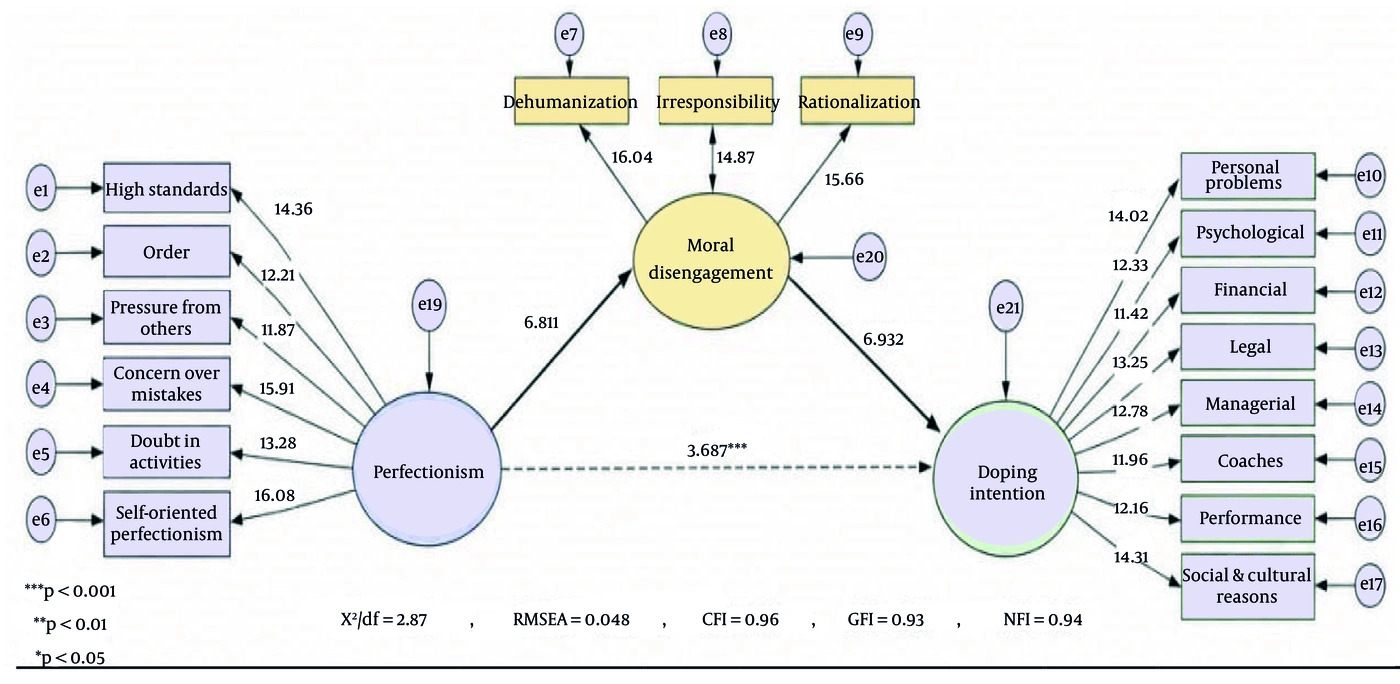
Figure 1.
Standardized Path Coefficients of the Proposed Structural Model
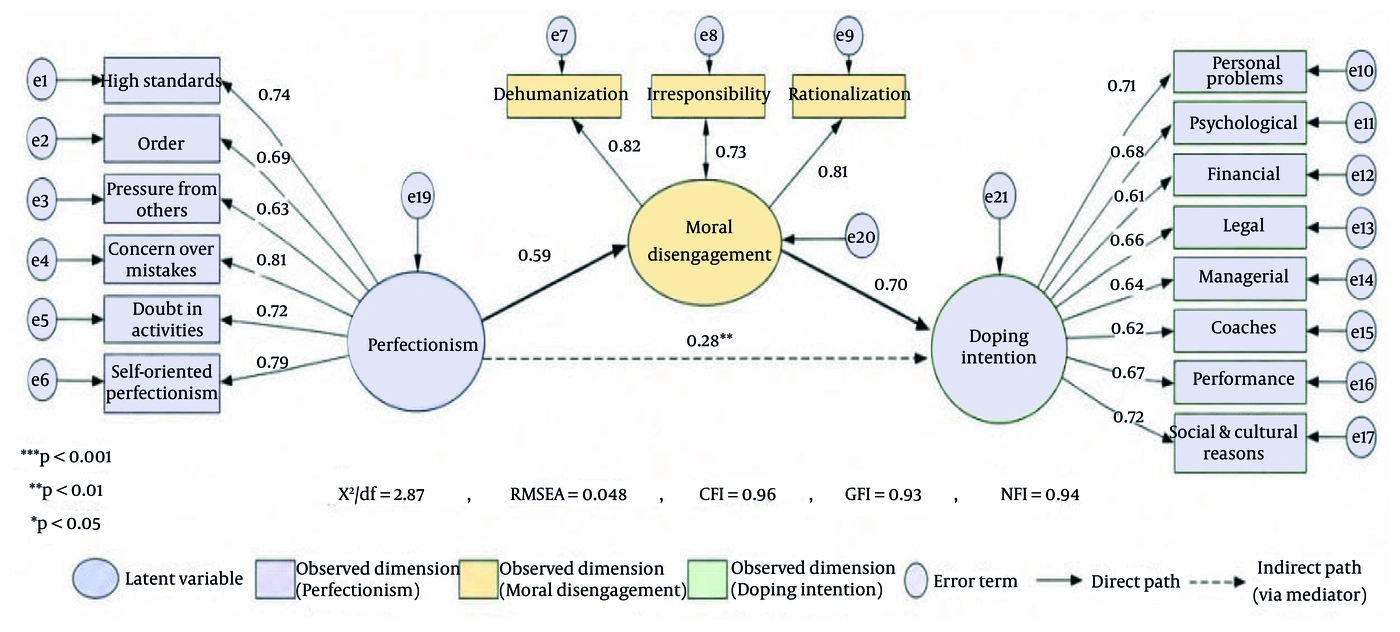
Figure 2.
Bootstrapped t Values of the Structural Model Paths
4.5. Mediation and Predictive Relevance
Mediation analysis indicated a significant indirect association between perfectionism and doping intention via moral disengagement (β = 0.41, 95% bootstrap CI = 0.26 - 0.56, P < 0.001). The direct association remained significant after accounting for moral disengagement (β = 0.28, 95% bootstrap CI = 0.13 - 0.43, P < 0.001), and the total effect was also significant (β = 0.69, 95% bootstrap CI = 0.51 - 0.78, P < 0.001). These findings support H4 and indicate a pattern consistent with partial mediation (Table 8).
Table 8.
Direct, Indirect, and Total Effects of the Structural Model
| Path | Effect | β | 95% Bootstrap CI | P-Value | Interpretation |
|---|---|---|---|---|---|
| Perfectionism → Doping Intention | Direct effect | 0.28 | 0.13 - 0.43 | < 0.001 | Significant |
| Perfectionism → Moral Disengagement → Doping Intention | Indirect effect | 0.41 | 0.26 - 0.56 | < 0.001 | Significant |
| Perfectionism → Doping Intention | Total effect | 0.69 | 0.51 - 0.78 | < 0.001 | Significant |
As presented in Table 9, the structural model explained 56% of the variance in doping intention (R2 = 0.56). The effect size (f2 = 0.24) indicated a moderate effect, while Q2 = 0.41 indicated predictive relevance for the endogenous construct. These indices describe the model's explanatory and predictive characteristics and should not be interpreted as evidence of external or out-of-sample predictive performance.
Table 9.
Explanatory Power and Predictive Relevance of the Structural Model
| Index | Value | Interpretation |
|---|---|---|
| Coefficient of Determination (R2) | 0.56 | Percentage of variance explained in doping intention |
| Effect Size (f2) | 0.24 | Medium effect size |
| Predictive Relevance (Q2) | 0.41 | Indicates adequate in-sample predictive relevance |
5. Discussion
This study examined the indirect association between perfectionism and doping intention through moral disengagement among elite athletes. The findings suggest that moral disengagement may represent a cognitive-moral process linking perfectionistic tendencies with doping intention. These findings are consistent with Social Cognitive Theory, which posits that unethical behavior may reflect interactions between individual characteristics and cognitive processes involved in moral self-regulation (3, 6).
The positive association between perfectionism and doping intention is consistent with evidence that athletes with elevated perfectionistic concerns may experience greater psychological vulnerability in demanding competitive environments (13). Persistent pressure, fear of failure, and dissatisfaction with performance may be associated with greater consideration of unethical performance-enhancing strategies (15). These findings suggest that perfectionistic concerns may be associated with doping intention in high-pressure contexts.
An important contribution of this study is the identification of moral disengagement as a potential cognitive process associated with the relationship between perfectionism and doping intention. According to Bandura's framework, moral disengagement may weaken moral self-regulation and reduce self-criticism and guilt during unethical behavior. Previous studies have identified moral disengagement as a correlate of doping intention, cheating, and other unethical behaviors in sport (5, 16). The findings suggest that stronger perfectionistic tendencies may be associated with higher moral disengagement, which, in turn, is associated with greater doping intention.
The observed indirect association is consistent with Social Cognitive Theory, which proposes that moral self-regulation may weaken under psychological pressure or situational justification. Elite athletes often compete under high expectations and performance pressure, which may be associated with greater cognitive justification of ethically questionable behaviors. Previous research has shown that moral disengagement is associated with favorable attitudes toward doping and a greater intention to use prohibited substances (6). These findings support the view that doping intention involves interactions among personality characteristics, social influences, and cognitive-moral processes (3). Specifically, perfectionistic tendencies were associated with moral disengagement, which was associated with doping intention.
The findings also complement the Theory of Planned Behavior by suggesting that moral-cognitive processes may be considered alongside traditional determinants of behavioral intention, including attitudes, subjective norms, and perceived behavioral control (16, 17). Although Ajzen's Theory of Planned Behavior was proposed in 1991, it remains a foundational framework for explaining behavioral intentions and continues to be applied in contemporary research on health-related and ethically sensitive behaviors. The results are also consistent with evidence that maladaptive perfectionism is associated with adverse psychological outcomes, including anxiety, emotional exhaustion, and reduced psychological well-being among athletes (13).
Overall, the findings support a social cognitive perspective in which perfectionistic tendencies are indirectly associated with doping intention through moral disengagement. Doping intention appears to involve interactions among personality characteristics, environmental influences, and cognitive-moral regulatory processes (18).
These findings suggest that maladaptive perfectionism may be associated with psychological difficulties and ethically relevant behavioral intentions. Anti-doping initiatives may benefit from strengthening moral reasoning and addressing maladaptive perfectionistic beliefs and performance pressure. Psychological interventions targeting maladaptive perfectionism may reduce vulnerability to performance pressure and unethical decision-making; however, their effectiveness in reducing doping-related intentions requires confirmation through longitudinal and experimental research. Cognitive restructuring, self-compassion training, adaptive goal setting, and psychological skills development may be promising strategies for future investigation. Anti-doping education may address cognitive mechanisms related to moral disengagement to strengthen ethical awareness and decision-making. Coaches and sport organizations may promote motivational climates that emphasize learning, personal improvement, and long-term development rather than exclusive competitive success. Anti-doping strategies may also benefit from integrating educational and psychological approaches with existing regulatory and disciplinary measures.
5.1. Limitations
First, the cross-sectional design does not allow causal or temporal conclusions. Although the model was theoretically informed, reciprocal or reverse associations cannot be excluded because all constructs were assessed at one time point. Longitudinal and experimental studies are needed to clarify the direction and temporal sequence of these associations.
Second, the exclusive use of self-report measures may have introduced common-method variance and socially desirable responding, particularly because doping-related attitudes are sensitive. Although anonymity and confidentiality procedures were implemented, potential bias cannot be excluded. A separate social desirability measure was not administered and should be considered when interpreting the findings. Future studies should incorporate behavioral indicators, social desirability assessments, or multiple information sources to examine these associations.
Finally, because the study involved Iranian elite athletes, caution is required when generalizing the findings to other cultural and sporting contexts. Cross-cultural studies are needed to examine whether these associations remain consistent across sociocultural contexts. Although demographic and sport-related characteristics were described, the structural model did not include relevant contextual factors, including sport type, competitive pressure, anti-doping education, previous doping exposure, and injury history. Future studies should examine these variables as potential covariates and assess whether the associations differ across athlete subgroups.