1. Background
According to reports of USA health statics center in 2009, suicide was the third leading cause of death for those ages 10 to 19 years in the USA (1). Also, the findings of a study conducted in Iran showed that adolescents are more at risk for suicidal attempts than non-adolescents (2). The rates of suicidal attempts and other self-harming behaviors in adolescents with a history of childhood maltreatment are higher than general population (3). While today we have more information about suicidal attempt than ever, information about suicide probability and its predictors in adolescents is scare. Suicide probability has been defined as a general tendency to kill oneself; it represents a novel measure for conceptualizing and assessing suicide risk. This construct is operationally defined by patients’ scores on subscales such as suicide ideation, negative self-evaluation, hostility-impulsivity and hopelessness (4).
Non-suicidal self-injury (NSSI) is defined as the direct, deliberate destruction of one’s own body without suicidal intent (5). Although suicidal attempts differ from NSSI, some studies show that NSSI can predict suicidal attempts over a six-month period (6). Previous findings have indicated that adolescents with NSSI and suicidal attempts, compared with NSSI alone, had higher scores in some of the suicide probability indices, such as impulsivity and suicide ideation (7, 8). Identifying specific factors that help to distinguish adolescents with NSSI alone, suicidal attempts alone, and combined forms of NSSI and suicidal attempts in terms of suicide probability, can help to develop better classifications for these two behaviors. So, one of the purposes of this study was to compare these groups in terms of suicide probability.
Although NSSI is associated with suicidal attempts, it seems this association is due to several underlying psychological risk factors. It has been identified that depression, a past history of suicidal attempts, low levels of social support, feelings of abandonment, and a history of sexual abuse are associated with suicidal attempts in adolescents (9). It would be useful to investigate other fundamental risk factors, such as emotional regulation difficulties and self-criticism, too. In other words, emotional regulation and self-criticism can be conceptualized as mechanisms or processes that link some known risk factors to suicidal attempts. Emotional regulation has been defined as people’s methods of attending, evaluating, and modifying their emotional states (10). In a theoretical model, Gratz and Roemer (11) classified emotional regulation difficulties into six categories: the non-acceptance of emotional responses, difficulty in goal-directed behavior, impulse control difficulties, a lack of emotional awareness, limited access to emotion-regulation strategies, and a lack of emotional clarity. Theoretically, based on the cry of pain model of suicide (12), we can hypothesize that emotional regulation difficulties may be associated with suicide probability. Furthermore, adolescents with high impulsivity have been more prone to suicidal attempts (13). Previous findings have shown that a perceived lack of access to emotional regulation strategies was associated with suicide ideation and attempts in undergraduate students (14), but the relationship between emotion regulation difficulties and suicide probability in adolescents with a history of childhood maltreatment has not previously been studied.
Some researchers believe that emotion regulation difficulties play a common role in different kinds of children’s and adults’s psychopathologies (15). With this in mind, there are likely other risk factors beyond emotional dysregulation that increase the risk of suicide probability. One of these risk factors is the way people relate to their own selves. Self-criticism has been identified as a mediating risk factor that associated with suicidal attempts (16). In a novel formulation, self-criticism is defined as a feeling about the self. It can be classified as two forms: the inadequate self and the hated self (17). Previous studies have indicated these kinds of self-criticism are associated with suicidal attempts and NSSI (18). Experiencing trauma in childhood may disrupt the development of a healthy self and lead to pathological self processes like self-criticism; these processes could increase the risk of suicide. We hypothesized that different kinds of self-criticism could predict suicide probability after controlling for other risk factors, such as frequency of NSSI and difficulties in emotional regulation.
2. Objectives
The aims of this research were to compare suicide probability in adolescents with NSSI only, suicidal attempts and NSSI, and suicidal attempts only and to identify predictors of suicide probability based on NSSI, difficulties in emotion regulation, and forms of self-criticism.
3. Patients and Methods
We used a correlation and cross sectional design in this study. The sample consisted of 169 adolescents with a history of childhood maltreatment. They lived in Iranian social welfare centers in Tehran, Karaj, and Shahr-e Rey. These adolescents were all between the ages of 12 and 18, and all can read and write. Having psychotic symptoms or cognitive deficits were exclusion criteria. According to Iranian social welfare centers’ rules, all adolescents are screened to assessed for cognitive deficits and other psychotic symptoms before entering these social welfare institutions. Study subjects were 116 females and 53 males with an overall mean age of 14.23 years. All participants who enrolled in the study completed informed consent paperwork. When the results of tests showed a high risk of suicidal attempts, we informed the psychiatrist or other staff members of centers to plan a preventive intervention.
3.1. Instruments
3.1.1. The Suicide Probability Scale
The suicide probability scale consists of 36 statements. Participants are asked to rate every question based on a 4-point Likert scoring system (ranging from “none or a little of the time” to “most or all of the time”). These ratings are then weighted selectively by item and summed to achieve a total weighted score and four subscale scores (4). Scale developers have reported an excellent internal consistency for the total scale, with an alpha coefficient of 0.93, and internal consistency ranging from fair to good for the remaining scales (4). This scale was administered to Iranian adolescents, and the findings showed that scores on this scale can discriminate suicidal adolescents from non-suicidal ones (19). In this study on adolescents with a history of childhood maltreatment, the alpha coefficient was obtained at 0.83 for the total scale.
3.1.2. The Difficulties in Emotion Regulation Scale
This scale examines six dimensions of emotion regulation skills. Respondents should indicate how often each item applies to them using a 5-point Likert scale ranging from 1 (almost never) to 5 (almost always). Previous studies have confirmed the factor structure and internal consistency of this scale in both foreign samples and among Iranian undergraduate students (11, 20).
3.1.3. The Forms of Self-Criticizing/Attacking and Self-Reassurance Scale
This scale consists of three subscales; we used two of them in this study: the inadequate self and the hated self. The scale starts with a general question, “When things go wrong for me…” and respondents rate 14 questions on a 5-point scale (ranging from “0,” not at all like me, to “4,” extremely like me). The factor structure of this scale in studies of university students has been confirmed, and the internal consistency of the scale was rated 0.88 for total sale (21). In our sample, factor analyses have confirmed the existence of two factors that explained 51% of participants’ scores on the scale (KMO = 0.909, χ2 = 1.10, P < 0.001).
3.1.4. The Non-Suicidal Self-Injury Checklist
This checklist was used to assess the presence and frequency of NSSI in the past year. The checklist includes behaviors such as self-cutting, burning, hitting, head banging, rubbing, and picking at wounds (22) Participants are asked to indicate which one of these behaviors they have ever engaged in. Two additional questions were asked about the respondents’ history of suicidal attempts and other self-harming behaviors not mentioned in the checklist. Questions were scored using a yes/no format. Participants were then classified as being a member of a group with NSSI, suicidal attempts, or both. A final question was asked to find the lifetime frequency of the NSSI.
4. Results
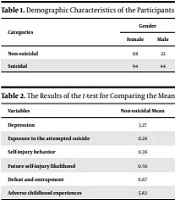
Among the 169 participants of this study, 116 (69%) were female and 53 (31%) were male. Descriptive results about NSSI methods and suicidal attempt in girls and boys are depicted in Table 1. There were 41 (24.4%) of participants between the ages of 12 and 14, 71 (42.3%) were between the ages of 15 and 17, and 55 (32.7%) were between the ages of 17 and 18. The majority of the sample were secondary school students (n = 77 (46.2%)), and 56 (33.3%) were in high school grade 10, 33 (18.6%) were in grade 11, and 3 (1.5%) had their high school diploma. Participants lived in social welfare centers because of bad parenting and abuse, and we did not collect data on the family status of participants.
Table 1.
Frequency of NSSI Methods and Suicidal Attempts by Gender
| Femalea | Malea | Contingency Coefficient | P Value | |
|---|---|---|---|---|
| Cutting | 49 (59) | 33 (40) | 5.64 | 0.017 |
| Burning | 21 (63) | 12 (36) | 0.058 | 0.45 |
| Hitting | 43 (65) | 23 (34) | 0.083 | 0.56 |
| Head banging | 38 (64) | 21 (35) | 0.074 | 0.338 |
| Rubbing | 23 (60) | 15 (40) | 0.099 | 0.196 |
| Picking wounds | 39 (70) | 16 (30) | 0.128 | 0.426 |
| Suicidal attempt | 46 (67) | 22 (33) | 0.025 | 0.746 |
aValues are expressed as No. (%).
The most common method used for NSSI was self-cutting (χ2 = 6.11, P < 00.1). The rate of self-cutting was significantly higher in girls than in boys (P = 0.017). The frequency of NSSI among participants include: 22 (13%) one time, 12 (7%) 2 - 4 times, 15 (9%) 4 - 6 times, 6 (4%) had engaged in NSSI more than 10 times, and 18 (11%) do it often (more than 20 times).
Mean and standard deviation of groups with NSSI and suicidal attempt in suicide probability subscales are represented in Table 2. Among all participants, 69 (41.1%) had a history of NSSI only, 48 (28.6%) had a history of only suicidal attempts, while 52 (30.4%) adolescents had a history of both suicidal attempts and NSSI. The frequency of suicidal attempts in the group with only suicidal attempts was one time, though there were two adolescents in this group who had attempted suicide 4 and 5 times. The frequency of suicidal attempts in the mixed group was between 1 and 5 times. The frequency of suicidal attempts in mixed group was higher than in the only suicidal attempt group.
| Group 1 | Group 2 | Group 3 | |
|---|---|---|---|
| Hopelessness | 24.7 (5.4) | 24.9 (3.8) | 25.9 (5.7) |
| Hostility/impulsivity | 20.1 (6.9) | 20.5 (5.1) | 19.6 (5.4) |
| Suicide ideation | 18.07 (7.08) | 21.4 (5.6) | 22.3 (6.7) |
| Negative self-evaluation | 22.4 (7.7) | 21.2 (5.7) | 19.8 (4.8) |
aDescriptions: Group 1, NSSI only; group 2, NSSI + suicidal attempt; group 3, suicidal attempt.
bValues are expressed as mean (%).
There was a significant difference between groups with NSSI, suicidal attempts, and the mixed group in terms of self-criticism (F = 14.62, df = 2,164; P < 0.001). The mean score of the mixed group (M = 22.35, SD = 12.20) was more than the group with only NSSI (M = 12.15, SD = 8.75) and group with only suicidal attempts (M = 19.96, SD = 11.95).
A comparison between groups with NSSI, suicidal attempts, and both in suicide probability subscales with MANOVA (multivariate analysis of variance) showed a significant difference between groups (Wilkis lambda = 0.828, F = 2.27, P = 0.024). Analyses of variance showed a significant difference between the three groups on the suicide ideation subscale (F = 3.46, P = 0.035). However, the group with suicidal attempts had the highest mean in suicide ideation, though the results of the post-hoc test (Dunnet test) showed that suicide ideation in the group with both behaviors (NSSI and suicidal attempts) was significantly higher than in the group with NSSI only (P < 0.05).
The emotion regulation difficulties subscale includes a lack of emotional clarity, difficulty engaging in goal-directed behaviors, impulse control difficulties, and limited access to emotional regulation strategies; these were associated with suicide probability. The zero-order correlation is shown in Table 3.
Table 3.
Zero-Order Correlation Between Difficulties in Emotion Regulation Subscales and Suicide Probability
| Variable | 1 | 2 | 3 | 4 | 5 | 6 | 7 |
|---|---|---|---|---|---|---|---|
| 1- SP | - | ||||||
| 2- Awarness | −0.093 | - | |||||
| 3- Clarity | 0.383 | −0.003 | - | ||||
| 4- Nonaccept | 0.364 | −0.177 | −0.333 | - | |||
| 5- Impulse | 0.448 | 0.365 | 0.365 | 0.537 | - | ||
| 6- Goals | 0.420 | −0.021 | −0.152 | 0.667 | 0.72 | - | |
| 7- Strategies | 0.519 | −0.076 | 0.389 | 0.640 | 0.69 | 0.6 | - |
Abbreviation: SP, suicide probability.
A multiple regression analysis showed that the inadequate self, hated self, impulse control problems, and frequency of NSSI predicted suicide probability. This model can explain 50% of the variances of suicide probability. As presented in Table 4, the inadequate self, the hated self, impulse control problems, and frequency of NSSI, respectively, explained 40%, 5%, 3%, and 2% of the variances of suicide probability. Results of the ANOVA showed this model was statistically significant (F = 40.49, P < 0.001).
Table 4.
Predictors of Suicide Probability by Emotion Regulation Difficulties, Forms of Self-Criticism and NSSI Frequency
| Variable | R | R2 | B | Beta | t | Sig |
|---|---|---|---|---|---|---|
| Inadequate self | 0.63 | 0.407 | 0.580 | 0.249 | 2.62 | 0.009 |
| Hated self | 0.67 | 0.454 | 1.50 | 0.337 | 3.72 | 0.001 |
| Impulse control | 0.698 | 0.488 | 0.549 | 0.169 | 2.68 | 0.008 |
| NSSI | 0.708 | 0.501 | 1.36 | 0.133 | 2.11 | 0.036 |
5. Discussion
The findings of this study show that suicide ideation in adolescents with a history of NSSI and suicidal attempts are significantly more common than in adolescents with NSSI alone. This finding is consistent with prior studies that compare suicidal attempt indicators in adolescents (6, 23). Unlike our results, which showed there was no significant difference between groups in terms of hostility-impulsivity and hopelessness, another research on adolescents from a psychiatric inpatient unit in the United States revealed that adolescents with NSSI and suicidal attempt were more hopeless and have higher scores in impulsivity (24). This can be attributed to the setting of the studies and different scales used for assessing suicide probability indices. With this in mind, it can be concluded that the most reliable indicator of suicide probability is the experience of suicidal ideation. The findings of studies in adults in inpatient settings have revealed that suicidal thoughts remain relatively stable even after patients are released from the hospital (25), so clinicians who work with adolescents who have a history of suicidal attempts should consider the risk of suicide and apply preventive programs to educate these adolescents in ways of coping with suicide ideation. It should be noted that, based on the results of the present study, adolescents with a history of suicidal attempts had the highest score in all of the suicidal probability subscales, but this difference was not significant. Suicide probability of adolescents with suicidal attempts and NSSI was greater than in the NSSI-only group, but the suicide probability of adolescents with both suicidal attempts and NSSI was less than in the group with past suicidal attempts only. These findings are consistent with previous studies (26) that have indicated that adolescents with past suicidal attempts are more prone to subsequent suicide behaviors. Additionally, as people’s experience with death cues, such as blood or the pain of self-injury increase, they become more prone to suicide risk (27).
A regression model indicated that an inadequate self, hated self, difficulty in impulse control and frequency of NSSI predicts a 50% variance of suicide probability. Our results were consistent with a previous finding (16) that confirmed the role of self-criticism as a main risk factor for engaging in suicide behaviors (16). Some forms of self-criticism, such as the inadequate self have greater association with suicide probability. According to the evolutionary model of self-criticism (18), self-criticism triggers threat and defensive emotions and behaviors, which lead to negative emotions that are difficult to regulate; thus, different kinds of psychopathology, like suicide behaviors, occur.
Although a zero-order correlation has revealed a significant association between difficulties in emotion regulation skills and suicide probability (except the difficulty in awareness subscale), in the regression model, only impulse control problems remained a significant predictor of suicide probability. This finding especially supports prior findings that showed impulsive adolescents are more inclined to suicidal attempts without prior planning (28). Our results did not confirm previous findings about the relationship between difficulties in emotion regulation skills and suicide ideation and behaviors (14). According to a previous study (14) of the emotion regulation subscale, only the perceived inability to access emotion regulation strategies predicted suicide ideation. It should be noted that we used a global index of suicide probability that consisted of ideation and inclination to suicidal attempts, rather than merely suicide ideation. So, it could be concluded that adolescents who have difficulty in controlling their impulses were more prone to suicide ideation and attempts.
Another predictor of suicide probability in the present study was the frequency of NSSI. This finding support previous studies, which have reported a significant association between NSSI and the tendency to suicide ideation and behaviors (6). However, it does not mean that every kind of NSSI leads to an increase in suicide probability. There have been different kinds of adolescents who engage in NSSI. Many of them engage NSSI just a few times, but a minority of adolescents who frequently use NSSI exclusively as a coping mechanism against any kind of life distress were more prone to act on their suicide ideations (28). Additionally, the association between NSSI and suicide probability can be explained based on Joiner’s interpersonal theory of suicide (26). According to this theory, burdensome feelings and a loss of social belonging leads to suicide ideation, but the most determining factor for acting on suicide ideation is the beginning of harming oneself and decreasing fear of suicide. The persons who habituate to different kinds of self-harm are more capable of acting on suicide ideations. It can be concluded that increasing frequency of NSSI leads to suicide probability by acquiring the ability to engage fearlessly in lethal self-harm.
In sum, the present study indicates that adolescents with a history of NSSI and suicidal attempts, compared to a NSSI-only group, were more prone to subsequent suicidal attempts, because they have more suicide ideations, even after passing several years without engaging in a suicidal attempt. Additionally, our findings revealed that self-criticism, impulse control difficulties, and the frequency of NSSI can predict suicide probability in adolescents with a history of childhood maltreatment. It should be noted that this study had a number of limitations. First, the design of this study was cross-sectional, and only self-report instruments were used for assessing our variables. Second, these findings were based exclusively on adolescents who had a history of childhood maltreatment, so they cannot be generalized to other adolescents in normal population or inpatient setting. Future studies should consider the role of these predictors of suicide probability while controlling for other known risk factors for suicidal attempts.
Adolescents with a history of childhood maltreatment, even after acute phases of suicide and hospitalization, are more prone to subsequent suicidal thoughts or behaviors. The risk of subsequent suicidal attempts is higher in adolescents with suicidal attempts and NSSI than in adolescents with NSSI only. Negative feelings about the self, like feelings of inadequacy or self-hatred, were a very important risk factor that can predict a great deal of variance in suicide probability. This study also showed that, among six dimensions of difficulties in emotion regulation skills (11), impulse control problems were a significant and stable predictor of suicidal attempts. So, psychological interventions should address impulse control problems in programs designed to prevent suicidal attempts. Adolescents who used NSSI frequently also are more prone to suicidal attempts. This association may be caused by their habituation to self-harming, which increases the risk of lethal self-harm. Indeed, according to the results of this study, it could be concluded that accepting one’s self, instead of criticizing the self and overcoming impulse control problems, can decrease rates of suicide probability in adolescents with a history of childhood maltreatment.