
1. Background
According to the report of the World Health Organization (WHO) in 2014, suicide is a serious threat to public health in the world, and the major share of the burden is allocated to low and middle-income countries (1). The death rate due to suicide in 2012 in the world was 11.4 per 100,000 people (15 in men and 8 in women) (1) and in Iran according to a meta-analysis conducted in 2015, The rate of suicide in the country estimated at 8 per hundred thousand people; This rate is estimated to be 11.11 in men and 7.4 in women (2). Also, the prevalence of lifetime of ideation and suicide attempts worldwide is 9.2% and 2.7%, respectively (3). The incidence of suicide attempts is higher in people between the ages of 18 and 34 (3). Behavior suicide and suicide attempts can lead to negative consequences such as injury, hospitalization, and loss of freedom, as well as impose huge financial costs on society (1, 3). The criteria also explicitly define “suicide attempt” as “a self-initiated sequence of behaviors by an individual who, at the time of initiation, expected that the set of actions would lead to his or her death” (4). This definition emphasizes the importance of intent when defining suicidal behavior while also recognizing the dilemma that individuals' ratings of suicidal intent do not always match the absolute or understood lethality of their methods of attempted suicide (5). The diagnosis of Suicide Behavior Disorder is also explicitly differentiated from another condition for further study, “Non-suicidal Self-Injury.” These criteria provide a helpful start for the investigation of such a disorder, but criteria could and should be refined with additional research into the construct (4). Although many risk factors have been mentioned so far for suicidal ideation, suicide attempts, and suicidal behavior, the role of psychological pain is more important (6). Psychological pain is unpleasant, continuing, and instability feeling that one does not see the ability to control and manage (7). Orbach et al. have described nine dimensions of psychological pain: (1) Lack of control, (2) irreversibility of pain, (3) emotional flooding, (4) estrangement, (5) freezing, (6) confusion, (7) narcissist wounds, (8) social distancing, and (9) emptiness (8). The severity of suicide attempts is related to these dimensions of psychological pain. So intense feelings of emptiness and cognitive confusion are among the most important risk factors for suicidal behaviors (9). Although the severity and lethality of suicide measures cannot be predicted based on psychological pain, it is possible to predict issues related to the seriousness of suicide about psychological pain with feelings of social isolation, communication problems with others, problems related to solving social problems, alexithymia, and personality traits (10). Temperament and character are other psychological variables affecting suicide attempts. According to Cloninger and Svrakic, the character reflects one’s emotions and learnings acquired through emotional and automatic behaviors, which turn into habits in one’s early life and remain almost stable throughout life (11, 12). Cloninger and Svrakic consider three dimensions of character, namely, self-directedness, cooperativeness, and self-transcendence (11-13). Previous studies have suggested other temperaments related to suicidal thoughts and actions, including low reward dependence, low persistence, low self-directedness, and low cooperativeness, besides high levels of self-transcendence and psychoticism (14, 15).
Childhood maltreatment is considered an underlying risk factor for mental harm and disorder (16). Early traumatic experiences of an individual in the family or relation to peers, especially those involving threat, shame, and bullying, may trigger negative emotions, which lead to threatening and defensive behaviors and may have harmful effects on the personal experiences of oneself or others (e.g., considering oneself to be inferior to others, believing that others have hostile behaviors, and considering oneself as worthless and unimportant) (17). These negative experiences can become conditioned emotional responses and negatively affect one’s self-identity (18). They also create a feeling of inferiority about others and disrupt emotional regulation (19-23).
Considering that suicidal thought, suicide attempts and suicide may not be continuous phenomena and can be influenced by biological, psychological, and social factors at different levels (24). Therefore, it's argued that psychological pain is a construct that unites all suicidal behaviors, even if the way psychological pain is explained varies across levels of suicidal behavior (10, 25). Studies on this issue are needed in the context of Iran and especially in the western provinces that have high suicide rates, considering the perception of early life experiences and personality traits, which are important factors for understanding the mental state of people committing suicide. Despite the extensive reported data and literature supporting the relationship between psychological pain and several dimensions of suicide, such as thoughts and ideation of suicide, motivation, preparation for suicide, and suicide attempt, no study that simultaneously separates the role of each of the variables was found. Considering the context and culture of Iran, this study can have additional insight into psychological influencing factors. However, it would be valuable to re-examine such relationships in Iranian culture. Considering the increasing suicide rates in different countries (26), including Iran (27), besides the social, economic, and psychological consequences of suicide attempts (28, 29), it is necessary to investigate the underlying factors for suicide attempts to prevent this global crisis.
2. Objectives
This study aimed to investigate early life experiences, temperament, character, and psychological pain in suicidal attempters and normal individuals.
3. Methods
In this cross-sectional study, the statistical population consisted of all individuals who had attempted suicide by drug poisoning and were referred to Imam Khomeini Hospital of Kermanshah (Kermanshah, Iran), as well as their companions. This study was conducted in 2017. The study sample included 60 women (49.6%) with an average age of 26.26 years and 61 (50.4%) men with an average age of 26.01 years, who were referred to the emergency department of the hospital due to suicide attempts. The participants were selected by purposeful sampling, according to the inclusion and exclusion criteria. The initial sample included 140 suicide attempters (suicide group) and 140 normal individuals (control group). However, after removing incomplete questionnaires (19 questionnaires from each group), the study sample included 121 suicide attempters in the suicide group and 121 normal individuals in the control group. A face-to-face interview was conducted using the structured clinical interview for DSM-5 (SCID-5) and the structured clinical interview for DSM-5 clinical version (SCID-5-PD), and checking the entry and exit criteria. Data were collected in structured clinical interviews with the suicide attempters; a psychiatrist and a clinical psychologist also took their family history. Entry criteria for people attempting suicide include attempting suicide between October and December of 2017, diagnosis of drug poisoning by an emergency physician at Imam Khomeini Hospital, attempting suicide for the first time using a self-report form, stable level of consciousness. At the time of answering the questionnaires, the minimum age is 18 and the maximum is 40 years, having education (at least the ninth grade), having the motivation to commit suicide based on self-report, having normal hearing and vision, and the exclusion criteria for people who had unknowing drug poisoning, self-harm without they were excluded from the study due to the intention to die or due to drug and alcohol overdose.
3.1. Data Collection Tools
3.1.1. Orbach & Mikulincer Mental Pain Scale (OMMP)
The Orbach and Mikulincer Mental Pain Scale (OMMP) has 44 items and was used to evaluate psychological pain (8). Participants rated each statement using a 5-point Likert scale (1 = strongly disagree, 2 = disagree, 3 = agree to some extent, 4 = agree, 5 = strongly agree) (30). In the study by Orbach et al., Cronbach's alpha coefficients were measured for the subscales of OMMP: Irreversibility, 0.95; loss of control, 0.95; narcissistic wounds, 0.93; emotional flooding, 0.93; freezing, 0.85; self-estrangement, 0.79; confusion, 0.80; social distancing, 0.80; and emptiness, 0.75 (30). Based on a study by Karami et al. the exploratory and confirmatory factor analysis identified six factors, which explained 66.40% of the variance in psychological pain. Cronbach’s alpha coefficient was 0.966 for the total OMMP, 0.925 for the subscale of emptiness, 0.893 for emotional flooding, 0.877 for loss of control, 0.872 for irreversibility, 0.869 for social distancing/self-estrangement, and 0.617 for freezing. In the present study, Cronbach’s alpha coefficient was 0.96 for the total scale (31).
3.1.2. Temperament and Character Inventory (TCI-125)
Cloninger, Przybeck, Svrakic, and Wetzel to assess personality traits developed this scale. The items on the scale have scored either one (“yes”) or zero (“no”). The validity and reliability of the inventory were found to be adequate. The factor structures of character and temperament dimensions are similar to the original factors (32). The test-retest reliability coefficients of Temperament and Character Inventory (TCI-125) (in 1-2 month intervals) ranged from 0.72 to 0.84 for the temperament dimensions and from 0.72 to 0.78 for the character dimensions (33). Kaviani in research with 1212 subjects in Tehran, Cronbach's alpha coefficient of this questionnaire was obtained in the range of -0.84 to 0.55. Of course, the only correlation higher than 0.40 between the triple dimensions of personality was related to self-directiveness and cooperation (34).
3.1.3. Early Life Experiences Scale (ELES)
This scale consists of 15 items and three subscales: (1) threat (six items); (2) submissiveness (six items); (3) unvalued (three reversed items). Participants rated each statement using a 5-point Likert scale (ranging from 1 = “completely untrue”, to 5 = “very true”). Initial reliability analysis of Early Life Experiences Scale (ELES) yielded an internal consistency coefficient of 0.92. Also, a subsequent reliability analysis of its three subscales indicated a Cronbach’s alpha coefficient of 0.89 for threat, 0.85 for submissiveness, and 0.71 for feeling (un)valued (18). In the present study, Cronbach’s alpha coefficient of the scale was 0.84. Subsequent reliability analysis of the three subscales indicated a Cronbach’s alpha coefficient of 0.86 for threat, 0.85 for submissiveness, and 0.82 for feeling (un)valued. In this study, the construct validity of the early life experiences questionnaire was found to have a favorable fit using confirmatory factor analysis in the three main factors (GFI ≤ 0.90, IFI ≤ 0.92, NFI ≤ 0.92, CFI ≤ 0.90, and P ≥ 0.05, RAMSE).
3.2. Procedures
Regarding ethical considerations, Kermanshah University of Medical Sciences (IR. approved this study KUMS.REC.1396.399), and the respondents’ names in the information form remained confidential. In addition, the participants were mentally prepared to answer the questions. The ethical principles observed in this research are the signing of the informed consent to participate in the research, ensuring the health and safety of the participants during and after the study, explaining the purpose of the research clearly and clearly informing about the extent of possible harm, and freedom of choice. The researchers were asked to withdraw from the study at every stage of the research and to comply with the criteria of anonymity, confidentiality, and privacy of information until the people do not have active thoughts, intentions, and plan to commit suicide, among the ethical criteria of this research.
The data were analyzed in IBM SPSS version 26. The normal distribution of variables was investigated using Kolmogorov-Smirnov test. Moreover, mean and standard deviation (SD) were measured to represent descriptive statistics, and to predict group membership, we used discriminant function analysis and logistic regression.
4. Results
Table 1 shows the level of education and gender and the average and standard deviation of age of participants in the two groups.
Table 1.
The Mean Age (and Standard Deviation) by Gender was Reported in the Two Groups
| Variables | Attempting Suicide (N = 121) | Normal (N = 121) | Test Values |
|---|---|---|---|
| Primary/secondary school | 63 (52.06) | 62 (51.23) | |
| Diploma | 34 (28.09) | 35 (28.92) | |
| Associate degree | 15 (12.39) | 17 (14.09) | |
| Bachelor’s degree | 9 (7.43) | 7 (5.78) | |
| Gender, No. (%) | |||
| Male | 61 (50.4) | 60 (49.6) | Chi-square = 1.339; df = 1; P > 0.247 |
| Female | 60 (49.6) | 58 (47.9) | |
| Age (y) (mean ± SD) | |||
| Male | 26.01 ± 3.15 | 24.16 ± 2.62 | t = 2.122; P > 0.036 |
| Female | 26.26 ± 3.34 | 25.54 ± 2.94 | t = 1.080; P > 0.282 |
According to the results presented in Table 1, chi-square test showed that there was no difference in gender between groups. In addition, the results of independent t-test showed that there was no difference between the age of men and women in the studied groups.
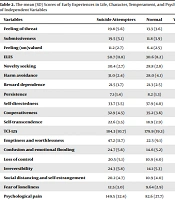
In Table 2, the mean and standard deviation of predictive variables for the two groups and the results of intergroup differences (using Wilks’ Lambda test) show that there is a significant difference between the predictive variables between the two groups
Table 2.
The mean (Standard Deviation) Scores of Early Experiences in Life, Character, Temperament, and Psychological Pain and a Summary of the Results of Discriminant Function Analysis of Independent Variables
| Variables | Suicide Attempters | Normal | Wilks’ Lambda Enter Method | Wilks’ Lambda Step Method | F |
|---|---|---|---|---|---|
| Feeling of threat | 19.8 (5.6) | 13.3 (3.6) | 0.60 | 153.9 | |
| Submissiveness | 19.5 (5.1) | 11.8 (3.9) | 0.58 | 170.8 | |
| Feeling (un)valued | 11.2 (2.7) | 6.4 (2.5) | 0.55 | 0.31 | 198.7 |
| ELES | 50.7 (11.8) | 30.6 (8.2) | 0.51 | 232.7 | |
| Novelty seeking | 30.4 (2.7) | 28.8 (2.8) | 0.92 | 19.0 | |
| Harm avoidance | 31.0 (2.4) | 28.0 (4.1) | 0.83 | 0.37 | 48.7 |
| Reward dependence | 21.5 (1.7) | 21.3 (2.5) | 0.99 | 0.63 | |
| Persistence | 7.1 (1.4) | 8.2 (1.3) | 0.88 | 0.34 | 31.2 |
| Self-directedness | 33.7 (3.5) | 37.9 (4.0) | 0.76 | 76.1 | |
| Cooperativeness | 32.9 (4.5) | 35.2 (3.6) | 0.93 | 0.30 | 18.0 |
| Self-transcendence | 22.6 (3.5) | 18.9 (2.9) | 0.75 | 0.29 | 79.8 |
| TCI-125 | 184.3 (10.7) | 179.9 (19.3) | 0.97 | 5.5 | |
| Emptiness and worthlessness | 47.2 (11.7) | 22.5 (9.1) | 0.42 | 0.42 | 331.4 |
| Confusion and emotional flooding | 24.7 (5.6) | 14.6 (5.2) | 0.54 | 240.1 | |
| Loss of control | 20.5 (5.1) | 10.9 (4.0) | 0.50 | 236.4 | |
| Irreversibility | 24.3 (5.8) | 14.1 (5.3) | 0.54 | 203.7 | |
| Social distancing and self-estrangement | 20.2 (4.7) | 10.9 (4.0) | 0.47 | 268.7 | |
| Fear of loneliness | 12.5 (3.0) | 9.64 (2.9) | 0.81 | 57.7 | |
| Psychological pain | 149.5 (32.4) | 82.6 (27.7) | 0.45 | 297.4 |
According to the results presented in Table 2, the mean differences between the two groups were significant regarding emptiness/worthlessness, psychological pain, and social isolation/self-estrangement, with Wilks’ lambda coefficients of 0.42, 0.45, and 0.47, respectively. The stepwise method, the total Wilks’ lambda and F estimate for the mentioned categories were 0.29 and 94.2, respectively. The canonical correlation coefficient of the six variables was equal to 0.84. The rate of accurate classification of suicide attempters was estimated at 91.7%, and the kappa coefficient was equal to 0.86. Therefore, these variables could accurately predict group membership.
In Table 3, the results of the Canonical correlation coefficient, kappa coefficient, and their significance level along with the discriminant function are presented enter and stepwise method for the strongest predictor. Then, using the logistic regression method, the strongest independent variables for separating normal and suicidal individuals were calculated using the Wald test and expected frequency.
Table 3.
Conventional Discriminant Analysis and the Important Results of Discriminant Function Analysis
| Important Results of Discriminant Function Analysis | Discriminant Function Analysis | Results of Logistic Regression Analysis | ||||
|---|---|---|---|---|---|---|
| Enter Method | Stepwise Method | Variables | B | Wald | Exp (B) | |
| Eigenvalue | 2.7 | 2.4 | Emptiness/worthlessness | 0.17 | 19.68 | 0.83 a |
| Canonical correlation analysis | 0.84 | 0.84 | ||||
| Eta-squared | 0.70 | 0.70 | Harm avoidance | 0.61 | 14.61 | 0.53 a |
| Wilks’ lambda | 0.28 | 0.29 | ||||
| Chi-square | 295.2 | 290.4 | Persistence | 1.23 | 15.12 | 3.42 a |
| Df | 17 | 6 | ||||
| P-value | < 0.001 | < 0.001 | Cooperativeness | 0.44 | 11.84 | 1.55 a |
| Functions at group centroids (suicide attempters) | 1.59 | 1.54 | ||||
| Functions at group centroids (normal individuals) | -1.59 | -1.54 | Self-transcendence | 0.25 | 3.70 | 0.77 b |
| Predicted group membership | 91.7 | 91.7 | ||||
| Kappa coefficient | 0.86 | 0.86 | Feeling (un)valued | 0.39 | 9.27 | 0.67 a |
| P-value | < 0.001 | < 0.001 | ||||
a P ≤ 0.001.
b P ≤ 0.05.
As shown in Table 3, based on the discriminant function analysis using both the enter method (with a combination of 4 components of early experiences of life, character, temperament, and psychological pain questionnaires) and the stepwise method (six subscales of the main variables included in the model), a high discriminant power was found in suicide attempters and normal individuals, accounting for variance in the dependent variable, with a small Wilks’ lambda coefficient and a large chi-square statistic (P < 0.001). According to this table, the eigenvalues of the discriminant function analysis were 2.7 (enter method) and 2.4 (stepwise method), respectively. In addition, the correlation coefficients in the conventional discriminant analysis were 0.84 (enter method) and 0.84 (stepwise method), respectively. The eta-squared statistics in the discriminant function analysis accounted for 70% of the variance in 4 variables using the enter method and 70% of the variance in six subscales independent variables using the stepwise method.
Based on the results presented in Table 3, the Wilks’ lambda coefficients in the discriminant function analysis were 0.28 and 0.29 using the enter and stepwise methods, respectively. In addition, the chi-square coefficients in the discriminant analysis were 295.2 and 290.4 using the enter and stepwise methods, respectively. The chi-square coefficients of the enter and stepwise methods were as follows: Wilks’ lambda (Λ) = 0.28, χ2 (df = 17, N = 121) = 295.2, P < 0.001 and Λ = 0.29, χ2 (df = 6, N = 121) = 290.4, P < 0.001, respectively. The row of the predicting group membership indicated that discriminant analyses using the enter (with 4 independent variables) and stepwise (with six independent variables) methods could correctly classify 91.7% and 91.7% of suicide attempts, respectively.
The results of logistic regression of 6 subscales based on the regression model can predict suicide attempts. The model was significantly stable (chi-square = 264.96, df = 6, P ≤ 0.001). In total, the variables of the model have made a correct prediction with a ratio of 93.4 percent of suicide attempts, 94.2 percent of non-suicide attempts, and a total of 93.8 percent.
The value of the logistic regression coefficient of the independent quantitative variable of emptiness/worthlessness (X2) which is 0.239 indicates that by controlling the X1 variable for a reduction score in emptiness/worthlessness, the ratio of the dependent variable odds is changed to e ratio of e 0.239, which according to the last column, this change is 0.866.
The value of the B coefficient of the independent variable of age (X1) indicates that by controlling the emptiness/worthlessness variable (X2), the ratio of the variable dependent on the ratio e is e 0.161, which according to the last column of this change is equal to 0.851. In other words, the value of the B coefficient of the independent quantitative variable of age indicates that with a reduced score, the probability of suicide decreases by 0.851.
The value of the B coefficient of the independent persistence (X4) variable indicates that by controlling the harm avoidance variable (X3) the ratio of the variable depending on the ratio e 1.30 changes, which according to the last column of this change is equal to 3.686. In other words, the value of the B coefficient of persistence independent variable indicates that with one score, the probability of suicide increases by 3.686. Therefore, the odd ratio for the persistence variable is 1.88 to 7.19.
In Table 4, standardized, non-standardized structural coefficients of each variable are reported in the discriminant function by enter and stepwise methods.
Table 4.
Standardized, Non-standardized, Structural, and Classification Function Coefficients in the Discriminant Function Analysis Using the Enter and Stepwise Methods
| Scales | Enter Method | Stepwise Method | ||||||||
|---|---|---|---|---|---|---|---|---|---|---|
| Standardized | Non-standardized | Matrix Structure | Classification Function | Standardized | Non-standardized | Matrix Structure | Classification Function | |||
| Suicide Attempters | Normal | Suicide Attempters | Normal | |||||||
| Feeling of threat | -0.10 | -0.02 | 0.50 | -0.12 | -0.05 | 0.50 | ||||
| Submissiveness | 0.21 | 0.04 | 0.52 | 1.6 | 1.4 | 0.44 | ||||
| Feeling (un)valued | 0.32 | 0.12 | 0.56 | 2.6 | 2.2 | 0.34 | 0.13 | 0.58 | 0.92 | 0.54 |
| ELES | 0.61 | - | 0.58 | |||||||
| Novelty seeking | 0.04 | 0.018 | 0.18 | 1.2 | 1.2 | 0.15 | ||||
| Harm avoidance | 0.42 | 0.12 | 0.28 | 3.0 | 2.6 | 0.41 | 0.12 | 0.29 | 3.30 | 2.92 |
| Reward dependence | -0.007 | -0.003 | 0.03 | 1.7 | 1.7 | 0.03 | ||||
| Persistence | -0.39 | -0.28 | -0.22 | 3.29 | 4.1 | -0.39 | -0.28 | -0.23 | 4.1 | 5.0 |
| Self-directedness | -0.16 | -0.04 | -.35 | 2.5 | 2.6 | - | - | -0.29 | - | - |
| Cooperativeness | -0.29 | -0.07 | -0.17 | 2.1 | 2.4 | -0.30 | -0.07 | -0.17 | 1.9 | 2.1 |
| Self-transcendence | 0.16 | 0.05 | 0.36 | -0.33 | -0.49 | 0.19 | 0.05 | 0.37 | 1.8 | 1.7 |
| TCI-125 | 0.14 | 0.009 | 0.09 | 0.45 | 0.42 | 0.08 | ||||
| Emptiness/worthlessness | 0.41 | 0.03 | 0.73 | -0.39 | -0.52 | 0.61 | 0.05 | 0.75 | 0.08 | -0.09 |
| Confusion and emotional flooding | -0.26 | -0.04 | 0.57 | -0.54 | -0.38 | 0.63 | ||||
| Loss of control | 0.04 | 0.009 | 0.61 | -0.25 | -0.28 | 0.60 | ||||
| Irreversibility | -0.05 | -0.009 | 0.14 | 0.17 | 0.59 | |||||
| Social distancing/self-estrangement | 0.27 | 0.063 | 0.65 | 0.63 | 0.43 | 0.61 | ||||
| Fear of loneliness | 0.09 | 0.033 | 0.31 | 3.5 | 3.4 | 0.27 | ||||
| Psychological pain | 0.69 | 0.70 | ||||||||
| Constant values | -3.9 | -256.03 | -243.32 | -3.32 | -127.49 | -117.23 | ||||
According to the row of non-standard coefficients and the discriminant function analysis constant in the enter method, the following predictive equation was obtained:
(X17 × 0.033) + (X7 × 0.003) + (X6 × 0.12) + (X5 × 0.018) + (X3 × 0.12) + (X2 × 0.04) + (X1 × -0.02) + 3.9- = D
Based on the row of non-standardized coefficients and the discriminant function analysis constant in the stepwise method, the following predictive equation was obtained:
(X13 × 0.05) + (X11 × 0.05) + (X10 × -0.07) + (X8 × -0.28) + (X6 × 0.12) + (X3 × 0.13) + 3.32- = D
5. Discussion
The current study aimed to investigate the early life experiences, character, temperament, and psychological pain in suicide attempters and normal individuals. The findings showed that the average scores of early life experiences (feeling of threat, submissiveness, and worthlessness) were significantly higher in the suicide group compared to the control group (their companions). This finding is in line with studies conducted by Gilbert and Irons (18), and Seon Cheol Park (35). In explaining this finding, it can be said that people who have attempted suicide behavior may have more early traumatic experiences than those who do not (36), which, due to the effects that may have on neuropsychological and psychological processes (37) involved in suicide, such as emotion dysregulation, impulsivity, and rumination (38), In turn, they can probably be decisive in the formation of incompatible cognitive and behavioral patterns such as suicide attempts (37).
Moreover, the present findings showed that the mean scores of character and temperament (novelty seeking, harm avoidance, and self-transcendence) were significantly higher in suicide attempters compared to the control group. However, the control group obtained higher scores of persistence, self-directedness, and cooperativeness, and no significant difference was found between the two groups in terms of reward dependence. These findings are in line with the results reported by Lewitzka et al. (39). To explain these findings, it can be argued that harm avoidance is associated with traits, such as harm avoidance, carefulness, and isolation. Due to their overconfidence, these individuals act without any concerns for the behavioral consequences or harmful effects of their actions. Lower levels of harm avoidance, associated with one’s higher self-confidence to face uncertainties, can lead to intense efforts with minimum personal discomfort. However, a disadvantage of harm avoidance behaviors is the lack of response to threats and over-optimism. Therefore, people with more harm avoidance behaviors cannot control themselves and are prone to suicide. This finding was consistent with the results of a study by Brezo et al. (40) on the relationship between suicide ideations or attempts and harm avoidance behaviors, neuroticism, extroversion, and novelty seeking. Besides, lower persistence increased the risk of suicide attempts. Some studies, including a study by Calati et al. (41), reported higher scores of persistence in suicide attempters, while some studies reported lower scores of persistence, including a study by Brezo et al. (40). It can be concluded that dependence on immediate rewards, seeking novelty, finding simple solutions for rewards, lack of perseverance and persistence, and immediate personal reactions are among characteristics that increase the vulnerability of suicide attempters.
In the present study, it was assumed that individuals with lower scores of self-directedness were fragile, ineffective, and irresponsible, with self-harm tendencies. According to a study by Cloninger et al., lower self-directedness in depressed suicidal patients may reflect an immature personality type or a lack of control over stimulating events. Therefore, lower scores of self-directedness, as a major component of personality disorders, indicate a fragile, irresponsible, and immature personality type, without social cohesion and directedness. This finding can be explained within the framework of identity disorder and chronic vanity/emptiness as the major characteristics of suicide attempters (32).
Other major characteristics of people with lower levels of cooperativeness include vindictiveness and feelings of animosity toward others. Some studies have reported higher scores of self-transcendence in suicide attempters (41), while some studies have not found any significant difference between suicide and non-suicide groups (40). If the level of self-transcendence is low in suicide attempters, they may be considered controlling people, pragmatists, realists, or materialists, as reported by Cloninger et al., leading to an increased risk of suicide attempts. It can be argued that people who commit suicide experience deep feelings of regret and guilt after their attempt (42).
Additionally, the findings of the present study showed a significant difference between the suicide and non-suicide groups concerning psychological pain. In other words, people who committed suicide obtained higher psychological pain scores. This finding is consistent with the results of studies by Orbach et al. (30), Meerwijk, and Weiss (43). In this regard, Shneidman, presented a cubic model of suicide and proposed a theory, which suggested that the probability of suicidal behavior is determined by three factors, namely, pain, anguish, and pressure. In this theory, unbearable psychological pain is a common trigger for suicidal behaviors, arising from neglected psychological needs (44). Moreover, two fundamental motivations (internal motivations based on psychological pain and external/interpersonal motivations to seek help) have been identified for suicide (45, 46). These motivations may be related to the effects of emotional regulation and anguish on suicide attempts. In the current study, emptiness and worthlessness were found to be the strongest predictors of suicide attempts. In other words, suicide attempts and non-suicidal self-harms were both manifestations of one’s inability to tolerate or cope with high or low levels of psychological pain.
5.1. Conclusions
Experiencing early traumatic events in the growth process by important people in life can result in defects in skills, decreased mood and the experience of strong negative emotions, such as guilt, shame, anger, hatred, and despair in people, and the perception of this damage in people can be the basis of an experience it becomes unbearable psychological pain in people. Especially when there is no foreseeable change in the future. As a result, people may be able to get rid of this unbearable psychological pain despite the lack of emotional regulation and problem-solving skills along with personality factors such as high harm avoidance, perseverance, self-direction, and low self-efficacy, which can create the ground for thoughts, preparation, motivation, and action, provide suicide in people.
Finally, considering the multidimensionality of suicide attempts based on biological, psychological, and social approaches, it is suggested that based on a structural model of demographic variables including age, gender, history of suicide attempt, history of attempted suicide, history of family action and psychological variables such as temperament and character dimensions, early life experiences, psychological pain and socio-cultural factors in the form of a multidimensional approach, the contribution of each of them in predicting suicide attempts is determined.
5.2. Limitations
First, it is recommended that future studies use shorter questionnaires. In addition, in this study, data were collected using a self-report technique, which could lead to bias in the results. It is recommended that future studies use other measurement methods, such as structured clinical interviews, behavioral rating scales, and direct assessment of behavior. Moreover, it is important to note that the current study had a cross-sectional design and that it was not possible to determine the causal relationship between cognitive and emotional dimensions and suicidal behaviors. Therefore, regarding the adjustment of relational patterns, further research is needed to confirm the validity of the current findings. Finally, the present results can be used for the design of plans and programs to reduce the frequency of non-suicidal and suicidal self-harms among adolescents with a history of childhood maltreatment.