1. Background
Hepatitis C is a global health problem. The hepatitis C virus (HCV) is mainly transmitted parenterally or in the course of blood contamination during medical procedures.
Worldwide prevalence rates range from 0.01 to 20%, and the world health organization (WHO) estimates that up to 3% of the world’s population (170 million) have been infected with HCV. In developing countries where resources and facilities may be significantly limited, the prevalence of HCV is higher than in the developed world (1).
Worldwide hepatitis C data show significant prevalence rates in high-risk populations, ranging from 30% to 50%, with injecting drug use being the predominant risk factor (1, 2). In Iran, opiates are the most commonly abused drug type, and it has been estimated that 2.8% of adults ages 15 to 64 are opiate abusers (3). Drug addicts are a high-risk group for acquiring one or more parenterally transmitted infection, such as human immunodeficiency virus (HIV), HCV, hepatitis B virus (HBV), and human T-cell leukemia virus type 1 (HTLV-1) (4).
Identified risk factors for HCV infection include intravenous drug use, exposure to infected blood/blood products, intranasal drug use, and tattooing. High-risk populations in Iran are individuals most at risk for hepatitis C, and include those medically underserved, have a history of IV drug injection, and high-risk behaviors (5-7). The main mode of HCV transmission among injecting drug users (IDUs) is by sharing injection equipment, not limited to needle sharing (8).
Prisoners, as a group with high-risk behaviors, are at a major risk of being infected. HCV is usually more prevalent in incarcerated populations than in the surrounding community (10). It is also predicted that prison-based sharing practices could exacerbate levels of HCV infection, given the current situation of IDUs in Iran (11). The association between HCV infection and a history of being tattooed inside prison has been reported from other countries (12-14). HCV infection control is an important public health concern, as the majority of infections do not resolve, but lead to chronic infection (11).
Therefore, the determination of the distribution and risk factors of HCV infection is important to understand the main methods of HCV transmission, which in turn may assist health organizations to plan better preventative policies. There are limited data on the prevalence and correlates of HIV/HCV/ HVB co-infection among addicts in Lorestan province, Iran.
2. Objectives
The purpose of this study was to survey addicts upon detention in Lorestan to measure the prevalence of co-infection and characterize the risk factors associated with HCV.
3. Patients and Methods
A cross-sectional study was carried out on 271 volunteers who were selected from among addicts in the drug treatment centers in Khorramabad, Lorestan, Iran to estimate the prevalence of HCV and HIV/HCV, HCV/HBV, and associated risk factors during June 20012 - March 213. The study included an interview and blood testing. The questionnaire covered demographic characteristics (e.g., age, gender, and marital status) as well as risk factors, including the duration of drug injection, past incarceration, injection drug, tattooing, a history of surgery, a history of blood transfusion, and a history of liver disease. Volunteers could end the interview at any time or refuse to answer any question. After completion of the interview, blood specimens were collected for those who agreed to participate in the blood test. The sera samples were tested for HBsAg, anti-HCV anibody (Ab), and anti-HIV-Ab. HIV/HCV, HCV/HBV co-infection, and HIV/HCV/HBV triple infections were defined in our study. All the samples were analyzed using ELISA technique to detect HBsAg (Pishtaz Teb Diagnostics, Iran), HIV-Ab (Wantai, China) and HCV-Ab (Diaplus, Italy) in Razi herbal medicines research center, Lorestan University of Medical Sciences, Khorramabad, Lorestan, Iran. The EIA procedure was applied according to the Diaplus Inc. catalog guidelines.
3.1. Statistical Analysis
The software SPSS Version 16.0 for Windows (SPSS Inc. Chicago, IL, USA) was used for analysis. Univariate analysis using chi-square or Fisher’s exact tests were done to assess the association between infection status and associated risk factors. Differences were considered significant when P < 0.05.
4. Results
4.1. Sociodemographic Characteristics of the Study Participants
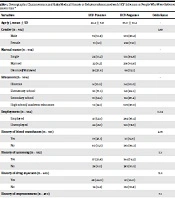
A total of 271 drug addicts (265 males and 6 females) participated in the study. As shown in Table 1, the majority of participants were male. Study participants ranged in age from 19 to > 51 years. Their mean age was 31.7 years old. Up to 60.2% of drug users had educational levels less than high school. Furthermore, 67.5% were self-employed, 32.5% were office workers, 93.7% were single, and 6.3 % were married. The mean duration of drug injection was 6.8 years.
4.2. Prevalence of HIV, HCV, and HBV Infections
In 20.66% of the tested participants, at least one of the three viral infections was seen (95% confidence interval (CI)). Forty-four out of 271 volunteers (16.23%) were positive for HCV-Ab (95% CI: 40.17, 46.62). Of those infected with HCV, 3 (1.10%) were co-infected with HBV (95% CI: 40.17, 46.62), 8 (2.95%) were positive for HIV, and 1 (0.36%) of HCV-positive cases were infected with all three viruses (95% CI: 40.17, 46.62).
In the current study, HCV (16.23%) is more prevalent than HIV (2.95%) and HBV (1.10%) among all addicts. Detailed results on the prevalence of the three infections in both sexes are shown in Table 1.
Table 1.
The Prevalence of HIV, HCV, Past or Current HBV, and Viral Co-Infections Among Addicts in Drug Treatment Centers, by Sex and Source of Sampling in Khorramabad, Lorestan, Iran
| Total | Male | Female | ||||
|---|---|---|---|---|---|---|
| Number Tested | Positive Casesa | Number Tested | Positive Casesa | Number Tested | Positive Casesa | |
| HCV | 271 | 44 (16.23) | 265 | 43 (15.86) | 6 | 1 (0.36) |
| HIV/HCV | 271 | 8 (2.95) | 265 | 8 (2.95) | 6 | 0 |
| HCV/ HBV | 271 | 3 (1.10) | 265 | 3 (1.13) | 6 | 0 |
| HIV /HCV/ HBV All three viruses | 271 | 1 (0.36) | 265 | 1 (0.36) | 6 | 0 |
aData are presented as No. (%).
4.3. Prevalence of HIV/HCV, HCV/HBV, and HIV/HCV/HBV Co-Infection
The prevalence of HIV/HCV, HCV/HBV, and HIV/HCV/HBV among volunteers was 2.95%, 1.10%, and 0.36%, respectively (Tables 1 and 2).
Table 2.
The Prevalence of HIV, HCV, HBV, and Viral Co-Infections Among Addicts in Drug Treatment Center, Age Groups and Source of Sampling in Khorramabad, Lorestan, Irana
| Age Groups | Number Tested | Positive Cases | HCV Positive Cases | HIV/HCV Positive Cases | HCV/HBV Positive Cases | HIV/HCV/HBV Positive Cases |
|---|---|---|---|---|---|---|
| 19 - 30 | 132 | 18 (6.64) | 15 (5.53) | 2 (0.73) | 0 | 1 (0.36) |
| 31 - 40 | 108 | 32 (11.80) | 25 (9.22) | 6 (2.21) | 1 (0.36) | 0 |
| 41 - 50 | 19 | 3 (1.1) | 3 (1.1) | 0 | 0 | 0 |
| > 51 | 10 | 3 (1.1) | 1 (0.36) | 0 | 2 (0.73) | 0 |
| Total | 56 (20.66) | 44 (16.23) | 8 (2.95) | 3 (1.1) | 1 (0.36) |
aData are presented as No. (%).
Table 3.
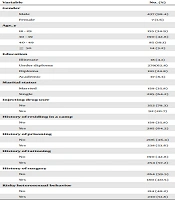
Behavioral Characteristics and Their Association With HCV and Co-Infection (HBV/HIV) Seropositivity Among Addicts in Drug Treatment Centers in Khorramabad, Lorestan, Irana
| Variables | Total (n = 271) | HCV and Co-Infection (HBV/HIV) Positive 1 (n = 56) |
|---|---|---|
| Marital status | ||
| Single | 254 (93.7) | 52 (92.9) |
| Married | 17 (6.3) | 4 (7.1) |
| Education level | ||
| Primary school | 52 (19.2) | 13 (23.2) |
| High school | 196 (72.32) | 39 (69.94) |
| University Degree | 23 (8. 48) | 4 (7.1) |
| Occupation | ||
| Self-employed | 183 (67.5) | 39 (69.6) |
| Office worker | 88 (32.5) | 17 (30.4) |
| Drugs reported having ever used (local name) | ||
| Opium (taryak) | 16 (5.9) | 4 (7.1) |
| Heroin | 55 (20.4) | 10 (17.9) |
| “Crack” (purer form of heroin) and Methamphetamine (crystal) | 22 (8.1) | 3 (5.4) |
| All drugs | 177 (65.6) | 39 (69.6) |
| Types of consumption | ||
| Injection | 16 (5.9) | 7 (12.5) |
| Inhalational | 7 (2.6) | 2 (3.6) |
| Smoking | 25 (9.2) | 2 (3.6) |
| All items | 223 (82.3) | 45 (80.4) |
| Duration of drug abuse | ||
| 1 - 5 years | 43 (15.9) | 1 (1.8) |
| 6 - 10 | 105 (38.7) | 25 (44.6) |
| 11 - 15 | 65 (24.0) | 13 (23.2) |
| 16 - 20 | 38 (14.0) | 16 (23.2) |
| 20< | 20 (7.4) | 4 (7.1) |
| Blood transfusion | ||
| No | 217 (80.7) | 46 (82.1) |
| Yes | 52 (19.3) | 10 (17.9) |
| Past incarceration | ||
| No | 106 (39.1) | 5 (8.9) |
| Yes | 165 (60.9) | 51 (91.1) |
| History of tattooing | ||
| No | 119 (45.1) | 15 (26.8) |
| Yes | 145 (54.9) | 41 (73.2) |
| History of surgery | ||
| No | 158 (58.5) | 34 (61.8) |
| Yes | 112 (41.5) | 21 (38.2) |
| History of liver disease (familial history) | ||
| No | 187 (87.8) | 49 (87.5) |
| Yes | 26 (12.2) | 7 (12.5) |
| History of high risk sexual behaviors | ||
| No | 159 (58.67) | 39 (69.64) |
| Yes | 112 (41.32) | 17 (6.27) |
aData are presented as No. (%).
4.4. Risk Behaviors Associated with HCV
There was no significant association between these infections with gender and source of sampling (P = 1.000).
The prevalence of HCV was significantly higher between 31 - 40 years old (P = 0.002). The results indicated that longstanding drug abuse (> 5 years) was significantly associated with HCV infection (P = 0.007).
In this study, the history of opioid use was documented; 7.1% (4 cases) of HCV-positive volunteers patients had used opium, 5.4 % (3 cases) methamphetamine (crystal), 17.9% (10 cases) heroin, and 69.6% (39 cases) have had all types of consumption. None had used “crack” (a purer form of heroin).
The demographic characteristics and risk behaviors of detained addicts are described in Tables 1 - 3. The chi-square test revealed that the factors significantly positively associated with HCV infection included age (P = 0.002), past incarceration (P ≤ 0.001), drug injection history (P = 0.047), the duration of drug use (P = 0.007), tattooing (P = 0.002), and heroin use (P > 0.05).
We found no statistical association between HCV and other demographic characteristics, included gender (P = 1.000), a history of surgery (P = 0.647), a history of blood transfusion (P = 0.851), educational level (P = 0.155), a history of liver disease (P = 1), marital status (single or married) (P = 0.759), and employment status (P = 0.751).
5. Discussion
Chronic liver diseases are serious health challenge worldwide. HBV or HCV infection is the main cause of liver insufficiency, with various frequency rates in different regions with different varieties of all over the world. Various studies on blood-borne infections have been conducted in Iran among drug users in different cities and different settings, such as IDUs in drug treatment centers, prisons, and in communities. It is well known that designing an effective management approach to control the prevalence of HIV, HCV, and HBV is a great challenge for health authorities. Therefore, information from a variety of populations and risk factors among them would be useful in understanding the correlation between these infections and the correlated factors in the transmission of each of them. Our study was conducted to study HCV and co-infections with HIV and HBV and to assess the related risk factors among drug abuse treatment centers in Khorramabad, Lorestan, Iran. In the current study, 16.23% of volunteers were positive for HCV. The prevalence of anti-HCV found in this study was high, but lower than that found in most previous studies. The.prevalence of HCV varies geographically, both within and between countries.
In early reports from Tehran by Zali et al. (9), ELISA tests were HCV-positive for 45% of imprisoned IDUs. In 2001 in the northwestern province of Zanjan, Iran, the HCV prevalence was 47.7% among 346 drug addict prisoners (13). The HCV prevalence was 60% among incarcerated IDUs in Mashhad, Iran (15). Kheirandish et al. (16) reported an 80.0% HCV prevalence among male IDUs in detention in Tehran, Iran. Furthermore, about 38% of IDU prisoners in the western province of Hamadan, 52% in Tehran, 64.8% in the southern cities of Bandar Abbas and Roodan, and 88.9% in the northern province of Guilan were HCV Ab-positive, whereas the rate in non-IDUs in prison was much lower (17, 18). In our investigation, we studied some risk factors related to HCV. The age-specific analysis of the subjects suggested that prevalence of drug abuse was significantly higher between 31 to 40 year olds. The mean age was 31.7 years. Other studies in Iran have shown that young age groups are more prone to using drugs (19, 20).
Furthermore, this finding could be due to Iran’s young population. In other countries, this age group is more susceptible to drug consumption. Interestingly, in the present study about 98% of the addicts were male. This could indicate the higher prevalence of high-risk behaviors among men compared to women, demonstrating males’ tendency toward addiction and drug injection in Iran. The male gender was reported as an independent predictive factor for HCV infection in different studies (21, 22). However, some studies have suggested there has been a rising number of female drug users over the past two decades (22). HCV is transmitted through contaminated blood transfusion, surgery, surgical instruments, and dental surgery (23). Some healthcare procedures, i.e., surgical and dental treatments, have recently been indicated as risk factors for acute HCV (24), but there was no significant difference between a history of surgery and HCV infection in this study. No significant difference was found between the HCV infection rate and a history of blood transfusions. The main risk factor for acquiring HCV infection before the routine anti-HCV screening of blood donors was blood transfusion in Iran; we started a blood donor screening program in all Iranian blood transfusion centers in 1996. Prior researchers have shown that the HCV infection rate has significantly reduced since the blood screening (25). The development of tests for surrogate markers for HCV and the screening of blood donors has reduced the risk of HCV transmission to 0.001% per unit of transfused blood in developed countries (26). In our study, HC- positive status was significantly associated with intravenous drug use.
IDUs constitute one of the most important groups at risk of being infected with HCV since they share contaminated needles and other equipment used in injection, use shooting galleries, use cocaine, engage in unsafe sexual activities, and share shaving equipment. They not only have the highest prevalence of HCV infection, but also constitute a potential reservoir of HCV in the community (6).
However, there are several studies in Iran showing that injected drug use is one of the main factors associated with the prevalence of HCV infection (6, 7). Our study has shown that HCV-positive patients had longstanding drug abuse (addictions); 98.1 % of HCV-positive cases had abused drugs for > 6 years. These findings are concerning two reasons. First, longstanding drug use makes treatment very difficult. Second, long-term opiate use can leads to drug injection as result, which is a sufficient amount of time to be afflicted with different infections transmitted by injection (27). Injecting and needle sharing are believed to be the major risk factors for HIV and HCV infections among IDUs. In addition, we found that individuals with a shorter duration of drug abuse were less likely to be HCV seropositive.
The majority of these volunteers had a prison history, showing that cases with a history of imprisonment are much more likely to inject drugs than IDUs without a history of imprisonment.
Our study corroborates the potential role of incarceration in propagating of HCV. As described in other studies, incarceration can lead to increased sharing of injection equipment due to the scarcity of clean needles and syringes (28). is consistent with multiple studies around the world that also find incarceration associated with HCV infection and with the injection-related practices that lead to HCV infection (15, 29). In addition, it is possible for non-injection drug users to be at elevated risk for HCV due to incarceration (30). As matter of fact, the incarceration of non-injecting opioid users can precipitate their change to injection, as smoking opium in jails is difficult to conceal. Thus, incarceration may accelerate HCV transmission among IDUs and among previously non-injecting drug users. Nearly 40% of Iranian prisoners were IDUs, and the prevalence of HCV infection among this population has been reported to be between 38 and 90% (15, 17). In high-risk populations in comparison to the general population, tattooing may increase risk status (5). The association between HCV infection and a history of being tattooed inside prison has been reported in other countries. We also found that a history of tattooing that was an independent risk factor for HCV infection (12-14). In the United States, Samuel et al. (12) reported that the receipt of a tattoo inside prison or jail was associated with both HBV and HCV. In Australia, it was also found that being tattooed was an independent risk factor for being HCV positive among a group of prisoners (31). The risk of tattooing for the transmission of HCV infection has also been reported in earlier studies among IDUs in Iran (9). In a study of prisoners in Zanjan, Iran, Khani et al. (13) reported that tattooing was associated with HCV positivity among prisoners. Another study has shown that tattoos might have a higher risk of HCV infection when given in prison (32).
In our study, most subjects had only a primary/secondary school degree, which can be result of dropping out of high school (73.2%)and 7.1% had university degree. A low educational level and/or low socioeconomic status has also been associated with the prevalence of a number of infectious diseases, but we found no statistical association between HCV and educational level.
In conclusion, these studies showed that risk characteristics, including injected drug use, homosexual sexual practice, tattooing, and the length of incarceration, are among potential correlates of HCV infection among drug addicts in Khorrambad, Lorestan, Iran. Continued education of public and healthcare professionals will play an important part in controlling this problem since injections in the community are reported as a risk factor for the acquisition of HBV and HCV.