
International Journal of Infection

Image Credit: International Journal of Infection

The Role of Self-Responsible Response Versus Lockdown Approach in Controlling COVID-19 Pandemic in Kurdistan Region of Iraq

Author(s):
Nawfal R HusseinNawfal R HusseinNawfal R Hussein ORCID1,*
1Department of Biomolecular Sciences, College of Medicine, University of Zakho, Kurdistan , Iraq
*Corresponding Author: Department of Biomolecular Sciences, College of Medicine, University of Zakho, Kurdistan, Iraq. Tel: +96-4627649807, Email: [email protected]

International Journal of Infection:Vol. 7, issue 4; e107092
Published online:Sep 01, 2020
Article type:Letter
Received:Jul 15, 2020
Accepted:Aug 23, 2020
How to Cite:Hussein NR. The Role of Self-Responsible Response Versus Lockdown Approach in Controlling COVID-19 Pandemic in Kurdistan Region of Iraq. Int J Infect. 2020;7(4):e107092. doi: https://doi.org/10.5812/iji.107092

Dear Editor,
When Coronavirus disease (COVID-19) spread throughout the planet, the vast majority of countries decided to take extraordinary actions to decelerate the spread of infection and decrease the fatality rate (1, 2). Most countries decided to go into lockdown status and reduce the financial problems associated with such an issue. Many governments are implementing a complementary socio-economic program to support those who face financial challenges. Few countries such as Sweden decided to go to a self-responsible response, which included softer guidelines to protect the population (3), urging the senior citizens to stay home and avoid contact with others, the prohibition of the gathering of over 50 people, avoiding overcrowding in pubs and restaurants (3).
When the first few cases of COVID-19 were diagnosed in Iraq, Kurdistan Regional Government decided to put an order of lockdown. In this unprecedented situation, the government took drastic actions to stop the spread of the infection, including the cancellation of gathering and religious rituals, closing schools and education institutes, closing airports and borders (4) and declaring state-imposed community-wide containment (4) which could control the spread of infection successfully. During the lockdown period, 452 patients were diagnosed with a case fatality of 1% (5). However, the economic turmoil associated with the outbreak in the Kurdistan Region had a severe impact on employment, particularly labor working with daily wages. Also, complete lockdown for around two months resulted in collective fatigue. Mounting socio-economic pressure with political necessity pushed the government to relax the measures at a progressively-elevated pace, which increased the likelihood of losing control and closed the decision-making process prematurely before exploring reasonable alternatives. At this stage, the government decided a self-responsible strategy to combat the outbreak by calling the people for using common sense and voluntarily take precautions against the infection. Policymakers did not launch any plans to protect high-risk groups, including the elderly, people with disabilities, and people with underlying health conditions. Besides, there were no clear plans for how to deal with people who do not follow instructions.
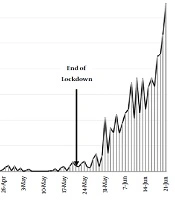
Additionally, a false sense of security made the displeasing situation even worse, and people started to gather again without precautions. As a result, a sharp increase in the number of cases was witnessed, and the number of confirmed cases soared from 5.5 cases per day to 109.7 cases per day (Figure 1), and the case fatality rate increased from 1% to 3.4% (6). Due to the increased number of patients, healthcare workers are struggling because of the shortage of personal protective equipment and a small number of ventilators. Local experts warn that the situation may relapse in the region just like the Lombardy region in Italy. Moreover, the government's underlying aim to avoid long-term economic issues was not achieved, and most businesses are about to collapse due to the global economic slowdown.
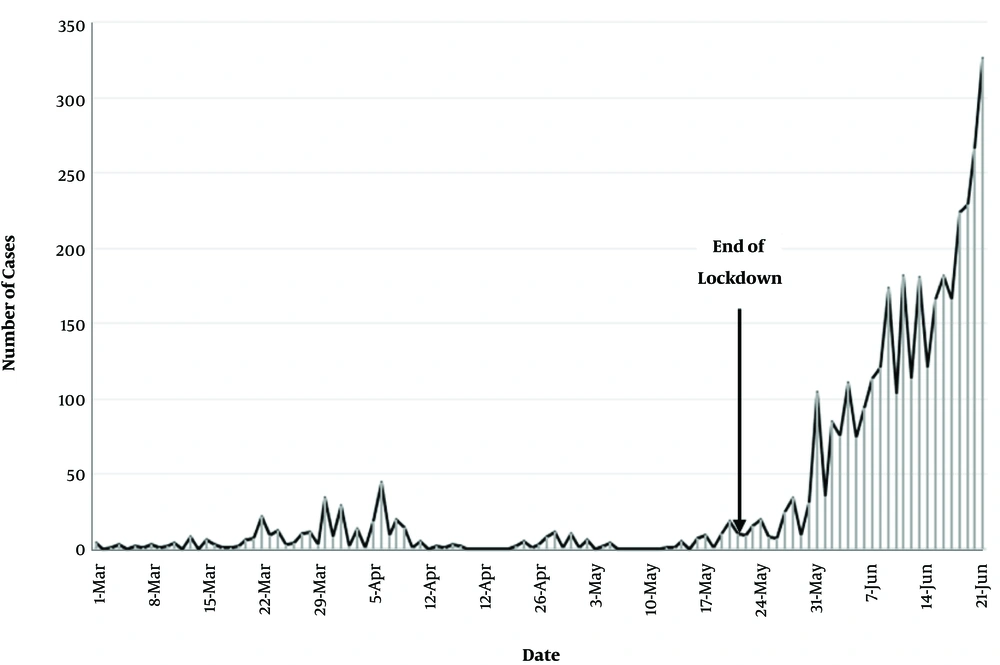
Distribution of Confirmed COVID-19 cases/day in Kurdistan Region, Iraq
Figure 1.

Distribution of Confirmed COVID-19 cases/day in Kurdistan Region, Iraq

In conclusion, the decision of a self-responsible approach and relaxing the containment measure without a plan was a dicey move. This approach cannot be successful unless associated with the long-term health education program to protect vulnerable groups. Since there is not sufficient time and resources for the long-term education program and no clear plans to protect high-risk groups, it is clear that a lockdown approach with a financial support program is the best way to control the spread of infection in our region.
Footnotes

  • Conflict of Interests: Nothing to declare.

  • Funding/Support: None.

References

Copyright

Copyright © 2020, International Journal of Infection. This is an open-access article distributed under the terms of the Creative Commons Attribution-NonCommercial 4.0 International License (http://creativecommons.org/licenses/by-nc/4.0/) which permits copy and redistribute the material just in noncommercial usages, provided the original work is properly cited.

Similar Articles

19
Apr
2020
Journal of Kermanshah University of Medical Sciences

Possible Factors Associated with Low Case Fatality Rate of COVID-19 in Kurdistan Region, Iraq

Nawfal R Hussein

Hussein NR. Possible Factors Associated with Low Case Fatality Rate of COVID-19 in Kurdistan Region, Iraq. J Kermanshah Univ Med Sci. 2020;24(1):e103393. doi: https://doi.org/10.5812/jkums.103393

20
May
2020
Hepatitis Monthly

The Impact of COVID-19 Pandemic on the Elimination of Viral Hepatitis in Duhok City, Kurdistan Region of Iraq

Nawfal Hussein

Hussein N. The Impact of COVID-19 Pandemic on the Elimination of Viral Hepatitis in Duhok City, Kurdistan Region of Iraq. Hepat Mon. 2020;20(5):e104643. doi: https://doi.org/10.5812/hepatmon.104643

13
Dec
2022

Shortage of Coronavirus RT-PCR Kits Increased the Spread of Infection in Kurdistan Region of Iraq

Nawfal Hussein,
Ibrahim Naqid

Hussein N, Naqid I. Shortage of Coronavirus RT-PCR Kits Increased the Spread of Infection in Kurdistan Region of Iraq. Arch Clin Infect Dis. 2022;17(6):e102896. doi: https://doi.org/10.5812/archcid-102896

1
Apr
2020
Archives of Clinical Infectious Diseases

The Required Confronting Approaches Efficacy and Time to Control COVID-19 Outbreak in Iran

Meysam Olfatifar,
Hamidreza Houri,
Sajad Shojaee,
Mohamad Amin Pourhoseingholi,
Walid Q. Alali,
Luca Busani
,et al.

Olfatifar M, Houri H, Shojaee S, Pourhoseingholi MA, Alali WQ, et al. The Required Confronting Approaches Efficacy and Time to Control COVID-19 Outbreak in Iran. Arch Clin Infect Dis. 2020;15(COVID-19):e102633. doi: https://doi.org/10.5812/archcid.102633

25
Jul
2020
Journal of Medical Education

Impact of COVID-19 on the Medical Education: Experience from Kurdistan Region of Iraq

Nawfal R Hussein,
Zana Sidiq M. Saleem,
Dildar H Musa,
Nashwan Ibrahim,
Ibrahim A Naqid

Hussein NR, M. Saleem ZS, Musa DH, Ibrahim N, Naqid IA. Impact of COVID-19 on the Medical Education: Experience from Kurdistan Region of Iraq. J Med Edu. 2020;19(1):e106889. doi: https://doi.org/10.5812/jme.106889

Download PDF156.75 KB

Crossmark

Crossmark

Checking

Share on
Cited by
Metrics

Ordering Reprints

Articles are published under the Creative Commons license stated on each article. No permission or royalty fee is required for uses permitted by that license. CCC handles optional bulk and customized reprint orders. Any quotation covers production and delivery services only, not copyright permission. > Request Reprints from CCC