
1. Background
Crimean-Congo hemorrhagic fever (CCHF) is a tick-borne viral disease caused by a virus (Nairovirus) in the family Bunyaviridae. The disease has received a great deal of attention because of its relatively high case fatality ratio (10-40%) (1, 2). CCHF is geographically distributed throughout the Mediterranean, Northwest China, Central Asia, Southern Europe, Africa, the Middle East, and the Indian subcontinent (3). The disease occurs sporadically in humans, however, in recent years outbreaks of CCHF have been reported from; Kosovo, Albania, Iran, Pakistan, and South Africa (1, 2). Although primarily an occupational disease that mostly affects animal breeders and slaughterhouse workers, individuals in contact with livestock in endemic regions may also contract CCHF. In Iran, from June 1999 to February 2011, CCHF cases were notified from 23 out of 30 provinces (Figure 1). Sistan and Baluchistan Province, in Southeast Iran, has the highest prevalence of CCHF (4, 5).
The way in which the general population perceives health risks is often subjective. In addition, perceptions will determine whether or not an individual takes appropriate action (6, 7). Understanding the contribution of risk perception and applying this information in risk communication may help to increase people's adherence to guidelines aimed at controlling infectious diseases.
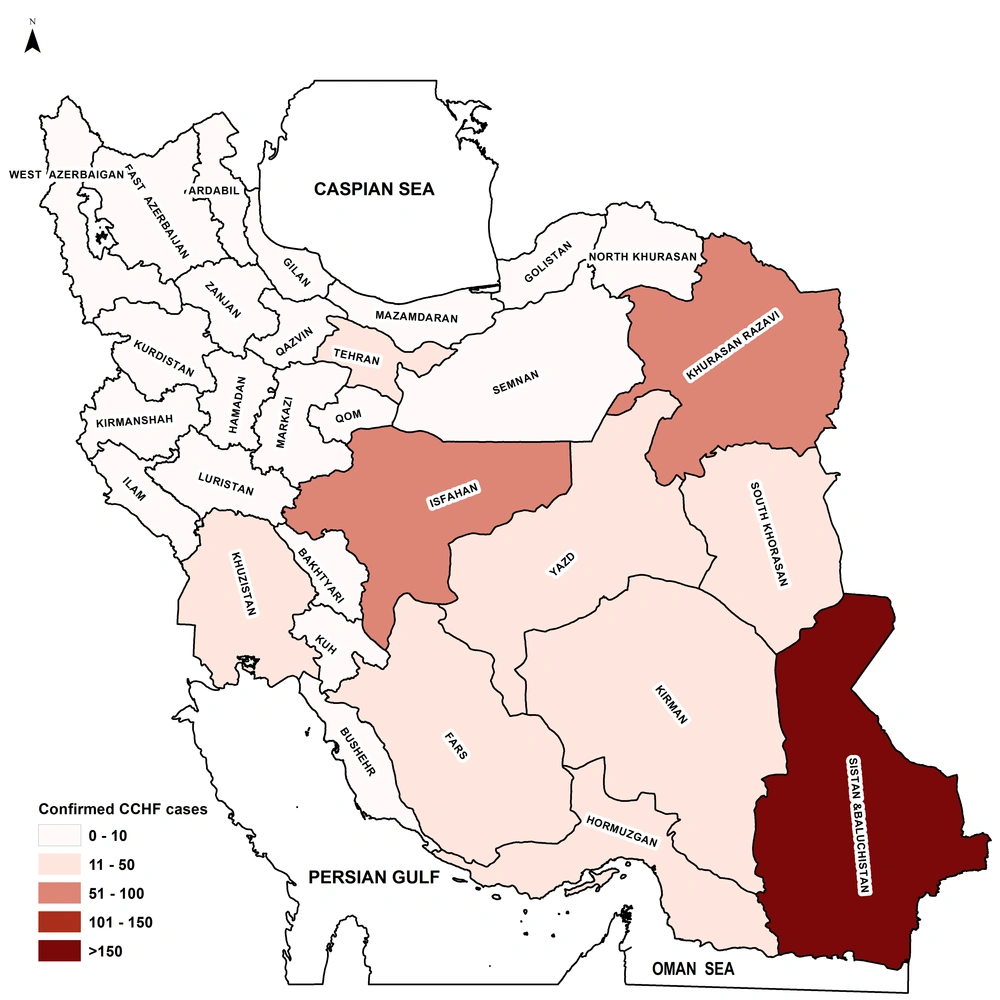
Figure 1.
Produced based on data released by the Iranian Ministry of Health, Center for Diseases Control, 2011
2. Objectives
The objective of this study was to assess CCHF-related risk perceptions, knowledge and attitudes among the residents of Zahedan, a city with the highest burden of disease in the Sistan and Baluchistan Province, and to identify predictors of high risk perception.
3. Patients and Methods
A cross-sectional study was conducted between September and December 2010 in the city of Zahedan, Southeast Iran. A sample of the general population was obtained from 20 health centers. The subjects included women attending maternal and child health clinics and private business owners (mostly men) located in the catchment areas of the health centers, supervised and inspected by environmental health officers. Multi-stage cluster sampling was used to recruit the subjects. Ten women attending the health clinic and the same number of business owners were randomly recruited from each health centre. The sample included equal numbers of subjects from the outskirts and central areas of the city to account for socioeconomic differences between different strata of the target population. All businesses involved in preparing and distributing meat products, that might have received special training on CCHF, were excluded from the study. A 55-item structured questionnaire was developed to elicitthe information. The questionnaire included questions on demographic characteristics, meat consumption and preparation practices, CCHF risk perceptions, knowledge and attitudes toward the disease. The questionnaire was field tested on 20 respondents and modifications were made as needed. Validity of the questionnaire was assessed by asking a panel of experts to indicate whether or not the questions included in the questionnaire were essential based on the objectives of the study. The feedback received from the expert panel was incorporated into the final questionnaire design.
Five point Likert-scale responses were used to investigate the risk perception by participants, ranging from 'not serious' to 'very serious'. Eight questions elicited information of the participants’ knowledge about; CCHF causative agents, symptoms, routes of transmission, protective measures, treatments, and vaccines. Some of these questions included more than one alternative that could have been chosen. Each correct response was scored one point and the incorrect response as zero. An overall knowledge score was calculated by summing the scores for each correct response, with the highest possible knowledge score of 20. The risk perception responses were separated into two categories by putting the perceived CCHF risk as 'serious' or 'very serious' into a 'high' perceived risk group and the rest of the responses into a 'low' perceived risk group. Ten attitude questions were included in the questionnaire with five-point Likert-scale responses ranging from 'completely disagree' to 'completely agree'. The responses were given a score of one to five in increasing order. An overall attitude score was calculated by adding the score for each attitude question.
The participants were interviewed by trained health officers when they attended clinics to receive maternal and child health care or during routine field inspections. Verbal consent was obtained from the participants before individual surveys were conducted. All continuous variables were tested for normality of distribution using a Kolmogorov-Smirnov goodness of fit test. Categorical variables were presented as counts and percentages. A chi-square test was used to compare the distribution of categorical variables between the different groups. Pearson and Kendall’s tau-b correlation coefficients were used to investigate the association between groups of continuous and categorical variables, respectively. Several multivariate logistic regression models were fitted using a forward likelihood ratio method to identify factors associated with a 'high' CCHF perceived risk. Linear logistic regression models were also fitted to identify factors predicting a'high' CCHF knowledge score. A p < 0.05 was considered significant for all analyses. Data analysis was performed using SPSS (version 14) statistical software package (Chicago, IL).
4. Results
A total of 400 subjects participated in the study (172 males and 228 females). Mean age was 31.5± 10.5 years (range 14 – 72). The demographic characteristics of the participants are presented in Table 1. The age and sex distribution of the participants living in the central and outskirt areas were similar. However, in comparison with the outskirt residents, those living in central areas were more likely to have a university degree (21.1% versus 4.6%, P =0.05), tended to have a smaller household size (household size 1-3: 33.2% versus 26.9%, P = 0.005), and were more likely to have a government job (8% versus 1.5%, P = 0.002).Table 2 shows the distribution of perceived risk categories among the study participants from central and outskirt areas. Approximately 70% of the participants in both groups reported the risk of CCHF to be 'serious' or 'very serious'. A greater proportion of outskirt residents reported the perceived CCHF risk as 'very serious' (45.9% versus 40.6%), although the difference was not statistically significant (P = 0.514). The participants’ responses to the knowledge questions are presented in Table 3. Only 29% of the participants knew that CCHF was a viral disease. Half of the subjects pointed out that butchers were occupationally at risk of contracting CCHF. Other occupations potentially vulnerable to the disease were less frequently cited. Fever was the most frequently mentioned symptom (51.8%) followed by bleeding (30.3%). Direct contact with infected animal blood and tissues was identified as a route of CCHF transmission by 45.5% of the participants and tick bite was mentioned by only 15.3%. Half of the participants knew that CCHF was treatable and 24.5% knew that there was no vaccine for preventing CCHF. Table 4 compares total knowledge and attitude scores between 'high' and 'low' perceived risk groups. A greater proportion of participants in the 'high' perceived risk group had knowledge scores of five and above (77% versus 50%) and the difference was statistically significant (P < 0.001). The distribution of total attitude score categories was relatively similar between the two perceived risk groups.
The correlation estimate for the association between total knowledge and attitude scores was not statistically significant (Pearson's correlation coefficient = 0.075, P = 0.135). A relatively low but statistically significant association was found between the total knowledge score group and the category of perceived CCHF risk (Kendall’s tau-b correlation coefficient = 0.208, P < 0.001). No association was found between the attitude score group and the CCHF risk category. Logistic regression analysis (forward likelihood ratio method) was performed in order to identify factors influencing the probability of a participant reporting a 'high' perceived risk. The initial model included; age, sex, level of education, household size, area of residence, knowledge and attitude score groups, and history of having had a friend/relative diagnosed with CCHF, as covariates, and two risk groups as dependent variables. As shown in Table 5, factors independently associated with the likelihood of having a 'high' CHF perceived risk that remained in the final model included; level of education, having had a relative/friend diagnosed with CCHF and the CCHF knowledge score. The final fitted model containing these three predictors was statistically significant, χ2 = 39.44, P < 0.001. The goodness of fit of the model was further supported by the chi-square value of 8.54 for the Hosmer-Lemeshow test with a significance level of 0.381.
In comparison with illiterate subjects, those who had a university degree were more than five and a halftimes more likely to have a 'high' perceived CCHF risk (OR = 5.65, 95%CI 2.02-15.83, P < 0.001). Similarly, participants with a high school degree had a 2.7 times chance of being in the 'high' perceived CCHF risk group (OR = 2.70, 95% CI 1.27- 5.75, P = 0.010). When compared with knowledge scores less than four, those participants with scores of nine or more had a higher than three times chance of reporting a 'high; perceived risk (OR = 3.37, 95% CI 1.61-7.07, P < 0.001). Knowledge scores between five and eight were associated with a two and a half times increase in the likelihood of 'high' risk perception (OR=2.58, 95% CI 1.51-4.39, P<0.001). Having had a friend/relative diagnosed with CCHF was associated with an almost three fold chance of 'high' perceived CCHF risk (OR = 2.94, 95% CI 1.08-7.96, P = 0.034).
Table 1.
Socio-Demographic Characteristics of the Participants by Area of Residencea
| Variables | Outskirts | Central | χ2 P Value |
|---|---|---|---|
| Gender | 0.840 | ||
| Male | 87 (43.5) | 85 (42.5) | |
| Female | 113 (56.5) | 115 (57.5) | |
| Age group | 0.270 | ||
| ≤ 19 | 19 (9.5) | 12 (6.0) | |
| 20-29 | 80 (40.2) | 79 (39.5) | |
| 30-39 | 58 (29.1) | 73 (36.5) | |
| 40-49 | 20 (10.1) | 22 (11.0) | |
| ≥ 50 | 22 (11.1) | 14 (7.0) | |
| Education | < 0.001 | ||
| Illiterate | 48 (24.6) | 11 (5.5) | |
| Primary school | 53 (27.2) | 28 (14.1) | |
| Guidance school | 35 (17.9) | 35 (17.6) | |
| High school | 50 (25.6) | 83 (41.7) | |
| University | 9 (4.6) | 42 (21.1) | |
| Occupation | 0.002 | ||
| Housewife | 91 (46.9) | 75 (37.5) | |
| Government job | 3 (1.5) | 16 (8.0) | |
| Student | 2 (1.0) | 10 (5.0) | |
| Worker | 10 (5.1) | 16 (8.0) | |
| Private business | 88 (45.4) | 83 (41.5) | |
| Household size | 0.020 | ||
| 1-3 | 52 (26.9) | 128 (33.2) | |
| 4-5 | 75 (38.9) | 153 (39.6) | |
| 6-7 | 41 (21.2) | 72 (18.7) | |
| ≥ 8 | 25 (13.0) | 33 (8.5) |
a Data are presented as No. (%).
Table 2.
Reported Perceived Risk by Participants’ Area of Residencea
| Variables | Outskirt | Central | χ2 P Value |
|---|---|---|---|
| Risk perception | 0.514 | ||
| Not serious | 11 (5.94) | 8 (4.1) | |
| Small | 26 (14.1) | 25 (13.0) | |
| Medium | 20 (10.8) | 22 (11.5) | |
| Serious | 43 (23.2) | 59 (30.7) | |
| Very serious | 85 (45.9) | 78 (40.6) |
a Data are presented as No. (%).
Table 3.
| Patients, No. (%) | |
|---|---|
| What is the CCHF causative agent? | |
| Virus | 116 (29.0) |
| Bacteria/fungi | 23 (5.8) |
| Do not know | 254 (63.5) |
| Who are at risk of contracting CCHF? | |
| Butchers | 205 (51.3) |
| Slaughter house workers | 150 (37.5) |
| Animal breeders/raisers | 75 (18.8) |
| Veterinary/medical staff | 21 (5.3) |
| What are CCHF symptoms? | |
| Fever | 207 (51.8) |
| Severe headache | 72 (18.0) |
| Muscle pain | 44 (11.0) |
| Bleeding | 121(30.3) |
| How is CCHF transmitted? | |
| Tick bite | 61 (15.3) |
| Slaughtering animals | 96 (24.0) |
| Eating infected meat | 119 (29.8) |
| Direct contact with infected animal blood andtissues | 182 (45.5) |
| Is CCHF transmitted through person-to-person contact? | |
| Yes | 163 (40.8) |
| No | 98 (24.5) |
| Do not know | 128 (32.0) |
| What protective clothing items are needed when slaughtering livestock? | |
| Gloves | 299 (74.8) |
| Eye shields | 41 (10.3) |
| Boots | 60 (15.0) |
| Gown | 12 (3.0) |
| Is there a treatment for CCHF? | |
| Yes | 211 (52.8) |
| No | 70 (17.5) |
| Do not know | 107 (26.8) |
| Is there a vaccine against CCHF? | |
| Yes | 132 (33.0) |
| No | 98 (24.5) |
| Do not know | 160 (40.0) |
a Abbreviations: CCHF, crimean-congo hemorrhagic fever
bData are presented as No. (%).
Table 4.
| CCHF Perceived Risk | χ2 P Value | ||
|---|---|---|---|
| Low | High | ||
| Knowledge Score | <0.001 | ||
| > 4 | 50 (44.6) | 61 (23.0) | |
| 5-8 | 48 (42.9) | 150 (56.6) | |
| ≥ 9 | 14 (12.5) | 54 (20.4) | |
| Attitude Score | 0.264 | ||
| < 20 | 10 (8.9) | 13 (4.9) | |
| 21-29 | 78 (69.6) | 184 (69.4) | |
| ≥ 30 | 24 (21.4) | 68 (25.7) | |
a Abbreviations: CCHF, crimean-congo hemorrhagic fever.
b Data are presented as No. (%).
Table 5.
Multivariate Logistic Regression Model Fitted to Identify Factors Associated With a 'High' CCHF Perceived Risk a
| Crude OR | Adjusted OR | Lower OR | Upper OR | P Value | |
|---|---|---|---|---|---|
| Education | |||||
| Illiterate | – | 1.00 | – | – | |
| Primary school | 1.57 | 1.76 | 0.78 | 3.93 | 0.171 |
| Guidance school | 1.56 | 1.56 | 0.69 | 3.52 | 0.282 |
| High school | 2.66 | 2.70 | 1.27 | 5.75 | 0.010 |
| University | 4.57 | 5.65 | 2.02 | 15.83 | 0.001 |
| CCHF knowledge score | |||||
| < 4 | 1.00 | ||||
| 5 – 8 | 2.56 | 2.58 | 1.51 | 4.39 | 0.001 |
| ≥ 9 | 3.16 | 3.37 | 1.61 | 7.07 | 0.001 |
| Having hadrelatives/ friends diagnosed with CCHF | |||||
| No | 1.00 | ||||
| Yes | 3.13 | 2.94 | 1.08 | 7.96 | 0.034 |
a Abbreviations: CCHF, crimean-congo hemorrhagic fever
5. Discussion
This cross-sectional study was conducted to investigate risk perceptions, knowledge and attitudes toward CCHF and the factors influencing the perceived risk in the general population residing in Zahedan, Southeast Iran.The majority (70%) of the participants perceived the risk of CCHF in the region to be 'high' regardless of their area of residence. It has been shown that the risk perceptions for emerging infectious diseasesare high, especially when people witness disease outbreaks (8-10). During the early phases of the outbreak in Iran, CCHF was associated with a relatively high case fatality ratio (up to 20%) (11), hence it was recognized as a deadly disease. The negative framing (12) the chance of death from CCHF, that was used by the mass media and health authorities for presenting the disease, was highly likely to have influencedrisk perception and interpretation of the danger in the study population. We found a strong association between holding a university graduate certificate or having high school education and the probability of reporting a 'high' CCHF perceived risk. Studies have shown that individuals with less formal education are less likely to understand and interpret risk information in a proper manner (13, 14). Our findings are consistent with results from a previous study that showed an inverse relationship between the level of education and the risk of CCHF infection (15). It could be expected that people with higher levels of education are more health-conscious and hence more likely to search for health information. People with a higher risk perception are more likely to comply with public health behaviors and take appropriate action to reduce their risk of contracting the disease (16-19). A positive association was found between the knowledge score and the perceived CCHF risk. The more aware people are of a risk, the better they perceive it. In the case of the recent influenza H1N1 pandemic, for instance, the disease was given wide media coverage and it received a great deal of attention by public and health authorities that resulted in greater risk perception worldwide (20, 21). Conversely, poor knowledge has been shown to be a risk factor for low risk perception and hence non-adherence to general precautions recommended by health authorities (22-24).
The results from our study showed that the knowledge and attitude of the general population relating to CCHF was below expectations. People living in the endemic areas seem to be aware of the risk CCHF poses to community health and well-being. In our study this was reflected in the relatively high proportion of respondents that reported the risk of CCHF in their area of residence to be 'high'. However, people failed to obtain enough knowledge and to use this information in a consistent way to formulate a judgment of their own vulnerability to CCHF. This is based on a reasoning process that encourages them to think that the hazard in question is not a real threat, even though it may affect people known to them, resulting in a 'self-exempting' optimistic bias (25). This optimism makes them feel that they do not need to improve their knowledge on different aspects of the disease. A similar study in Turkey also reported insufficient knowledge on CCHF in their study population (26).
Having had a friend or relative diagnosed with CCHF was positively associated with reporting a 'high' CCHF risk. Knowledge gained from past personal experiences or witnessing someonesuffering from a health event has been thought to increase risk perception (27-29). One of the strengths of this survey was that all of the subjects, who were approached, participated in the study which resulted in a 100% response rate. Moreover, a comprehensive structured questionnaire was used by trained health officers for collecting the data. The interviewers received special training prior to the start of the survey to reduce possible sources of interviewer bias.
One of the limitations of this study was that the subjects were recruited through health centers. It could be argued that they might not be an ideal representative of the general population as not all people attend health centers. However, the demographic characteristics of the participants closely matched the most recent population census data.
In summary, our study population perceived that CCHF was highly likely to affect the society in spite of their relatively low level of knowledge and attitude toward CCHF. Risk interpretation and adoption of preventive behaviors are motivated by different factors including knowledge and education levels. Using appropriate methods to convey health messages and provide better risk communication to enhance public awareness should be integrated into all CCHF control programs in the region.