
1. Background
Zoonosis, or diseases that can be transmitted between humans and animals are important in terms of public health and economics (1). One of the most common zoonotic diseases worldwide is Crimean Congo hemorrhagic fever (CCHF), known for its symptoms of fever, hemorrhage, and 30% mortality. Various disease reports have been published in more than 30 countries on different continents (2, 3). That is caused by a virus of the genus Nairovirus from the Bunyaviridae family (4). The primary methods of pathogens transmission are through tick bites of Ixodidae, especially the mature or premature Hyalomma genus (4, 5), touching the ticks, exposure to the blood or tissue of domestic animals, and direct contact with the blood and body fluids of infected individuals (6, 7). Over 40 years of age, occupation (butcher, doctor, veterinarian, rancher), contact with farm animals, circulating in the wild, and other agricultural activities are factors for exposure to ticks (8, 9). There is no definitive treatment or a specific vaccine against CCHF; currently, supportive therapy is used for the lethal disease CCHF (4, 7).
National Technical Committee to Coordinate the Care System and Disease Registry has provided three definitions: (A) suspected case: Signs of bleeding, fever, and muscle aches with an epidemiological history (history of tick bites or mite crushing by hand, direct contact with fresh blood, or other contaminated animal or their tissues, direct contact with blood, secretions, or discharge of a positive or suspected patient with CCHF, and residency or travel in a rural area where there is a risk of contact with livestock or mites; (B) verisimilar case: The suspected case with thrombocytopenia (platelets less than 150,000/mm3) and leukopenia (white blood cells less than 4,000/mm3) or leukocytosis (white blood cells more than 9,000/mm3); (C) positive case: Verisimilar cases plus positive serological tests or isolation of the virus from the patient's body (10).
Although the highest prevalence of this disease has been reported in the eastern and southern provinces of Iran (8), the prevalence of this disease across the country's eastern, western, and northern borders has been published (6). Kermanshah is located in the west of Iran, and the favorable weather conditions (mean temperature of 15.4°C and an average rainfall of 300 to 800 mm) have caused the employment of a substantial number of villagers in livestock and animal husbandry; on the other hand, the common border with Iraq and the transfer of livestock are other factors that make this region suitable for the prevalence of zoonotic diseases such as CCHF.
2. Objectives
Given the importance and risks of developing the disease, this study was conducted to investigate the frequency of this disease in Kermanshah from 2006 to 2020.
3. Methods
In this study, data regarding the frequency of CCHF in Kermanshah province were obtained from different main clinical centers. Three hundred files were investigated from three medical centers where infectious patients were referred, and 130 patients were extracted and analyzed according to the study criteria. All CCHF patients, who were referred to our studied medical centers, were recorded in a special form and were categorized according to age, sex, occupation, clinical signs, residency (urban/rural), the mode of transmission, and the status at the time of discharge (recovery or death). In this form, regarding the clinical information of patients, suspicious, positive, and verisimilar cases were also identified according to the National Technical Committee to Coordinate the Care System and Disease Registry. Among those whose information had been recorded, only the positive cases (having the clinical signs plus detection of IGM antibodies by ELISA in their serums) were screened.
The protocols pursued in our study are authorized by the Local Ethics Committee and are in line with the principles of the Helsinki Declaration on Human Studies (IR.KUMS.REC.1399.036). Informed consent was obtained before the study, and the participants consented to submit the report to the journal. SPSS software (version 16) was used for statistical analysis; mean ± standard deviation (SD) and median were considered to express the study results.
4. Results
Generally, 130 patients were recorded in our study; 19 cases were positive (14.61%), 66 cases were verisimilar (50.77%), and the rest (31.54 %) were suspected. Among the positive cases, 15 patients recovered, and four died; 12 cases (63.16%) were men, and 7 cases (36.84%) were women. The average patient was 41.42 ± 21.86 years old; the youngest and oldest were 2 and 73 years old. In the age group of 15 to 30, most cases (6 cases) were observed (Table 1). From all, 15 patients (78.95%) were in contact with domestic livestock, five patients (26.31%) had a history of contact with ticks, two patients (10.53%) had contact with raw meat and liver and one patient (5.26%) had a history of family contact with an infected person.
Table 1.
Demographic and Clinical Information of Positive Cases of Crimean Congo Hemorrhagic Fever in Kermanshah Province (2006 - 2020)
| Variables | Frequency (%) |
|---|---|
| Age groups (y) | |
| < 15 | 1 (5.26) |
| 15 - 30 | 6 (31.58) |
| 31 - 45 | 2 (10.53) |
| 46 - 60 | 5 (26.31) |
| > 60 | 5 (26.31) |
| Occupation | |
| Ranchers | 9 (14.37) |
| Students | 3 (15.79) |
| Housewives | 3 (15.79) |
| Other | 4 (21.05) |
| Symptoms | |
| Bleeding | 13 (68.4) |
| Fever & chills | 12 (63.1) |
| Vomiting & nausea | 10 (52.6) |
| Weakness & anorexia | 9 (47.3) |
| Diarrhea | 7 (36.8) |
| Myalgia | 5 (26.3) |
| Mode of transmission | |
| Contact with patient | 1 (5.26) |
| Contact with raw meat | 2 (10.53) |
| Contact with tick | 5 (26.31) |
| Contact with domestic livestock | 15 (78.95) |
| Residency | |
| Rural | 12 (63.16) |
| Urban | 7 (36.84) |
| Patients in months | |
| April | 2 (10.53) |
| May | 3 (15.79) |
| June | 9 (47.37) |
| July | 4 (21.05) |
| Others | 0 (0) |
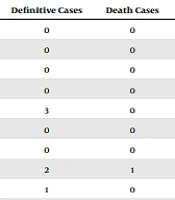
The frequency of mortality due to disease during the study was 21.05%, and most cases were reported from 2019 to 2020 (with six positive cases), while in 2006 to 2010, 2012, and 2013 no positive cases were reported (Table 2). The most common treatments in these patients were a prescription of Ribavirin, antibiotic, and platelet therapy.
Table 2.
Frequency of Crimean Congo Hemorrhagic Fever Cases Recorded in Clinical Centers in Kermanshah (2006 - 2020)
| Time (y) | Definitive Cases | Death Cases | Improvement Cases |
|---|---|---|---|
| 2006 | 0 | 0 | 0 |
| 2007 | 0 | 0 | 0 |
| 2008 | 0 | 0 | 0 |
| 2009 | 0 | 0 | 0 |
| 2010 | 3 | 0 | 3 |
| 2011 | 0 | 0 | 0 |
| 2012 | 0 | 0 | 0 |
| 2013 | 2 | 1 | 1 |
| 2014 | 1 | 0 | 1 |
| 2015 | 1 | 1 | 0 |
| 2016 | 1 | 1 | 0 |
| 2017 | 2 | 1 | 1 |
| 2018 | 3 | 0 | 3 |
| 2019 | 6 | 0 | 6 |
| 2020 | 0 | 0 | 0 |
5. Discussion
In our cross-sectional study, the frequency of CCHF, along with the demographic and clinical information of CCHF patients, were studied (2006 - 2020). Our results showed that the frequency of CCHF was raised in recent years.
The prevalence of CCHF is a challenge to public health services because the virus that causes this disease can lead to epidemics with a high number of fatalities (10 - 40%). The nature of the widespread of the virus makes its prevention and treatment difficult (11). The death frequency of mortality due to disease during the studied years in the province was 21.05%. According to the previous report of the World Health Organization Eastern Mediterranean Region, the death rate of CCHF was 14% (from 2000 to 2015) (4). This report in Afghanistan and Pakistan, which are neighboring Iran with the eastern borders, was 33% (12) and 41%, respectively (13).
Regarding the frequency of CCHF in men, our result was consistent with some reports in other places of Iran, so Fars (14), Khuzestan (15), and Zabol (16) had reported a more incidence in men. Compared to Iranian women, men are more involved in butchery, animal husbandry, and agriculture occupations. On the other hand, using the safety cover is not their concern. What is mentioned above can be the reason for more incidences in men.
The highest prevalence of CCHF was observed in the age group of 15 to 30 years (6 cases). Previous studies have reported different results in this case. Rezaei et al. reported that more positive cases occurred in the age range of 25 to 46 years (14). This result in Mofleh and Ahmad study in Afghanistan was 18 - 55 years (12). This result can be justified due to the higher prevalence of high-risk jobs in these age groups.
In this study, 63.16% of the patients were rural, consistent with 64.3% reported by Sharififard et al. in Khuzestan (15). A similar study in Turkey showed a higher incidence in rural patients (4). Dealing with livestock, like the conditions experienced by nomadic and rural ranchers, increase the risk of CCHF infection.
Among preventive procedures for this group of people in contact with blood and secretions of livestock is using the safety cover, which includes special clothes and gloves (5). A person dealing with livestock should check for ticks daily and visit a doctor if they have any symptoms (10). Other occupations that are at risk of affecting this disease are health care workers who are likely to be infected while caring for patients (4).
In this study, no cases were reported in health care workers. The reasons justifying this result are continuous training, sufficient knowledge, and proper staff performance while caring for patients. Despite the disease being highly prevalent among ranchers, farmers, and butchers, it has also affected housewives and students. Considering that in Iran, shepherding and animal husbandry are usually entrusted to young people in the family, this issue can be a justification for infecting students and people aged 15 - 30 years.
Aslani et al. reported that the most common clinical symptoms in patients with CCHF are fever, nausea, vomiting, bleeding, and myalgia. Also, they reported that the most common laboratory findings are thrombocytopenia and leukopenia. These findings are consistent with the present study concerning the most common symptoms (17). Similarly, other studies have reported fever, pain, myalgia, and bleeding as the most common symptoms of referred people to hospitals (18, 19).
Among our patients, one case (5.26%) had a history of family contact with a patient member, two patients (10.53%) had contact with raw meat and liver, five patients (26.31%) had a history of contact with ticks and 15 patients (78.95%) were also in contact with domestic livestock. According to a report about the mode of transmission of the disease in Afghanistan, the most common ways include contact with livestock meat (70%), animal husbandry (10%), contact with ticks (10%), and unspecified reasons (10%) (12). A study in Turkey showed that the transmission of the disease through contact with ticks or tick bites is 69%, and direct contact with blood tissue and animal fluids is 61.7% (20).
Most cases occurred from April to August, and the utmost was reported in June and July, consistent with previous studies in other regions (17). In Turkey, most cases are reported from May to September (21). The increase in the disease in this period can be mentioned as the increase in the tick population and livestock and agricultural activities (17).
Previous studies have mentioned temperature, rainfall, and humidity indices as important drivers for CCHF infection (7). According to ecological models, an increase in temperature and a decrease in rainfall may expand the suitable habitats for Hyalomma mites and lead to the northward spread of CCHF (4).
In this study, the treatments used for positive cases were ribavirin in 17 cases (89.47%), antibiotics (ceftriaxone, vancomycin, ciprofloxacin, co-amoxiclav) in 6 cases (31.58%), and supportive therapy (blood and platelets, etc.) in 5 cases (26.31%). Ribavirin has a wide range of antiviral activity against many viruses and is used to treat CCHF (22). Also, in non-hemorrhagic cases, patients can receive supportive care, including intravascular isotonic fluids, lactated ringers, normal saline, and nutritional serums. In more severe cases, injections of blood products such as platelets, packed red blood cells, and fresh frozen plasma (FFP) can be prescribed. Intravenous proton pump inhibitors (PPIs) to prevent gastrointestinal bleeding and oral progesterone to prevent or control menstrual bleeding are essential. Among the various strategies used to control CCHF, corticosteroids, intravenous immunoglobulin (IVIG), and plasma exchange are not valid enough (23).
5.1. Conclusions
Our results have shown that the CCHF frequency has recently increased in Kermanshah province. By understanding the geographic distribution and the factors involved in CCHF, we can take effective measures to prevent and control this condition. Wearing safety covers resistant to moisture (such as long-sleeved shirts, long pants, hats, etc.) is essential for individuals involved in agriculture and animal husbandry, particularly those residing in endemic areas. Additionally, employing tick control methods upon returning home can help decrease the incidence of the disease. Separating home and work clothes and checking work clothes at the end of each day are helpful habits. However, in rural areas with limited resources, it is not practical to suggest taking a shower every day.