
1. Background
Today, zoonotic diseases are among the most serious, fatal, and widespread human diseases. The causative factors include viruses, bacteria, and fungi, among which viruses are considered as the most dangerous and severe agents (1). Crimean-Congo Hemorrhagic Fever (CCHF) is one of the most common and well-known zoonotic diseases caused by a viral agent (2). This disease was first reported in Crimea Island in Ukraine (3, 4). In 1956, the causative virus was isolated from a patient with a one-day fever in Stanley Ville, currently known as Kisangani, in the Democratic Republic of Congo. Since then, Crimean-Congo was combined to refer to this virus (5, 6).
According to studies, from 1999 onwards, various cases of CCHF have been reported as epidemics in many parts of Iran, confirmed with paraclinical examinations (7). According to the World Health Organization (WHO) in 2008 (8) and the disease geographical spread map in 2015 (9), Iran is located in the regional belt of the maximum incidence of CCHF. Most clinical cases have reported from eastern provinces, including Sistan and Baluchistan, Fars, and Khorasan (10, 11).
The clinical symptoms of CCHF develop suddenly as fever, muscle pain, fatigue, nausea, vomiting, headache, abdominal pain, diarrhea, conjunctivitis, jaundice, photophobia, and mood disorders (12-14). Human contamination can occur after contact with the blood and secretions of animals, contact with human patients, or through a tick bite. Alternatively, the infection can develop through jobs associated with infected livestock, such as farmers, butchers, and livestock breeders (15). Farmers are more affected by this disease due to contact with animals (1). In endemic regions, farmers, shepherds, and veterinarians who have contact with both domestic and wild animals are considered high-risk groups (16). Studies performed in Iran indicate that CCHF is observed more among those who work in animal husbandry and agriculture, i.e., people who deal with animals (17-19). Farmers are more affected by this disease due to contact with animals.
2. Objectives
Since the villagers in Khoramabad city are mostly stockmen and farmers, and the cattle are present in rural areas, the transmission of CCHF is more likely to occur. This health problem can be controlled by promoting preventive behaviors, enhancing the knowledge of the routes of transmission, and making a proper attitude to the prevention of this disease. Thus, this study was performed to investigate the knowledge, attitude, and practice of farmers in Khorramabad city regarding CCHF in 2018.
3. Methods
In this cross-sectional analytical study, the population consisted of all farmers in Khoramabad city, the capital of Lorestan province, Iran. The sample size was calculated based on an alpha of 0.05 and beta of 0.2 using the formula N = (z2 × s2)/d2, where the z value is 1.96 at a confidence interval of 0.95%, s shows the standard deviation equal to 0.05, and d represents the extent of accuracy considered as 0.06. The obtained sample size was 267 cases. Given the probability of 10% attrition, overall, 300 individuals were considered. However, incomplete questionnaires were replaced; thus, there was no attrition.
A stratified sampling method was used. Briefly, six villages were considered as the strata (three from northern and three from southern villages) of Khoramabad city. Among the farmers in these villages, 50 farmers were chosen as the sample through random sampling.
The instrument utilized in this research was a questionnaire. The questionnaire consisted of four sections: (1) demographic questions about age, gender, marital status, level of education, type of animal husbandry, and type of livestock; (2) attitude questions with 10 items on a five-point Likert scale (absolutely disagree = 1, disagree = 2, no idea = 3, agree = 4, and absolutely agree = 5), with the scores ranging from 10 to 50; (3) knowledge questions with 10 items for measuring the knowledge of the target group, and whether they were familiar with the symptoms and ways of fighting the disease (each item had one correct option while the other options were wrong; two scores for the correct option, one score for “I don’t know”, and no score for the wrong answer; the range of scores 0 - 20); (4) practice questions with 10 yes/no questions measuring the necessary actions to be taken in the case of observation of the disease among the target group (Y = score 1, No = score 0; nevertheless, items 5, 2, 1, and 3 were scored inversely; score range 0 - 10). Our scoring system for attitude, knowledge, and practice-based of the original version. The mean score for each section was calculated and, based on the deviation from the mean, was classified into three categories: good, moderate, and weak (2). The reliability and validity of the instrument were evaluated in the study by Mokhtari et al. (2). They found it as a reliable instrument with a Cronbach alpha of 0.78.
Once the proposal of the research was approved at Payam Nour University, the Eastern Branch in Tehran, 50 farmers were randomly chosen from the farmers of the intended villages. Initially, the research objectives were clarified for the farmers. Then, after obtaining their informed consent, they were asked to complete the questionnaires. In this way, ethical considerations were followed, and the confidentiality and anonymity of the questionnaires were ensured. The participants were assured that their information would not be used for any purpose other than scientific research. After the completed questionnaires were collected, they were analyzed by SPSS 18.
For statistical analysis, descriptive statistics (frequency distribution, percentage, mean, and standard deviation) were used. Also, for analytical statistics, the Kolmogorov-Smirnov test was initially conducted to measure the normal distribution of the research variables and decide on employing parametric or nonparametric tests. As the data had non-normal distribution, nonparametric tests (Mann-Whitney-U and Kruskal-Wallis tests) were used.
4. Results
The present study was performed on 300 farmers. The mean age was 38.94 ± 14.28 years ranging from 22 to 60 years. Besides, 57% of the participants were married, and 95% had traditional animal husbandry. Other information is provided in Table 1.
Table 1.
The Frequency Distribution of Participants in Terms of Demographic Variables
| Variables | Number | Percentage |
|---|---|---|
| Age | ||
| < 30 | 53 | 17.7 |
| 31 – 45 | 133 | 44.3 |
| > 45 | 114 | 38 |
| Marital status | ||
| Single | 171 | 57 |
| Married | 129 | 43 |
| Education level | ||
| Illiterate | 84 | 28 |
| High school | 84 | 28 |
| Diploma | 54 | 18 |
| Academic | 78 | 26 |
| Type of animal husbandry | ||
| Traditional | 285 | 95 |
| Industrial | 15 | 5 |
| Type of livestock | ||
| Goat and sheep | 136 | 45.3 |
| Cow | 44 | 14.7 |
| Both | 120 | 40 |
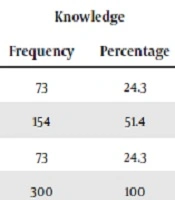
The mean scores of knowledge, attitude, and practice of the participants regarding CCHF were 18.46 ± 5.05, 40.7 ± 2.18, and 6.42 ± 3.40, respectively. As shown in Table 2, knowledge, attitude, and practice scores were categorized as weak, moderate, and good.
Table 2.
The Scores of Knowledge, Attitude, and Practice of Participants Regarding Crimean-Congo Hemorrhagic Fever
| Level | Knowledge | Attitude | Practice | |||
|---|---|---|---|---|---|---|
| Frequency | Percentage | Frequency | Percentage | Frequency | Percentage | |
| Weak | 73 | 24.3 | 80 | 26.7 | 136 | 45.3 |
| Moderate | 154 | 51.4 | 122 | 40.6 | 89 | 29.7 |
| Good | 73 | 24.3 | 98 | 32.7 | 75 | 25 |
| Total | 300 | 100 | 300 | 100 | 300 | 100 |
As can be seen in Table 3, the comparison of participants’ knowledge, attitudes, and practice scores based on their marital status showed a significant relationship between the knowledge score (P < 0.001), attitudes score (P < 0.001), and practice score(P < 0.001), and marital status (P < 0.001). Also, comparing the mean scores of participants’ knowledge, attitude, and practice based on education level showed a significant difference between knowledge (P < 0.001), attitude (P < 0.001), and practice (P < 0.001) scores of participants based on their education level (P < 0.001).
Table 3.
Comparison of the Knowledge, Attitude, and Practice Scores of Participants for Demographic Variables
| Variables | Knowledge, Mean ± SD | Attitude, Mean ± SD | Practice, Mean ± SD |
|---|---|---|---|
| Marital status | |||
| Married | 17.60 ± 4. 5 | 29.1 ± 6.19 | 5.03 ± 3.2 |
| Single | 19.55 ± 5.45 | 45.31 ± 4.5 | 8.14 ± 2.7 |
| P | < 0.001** | < 0.001** | < 0.001** |
| Education level | |||
| Illiterate | 17.55 ± 3.43 | 36.14 ± 8.52 | 4.72 ± 3.34 |
| High school | 17.17 ± 5.53 | 42.6 ± 4.22 | 4.96 ± 3.22 |
| Diploma | 16.01 ± 3.18 | 43.51 ± 8.4 | 6.85 ± 2.55 |
| Academic | 22.44 ± 4.4 | 42.20 ± 3.50 | 9.28 ± 1.9 |
| P | < 0.001** | < 0.001** | < 0.001** |
As can be seen in Table 4, there was a significant inverse correlation between age and attitude (P < 0.001. r = -0.33), knowledge (P < 0.001. r = -0.42), and practice (P < 0.001. r = -0.39). There was a significant positive relationship between practice and knowledge (P = 0.001. r = -0.39) and attitude (P < 0.001. r = -0.39).
Table 4.
Relationship Between Age, Attitude, Knowledge and Practice Variables
| Knowledge | Attitude | Practice | ||
|---|---|---|---|---|
| Knowledge | 1 | |||
| Attitude | R = -0.109, P = 0.061 | 1 | ||
| Practice | R = 0.447, P < 0.001* | R = -0.042, P = 0.477 | 1 | |
| Age | R = -0.39, P < 0.001* | R = -0.33, P < 0.001* | R = -0.42, P < 0.001* | 1 |
The results of the regression analysis showed that all the variables of knowledge, attitude, and age predicted 28% of changes in CCHF preventive practice. There was an inverse association between age and practice (P < 0.001) and a positive relationship between knowledge and practice (P < 0.001). No association was found between attitude and practice (P = 0.805). The results are given in Table 5.
5. Discussion
This study aimed to investigate the knowledge, attitude, and practice of farmers about Crimean-Congo hemorrhagic fever. Regarding knowledge, most farmers had a moderate level of knowledge about CCHF. In the study by Raab et al., a vast majority of respondents demonstrated excellent knowledge and favorable attitudes towards viral hemorrhagic fevers VHF (20). In the study by Abdollahi Shahvali et al., the knowledge of stockbreeders regarding CCHF was not adequate, and they needed the training to raise their knowledge in this regard (21).
The findings of the present study showed that most farmers had a moderate attitude toward CCHF. On the other hand, farmers showed poor attitudes toward controlling the disease by themselves. This suggests that poor attitude to an issue may cause it to become undervalued, and thus, individuals find an unfortunate practice in this regard. In the study by Abdollahi Shahvali et al., they also concluded that the attitude of stockbreeders regarding CCHF was not suitable and they required training to enhance their attitude in this regard to develop CCHF preventing behaviors (21).
Most of the participants had poor practice regarding protective measures for controlling CCHF. Based on the other findings of this study, poor attitude and knowledge about the disease among the participants can be a reason for their poor practice. The study by Ziapour et al. was also in line with our findings and showed that the frequency of practicing risky behaviors by those employed in the livestock and meat industry in Noor town was high regarding the disease. Further, practicing preventive behaviors against this fatal disease is deficient in occupations, such as animal husbandry and butchery (8).
In the present study, a significant relationship was found between knowledge, attitude, and practice regarding CCHF and marital status. Thus, by increasing their knowledge in different areas, one can alter their practice and improve their productivity. Also, the bolder presence of women in rural regions, as well as the cooperation that exists between men and women in agriculture and animal husbandry, can justify the relationship between marital status and knowledge, attitude, and practice regarding CCHF.
The results also revealed a significant relationship between the level of education and knowledge of individuals about CCHF. High levels of education can lead to studying more, thereby elevating the level of knowledge. Ziapour et al. also stated that more than half of the target group was poorly literate and thus had less knowledge about preventive solutions for the disease. As such, they did not use protective covers (8).
Besides, there was a significant relationship between the level of education and attitude of individuals to CCHF. High levels of education drive studying more and increase awareness about livestock diseases. In this way, the person becomes familiar with protective measures for disease prevention. As such, they would know that many diseases can be prevented by following some guidelines. Thus, the level of education can cause changes in the attitude of individuals to CCHF. In line with these results, Arikan et al. concluded that a higher level of education leads to a better attitude to preventive behaviors regarding CCHF (22). This outcome also held for practice; there was a significant relationship between the level of education and practice of individuals regarding CCHF. This suggests that the elevation of the level of education leads to studying more, enhancing knowledge, and thus altering the attitude. A change to the attitude can alter and boost the performance regarding adherence to protective measures for preventing CCHF. In line with these results, Sharifian et al. found a significant relationship between the level of education and the application of protective covers (23).
Based on the results of the present study, there was an inverse relationship between the age and level of knowledge. This suggests that older individuals in the study do not have adequate knowledge of CCHF. These results are congruent with the findings by Masoudy et al. regarding age and knowledge. They found that the old age of stockbreeders and low literacy caused them not to have adequate knowledge about the disease (24).
There was also a significant inverse relationship between the age and attitude levels of the participants. In this study, increasing age caused diminished attitude, suggesting that the studied elderly did not have an excellent attitude to CCHF. Little information about this issue and low literacy levels in the elderly lead to a low attitude of participants to the disease. In the study by Yilmaz et al. on the public knowledge of and attitude to CCHF in Turkey, 28% of the participants did not have adequate knowledge about this disease. They also found an inverse relationship between age and attitude due to poor literacy at advanced ages and the difficulty of attitude formation at old ages (25).
The findings revealed a significant inverse relationship between the age and level of practice of the participants. In this regard, with an increase in the age of participants, their level of practice diminished, confirming a lack of knowledge among the elderly and people with low levels of education and low attitude, and thus poor practice. Izadi et al., in a case study in Sistan and Baluchistan province, reported variables such as age above 40, history of slaughtering and high-risk jobs, and history of a tick bite as the risk factors for the disease (26).
One of the limitations of the present study was its cross-sectional design. Interventional and promotional studies should be conducted in this regard to improve the weak practice of farmers. Another limitation was the small sample size, which was limited to only one city in Lorestan province, which expectedly is going to address in further research. The present study was implemented through a questionnaire quantitatively. Thus, to better interpret the practice and its influential factors, qualitative studies are also required.
Based on the results of this study, the lack of knowledge and suitable attitude toward the disease may have resulted in poor practice in preventing and controlling CCHF. Thus, based on the findings of this study and the level of literacy of farmers in the studied region, it is suggested that suitable educational sessions be held in line with the literacy level of farmers to train them on how to prevent and control CCHF. It also proposed that regional veterinarians explain all signs of CCHF to farmers while examining the livestock.