1. Background
A common clinical problem in premature infants is patent ductus arteriosus (PDA), which is a congenital heart defect. Chronic PDA will unfavorably affect the cardiopulmonary status of these infants, especially when the condition is hemodynamically significant. Hemodynamically significant PDA (hsPDA), usually diagnosed by a combination of clinical signs and echocardiogram, can cause left-to-right shunt associated with a series of complications, including congestive heart failure, bronchopulmonary dysplasia (BPD), intraventricular hemorrhage, and necrotizing enterocolitis, any of which can affect the survival and prognosis of premature infants (1-3). The younger the gestational age of the infant at birth, the more likely the presence of PDA. For instance, the PDA rate in extremely premature infants (EPI) with a gestational age of 28 weeks is as high as 75% (4).
Decancq in 1963 reported the first case of PDA ligation in a premature infant with a birth weight of 1,417 g (5). Subsequently, non-steroidal anti-inflammatory drugs, such as indomethacin and ibuprofen were used for the treatment of PDA, and the number of infants undergoing surgical ligation decreased remarkably. However, surgical ligation is still an important therapeutic option in premature infants who are contraindicated for medical treatment, or for whom medical treatment has failed. According to a study in Nationwide Children’s Hospital, Columbus, the rate of PDA ligation decreased substantially since 2010 (1).
There are still substantial controversies over the indications and optimal timing of surgical ligation for PDA (6). It has not been determined definitively whether more aggressive surgical strategies are of greater benefit to premature infants with hsPDA. Hence, it is not still clear which of the methods (early or late ligation) is preferable for EPI.
To provide useful references for the clinical treatment of PDA in premature infants, the present retrospective study evaluated the outcomes associated with the timing and safety of surgical ligation. To achieve the study aims, we reviewed the clinical data of 44 EPI (gestational age at birth 26.8 ± 0.67 weeks; birth weight 997 ± 152 g) who received surgical ligation for hemodynamically significant PDA (hsPDA) in the Neonatal Intensive Care Unit (NICU) of the Seventh Medical Center of PLA General Hospital in China between January 2021 and December 2014.
2. Methods
2.1. Subjects and Methods
The current retrospective cohort study was approved by the Ethics Board of the Seventh Medical Center of PLA General Hospital, and all protocols were in accordance with the Helsinki Declaration. For all preterm infants enrolled in this study, written informed consent was obtained from the parents or their legal guardians prior to PDA screening and treatment.
Forty-four EPI with PDA who received surgical ligation in the NICU between January 2021 and December 2014 were enrolled in our study. We retrieved the clinical data of all patients from the hospital’s electronic database. Data included gender, gestational age at birth, birth weight, perinatal factors, main underlying diseases, and outcome. The inclusion criteria were: < 28 weeks of gestational age at birth; with hsPDA, for which medical treatment has failed or is contraindicated; and PDA ligation during hospitalization. The diagnosis of hsPDA was made according to the criteria by Malviya et al. (7), which includes a clinical sign of PDA (heart murmur, water-hammer pulse, tachycardia, increased precordial beating, increased pulse pressure difference, and deterioration of respiration). In addition, hsPDA was adjudged for any of the following echocardiography tests: left-right shunting or bidirectional two-phase shunting; a left atrial-to-aortic root ratio (LA/LO) > 1.3; and DA diameter > 1.5 mm. Failure of medical treatment was defined as persistent hsPDA after two courses of drug treatment. Infants with other congenital malformations or congenital heart diseases and those who died within 15 days after birth were excluded from the study.
The patients were classified into two groups of early ligations (≤ 14 days after birth) and late ligation (> 14 days after birth). Then, the following were compared between the two groups: general and perinatal data, main underlying diseases, size of the ductus arteriosus (DA), intervention, postoperative complications, and outcome.
The first echocardiography was performed between 48 and 72 hours after birth. In premature infants with hsPDA and without medical contraindications, oral ibuprofen was first administered, with a first dose of 10 mg/kg and second/third doses of 5 mg/kg at 24-h intervals. Ibuprofen was contraindicated for patients with any of the following problems: urine output < 1 mL/kg/h for > 8 h; platelet count < 60 × 109/L; presence of intraventricular hemorrhage within 12 h; serum creatinine > 140 μmol/L; or active hemorrhage.
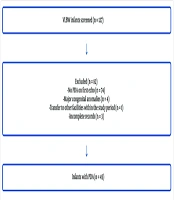
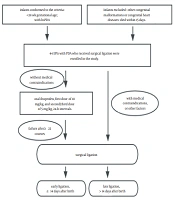
Surgical ligation of PDA was indicated upon diagnosis of hsPDA, failure after ≥ 2 courses of medical treatment, or contraindications for treatment. In addition, surgical ligation was indicated in the present of cardiopulmonary compromise related to the PDA, such as ventilatory needs increasing over several days, persistent hypotension requiring inotropic support, persistent oliguria/renal failure, feeding intolerance, or failure to gain weight. Recurrent or severe pulmonary bleeding associated with PDA also indicated the need for surgical ligation. Figure 1 is the flow diagram of the study.

Figure 1.
Flow diagram of the patients
All surgical procedures were performed by the same surgical team at the NICU bedside with the patient under general anesthesia. Surgical ligation was performed via a small incision in the left 3 - 4 intercostal space, using titanium clip clamping or direct double ligation with silk.
2.2. Statistical Methods
All data were analyzed using SPSS 18.0 software. Measurement data were expressed as mean ± standard deviation, and inter-group differences were compared by chi-squared test. Fisher’s exact probability method was used to analyze groups with sample size < 5. Comparison of the mean value between two groups was performed by independent samples t-test. P < 0.05 was considered as statistically significant.
3. Results
3.1. General Characteristics, Main Underlying Diseases, and Intervention Measures
Out of a total of 44 EPI included in the study, 28 were boys, and 16 were girls (gestational age at birth 26.80 ± 0.67 weeks and birth weight 996.75 ± 152.07 g) (Table 1). There were 20 and 24 infants in the early and late ligation groups, respectively. We compared the gender, gestational age at birth, birth weight, and other perinatal features among the two groups. The percentage of patients with neonatal respiratory distress syndrome in the early ligation group was significantly higher than that of the late ligation group. The percentage of patients with pulmonary hemorrhage and use of pulmonary surfactants was higher in the early ligation group compared with the late ligation group, but the difference was not statistically significance (Table 1).
Table 1.
General Characteristics, Main Underlying Diseases, and Intervention Measures of the Early and Late Ligation Groups (n = 20 and 24, Respectively) a
| Early Ligation | Late Ligation | χ2/t | P | |
|---|---|---|---|---|
| Male | 11 (55.00) | 17 (70.83) | 1.182 | 0.277 |
| Gestation age, wk | 26.76 ± 0.68 | 26.83 ± 0.68 | 0.337 | 0.738 |
| Birth weight, g | 1011.35 ± 144.83 | 984.58 ± 159.90 | 0.577 | 0.567 |
| 1-min Apgar | 5.65 ± 3.08 | 5.58 ± 3.09 | 0.071 | 0.943 |
| 5-min Apgar | 7.15 ± 2.39 | 7.38 ± 2.18 | 0.324 | 0.748 |
| Single/twin, n/n | 11/9 | 14/7 | 0.049 | 0.823 |
| Cesarean section | 7 (35.00) | 6 (25.00) | 0.563 | 0.453 |
| Maternal age, y | 28.53 ± 5.30 | 30.80 ± 3.25 | 1.625 | 0.113 |
| Prenatal DEX administration | 8 (40.00) | 9 (37.50) | 0.029 | 0.865 |
| ART b | 2 (10.00) | 5 (20.83) | 0.935 | 0.328 |
| NRDS b | 20 (100.00) | 18 (75.00) | 5.658 | 0.025 |
| Pneumonia b | 3 (15.00) | 7 (29.17) | 1.247 | 0.264 |
| Metabolic acidosis | 7 (35.00) | 10 (41.67) | 0.205 | 0.651 |
| Pulmonary hemorrhage | 7 (35.00) | 6 (25.00) | 0.524 | 0.469 |
| IVH | 9 (45.00) | 14 (58.33) | 0.777 | 0.378 |
| Pulmonary surfactant b | 20 (100.00) | 22 (91.67) | 1.746 | 0.186 |
| Vasoactive drugs b | 19 (95.00) | 18 (75.00) | 3.262 | 0.071 |
| Invasive ventilation | 20 (100.00) | 24 (100.00) | — | — |
Abbreviations: ART, assisted reproductive technology; DEX, dexamethasone; IVH, intraventricular hemorrhage; NRDS, neonatal respiratory distress syndrome.
aValues are expressed as No. (%) or mean ± SD.
bFisher’s exact probability method
3.2. Size of DA and Intervention Measures
As Table 2 shows, the groups were similar in the following parameters: size of DA primary ultrasound; maximum DA diameter; intra-operative DA diameter; LA/LO; and medical treatment cycles. Medical treatment (ibuprofen) was initiated at a significantly earlier age in the early ligation group.
Table 2.
DA Status and Intervention Measures of the Early and Late Ligation Groups
| Early Ligation | Late Ligation | χ2/t | P | |
|---|---|---|---|---|
| DA diameter, mm | ||||
| Primary ultrasound | 2.2 ± 0.4 | 2.1 ± 0.5 | 1.018 | 0.315 |
| Maximum | 2.6 ± 0.6 | 2.9 ± 0.6 | 1.345 | 0.186 |
| Intraoperative | 4.6 ± 0.8 | 5.0 ± 1.3 | 1.286 | 0.205 |
| LA/LO | 1.6 ± 0.2 | 1.5 ± 0.2 | 1.107 | 0.274 |
| Ibuprofen, d | ||||
| Age at initiation | 3.0 ± 2.1 | 6.5 ± 5.8 | 2.216 | 0.034 |
| Course | 1.9 ± 0.6 | 1.8 ± 1.0 | 0.346 | 0.732 |
| Age at ligation, d | ||||
| Mean ± SD | 11.3 ± 1.8 | 29.8 ± 18.0 | 4.579 | 0.000 |
| Median (range) | 11 (8 - 14) | 24 (15 - 99) |
Abbreviations: SD, standard deviation.
3.3. Postoperative Complications and Main Conversion Parameters
No intra-operative deaths occurred among the 44 patients (Table 3). There were three cases for each of the postoperative infection and hypotension, and two cases for postoperative pneumothorax. In addition, there was one case for each of the recurrent laryngeal nerve injury and hypertension. The overall rates of postoperative complications were relatively low in both groups. The two groups were similar in terms of postoperative pneumothorax, infection, pleural cavity hemorrhage, recurrent laryngeal nerve injury, hypotension, and hypertension. Moreover, the groups were similar regarding the rates of the following late postoperative complications: BPD, retinopathy of prematurity, periventricular leukomalacia, and necrotizing enterocolitis. There was no significant difference between the two groups in mortality, total hospital stays, and medical costs.
Table 3.
Postoperative Complications and Main Outcome Parameters of the Early and Late Ligation Groups a
| Early Ligation | Late Ligation | χ2/t | P | |
|---|---|---|---|---|
| Postop pneumothorax b | 1 (5.00) | 1 (4.17) | 0.017 | 0.896 |
| Postop pleural hemorrhage | 0 (0.00) | 0 (0.00) | - | - |
| Recurrent laryngeal nerve injury b | 0 (0.00) | 1 (4.17) | 0.833 | 0.361 |
| Postop infection b | 2 (10.00) | 1 (4.17) | 0.571 | 0.450 |
| Postop hypotension b | 3 (15.00) | 0 (0) | 3.766 | 0.086 |
| Postop hypertension b | 1 (5.00) | 0 (0) | 1.200 | 0.455 |
| BPD * | 17 (85.00) | 21 (87.50) | 0.058 | 0.810 |
| Preop BPD b | 0 (0.00) | 8 (33.30) | 8.148 | 0.004 |
| Severe BPD | 7 (35.00) | 16 (66.67) | 4.385 | 0.036 |
| Retinopathy of prematurity | 14 (70.00) | 21 (87.50) | 2.053 | 0.152 |
| PVL b | 2 (10.00) | 3 (12.50) | 0.066 | 0.797 |
| NEC b | 1 (5.00) | 1 (4.17) | 0.017 | 0.896 |
| Age at total enteral feeding, d | 34.00 ± 13.61 | 43.68 ± 14.89 | 2.232 | 0.031 |
| Respiratory support, d | 44.50 ± 26.41 | 59.96 ± 22.27 | 2.082 | 0.044 |
| Death b | 4 (20.00) | 3 (12.50) | 0.448 | 0.684 |
| Hospital stays, d | 89.25 ± 34.86 | 96.29 ± 30.32 | 0.717 | 0.478 |
| Hospitalization cost, 10 Wan CNY | 14.91 ± 4.79 | 15.72 ± 4.99 | 0.546 | 0.588 |
Abbreviations: BPD, bronchopulmonary dysplasia; NEC, necrotizing enterocolitis; PVL, periventricular leukomalacia.
a Values are expressed as No. (%) or mean ± SD.
b Fisher’s exact probability method
However, the rate of severe BPD in the late ligation group was significantly higher than that of the early ligation group. Notably, eight patients in the late ligation group were diagnosed with BPD before the surgery. The late ligation group also experienced a significantly longer time to reach total enteral feeding and time of total (invasive plus non-invasive) respiratory support.
4. Discussion
In this study, we retrospectively reviewed 44 EPI cases who underwent surgical ligation to determine the best age range for repairing the hsPDA. We compared the mortality rates, BPD, retinopathy of prematurity, necrotizing enterocolitis, and periventricular leukomalacia between the two groups of early ligations (≤ 14 days after birth) and late ligation (> 14 days after birth). The percentage of infants who developed severe BPD was significantly lower in the early ligation group compared with late ligation group. In addition, infants who underwent early ligation required significantly less time to achieve total enteral feeding and weaning from respiratory support. These results indicate that in EPI with PDA, for whom medical therapy is not viable, early surgical ligation is more beneficial.
The infants in both groups were similar in general characteristics, including gender, gestational age at birth, birth weight, maternal age, mode of delivery, prenatal hormone use, 1- and 5-min Apgar scores, and other perinatal parameters. However, the rates of neonatal respiratory distress syndrome, pulmonary hemorrhage, or use of vasoactive drugs were higher in the early ligation group compared with the late ligation group. This suggests that the pathologic condition of the premature infants in the early ligation group was more severe than that of the late ligation group. The size of the DA and LA/LO of the two groups were similar, as shown by both ultrasound and intra-operative measurements. However, the infants of the early ligation group were younger at the time that medical therapy was initiated, perhaps because of the high rate of neonatal respiratory distress syndrome and poorer pulmonary status.
Chronic hsPDA may lead to a series of complications in premature infants. The increased pulmonary blood flow (steal phenomenon) that is a feature of hsPDA is a risk factor of pulmonary congestion, edema, or even hemorrhage, which can lead to BPD. Simultaneously, the decrease in systemic blood flow can lead to feeding intolerance, necrotizing enterocolitis, renal function impairment, and cerebral ischemia (8-10). Delayed ligation can increase the risk of these complications, but the optimal time of surgical ligation has remained uncertain. Martini et al. (11) reported that PDA ligation within three weeks after birth was safe and effective; but they did not find that early ligation held advantages over late ligation in terms of intubation withdrawal or BPD. In contrast, a recent multicenter trial compared early routine pharmacologic treatment of moderate-to-large PDA at the end of week 1 with a conservative approach that required prespecified respiratory and hemodynamic criteria before treatment could be given. They concluded that the early routine pharmacologic treatment group had a significantly lower rate of moderate-to-large PDA at 10 days and a significantly lower rate of receiving rescue treatments compared with the conservative treatment group (12). Martini et al. (11) also found that earlier PDA ligation may contribute to reduced rates of late-onset sepsis and post-discharge home oxygen therapy, with possible cost-benefit implications. Lee et al. (13) found that ligation within 15 days after birth could reduce the rate of necrotizing enterocolitis and improve feeding intolerance. However, the rates of BPD were not affected by the age at ligation.
According to the mentioned results, early ligation may be more beneficial for medical refractory premature infants, especially in those with low gestational age and birth weight. In the present study, the mortality rates, BPD, total hospital stay, and hospital costs were similar between the two groups. However, the total duration of respiratory support was shorter, the age to reach total enteral feeding was lower, and the occurrence of severe BPD was lower in the early ligation group, suggesting that early closure of hsPDA could attenuate the effect of DA shunting on the pulmonary and gastrointestinal circulations and improve the prognosis.
The operative time of PDA ligation and the associated risks have remarkably reduced due to the improvements in surgical techniques and instruments and widespread application of bedside surgery. Some recent large-scale studies have highlighted the safety and effectiveness of surgical ligation of PDA in premature infants, stating that the mortality rate of infants who undergo ligation is significantly lower than those who do not undergo ligation (14). In our study, the rates of procedure-related complications were low, specifically in three cases of postoperative infection, two cases of pneumothorax, and one cases in each of the recurrent pharyngeal nerve injury, postoperative hypotension, and postoperative hypertension. The early and late ligation groups had similar rates of procedure-related complications. This suggests that bedside PDA ligation is safe and effective for EPI cases, whether performed before or after the age of 14 days.
The limitations of the present study include an inherent bias due to its retrospective nature and a relatively small sample size. Nevertheless, our data supported that for EPI with hsPDA, who are contraindicated for medical therapy or fail to respond to medical therapy, early ligation is preferable. The infants who underwent early ligation required significantly less time for respiratory support, achieved total parenteral nutrition more quickly, and suffered a lower rate of severe BPD.