
1. Background
Approximately 240,000 new acute lymphoblastic leukemia (ALL) cases are annually identified in children (1). This kind of leukemia is caused by the excessive growth of immature lymphoid cells in the peripheral blood and bone marrow (2). The Children’s Oncology Group protocol is applied for treating ALL children. This protocol initiates with an induction stage, followed by stabilization and maintenance stages. In this protocol, methotrexate (MTX, 20 mg/m2) is given weekly to patients. Also, they receive 6-mercaptopurine (75 mg/m2) daily and the pulses of prednisolone and vincristine or dexamethasone every 28 days until ending the maintenance stage (3).
Different complications can be caused by MTX toxicities in patients. About 2 - 4% of all cured patients reported the occurrence of hematologic toxicity. The most prevalent hematologic problems of this medicine include the occurrence of agranulocytosis, pancytopenia, and hematopoietic disorders. Besides, this drug can result in hepatic complications. As another related issue, if this drug is used in high doses, it may increase serum levels of alanine aminotransferase (ALT) 10 - 20 times in 12 - 48 h. However, its low to moderate doses can raise aspartate aminotransferase levels or serum ALT in 15 - 50% of cases. In this respect, more liver problems occur when this drug is concurrently taken with other drugs, e.g., azathioprine or leflunomide (4-9).
The MTX pharmacokinetics can be affected by expression forms of ABCB1 gene polymorphisms that significantly affect MTX toxicity and activity. Studies have shown that these issues also are accompanied by an increased risk of ALL in the Asian population (10, 11).
As reported in (12), 28 exons exist in the ABCB1 gene – a gene on chromosome 7 (q21.12) that duplicates the multidrug resistance (MDR1) protein. High levels of ABCB1 expression result in reduced intracellular concentration of medicines. Besides, the activity of ABCB1 essentially has a role in the toxicity and effectiveness of the drug during the treatment, affecting hepatic or renal excretion and gastrointestinal absorption of drugs (13). Mutations can create C to T mutates at 3435 points of the ABCB1 gene, which is a Wobble gene. Moreover, G to A nucleotide mutates are caused by the mutation at the 1199 point of this gene, altering the amino acid SER 400 to ASN 400 (14).
MTX toxicity is inevitable even in some patients with leukemia despite advanced clinical procedures and standard approaches. Hence, it seems that this medicine’s toxicity and the identification of genetic factors (mutant alleles) in the patients is necessary for detecting those vulnerable to hepatic and hematologic toxicity. Moreover, such studies are necessary because MTX is cheap and vital for acute leukemia treatment in pediatric patients, and there is no substitute in this way.
2. Objectives
Regarding the mentioned points, the present work aims to evaluate Methotrexate toxicity and its association with ABCB1 genetic polymorphism in ALL pediatric patients in Kurdistan, Iran.
3. Methods
3.1. Research Design, Period, and Area
This cross-sectional research was carried out on 1 - 15-year-old children with ALL referred to Be’sat Hospital in Sanandaj, Kurdistan province (Iran), from 2012 to 2019.
3.2. Inclusion Criteria
(1) Children diagnosed with the disease according to clinical symptoms and bone marrow aspiration samples tested by the Department of Pediatric Hematology and Oncology during 2012 – 2019.
(2) All children diagnosed with ALL during the present research and under MTX treatment.
3.3. Exclusion Criteria
(1) Reluctance of patients for cooperating and participating in the research.
(2) Not coming for the check-up and not following the therapy for any reason.
3.4. Data Collection
The research was initiated after obtaining patients’ permission to conduct the study. Taking blood samples and other procedures were conducted as a part of the therapy process. Genetic examinations were not a part of the therapy process proposed in this research.
3.4.1. Blood Sampling
In the present work, 4 mL samples of peripheral blood were taken from each participant. CBC tubes were used for collecting blood samples with the ethylenediaminetetraacetic acid anticoagulant. The samples were then transported to the lab at 4°C and kept in the freezer.
3.4.2. Disease Diagnosis and Detection of Laboratory Toxicity Factors
There was continuous monitoring for hepatotoxicity and blood toxicity in all MTX-treated subjects. We also assessed, checked, and recorded the amount of platelets and leukocytes, neutrophil percent, alanine transaminase activity, hemoglobin, and aspartate transaminase.
3.4.3. ABCB1 Genotyping
The DNA of peripheral blood samples was extracted using a DNA isolation kit (GeneAll, Seoul, South Korea) based on the manufacturer’s instructions. Next, DNA was diluted in 50 μL of deionized sterile water. The extracted DNA was analyzed quantitatively and qualitatively at 280 and 260 nm. Then, a nanodrop spectrophotometer was applied for genotyping ABCB1 C3435T and G1199A polymorphisms. Using 300 µL of DNA samples, PCRs were conducted at 94°C for 5 min, followed by 35 cycles of 94°C for 30 s, 62°C for 30 s (to detect C3435T)/2°C for 30 s (to detect G1199A) and 72°C for 1 min, and finally at 72°C for 10 min. It is of note that these reactions were carried out in a 10 μL reaction volume consisting of 1 μL isolated DNA, 5 μL 2 × PCR Master Mix, and 0.5 μL to 10 μM of each reverse and forward primer (Table 1).
Table 1.
The Applied Primer for Examining Gene Expression
| Gene Name | Primer Name | Sequence | Size |
|---|---|---|---|
| G1199A | MDR-24 forward | 5-CAG CTA TTC GAA GAG TGG GC | 258 |
| MDR-25 reverse | 5-CCG TGA GAA AAA AAC TTC AAG G | ||
| C3435T | MDR-11 forward | 5-TGT TTT CAG CTG CTT GAT GG | 244 |
| MDR-12 reverse | 5-AAG GCA TGT ATG TTG GCC TC |
Abbreviation: MDR, multidrug resistance.
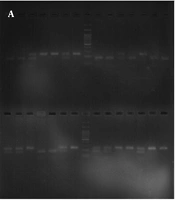
The ABCB1 C3435T and ABCB1 G1199A polymorphisms were specified by PCR-restriction fragment length polymorphism (RFLP) test using Mbo-1 and Acu-1 restriction enzymes, respectively (Thermo Fischer Scientific, USA). The electrophoresis of RFLP and PCR products was done on the stained agarose gel (3%) and visualized under UV light using a UV transilluminator (Figure 1). The reliability of PCR methods was ensured using Sanger sequencing for analysis of all the variant samples, as the results were completely compatible with enzyme digestion and amplification approaches.
![A, Agarose gel of the ABCB1 3435 (Lanes with 3 bands: CT genotype; Lanes with 2 bands: CC genotype, Lanes with 1 band: TT genotype); B, Agarose gel of the ABCB1 1199 [Lanes 1, 2 and 3 (undigested bands), GG genotype; Lanes 4 (digested band), AA genotype].](https://brieflands.com/journals/ijp/articles/115502/figures/ijp-115502-g001-F1-preview.webp "A, Agarose gel of the ABCB1 3435 (Lanes with 3 bands: CT genotype; Lanes with 2 bands: CC genotype, Lanes with 1 band: TT genotype); B, Agarose gel of the ABCB1 1199 [Lanes 1, 2 and 3 (undigested bands), GG genotype; Lanes 4 (digested band), AA genotype].")
Figure 1.
A, Agarose gel of the ABCB1 3435 (Lanes with 3 bands: CT genotype; Lanes with 2 bands: CC genotype, Lanes with 1 band: TT genotype); B, Agarose gel of the ABCB1 1199 [Lanes 1, 2 and 3 (undigested bands), GG genotype; Lanes 4 (digested band), AA genotype].
3.5. Ethical Considerations and Participation Consent
For participants younger than 16 years, written consent was taken from their parents or guardians. The Ethics Committee of Kurdistan University of Medical Sciences (KUMS) approved this research (Code: IR.MUK.REC.1397/241) in terms of ethical considerations.
3.6. Data Analysis
Data were analyzed using SPSS software. The occurrence of side effects of the drug was measured in research groups. Additionally, the indicators were studied in terms of before and after changes. The chi-square test was performed to compare qualitative variables between research groups. A P-value below 0.05 was regarded as the significance level.
4. Results
The present research was conducted on 81 ALL children, including 36 females and 45 males (55.5%) with a mean age of 6.32 ± 3.08 years old (Table 2), and there was no excluded case.
Table 2.
Demographic Characteristics
| Variables | No. (%) |
|---|---|
| Gender | |
| Male | 45 (55.5) |
| Female | 36 (44.6) |
| Type of ALL | |
| Pre B cell | 75 (92.59) |
| T cell | 4 (4.93) |
| Pre B cell + AML | 2 (2.49) |
| Early pre B cell | 0 (0) |
| At-risk groups | |
| Standard/low risk | 62 (76.54) |
| Medium/high risk | 19 (23.45) |
Abbreviations: AML, acute myeloid leukemia; ALL, acute lymphoblastic leukemia.
The ABCB 1 gene mutation frequency at 1199 G->A and 3435 C->T points were 4.9 and 70.4% (Table 3), respectively. The frequency of leukopenia (P = 0.512), gastrointestinal toxicity (P = 0.876), anemia (P = 0.780), hepatotoxicity (P = 0.543), neutropenia (P = 0.708), and thrombocytopenia (P = 0.563) in cases with variant alleles of the ABCB 1 (heterozygous and homozygous) mutation at the 3435 C->T point was not significantly different with those having regular homozygous polymorphisms (Table 4).
Table 3.
Frequency of Mutant & Normal Alleles on ABAB1 Gene at 3435 & 1199 Points
| Allele | No. (%) |
|---|---|
| 1199 | |
| GG | 77 (95.1) |
| GA | 3 (3.7) |
| AA | 1 (1.2) |
| 3435 | |
| CC | 24 (29.4) |
| CT | 31 (38.3) |
| TT | 26 (32.1) |
Table 4.
Association Between Side Effects of Drug in Children with ALL having ABAB1 Gene Mutation at 3435 Point(C->T) and 1199 Point (G->A)
| Drug Side Effects | ABCB1 Genotype | ||||||||
|---|---|---|---|---|---|---|---|---|---|
| Wild-Type | Variant | Variant | Total | P-Value | |||||
| (CC) | (GG) | (CT) | (GA) | (TT) | (AA) | C->T | G->A | ||
| Liver toxicity | 7 (30.4) | 22 (95.7) | 7 (30.4) | 1 (4.3) | 9 (39.1) | 0 (0.0) | 23 (28.4) | 0.543 | 0.805 |
| Gastrointestinal toxicity | 5 (35.7) | 14 (100) | 5 (35.7) | 0 (0) | 4 (28.6) | 0 (0.0) | 14 (17.3) | 0.876 | 0.644 |
| Leukopenia | 16 (32.7) | 47 (95.9) | 20 (40.8) | 2 (4.1) | 13 (26.5) | 0 (0.0) | 49 (60.5) | 0.512 | 0.452 |
| Anemia | 13 (32.5) | 39 (97.5) | 14 (35) | 2 (2.5) | 13 (32.5) | 0 (0.0) | 40 (49.4) | 0.780 | 0.513 |
| Thrombocytopenia | 13 (33.3) | 37 (94.9) | 16 (41) | 2 (5.1) | 10 (25.6) | 0 (0.0) | 39 (48.1) | 0.563 | 0.511 |
| Neutropenia | 15 (31.9) | 46 (97.9) | 19 (40.4) | 1 (2.1) | 13 (27.7) | 0 (0.0) | 47 (58.2) | 0.708 | 0.329 |
| Renal toxicity | 0 (0.0) | 0 (0.0) | 0 (0.0) | 0 (0.0) | 0 (0.0) | 0 (0.0) | 0 (0.0) | - | - |
Abbreviations: ALL, acute lymphoblastic leukemia.
Based on the results, the frequency of leukopenia (P = 0.452), gastrointestinal toxicity (P = 0.644), thrombocytopenia (P = 0.511), anemia (P = 0.513), neutropenia (P = 0.329), and hepatotoxicity (P = 0.805) was not significantly different in patients with variant alleles of the ABCB 1 (heterozygous and homozygous) mutation at the 1199 G->A point compared with cases having ordinary homozygous polymorphisms (Table 4).
5. Discussion
ALL is the most prevalent kind of hematologic malignancy in children. Despite several treatments and diagnosis procedures available for leukemia children, long-term complications are noticed in many of them. The treatment lasts almost 3 years, and 80% of ALL children show complete recovery. Despite the high potential of MTX as a therapy in ALL patients, it may result in different complications. Thus, studying factors causing or exacerbating these complications is of great importance. In respect, it is important to investigate this drug’s toxicity and identify genetic factors (mutant alleles) in patient for detecting those vulnerable to hepatic and hematologic toxicity.
The current research shows that the ABCB 1 gene mutation prevalence at 1199G->A and 3435 C->T points was 4.9 and 70.4%, respectively. Also, the allelic frequency for Ser400Asn in the Caucasian people and the ABCB1 gene mutation prevalence at 3435 points were expressed as 5.5% and 53.9, respectively (15).
In addition, the ABCB 1 gene mutation prevalence at 3435 points was 87.14 and 60% in chronic myelogenous leukemia and normal Iranian populations, respectively (16). Based on the obtained results, its prevalence was 72.7 and 69.6% among Italy’s Japanese and Tuscany populations, respectively (17).
According to the study results, cases with homozygous and heterozygous mutant mutations of the ABCB1 gene at 1199 points showed an incidence frequency of leukopenia, gastrointestinal toxicity, thrombocytopenia, hepatotoxicity, anemia, nephrotoxicity, and neutropenia than those with polymorphism.
Accordingly, a protective effect can be found in the ABCB1 gene mutation at 1199 G->A point against MTX complications in those having this gene mutation.
To the best of our knowledge, no research has been conducted on the relationship between ABCB1 gene polymorphism at 1199 points and hematologic, gastrointestinal, hepatic, and kidney toxicity. Nevertheless, as represented by earlier evidence concerning this gene mutation, its recurrence risk in cases with 1199GA polymorphisms augmented 2.9 times compared with 1199GG polymorphisms. This result suggests the possibility of the 1199 G->A ABCB1 mutation as a new prognosis predictor in pediatric patients. As reported by Woodahl et al., MDR1 G1199A polymorphism could have an anti-cancer effect through modulation of drug distribution and delivery of tumor cells (18).
Results of data analysis indicated no significant difference in the incidence of leukopenia, gastrointestinal toxicity, anemia, hepatotoxicity, thrombocytopenia, nephrotoxicity, and neutropenia in cases with the homozygous and heterozygous polymorphisms of the ABCB1 gene mutation compared to those with polymorphism at point 3435. This outcome rejects the possibility of the relation of hepatic, hematologic, renal, and gastrointestinal toxicities by the ABCB1 gene mutation at 3435 C->T point.
Zgheib et al. studied 127 Lebanese patients with ALL and demonstrated a statistically significant association between alkaline carriers of types ABCB1 rs1128503 (C1236T) and ABCB1 rs1045642 (C3435T) and neutropenia (absolute neutrophil count < 500). Besides, they showed that genotyping for ABCB1 polymorphism could be helpful to identify patients vulnerable to MTX toxicity (19).
As reported by Gregers et al., cases with the TT genotype at 3435 points of ABCB1 gene within vincristine, prednisolone, and doxorubicin therapy showed a higher bone marrow toxicity rate. Moreover, cases with the CC genome at 3435 points exhibited hepatotoxicity in the high-dose therapy with MTX (20). Another study showed that neutrophils (63, 72, and 80%) CC, CT, and TT genomes were more significantly reduced in subjects with varying ABCB1 C3435T alleles (21).
In another case, 78 SNPs were studied by Yao et al. in ABCC1, ALDH1A1, and ABCB1 in 882 patients with breast cancer. The results showed no significant association between any SNPs in ABCB1 and blood toxicity and no relationship between any of the 16 single nucleotide polymorphisms in ALDH1A1 or ABCB1 and gastrointestinal toxicity (22).
Samara et al. examined the association between MDR1 C3435T and RFC1 G80A polymorphisms and response to MTX and toxicity in patients with rheumatoid arthritis and found a statistically significant relationship in this regard. According to their results, the risk of gastrointestinal toxicity was higher in cases with the RFC1 80GG genotype. Meanwhile, the risk of MTX general toxicity, particularly hepatotoxicity, was higher in patients with a minimum of one MDR1 3435T allele (23).
As concluded by Suthandiram et al., there was an association between ABCB1 C3435T and SLC19A1 G80A and hepatic toxicity. In this study, concentrations of MTX plasma showed a significant rise in cases with ABCB1 C3435T and MTHFR C677T polymorphisms (24).
Bergmann et al. studied the paclitaxel effect in ovarian cancer patients and genetic variants’ effect in ABCB1 and CYP2C8 on the disease survival and toxicity. However, they did not find a significant association between ABCB1 and CYP2C8. C1236T, C3435T, and G2677T/A with neutropenia, general survival, and sensory neuropathy (25).
5.1. Limitations
The main problem faced in the current study was the common errors in blood sample collection, including insufficient sample quantity, clotting, and hemolysis. On some occasions, it was necessary to collect blood samples once more, which sometimes disturbed the patients. Therefore, it was tried to talk to patients and their parents to remind them how their contribution would be for all patients with the same disease worldwide.
The present study results can be generalized to patients with ALL in Be’sat Hospital of Kurdistan (Iran) and all other patients, although with caution and sufficient knowledge. Also, since this study was performed on children with ALL, its results cannot be generalized to the whole community.
5.2. Conclusions
The current research findings showed no significant difference in MTX toxicity rate in cases with ABCB1 gene mutation at point 3435 C->T. Also, the findings suggest the possible protective effect of ABCB1 gene mutation at 1199 G->A against the MTX complications’ effects. However, no significant association was found in this regard. Hence, it seems that C3435 T, G1199A, and ABCB1 are significant MTX toxicity markers in children with ALL.