Innovative Journal of Pediatrics
The Scientific Journal of Growth & Development Research Center
e-ISSN 3117-5341
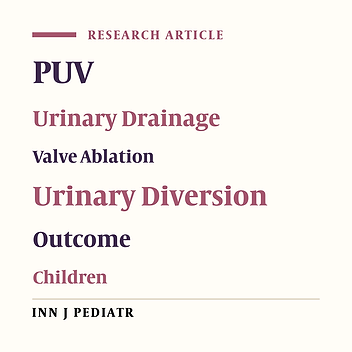
Image Credit:Inn J Pediatr
Outline
Posterior Urethral Valves; A single Center Experience
Authors
Alireza Mirshemirani1,*, Ahmad Khaleghnejad2, Mohsen Rouzrokh3, Afsaneh Sadeghi4, Leila Mohajerzadeh5, Mustafa Sharifian6
Published online:Aug 05, 2013
Article type:Research Article
Received:Feb 27, 2013
Accepted:May 15, 2013
How to Cite:Mirshemirani A, Khaleghnejad A, Rouzrokh M, Sadeghi A, Mohajerzadeh L, et al. Posterior Urethral Valves; A single Center Experience. Inn J Pediatr. 2013;23(5):. doi:
Abstract
Objective: Posterior urethral valves (PUV) are the most common cause of bladder outlet obstruction in infancy that impair renal and bladder function. This study was planned to evaluate and record the various clinical presentations and management, complications, and surgical management and long-term outcome of PUV. Methods: In a retrospective study, 98 patients who have been treated for PUV are evaluated in Mofid Children’s Hospital from January 2007 to December 2012. Detailed history taken and paraclinical examinations were performed in each patient and diagnosis was confirmed by voiding-cysto-urethrography (VCUG). PUV had been ablated in 62 patients by electric hook, and diversion was performed in 42 (42.85%) cases. Data were analyzed by SPSS software version18. Findings: Totally 98 patients with mean age at diagnosis 62 (±13) days were included in this study. Fifty seven cases had been catheterized within one to 6 days of life (mean age one day), PUV was ablated in 62 patients by electric hook, and diversion was performed in 42 cases. The most common symptom in our group was dribbling poor stream 51% and urinary tract infection (UTI) 40.8%. There was vesico-ureteral-reflux (VUR) in 61.2%, and hydronephrosis in 82.6%. Most common associated anomaly was kidney anomalies (multicystic kidney disease and renal agenesis/dysplasia) in 8 (8.2%) patients. Twenty patients had prenatal diagnosis of PUV. Complication occurred in three (3.1%) patients. Mortality occurred in 5 (5.1%) patients. Mean follow-up period was 3.4±1.2 years (1.5 months to 5 years). Conclusion: Urinary drainage by feeding tube in early days of infancy, followed by valve ablation is the best treatment in PUV, and urinary diversion improves the outcome. VCUG is still the gold-standard imaging modality for documenting PUVs. The factors like renal dysplasia and UTI have their role in final outcome.
Highlights
References
- 1.References are available on the PDF.
Copyright
© 2013, Author(s). This open-access article is available under the Creative Commons Attribution 4.0 (CC BY 4.0) International License (https://creativecommons.org/licenses/by/4.0/), which allows for unrestricted use, distribution, and reproduction in any medium, provided that the original work is properly cited.
Similar Articles
8
May
2019
Renal Tubular Functions in Patients with Posterior Urethral Valve
Zeynep Alp Unkar,
Nur Canpolat,
Mine Kucur,
Salim Caliskan,
Lale Sever
Alp Unkar Z, Canpolat N, Kucur M, Caliskan S, Sever L. Renal Tubular Functions in Patients with Posterior Urethral Valve. Inn J Pediatr. 2019;29(3):e88804. doi: https://doi.org/10.5812/ijp.88804
7
Sep
2017
The Dilemma of Ureterovesical Junction Obstruction
Seyed Mohammadreza Rabani,
Ali Mousavizadeh
Rabani SM, Mousavizadeh A. The Dilemma of Ureterovesical Junction Obstruction. Nephro-Urol Mon. 2017;9(5):e57201. doi: https://doi.org/10.5812/numonthly.57201
10
Feb
2018

Management and Outcome of Vesicoureteral Reflux: A 14-Year Experience
Seyed-Javad Nassiri,
Maryam Ghavami-Adel
Nassiri S, Ghavami-Adel M. Management and Outcome of Vesicoureteral Reflux: A 14-Year Experience. Inn J Pediatr. 2018;28(1):e57730. doi: https://doi.org/10.5812/ijp.57730
9
Nov
2013
Protective Temporary Vesicostomy for Upper Urinary Tract Problems in Children: A Five-Year Experience
Alireza Mirshemirani,
Mohsen Rouzrokh,
Ahmad Khaleghnejad-Tabari,
Naser Sadeghian,
Leily Mohajerzadeh,
Maesomeh Mohkam
Mirshemirani A, Rouzrokh M, Khaleghnejad-Tabari A, Sadeghian N, Mohajerzadeh L, et al. Protective Temporary Vesicostomy for Upper Urinary Tract Problems in Children: A Five-Year Experience. Inn J Pediatr. 2013;23(6):. doi:
22
Nov
2012
Spontaneous Rupture of Kidney Due to Posterior Urethral Valve– Diagnostic Difficulties
Katarzyna Kiliś-Pstrusińska,
Agnieszka Pukajło-Marczyk,
Dariusz Patkowski,
Urszula Zalewska-Dorobisz,
Danuta Zwolińska
Kiliś-Pstrusińska K, Pukajło-Marczyk A, Patkowski D, Zalewska-Dorobisz U, Zwolińska D. Spontaneous Rupture of Kidney Due to Posterior Urethral Valve– Diagnostic Difficulties. Inn J Pediatr. 2013;23(3):. doi:
Cited by
- Scopus by DOI: 0
Last Update: 1 week ago
- Scopus by Title: 22
Last Update: 1 week ago
- Scopus by Title (Ref): 22
Last Update: 1 week ago
- CrossRef: 0
Last Update: 4 hours ago
- OpenAlex: 0
Last Update: 7 hours ago
- OpenCitations: 0
Last Update: 5 days ago
Comments
Number of Comments:0