
Innovative Journal of Pediatrics
The Scientific Journal of Growth & Development Research Center
Image Credit:Inn J Pediatr
Outlines
Predictive Role of Pentraxin-3 (PTX-3) in IgA Vasculitis Nephritis: Insights from a Prospective Study
Author(s):
1Department of Pediatric Rheumatology and Pediatric Nephrology, Medical Faculty, Canakkale Onsekiz Mart University, Çanakkale, Turkey
Published online:Jul 09, 2025
Article type:Letter
Received:Mar 30, 2025
Accepted:May 29, 2025
How to Cite:Yuksel S. Predictive Role of Pentraxin-3 (PTX-3) in IgA Vasculitis Nephritis: Insights from a Prospective Study. Inn J Pediatr. 2025;35(4):e161521. doi: https://doi.org/10.5812/ijpediatr-161521
Dear Editor,
We read with great interest the recent comprehensive review by Li et al., titled "A Review of the Pathogenesis of IgA Vasculitis Nephritis in Children," published in the Iran Journal of Pediatrics (1). While Li et al. (1) thoroughly describe the pathogenesis of IgA Vasculitis Nephritis (IgAVN), their review does not explore prospective biomarkers such as Pentraxin-3 (PTX-3), highlighting a gap that our study aims to address. We respectfully offer additional insights regarding the critical role of Pentraxin-3, which could further enrich the understanding of IgA Vasculitis Nephritis.
Our prospective cohort study, published in Pediatric Nephrology, demonstrated that elevated serum PTX-3 levels at disease onset significantly predicted subsequent renal involvement in pediatric IgA vasculitis (2). In our study, initial elevated serum PTX-3 levels at disease onset significantly predicted subsequent renal involvement; mean serum PTX-3 was significantly higher in patients who later developed renal involvement compared to patients without renal involvement (2.20 ± 1.30 vs. 1.36 ± 0.85 ng/mL, respectively; P = 0.004) (2). Furthermore, we observed that serum PTX-3 concentrations increased proportionally with the severity of renal involvement classified by Meadow's criteria, providing robust evidence for the biomarker's predictive utility (2).
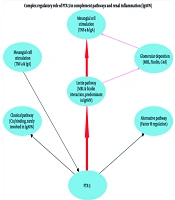
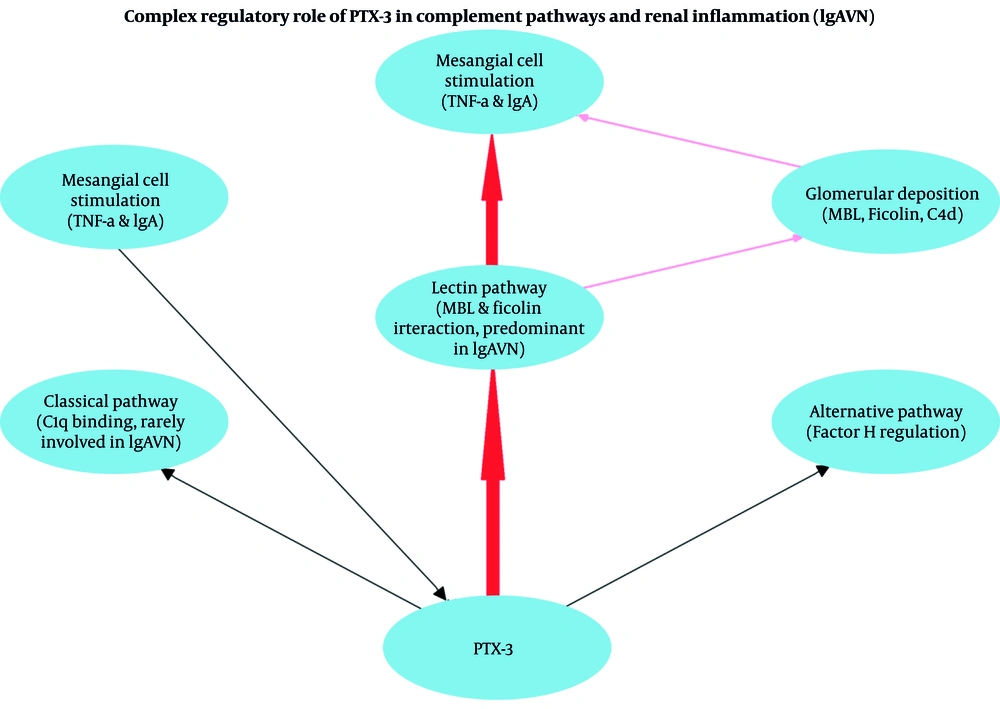
PTX-3 has a complex regulatory role in complement activation, primarily interacting with the lectin pathway components such as mannose-binding lectin (MBL) and ficolins, rather than the classical complement pathway involving C1q (3-7). This distinction is particularly important since previous research highlights that the lectin complement pathway, rather than the classical pathway, plays a pivotal role in the pathogenesis of IgAV nephritis (6). Specifically, Hisano et al. reported activation of the lectin pathway in renal biopsies from patients with Henoch–Schönlein purpura nephritis, emphasizing its significant contribution to renal damage in this condition (6). The interaction of PTX-3 with complement regulators, such as factor H, further supports its role in modulating complement activation and subsequent renal inflammation (5). These mechanisms collectively underscore PTX-3's potential role as an early biomarker for identifying renal involvement risk in IgAV, thus aiding early clinical interventions (Figure 1).
Given the predominantly retrospective nature of previous studies investigating PTX-3 in IgAVN, our prospective findings (2) provide valuable additional evidence that strengthens the clinical applicability of PTX-3 as an early predictor of renal involvement. Incorporating these findings into clinical practice, PTX-3 may enhance clinical strategies for the early detection of renal involvement; however, further validation studies are needed to confirm its practical feasibility in predicting, monitoring, and managing IgAV nephritis.
Footnotes
References
- 1.Li Q, Chen R, An H, Tang Y, Yang B. Review of the Pathogenesis of IgA Vasculitis Nephritis in Children. Iran J Pediatr. 2025;35(1). e150310. https://doi.org/10.5812/ijp-150310.
- 2.Yüksel S, Çağlar M, Evrengül H, Becerir T, Tepeli E, Ergin A, et al. Could serum pentraxin 3 levels and IgM deposition in skin biopsies predict subsequent renal involvement in children with Henoch-Schönlein purpura? Pediatr Nephrol. 2015;30(6):969-74. eng. [PubMed ID: 25543194]. https://doi.org/10.1007/s00467-014-3026-x.
- 3.Nauta AJ, Bottazzi B, Mantovani A, Salvatori G, Kishore U, Schwaeble WJ, et al. Biochemical and functional characterization of the interaction between pentraxin 3 and C1q. Eur J Immunol. 2003;33(2):465-73. [PubMed ID: 12645945]. https://doi.org/10.1002/immu.200310022.
- 4.Gout E, Moriscot C, Doni A, Dumestre-Perard C, Lacroix M, Perard J, et al. M-ficolin interacts with the long pentraxin PTX3: a novel case of cross-talk between soluble pattern-recognition molecules. J Immunol. 2011;186(10):5815-22. [PubMed ID: 21490156]. https://doi.org/10.4049/jimmunol.1100180.
- 5.Deban L, Jarva H, Lehtinen MJ, Bottazzi B, Bastone A, Doni A, et al. Binding of the long pentraxin PTX3 to factor H: interacting domains and function in the regulation of complement activation. J Immunol. 2008;181(12):8433-40. [PubMed ID: 19050261]. https://doi.org/10.4049/jimmunol.181.12.8433.
- 6.Hisano S, Matsushita M, Fujita T, Iwasaki H. Activation of the lectin complement pathway in Henoch-Schonlein purpura nephritis. Am J Kidney Dis. 2005;45(2):295-302. [PubMed ID: 15685507]. https://doi.org/10.1053/j.ajkd.2004.10.020.
- 7.Sahin S, Adrovic A, Barut K, Durmus S, Gelisgen R, Uzun H, et al. Pentraxin-3 levels are associated with vasculitis and disease activity in childhood-onset systemic lupus erythematosus. Lupus. 2017;26(10):1089-94. [PubMed ID: 28420068]. https://doi.org/10.1177/0961203317699286.
Copyright
Copyright © 2025, Yuksel. This open-access article is available under the Creative Commons Attribution 4.0 (CC BY 4.0) International License (https://creativecommons.org/licenses/by/4.0/), which allows for unrestricted use, distribution, and reproduction in any medium, provided that the original work is properly cited.
Crossmark
Checking
Comments
Number of Comments:0Cited by
- Scopus by DOI: 0
Last Update: 3 days ago
- Scopus by Title: 0
Last Update: 3 days ago
- Scopus by Title (Ref): 0
Last Update: 3 days ago
- CrossRef: 0
Last Update: 6 days ago
Ordering Reprints
Articles are published under the Creative Commons license stated on each article. No permission or royalty fee is required for uses permitted by that license. CCC handles optional bulk and customized reprint orders. Any quotation covers production and delivery services only, not copyright permission. > Request Reprints from CCC
Search Relations
Related Articles