1. Background
Children's use of digital technologies has increasingly integrated media devices into their environments. Due to the increase in the number of media tools and their easy accessibility today, the average time children spend using these media tools is also increasing. They routinely engage with television (TV), computers, tablets, mobile phones, and gaming consoles, with consumption of these media platforms rising annually (1, 2). The Turkish Statistical Institute's (TÜİK) 2021 Survey on Children's Use of Information Technologies showed that internet usage among children aged 6 - 15 rose from 50.8% to 82.7% in the last ten years (3). It has been reported that children aged 8 - 12 in the United States (USA) spend an average of 4-6 hours using digital media, with this time increasing to 9 hours among adolescents (4).
Media tools can have both positive and negative effects on child development. Beneficial impacts include fostering curiosity to learn, aiding foreign language education, and supporting the development of reasoning, planning, abstract thinking, and social skills (5, 6). However, unfavorable consequences that concern families and pediatricians include sleep disturbances, risk of obesity and depression, difficulties with learning, delays in language acquisition, and attention deficits (5).
Age-appropriate sleep duration is vital for healthy neuropsychological maturation in children. Previous studies have shown that short sleep duration is associated with decreased concentration, low academic achievement, susceptibility to obesity, depression, and increased suicidal ideation in childhood (7). Children obtaining sufficient sleep were less likely to require medical attention for any reason compared to those with shorter sleep periods (8). Studies have reported that sleep disorders are more common in children who use media extensively or sleep with a media device in their room (5).
A meta-analysis that included 20 different studies investigating the relationship between mobile devices and sleep, evaluating more than 125,000 children, found a significant relationship between screen use before bedtime and insufficient sleep duration, decreased sleep quality, and daytime sleepiness (9).
2. Objectives
The aim of this study was to determine the relationship between media use and sleep problems in otherwise healthy children aged 6 to 11 years using validated objective questionnaires.
3. Methods
3.1. Participants
This cross-sectional observational study surveyed parents of children aged 6 - 11 years attending outpatient clinics at the Division of Social Pediatrics and General Pediatrics of Gazi University Faculty of Medicine. Children with pre-existing conditions potentially impacting sleep, receiving treatment/medication, or with previously diagnosed sleep disorders were excluded, as were those with chronic illnesses such as obesity, diabetes, epilepsy, asthma, attention deficit hyperactivity disorder, intellectual disability, or autism.
Among the 313 patients aged 6 - 11 years who were admitted to the hospital during the study period between March and May 2023, 26 were excluded due to incomplete questionnaires and pre-existing medical conditions. To avoid selection bias, random sampling was performed during the study period. The remaining 287 questionnaires were enrolled in the study. All participating parents provided written informed consent. Data were obtained through parental reports of children's media habits, sleep routines, and responses to validated psychometric instruments, including the Problematic Media Use Measure-Short Form (PMUM-SF) and Sleep Disturbance Scale for children (SDSC).
3.2. Forms and Scales
Participating parents, both mothers and fathers, were given a three-part questionnaire. The first section encompassed a sociodemographic data form, while the second section involved the utilization of the Problematic Media Use Measure-Short Form, a 9-item questionnaire. The third section comprised the SDSC, consisting of 26 items.
The Problematic Media Use Measure-Short Form was employed to evaluate the presence of pathological attitudes toward screen usage in children. Developed by Domoff et al., this scale aims to identify problematic media use among children aged 4 to 11 years (10). The Turkish version of the scale was validated and assessed for reliability by Furuncu and Öztürk (11). The PMUM-SF encompasses a shorter version composed of nine questions, as well as a longer version comprising 27 questions. In our study, the short form was utilized. The scale assesses problematic utilization of media tools such as television, computers, tablets, and cell phones. Each question is rated on a five-point Likert-type scale, with response options varying based on the frequency of screen usage behaviors. Scores range from 1 (lowest) to 5 (highest), with higher scores indicating a greater level of problematic media use in the child.
The SDSC, developed by Bruni et al., is a validated tool designed to assess specific sleep disorders and problems (12). A Turkish version of the SDSC was created and validated by Ağca et al. for use in the age group of 6 to 16 years (13). This parent-report questionnaire consists of 26 items, encompassing various subscales related to sleep disorders, including sleep initiation and maintenance disorders, sleep breathing disorders, sleep awakening disorders, sleep-wake transition disorders, excessive sleepiness disorders, and excessive sweating during sleep. Each item is scored on a Likert-type scale ranging from 1 to 5. The total score ranges from 26 to 130, with a score of 39 or higher indicating the presence of a sleep disorder according to Bruni et al. (12). In the evaluation of sleep disorders, a T-score is used, calculated as T-score = 50 + (score-mean)/standard deviation × 10. T-scores above 70 indicate the presence of sleep disorder symptoms.
Given that the Turkish validity and reliability studies of the PMUM-SF and the SDSC have demonstrated their appropriateness for use in the 4 - 11 years and 6 - 16 years age groups, respectively, our study included children aged 6 - 11 years, which represents the overlapping age range of both scales.
Permission to use the SDSC and PMUM-SF was obtained through email correspondence with the researchers who conducted the Turkish validity and reliability studies for these measures.
3.3. Ethics Committee Approval
The study was approved by the Gazi University Clinical Research Ethics Committee in accordance with the Declaration of Helsinki (ethics approval number: 888/2022)
3.4. Statistical Analysis
The SPSS (version 23.0, IBM Corp) program was used for statistical analysis. Descriptive statistical methods (mean, standard deviation (SD), median, ratio, minimum, maximum), t-test for two-group comparisons, one-way ANOVA test for more than two groups, and Tukey test as post hoc analysis were used to compare quantitative data. Chi-square test was used to analyze categorical variables. Pearson correlation test (correlation coefficient: r) was used to determine the relationship between continuous variables. Sleep disorder and problematic media use were categorized into two categories according to whether they were present or not, and for the factors affecting these, logistic regression analysis was used. In the analysis for the SDSC, those with a T-score below 70 were considered as 0 (no sleep disorder) and those with a T-score above 70 were considered as 1 (sleep disorder), and a logistic regression model was created. The results were evaluated at 95% confidence interval, P < 0.05 significance level, and P < 0.01 advanced significance level.
4. Result
The study included a total of 287 children with a mean age of 8.5 ± 1.5 years (range: 6 - 11 years). Of the participants, 66% were mothers (n = 190) and 34% were fathers (n = 97). Approximately half of the parents were university graduates, while one-third had completed high school. Regarding employment status, one-third of the mothers were employed, whereas all fathers were employed (Table 1).
Table 1.
Socidodemographic Data of Participants a
| Characteristics | Study Group; n = 287 (100%) |
|---|---|
| Gender | |
| Female | 136 (47) |
| Male | 151 (53) |
| Age | |
| mean ± SD | 8.5 ± 1.5 |
| median; min - max | 8.3; 6-11 |
| Body Mass Index (%) | |
| < 5 | 9 (3) |
| 5 - 85 | 210 (73) |
| 85 - 95 | 38 (13) |
| > 95 | 30 (11) |
| Gestation week | |
| Before 37 | 31 (11) |
| 37- 42 | 251 (88) |
| 42 and later | 5 (1) |
| School grade | |
| Kindergarten | 30 (11) |
| 1 | 46 (16) |
| 2 | 71 (25) |
| 3 | 52 (18) |
| 4 | 52 (18) |
| 5 | 27 (9) |
| 6 | 9 (3) |
| Number of siblings | |
| 0 | 71 (25) |
| 1 | 145 (50) |
| 2 | 63 (22) |
| 3 | 8 (3) |
| Room sharing | |
| No | 161 (56) |
| Yes (with sibling) | 126 (44) |
a Values atre expressed as No. (%) unless otherwise indicated.
Television (TV) was the most commonly used media tool, reported by 92% of the children in the study. Among them, 47% had started using media devices before the age of 2, and a significant proportion (47%) owned their own media device. Furthermore, 69% of the participants reported using media devices for more than 2 hours per day (Table 2).
Table 2.
Data Related to Media Use Among Participants a
| Characteristics | Study Group |
|---|---|
| Media type | |
| Television | 265 (92) |
| Computer | 131 (46) |
| Tablet | 157 (54) |
| Cell phone | 218 (76) |
| Playstation | 21 (7) |
| Media use before age 2 | |
| Yes | 134 (47) |
| No | 153 (53) |
| Having his/her own media | |
| Yes | 135 (47) |
| No | 152 (53) |
| Age of media device acquisition (y) | |
| mean ± SD | 6.4 ± 1.8 |
| median; min-max | 6; 3 - 10 |
| Purpose of media use | |
| Online lesson | 108 (37) |
| Homework research | 151 (53) |
| Game | 216 (75) |
| Fun (video/film) | 266 (93) |
| Game type | |
| Car race | 46 (21) |
| Baby play | 13 (6) |
| Painting | 15 (7) |
| Sport | 21 (10) |
| War-game | 67 (31) |
| Strategy | 12 (5) |
| Brain teaser | 42 (19) |
| Media content control by parents | |
| Always | 82 (29) |
| Frequently | 88 (30) |
| Occasionally | 77 (27) |
| Rarely | 26 (9) |
| Never | 14 (5) |
| Rule on media use | |
| Duration | 114 (40) |
| Content | 47 (16) |
| No rules | 126 (44) |
| Screen exposure before sleep | |
| Half an hour and before | 119 (42) |
| One hour | 96 (33) |
| Two hours or later | 72 (25) |
| Food consumption in front of media | |
| No | 111 (39) |
| Yes | 176 (61) |
a Values atre expressed as No. (%) unless otherwise indicated.
Upon analyzing the duration of nighttime sleep among the children, it was observed that approximately half of the participants slept for 8 - 9 hours. However, only one-fifth of the participants engaged in two or more hours of indoor or outdoor physical activities (Table 3).
Table 3.
Data Related to Physical Activity and Sleep Among Participants
| Characteristics | Study Group; No. (%) |
|---|---|
| Indoor physical activity (h) | |
| Less than 1 | 123 (43) |
| 1 - 2 | 105 (37) |
| 2 and more | 59 (20) |
| Outdoor physical activity (h) | |
| Less than 1 | 114 (40) |
| 1 - 2 | 116 (41) |
| 2 and more | 57 (19) |
| Bedtime at night | |
| 20.00 - 21.00 | 41 (14) |
| 21.00 - 22.00 | 127 (44) |
| 22.00 - 23.00 | 100 (35) |
| 23.00 - 00.00 | 19 (7) |
| Morning wake up time | |
| 06.00 - 07.00 | 21 (7) |
| 07.00 - 08.00 | 172 (60) |
| 08.00 - 09.00 | 73 (25) |
| 09.00 - 10.00 | 21 (8) |
| Nighttime sleep duration (h) | |
| 6 - 7 | 7 (2) |
| 7 - 8 | 56 (20) |
| 8 - 9 | 139 (48) |
| 9 - 10 | 85 (30) |
| Duration of falling asleep (min) | |
| Less than 15 | 95 (33) |
| 15 - 30 | 118 41) |
| 30 - 45 | 52 (18) |
| 45 - 60 | 22 (8) |
4.1. Findings Related to Problematic Media Use Measure-Short Form
The mean score on the PMUM-SF among the participants was 2.40 ± 0.86, ranging from 1 to 4.67. Of the children, 56% obtained a score higher than 2.5. The PMUM-SF scores demonstrated a significant positive correlation with the children's age (P < 0.01) (Figure 1).
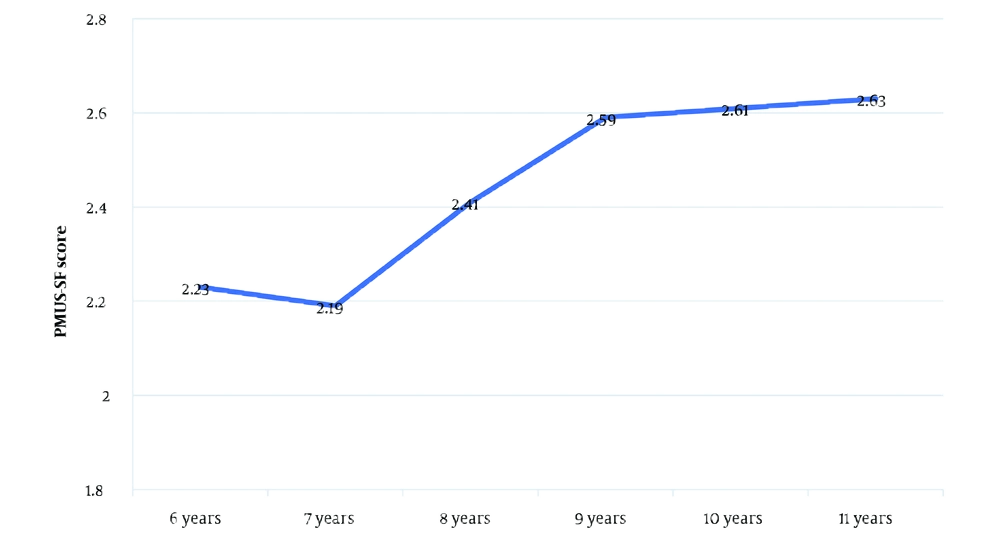
Figure 1.
Mean score on the Problematic Media Use Scale-Short Form by age
Children who were exposed to media before the age of 2 years obtained higher scores on the PMUM-SF (2.6 vs. 2.1; P < 0.01). Among different game types, children who engaged in war-themed games had higher scores on the problematic media use scale (2.9 vs. 2.2; P < 0.01). Notably, children who consumed food in front of media devices had higher scores on the PMUM-SF (2.4 vs. 2.1; P < 0.01). Furthermore, an inverse relationship was observed between the amount of time children spent on indoor physical activity and problematic media use (P < 0.01) (Table 4).
Table 4.
Problematic Media Use Scale-Short Form Score According to Participants’ Characteristics
| Characteristics | PMUM-SF (Mean ± SD) | P-Value |
|---|---|---|
| Gender | < 0.01 | |
| Female | 2.24 ± 0.87 | |
| Male | 2.55 ± 0.82 | |
| Body Mass Index | < 0.01 | |
| Normal weight (5 - 85p) | 2.33 ± 0.82 | |
| Obese (> 95) | 2.88 ± 0.85 | |
| Media use before age 2 | < 0.01 | |
| Yes | 2.66 ± 0.85 | |
| No | 2.18 ± 0.80 | |
| Having his/her own media | < 0.01 | |
| Yes | 2.56 ± 0.89 | |
| No | 2.27 ± 0.80 | |
| Playing war-game | < 0.01 | |
| Yes | 2.92 ± 0.82 | |
| No | 2.25 ± 0.81 | |
| Screen exposure before sleep | < 0.01 | |
| Half an hour and before | 2.61 ± 0.85 | |
| Two hours or later | 1.96 ± 0.74 | |
| Food consumption in front of media | < 0.01 | |
| Yes | 2.57 ± 0.88 | |
| No | 2.14 ± 0.76 | |
| Media content control by parents | < 0.01 | |
| Always | 2.14 ± 0.94 | |
| Occasionally | 2.57 ± 0.77 | |
| Indoor physical activity (h) | < 0.01 | |
| Less than 1 | 2.66 ± 0.90 | |
| 2 and more | 2.20 ± 0.73 |
In this study, a significant correlation was observed between problematic media use and sleep disturbance scores (P < 0.01, r = 0.46). However, there was a weak correlation between problematic media use and children's age (P < 0.01, r = 0.17).
Logistic regression analysis was conducted to examine the factors influencing problematic media use. Media use for playing war games, spending time in front of a computer, and screen exposure before sleep were found to increase the problematic media use score. In a multiple logistic regression analysis that included these factors in the model, the following results were obtained: media use for war games increased the PMUM-SF score by 4.1 times (P < 0.001, odds ratio [OR]: 4.1, 95% confidence interval [CI]: 2.81 - 8.003), screen exposure within one hour before bedtime increased the score by 3.1 times (P = 0.002, OR: 3.1, 95% CI: 1.54 - 6.50), and spending more than 2 hours in front of the computer increased the score by 4.8 times (P < 0.001, OR: 4.8, 95% CI: 2.10 - 11.06).
4.2. Findings Related to Sleep Disturbance Scale for Children
The mean score on the SDSC was 45.2 ± 10.3. Among the participants, 68% obtained a score of 39 or higher, while 32% obtained a score below 39. Using the T-score, sleep disorders were identified in 15% of the children.
Children who used a media device before the age of 2 years and those who used media for playing games exhibited higher mean scores on the SDSC (P = 0.04, 0.02, respectively). Among different game types, children who engaged in war-themed games had higher sleep disturbance scores compared to other games (49 vs. 44; P < 0.01). Furthermore, increased screen time in front of the TV and computer was associated with higher sleep disturbance scores (P = 0.02, < 0.01, respectively). Among children who consumed food in front of a screen, the mean SDSC score was higher (46 vs. 43; P = 0.05) (Table 5).
Table 5.
Sleep Disturbance Scale for Children Score According to Participants’ Characteristics
| Characteristics | SDSC (Mean ± SD) | P-Value |
|---|---|---|
| Media use before age 2 | 0.04 | |
| Yes | 46.5 ± 11.3 | |
| No | 44.0 ± 9.1 | |
| Playing war-game | < 0.01 | |
| Yes | 48.9 ± 10.0 | |
| No | 43.9 ± 10.2 | |
| Time spent in front of TV | 0.02 | |
| 1 - 2 | 43.7 ± 8.1 | |
| 2 or more | 47.8 ± 10.3 | |
| Time spent in front of computer (h) | < 0.01 | |
| 1 or less | 43.0 ± 10.3 | |
| 2 or more | 50.4 ± 6.8 | |
| Media content control by parents | < 0.01 | |
| Always | 42.3 ± 11.5 | |
| Occasionally | 48.7 ± 9.8 | |
| Food consumption in front of media | 0.05 | |
| Yes | 46.1 ± 10.3 | |
| No | 43.7 ± 10.1 |
Furthermore, it was observed that the mean sleep disturbance score increased as the age at which children acquired media devices decreased (P = 0.04 r = -0.17).
Logistic regression analysis was conducted to examine the factors influencing sleep disturbance scores. It was found that increased time spent in front of a cell phone was associated with higher sleep disturbance scores, while maternal age was associated with lower sleep disturbance scores. In a multiple logistic regression analysis that included these factors in the model, the following results were obtained: spending 2 hours or more in front of a cell phone increased the sleep disturbance score by 2.8 times (P = 0.014, odds ratio [OR]: 2.87, 95% confidence interval [CI]: 1.2 - 6.6).
5. Discussion
This cross-sectional study aimed to investigate the association between media use and sleep disturbance in healthy children aged 6 - 11 years. The study revealed that approximately half of the children began media usage before the age of two, and those who did so exhibited higher sleep disturbance scores. A significant relationship was observed between problematic media use and sleep disturbance, with spending 2 hours or more in front of a cell phone increasing sleep disturbance by 2.8 times.
Regarding media device usage, our study revealed that 76% of children used cell phones, 54% used tablets, and 46% used computers, with nearly half of the children owning their own media device. The mean age of media device acquisition was 6 years. In contrast, a study conducted in the USA reported that three-quarters of children owned their own devices, with ownership starting as early as 4 years of age (1). These differences in device acquisition age may be attributed to economic and cultural disparities between countries. In terms of media usage purposes, entertainment (video/movies) (93%) and games (82%) were the most common activities identified in our study. In contrast, according to the TÜİK 2021 data, the predominant purposes of media use were online lessons (83%) (3). This discrepancy can be attributed to the age of media device use, which is 6 in our country and corresponds to school age. In the USA, the younger age of media device use may be for more entertainment.
In this study, 69% of children exceeded the recommended daily limit of 2 hours of media use. A study conducted in the USA reported an increase in cell phone/tablet use duration among children aged 0-8 years, from five minutes in 2011 to fifteen minutes in 2013, and forty-eight minutes in 2017 (14). Similarly, studies conducted in our country demonstrated that 76-80% of children aged 4 - 11 years spent 2 hours or more on media daily (15, 16). Another study conducted with 11,000 children aged 9 - 10 years found that 26% spent 2 hours or more watching television and 21% spent 2 hours or more playing video games (17). These findings align with both our study and the existing literature, illustrating a lack of adherence to the American Academy of Pediatrics (AAP) recommendations for media use duration, with three out of every four children exceeding the recommended limit.
Despite the AAP's recommendation against media use in children under the age of two (18), our study revealed that almost half of the children started using media before reaching this age. This widespread early exposure to media highlights a growing concern. In this study, problematic media use was observed in approximately half of the children. A study conducted in Turkey in 2021 using the same scale reported problematic media use in 33% of children (15), and a similar prevalence was found in another Turkish study conducted in 2023 with the same age group (19). Previous studies conducted in Turkey have reported that 76 - 80% of children aged 4 - 11 years use media for 2 hours or more per day (15, 16). Similarly, Hisler et al. (17) found in their study of 11,000 children aged 9 - 10 years that 26% spent 2 hours or more per day watching television and 21% spent 2 hours or more per day playing video games. However, these prior investigations relied on structured researcher-administered questions to assess problematic media use. In contrast, the current study employed the PMUM-SF, an objective scale, to evaluate problematic media use patterns (19-23). One of the interesting findings of this study was that nearly half of children began using media before the age of two, and problematic media use was observed in half of children aged 6 to 11. Based on this, we may say that media use before the age of two can lead to problematic media use during school age.
In terms of sleep duration, approximately half of the children in our study slept for 8 - 9 hours per day. However, the AAP recommends 9 - 11 hours of sleep for children in the 6 - 11 age group, a recommendation followed by only 30% of the children in our study. In a similar age-group study conducted in our country, sleep disorder rates were found in half of children aged 6 - 18 (24, 25). International studies have reported varying rates of sleep disorders, ranging from 30 to 50% in children (26-28). In this study, in order to assess sleep disturbances, we utilized the SDSC, which has undergone a Turkish validity and reliability study. The cutoff value of the SDSC scale was determined as 39 by Bruni et al. (12), who developed the scale. In our study group, 68% of children scored 39 and above. However, Ağca's Turkish validity and reliability study (13) developed a T-score table, considering a T-score > 70 indicative of sleep disorder. According to this table, 15% of children in our study group were found to have sleep disorders. A study conducted in China with 3525 children aged 6 - 13 years revealed a sleep disorder prevalence of 4.43% (29), 4% in Italy (30), 10% in Australia (31), 24% in Egypt (32), and 26% in Finland (33), while a study in Spain with 2733 children aged 6 - 16 years reported a prevalence of 4.2% (22). In a Turkish study using the SDSC, sleep disorders were found in 20% of children (23). These variations in sleep disorder rates may be attributed to sociodemographic characteristics, cultural differences, variations in the age group studied, the use of different sleep assessment scales, and the level of awareness among families regarding sleep disorders in their children.
Correlational analyses in our study revealed that higher scores of problematic media use were associated with increased sleep disturbance, as well as earlier acquisition of media devices and media use before the age of two. These findings are consistent with previous studies (17, 34, 35) and highlight the significant risk factors for sleep disturbance in children, namely excessive media use throughout the day and media exposure at a young age. The stimulating effects of media, which disrupt sleep, and the suppression of endogenous melatonin release caused by the blue light emitted from screens are considered underlying mechanisms linking media use to sleep disturbance (36-38). A sleep laboratory study conducted in Japan found that playing "exciting" video games was associated with elevated heart rate, delayed sleep onset, and reduced rapid eye movement sleep (39). Additionally, using mobile devices in close proximity to bedtime was associated with sleep disturbance (40). Recommendations include the absence of televisions and computers in children's bedrooms and discontinuing media use approximately one hour before bedtime (18, 41). However, our study revealed that nearly half of the children were exposed to screens within 30 minutes of sleep, which may partially explain the higher prevalence of sleep disturbance compared to other studies conducted in our country.
Moreover, this study found that children who were supervised by their parents experienced less sleep disturbance. Parental control over media use has a positive impact on children's sleep patterns, which in turn contributes to their overall development.
5.1. Limitations
Limitations of this study were the design of the study. This study was a cross-sectional study, and establishing cause-and-effect relationships is difficult. The sample size is not sufficient to make a general statement about a population. Another common disadvantage of survey studies is that participants' tendency to respond in line with social expectations may lead to response bias. And finally, surveys are mostly based on participants' own statements, and thus reliability can be questionable. However, using validated objective questionnaires can be a good tool to understand the main problems in a population, and thus our study can be a good example for developing countries.
5.2. Conclusion
This study represents the initial attempt to assess the impact of screen use on sleep by utilizing the PMUM-SF, an objective scale, along with structured survey questions designed to identify pathological attitudes toward screen use in children. Addressing problematic attitudes toward childhood media use that significantly impact sleep and providing appropriate guidance are important issues that require emphasis. Safeguarding children's health and promoting the quality of their sleep are essential for facilitating their comprehensive neuropsychosocial development. The key finding of this study underscores the importance of informing and guiding parents and children accurately regarding media use during pediatric health visits. Studies aiming to improve the health of school-age children can be carried out in multidisciplinary settings. This study also reflects the current condition of problematic media use among school-age children in a developing country; therefore, further studies aiming to solve this problem should be carried out for a better future for our children.