
1. Background
Childhood and adolescent obesity are major public health challenges worldwide. The World Health Organization defines obesity as abnormal or excessive fat accumulation that may impair health (1). Beyond cardiometabolic consequences, pediatric obesity has important psychosocial and behavioral impacts and typically requires a multidisciplinary approach (2, 3). Excess adiposity often tracks into adulthood and is associated with earlier onset of hypertension, type 2 diabetes, and cardiovascular disease (4, 5).
Iron is an essential micronutrient required for oxygen transport, cellular energy production, enzymatic reactions, immune function, and nucleic acid/protein synthesis (6). Obesity and iron deficiency are among the most common nutritional disorders globally, and iron deficiency has been reported more frequently in overweight and obese children than in their normal-weight peers (7, 8). Nevertheless, the mechanisms underlying obesity-associated hypoferremia and alterations in iron indices remain incompletely understood (9, 10).
Obesity is increasingly recognized as a chronic low-grade inflammatory state in which adipose tissue functions as an endocrine organ (11-14). Hepcidin, a peptide hormone and the central regulator of systemic iron homeostasis (15, 16), is produced mainly in the liver but is also expressed in adipose tissue, particularly in severe obesity (17). By binding to the iron exporter ferroportin, hepcidin induces its internalization and degradation, thereby reducing intestinal iron absorption and limiting iron release from macrophages (18). Hepcidin synthesis is upregulated during inflammation — prominently through IL-6/STAT3 signaling — and functions as an acute-phase reactant (19, 20). Systemic inflammation is commonly assessed clinically using C-reactive protein (CRP) (21). In this context, increased hepcidin has been proposed as a mechanistic link between obesity-related inflammation and restricted iron availability (9, 10, 22). Leptin, which rises with adiposity (23, 24), may further stimulate hepcidin expression via JAK/STAT pathways (25), suggesting a leptin–hepcidin axis. In pediatric cohorts, higher hepcidin levels have been reported in obesity and may decrease after Body Mass Index (BMI) reduction, although results across studies are heterogeneous (22, 26). Recent pediatric studies focusing on inflammatory indices and obesity-related metabolic complications such as metabolic syndrome and metabolic dysfunction-associated fatty liver disease further support the importance of inflammatory-metabolic pathways in obese youth (27-29).
2. Objectives
To determine whether serum hepcidin levels are elevated in obese children and adolescents compared with healthy controls and to characterize groupwise differences in iron-status indicators (serum iron, TIBC, TSAT, and ferritin), leptin, and inflammatory markers (CRP and white blood cell count).
3. Methods
3.1. Study Design and Setting
This was a single-center, case–control study conducted at the Pediatrics Outpatient Clinic and Pediatric Hematology Outpatient Clinic of Recep Tayyip Erdoğan University Training and Research Hospital, Rize, Turkiye. Cases and controls were recruited from the routine outpatient population served by the same hospital-based catchment using a pragmatic clinic-based sampling approach. The archived study records allowed reconstruction of the study setting and eligibility criteria but did not preserve a formal screening log with exact recruitment dates or the full chronological sequence of participant approach; this limitation is acknowledged in the Discussion.
3.2. Participants
The obese group consisted of children and adolescents with obesity, defined as BMI-for-age > 95th percentile for age and sex according to pediatric percentile-based reference criteria (30). Eligible participants had no known chronic disease apart from obesity and no evidence of active infection at the time of evaluation. Before enrollment, a detailed clinical history was obtained, including age, sex, medication use, allergy history, immunization status, previous illnesses, and family history, to identify conditions that could affect inflammation or iron metabolism. Exclusion criteria applied to both groups were active infection, renal or hepatic disease, known or newly diagnosed hematological disease, immunological or rheumatological disease, and any other chronic condition that could affect inflammation or iron metabolism.
The control group included healthy children and adolescents presenting for routine evaluation in the same outpatient setting, without acute or chronic infection, chronic disease, or hematological disease, and without iron therapy in the preceding year or a history of blood/blood-product transfusion.
Initially, 40 obese participants were planned; 7 did not complete follow-up or did not provide blood samples, resulting in a final obese group of 33 participants.
3.3. Ethical Considerations
Ethical approval for this study was obtained from the Clinical Research Ethics Committee of Recep Tayyip Erdoğan University Faculty of Medicine (07 November 2014; decision no: 176). The study was conducted in accordance with the Declaration of Helsinki. Written informed consent was obtained from the parents or legal guardians of all participants.
3.4. Clinical and Laboratory Measurements
Age, sex, and anthropometric measures (height, weight, BMI, and waist circumference) were recorded. Venous blood samples were obtained for complete blood count, serum iron, total iron-binding capacity (TIBC), transferrin saturation (TSAT), ferritin, CRP, leptin, and hepcidin. Because no a priori categorical definition of iron deficiency or functional iron restriction had been prespecified in the archived study protocol, analyses focused on continuous iron-status indices and their between-group patterns. Archived assay documentation was complete for complete blood count, ferritin, serum iron, and hepcidin, whereas detailed kit-level metadata for CRP and leptin were not consistently retained in the study files and, therefore, could not be fully reconstructed retrospectively.
Complete blood count: Automated hematology analyzer (CELL-DYN Ruby, Abbott Diagnostics, Santa Clara, CA, USA).
Ferritin: Chemiluminescent microparticle immunoassay (Abbott Diagnostics).
Serum iron: Aeroset system (Abbott Diagnostics).
Hepcidin: Serum samples were stored at -20°C and measured using a commercially available ELISA kit (DRG Instruments GmbH, Germany) according to the manufacturer’s protocol. Samples and standards were added to microtiter wells pre-coated with anti-hepcidin antibody, incubated, washed, and read on a Multiskan GO microplate reader (Thermo Scientific) at 450 ± 10 nm. Hepcidin values are reported in ng/mL.
3.5. Statistical Analysis
Statistical analyses were performed using SPSS for Windows (version 13.0; SPSS Inc., Chicago, IL, USA). Continuous variables are presented as mean ± standard deviation. Between-group comparisons were performed using Student’s t-test or the Mann-Whitney U test, as appropriate according to data distribution. All tests were two-sided, and P < 0.05 was considered statistically significant. Because the number of available observations differed across variables, analyses were conducted on an available-case basis without imputation. Given the modest sample size and incomplete availability of key covariates (e.g., pubertal stage, dietary iron intake, recent infection history beyond clinical screening, and socioeconomic characteristics), multivariable adjustment was not prespecified, and the results should be interpreted as unadjusted between-group comparisons.
4. Results
A total of 53 participants were included: 33 obese children and adolescents and 20 healthy controls. Missingness was variable-specific. In controls, missing values were present for height, weight, BMI, and waist circumference (n = 3 each) and for ferritin (n = 1). In the obese group, missing values were present for age (n = 3), height, weight, and BMI (n = 1 each), waist circumference (n = 4), CRP (n = 3), serum iron/TIBC/TSAT (n = 4 each), and ferritin (n = 4). Reasons for variable-level missingness were not systematically recorded in the archived study files; therefore, differential missingness between groups is possible.
4.1. Demographic and Anthropometric Findings
Baseline demographic and anthropometric characteristics are presented in Table 1., and descriptive laboratory parameters are summarized in Table 2. The mean age did not differ significantly between groups, whereas height, weight, BMI, and waist circumference were significantly higher in the obese group than in controls (all P < 0.05; Table 3.).
Table 1.
Demographic and Anthropometric Characteristics of the Study Groups a
| Variables | Control | Control | Obese | Obese |
|---|---|---|---|---|
| Age (y) | 20 | 15.90 ± 2.32 | 30 | 15.57 ± 2.11 |
| Height (cm) | 17 | 158.76 ± 8.51 | 32 | 166.16 ± 8.73 |
| Weight (kg) | 17 | 52.12 ± 7.60 | 32 | 97.00 ± 15.89 |
| BMI (kg/m²) | 17 | 20.59 ± 2.13 | 32 | 35.25 ± 3.91 |
| Waist circumference (cm) | 17 | 71.53 ± 8.43 | 29 | 105.90 ± 11.96 |
Abbreviation: BMI, Body Mass Index.
a Values are as expressed as No. or mean ± SD.
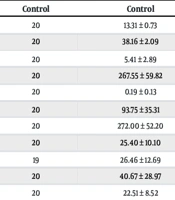
Table 2.
Laboratory Parameters of the Study Groups a
| Variables | Control | Control | Obese | Obese |
|---|---|---|---|---|
| Hemoglobin (g/dL) | 20 | 13.31 ± 0.73 | 33 | 13.43 ± 1.76 |
| Hematocrit (%) | 20 | 38.16 ± 2.09 | 33 | 39.28 ± 4.34 |
| WBC (×10³/µL) | 20 | 5.41 ± 2.89 | 33 | 7.91 ± 1.82 |
| Platelets (×10³/µL) | 20 | 267.55 ± 59.82 | 33 | 328.70 ± 65.59 |
| CRP (mg/L) | 20 | 0.19 ± 0.13 | 30 | 0.51 ± 0.50 |
| Serum iron (µg/dL) | 20 | 93.75 ± 35.31 | 29 | 79.34 ± 41.73 |
| TIBC (µg/dL) | 20 | 272.00 ± 52.20 | 29 | 311.72 ± 70.03 |
| TSAT (%) | 20 | 25.40 ± 10.10 | 29 | 20.48 ± 12.68 |
| Ferritin (ng/mL) | 19 | 26.46 ± 12.69 | 29 | 32.81 ± 17.98 |
| Leptin (ng/mL) | 20 | 40.67 ± 28.97 | 33 | 131.42 ± 73.49 |
| Hepcidin (ng/mL) | 20 | 22.51 ± 8.52 | 33 | 28.68 ± 6.64 |
Abbreviations: WBC, white blood cell count; CRP, C-reactive protein; TIBC, total iron-binding capacity; TSAT, transferrin saturation.
a Values are as expressed as No. or mean ± SD.
| Variables | Control | Control | Obese | Obese | P-Value |
|---|---|---|---|---|---|
| Age (y) | 20 | 15.90 ± 2.32 | 30 | 15.57 ± 2.11 | 0.493 |
| Height (cm) | 17 | 158.76 ± 8.51 | 32 | 166.16 ± 8.73 | 0.007 |
| Weight (kg) | 17 | 52.12 ± 7.60 | 32 | 97.00 ± 15.89 | <0.001 |
| BMI (kg/m²) | 17 | 20.59 ± 2.13 | 32 | 35.25 ± 3.91 | <0.001 |
| Waist circumference (cm) | 17 | 71.53 ± 8.43 | 29 | 105.90 ± 11.96 | <0.001 |
Abbreviations: BMI, Body Mass Index.
a Values are as expressed as No. or mean ± SD.
b Student’s t-test was used.
4.2. Iron Status Indicators
Between-group comparisons of iron-status indicators are shown in Table 4. Hemoglobin, serum iron, and ferritin did not differ significantly between groups (P > 0.05; Table 4.). TSAT tended to be lower in the obese group but did not reach statistical significance (P = 0.089; Table 4.). In contrast, TIBC was significantly higher in the obese group (P = 0.036; Table 4.).
| Variables | Control | Control | Obese | Obese | P-Value |
|---|---|---|---|---|---|
| Hemoglobin (g/dL) | 20 | 13.31 ± 0.73 | 33 | 13.43 ± 1.76 | 0.770 |
| Serum iron (µg/dL) | 20 | 93.75 ± 35.31 | 29 | 79.34 ± 41.73 | 0.213 |
| TIBC (µg/dL) | 20 | 272.00 ± 52.20 | 29 | 311.72 ± 70.03 | 0.036 |
| Ferritin (ng/mL) | 19 | 26.46 ± 12.69 | 29 | 32.81 ± 17.98 | 0.189 |
| TSAT (%) | 20 | 25.40 ± 10.10 | 29 | 20.48 ± 12.68 | 0.089 |
Abbreviations: TIBC, total iron-binding capacity; TSAT, transferrin saturation.
a Values are as expressed as No. or mean ± SD.
b Student’s t-test was used for hemoglobin, serum iron, TIBC, and ferritin; Mann–Whitney U test was used for TSAT.
4.3. Inflammatory Markers, Leptin, and Hepcidin
Between-group comparisons of inflammatory markers, leptin, and hepcidin are presented in Table 5. CRP and white blood cell count were significantly higher in obese participants (CRP P = 0.001; white blood cell count P < 0.001; Table 5.). Leptin and hepcidin were also significantly higher in the obese group compared with controls (leptin P < 0.001; hepcidin P = 0.035; Table 5.).
| Variables | Control | Control | Obese | Obese | P-Value |
|---|---|---|---|---|---|
| CRP (mg/L) | 20 | 0.19 ± 0.13 | 30 | 0.51 ± 0.50 | 0.001 |
| WBC (×10³/µL) | 20 | 5.41 ± 2.89 | 33 | 7.91 ± 1.82 | < 0.001 |
| Leptin (ng/mL) | 20 | 40.67 ± 28.97 | 33 | 131.42 ± 73.49 | < 0.001 |
| Hepcidin (ng/mL) | 20 | 22.51 ± 8.52 | 33 | 28.68 ± 6.64 | 0.035 |
Abbreviations: CRP, C-reactive protein; WBC, white blood cell count.
a Values are as expressed as No. or mean ± SD.
b Mann–Whitney U test was used.
5. Discussion
In this case–control study, obese children and adolescents had higher serum hepcidin and leptin levels than healthy controls, together with higher CRP and white blood cell counts. Conventional iron indices showed a subtler pattern: TIBC was significantly higher in obesity, whereas serum iron and TSAT tended to be lower, and hemoglobin and ferritin did not differ significantly. Taken together, these findings suggest that pediatric obesity is accompanied by an inflammatory–metabolic milieu that may alter iron regulation before overt hematologic changes become apparent.
5.1. Inflammation and Hepcidin in Pediatric Obesity
Our finding of higher hepcidin in obese participants is biologically plausible and broadly consistent with prior pediatric reports linking obesity to increased hepcidin concentrations (9, 10, 22, 26, 31-33). Obesity is increasingly understood as a chronic low-grade inflammatory state in which adipose tissue acts as an active endocrine and immune organ (11-14). In the present cohort, higher CRP and white blood cell counts support the presence of systemic inflammatory activation. Because hepcidin is upregulated by inflammatory signaling, particularly through IL-6/STAT3-related pathways, the coexistence of higher inflammatory markers and higher hepcidin provides a coherent mechanistic framework for our findings (19, 20). Although IL-6 and other cytokines were not measured directly, the overall pattern is compatible with inflammation-driven modulation of iron homeostasis in pediatric obesity.
5.2. Iron-Status Pattern and Clinical Interpretation
The iron profile in our study is notable less for overt deficiency than for a pattern suggestive of altered iron availability. Obese participants had significantly higher TIBC and numerically lower serum iron and TSAT, whereas hemoglobin and ferritin remained similar between groups. This constellation does not establish definite iron deficiency, but it is compatible with early or compensated impairment in iron availability. From a clinical perspective, this distinction is important: Ferritin may remain normal or appear relatively preserved in inflammatory states, potentially obscuring underlying restrictions on circulating iron. Our results therefore support interpreting iron status in obese children and adolescents using multiple parameters rather than relying on ferritin alone, especially when biochemical abnormalities are mild or apparently discordant.
5.3. The Leptin-Hepcidin Axis as an Integrative Pathway
The marked elevation in leptin among obese participants adds another plausible biological layer to these findings. Leptin rises with adiposity, and experimental data suggest that it can stimulate hepcidin expression via JAK/STAT signaling (23-25). The concurrent increase in leptin and hepcidin observed in our cohort is therefore consistent with the concept of a leptin-hepcidin axis linking excess adiposity to altered iron handling. At the same time, our design does not permit causal or mediation inferences, and we cannot determine whether leptin exerted an effect independent of generalized inflammation. Larger studies incorporating correlation analyses, multivariable models, and broader adipokine profiling would help clarify the relative contribution of leptin to hepcidin regulation in obese youth.
5.4. Clinical Implications
Although our data do not justify diagnosing iron deficiency on the basis of hepcidin alone, they do have practical implications for follow-up in pediatric obesity. In obese youth with borderline iron indices, apparently normal ferritin should not automatically exclude disturbed iron handling, particularly when inflammatory markers are elevated. A multi-parameter approach that considers serum iron, TSAT, TIBC, ferritin, and inflammatory context may therefore provide a more clinically informative assessment than any single marker in isolation. This perspective is also consistent with recent pediatric literature linking obesity-related inflammation to broader metabolic complications in children and adolescents (27-29, 31-33).
5.5. Strengths, Limitations, and Future Directions
This study has several strengths. It addresses a clinically relevant question in pediatric obesity and evaluates hepcidin alongside conventional iron indices, leptin, and inflammatory markers within the same cohort. In addition, cases and controls were drawn from the same hospital-based outpatient catchment, which supports group comparability. These strengths should, however, be interpreted alongside important limitations. The sample size was modest, missingness varied across variables, and the archived study files did not preserve a formal screening log or systematic reasons for all missing values. Potential confounders such as pubertal stage, dietary iron intake, recent infection history beyond clinical screening, and socioeconomic characteristics were not comprehensively available, so multivariable adjustment could not be performed. Detailed assay-performance characteristics, including intra-/inter-assay coefficients of variation and blinding status, were not retained for all biomarkers. Finally, the single-center observational design limits generalizability and precludes causal inference. Future studies should use prospectively standardized recruitment tracking, prespecified definitions of iron deficiency, broader inflammatory panels, and multivariable analytical models to determine whether hepcidin independently identifies obese pediatric patients at risk for clinically meaningful iron restriction.
5.6. Conclusions
In conclusion, obese children and adolescents in this cohort had higher serum hepcidin, leptin, CRP, and white blood cell counts than healthy controls, together with a pattern of higher TIBC and lower iron-availability indices. These findings support the view that pediatric obesity may influence iron homeostasis through intertwined inflammatory and adipokine-related mechanisms. Rather than indicating definitive iron deficiency, the observed pattern is more consistent with early disturbance in iron availability, underscoring the value of multi-parameter iron assessment in the clinical follow-up of obese youth.