
1. Background
Sleep is a fundamental need for an individual's physical, mental, and emotional development. Biological and environmental shifts, particularly during adolescence, can lead to substantial alterations in sleep patterns. Sleep problems among adolescents are associated with attention deficits, poor academic performance, mood disorders, and reduced quality of life. Recent studies on sleep and cognition across infancy, childhood, and adolescence suggest that sleep plays a significant role in human cognitive function and that a relationship exists between brain development, sleep, and cognition (1-3).
In a review by Bozkurt et al., 27 sleep instruments were identified, including 9 child and adolescent and 18 adult sleep instruments, validated in Turkish in studies published up to October 2023 (4).
Adolescents' sleep habits can vary not only due to biological factors but also due to sociodemographic factors. Factors such as the individual's own education level, their parents' education level, and family income level have been shown to influence sleep patterns and quality. Therefore, in this study, adolescents' sleep habits were assessed using the Children’s Sleep Habits Questionnaire (CSHQ) (5), and their associations with sociodemographic characteristics were also examined. Fis et al. adapted the Child Sleep Habits Questionnaire-Short Form into Turkish and conducted a validity and reliability study in 2010. Cronbach's alpha coefficient was found to be 0.78. Sleep scores increased with lower socioeconomic status (P < 0.001). A statistically significant correlation was found between all behavioral and emotional parameters and the presence of sleep problems (6).
Poor sleep quality, difficulty initiating sleep, excessive daytime sleepiness, and sleep disorders in adolescents may increase the risk of behavioral problems (7).
Disrupted sleep patterns in adolescents may contribute to sleep disturbances, particularly disruptions in sleep timing and duration between weekdays and weekends. Later weekend wake-up times have been associated with reduced gray matter volumes in adolescents' medial prefrontal cortex and amygdala. Maintaining regular sleep habits during adolescence may serve as a protective factor against the emergence of psychopathology in adulthood by promoting healthy brain development (8).
In a study conducted in Italy with children aged 1 - 18 (41.3% adolescents), the most frequently reported sleep disorders were restless sleep (35.6%), difficulty falling asleep (16.8%), waking up > 2 times a night (9.9%), and bruxism (9.6%). Results indicated that increased screen time was associated with later bedtimes on weekdays across all age groups (9).
While many studies focus on clinical populations, there is a lack of research examining how sociodemographic factors uniquely interact with sleep subscales in a healthy Turkish adolescent cohort using a multidimensional approach such as the CSHQ.
2. Objectives
This study aimed to evaluate the sleep habits of adolescents and examine the relationship between these habits and various sociodemographic factors.
3. Methods
3.1. Study Group
This cross-sectional, descriptive study included a total of 355 adolescents aged 10 - 17 years who provided voluntary participation. Participants were recruited using convenience sampling from schools and community institutions in Şişli/İstanbul. As participants were recruited through convenience sampling from selected schools and community institutions, the sample may not be representative of the broader adolescent population. Ethics committee approval and parental and/or participant consent were obtained before study enrollment. The study was conducted in accordance with the Declaration of Helsinki.
Inclusion criteria: (1) Age between 10 and 17 years; (2) voluntary participation; (3) completion of the study forms.
Exclusion criteria: (1) Presence of a chronic illness; (2) incomplete questionnaire data.
3.2. Data Collection Tools
Data were collected using a sociodemographic information form and the Turkish version of the Children’s Sleep Habits Questionnaire (CSHQ). The forms were completed by the participating parent/caregiver respondent. Higher CSHQ total and subscale scores indicate greater sleep disturbance. Respondent type (mother vs father) was analyzed as an independent grouping variable in comparisons of CSHQ total and subscale scores. A further limitation is that sleep data were obtained through parent/caregiver proxy report. Differences between mother and father respondents may have introduced reporting bias, as perceived sleep problems may vary according to respondent awareness, observation patterns, or interpretation of questionnaire items.
Data were collected using two instruments:
3.2.1. Sociodemographic Information Form
A structured questionnaire capturing information such as the participants' age, gender, grade level, parental education level, and economic status.
3.2.2. Children’s Sleep Habits Questionnaire (CSHQ)
A 33-item, 3-point Likert-type scale covering subscales such as difficulty falling asleep, nighttime awakenings, sleep duration, and daytime sleepiness. Higher scores on the scale indicate greater sleep disturbances. A total CSHQ score > 41 was used as the validated cutoff to identify significant sleep disturbances.
3.3. Statistical Analysis
All statistical analyses were conducted using SPSS version 27.0 (IBM Corp., Armonk, NY, USA). Continuous variables were expressed as mean ± standard deviation or median (minimum–maximum), depending on distribution, and categorical variables as number and percentage. Normality was assessed using the Shapiro–Wilk test, skewness-kurtosis values, and visual inspection of histograms and box plots. For two-group comparisons of CSHQ total and subscale scores, Student’s t-test was used for normally distributed variables and the Mann–Whitney U test for non-normally distributed variables. These comparisons included child gender and respondent type (mother vs father). For comparisons involving more than two groups, one-way analysis of variance or the Kruskal–Wallis test was used as appropriate; these analyses were applied to parental education level, economic status, and number of children. Significant omnibus tests were followed by Bonferroni or Dunn–Bonferroni post hoc analyses, respectively. Correlations between continuous variables (child age and parent age) and CSHQ total/subscale scores were examined using Pearson or Spearman correlation coefficients, as appropriate. Since the study had a cross-sectional design, no paired or repeated-measures analyses were performed. A multiple linear regression model was performed to identify independent predictors of total CSHQ scores. Variables found to be significant in univariate analyses (age, parental education, and economic status) were included as independent variables. Multicollinearity was assessed using the variance inflation factor. All tests were two-sided, and P < 0.05 was considered statistically significant. No overall multiple-comparison correction was applied across all analyses.
4. Result
The study was conducted between April 1, 2025, and July 1, 2025, with a total of 355 participants, of whom 56.3% (n = 200) were girls and 43.7% (n = 155) were boys. The participants' ages ranged from 10 to 17 years, with a mean age of 13.91 ± 1.83 years. Regarding educational level, 78% (n = 277) were in primary school, and 22% (n = 78) were in high school. Among the responding parents, 59.2% (n = 210) were female and 40.8% (n = 145) were male. Descriptive characteristics of the participants (parents and children) are presented in Table 1.
Table 1.
Descriptive Characteristics of Parents and Adolescents
| Variables | Values a |
|---|---|
| Parents | |
| Gender | |
| Female | 210 (59.2) |
| Male | 145 (40.8) |
| Age | |
| Mean ± SD | 42.96 ± 3.81 |
| Median (min-max) | 44 (30 - 50) |
| Education level | |
| Illiterate | 6 (1.7) |
| Literate | 18 (5.1) |
| Primary school | 129 (36.3) |
| High school | 157 (44.2) |
| University | 45 (12.7) |
| Economic status | |
| Low | 45 (12.7) |
| Low-medium | 51 (14.4) |
| Medium | 168 (47.3) |
| Medium-high | 34 (9.6) |
| High | 57 (16.1) |
| Number of children | |
| 1 | 33 (9.3) |
| 2 | 215 (60.6) |
| 3 | 82 (23.1) |
| 4 | 12 (3.4) |
| 5 | 13 (3.7) |
| Children | |
| Age | |
| Mean ± SD | 13.91±1.83 |
| Median (min-max) | 14 (10-17) |
| Gender | |
| Girl | 200 (56.3) |
| Boy | 155 (43.7) |
| Education level | |
| Primary school | 277 (78.0) |
| High school | 78 (22.0) |
a Values are expressed as No. (%) unless otherwise indicated.
Participants' responses to the Children’s Sleep Habits Questionnaire (CSHQ) are shown in Table 2. Regarding bedtime, 21.4% (n = 76) of children went to bed between 9:00 PM and 10:00 PM, 38.6% (n = 137) between 10:30 PM and 11:30 PM, and 40% (n = 142) between 12:00 AM and 2:00 AM. The average sleep duration was 7.62 ± 1.62 hours (range: 4 - 13 hours). Regarding wake-up times, 32.4% (n = 115) of the participants reported waking between 5:45 AM and 6:30 AM, 63.4% (n = 225) between 7:00 AM and 8:30 AM, and 4.2% (n = 15) between 9:00 AM and 11:00 AM (Table 3).
Table 2.
Distribution of Responses to the Children’s Sleep Habits Questionnaire (CSHQ)
| Children Sleep Habits Questionnaire | 3. Usually (5 - 7) | 2. Sometimes (2 - 4) | 1. Rarely (1) |
|---|---|---|---|
| Child goes to bed at the same time at night. | 36 (10.1) | 93 (26.2) | 226 (63.7) |
| Child falls asleep within 20 minutes of going to bed. | 84 (23.7) | 75 (21.1) | 196 (55.2) |
| Child falls asleep alone in their own bed. | 63 (17.7) | 72 (20.3) | 220 (62) |
| Child falls asleep in their parent's or sibling's bed. | 154 (43.4) | 123 (34.6) | 78 (22) |
| Child needs their parent in the room to fall asleep. | 175 (49.3) | 102 (28.7) | 78 (22) |
| Child cuddles at bedtime. | 226 (63.7) | 105 (29.6) | 24 (6.8) |
| Child is afraid to sleep in the dark. | 200 (56.3) | 104 (29.3) | 51 (14.4) |
| Child is afraid to sleep alone. | 183 (51.5) | 109 (30.7) | 63 (17.7) |
| Child sleeps too little. | 81 (22.8) | 132 (37.2) | 142 (40) |
| Child sleeps the right amount. | 98 (27.6) | 128 (36.1) | 129 (36.3) |
| Child sleeps about the same amount every day. | 88 (24.8) | 156 (43.9) | 111 (31.3) |
| Child wets the bed at night. | 150 (42.3) | 135 (38) | 70 (19.7) |
| Child moves during sleep. | 157 (44.2) | 129 (36.3) | 69 (19.4) |
| Child is asleep and moves a lot. | 135 (38) | 138 (38.9) | 82 (23.1) |
| Child sleepwalks at night. | 294 (82.8) | 31 (8.7) | 30 (8.5) |
| Child moves to someone else's bed at night (parent, sibling, older sister, child). | 192 (54.1) | 148 (41.7) | 15 (4.2) |
| Child grinds their teeth during sleep. | 291 (82) | 31 (8.7) | 33 (9.3) |
| Child snores loudly. | 222 (62.5) | 124 (34.9) | 9 (2.5) |
| Child appears to stop breathing during sleep. | 247 (69.6) | 99 (27.9) | 9 (2.5) |
| Child grunts and makes wheezing sounds during sleep. | 216 (60.8) | 130 (36.6) | 9 (2.5) |
| Child has difficulty sleeping away from home when visiting relatives. | 210 (59.2) | 136 (38.3) | 9 (2.5) |
| Child wakes up screaming, sweating, and inconsolable at night. | 282 (79.4) | 37 (10.4) | 36 (10.1) |
| Child The child wakes up alarmed by a frightening dream. | 283 (79.7) | 42 (11.8) | 30 (8.5) |
| Child wakes up once a night. | 187 (52.7) | 138 (38.9) | 30 (8.5) |
| Child wakes up more than once a night. | 154 (43.4) | 135 (38) | 66 (18.6) |
| Child wakes up spontaneously. | 133 (37.5) | 96 (27) | 126 (35.5) |
| Child wakes up in a negative mood. | 136 (38.3) | 120 (33.8) | 99 (27.9) |
| Adults or siblings wake the child. | 168 (47.3) | 112 (31.5) | 75 (21.1) |
| Child has difficulty falling asleep and getting out of bed in the morning. | 185 (52.1) | 122 (34.4) | 48 (13.5) |
| Child takes a long time to wake up in the morning. | 199 (56.1) | 110 (31) | 46 (13) |
| Child appears tired. | 210 (59.2) | 102 (28.7) | 43 (12.1) |
| During the past week, your child seemed very sleepy or fell asleep in the following situations: | |||
| Watching TV | 218 (61.4) a | 12 (3.4) b | 125 (35.2) c |
| Riding in car | 200 (56.3) a | 12 (3.4) b | 143 (40.3) c |
a Didn’t sleep.
b Very sleepy.
c Fall asleep.
Table 3.
Distribution of Responses to Open-Ended Sleep Habit Questions
| Variables | No. (%) |
|---|---|
| Child's bedtime | |
| 21:00 - 22:00 | 76 (21.4) |
| 22:30 - 23:30 | 137 (38.6) |
| 00:00 - 2:00 | 142 (40.0) |
| Amount of sleep (h) | |
| Mean ± SD | 7.62 ± 1.62 |
| Median (min-max) | 7.5 (4 - 13) |
| Child's wake-up time | |
| 05:45 - 06:30 | 115 (32.4) |
| 07:00 - 08:30 | 225 (63.4) |
| 09:00 - 11:00 | 15 (4.2) |
The CSHQ subscale scores demonstrated the following patterns: the mean score for the Bedtime subscale was 9.63 ± 2.28 (range: 6 - 18). The sleep duration subscale had a mean of 6.02 ± 1.44 (range: 3 - 9). The mean score for sleep anxiety was 6.40 ± 1.78 (range: 4 - 12), while the night wakings subscale averaged 4.81 ± 1.34 (range: 3 - 9). The Parasomnias subscale had a mean of 10.50 ± 2.61 (range: 7 - 21). The sleep-disordered breathing subscale mean was 4.15 ± 1.26 (range: 3 - 9). The daytime sleepiness subscale had a mean of 11.94 ± 3.28 (range: 6 - 20). The sleep onset delay subscale, which consists of a single item, had a mean score of 1.68 ± 0.83 (range: 1 - 3). The total CSHQ score was 55.14 ± 8.38 (range: 37 - 87) (Figure 1).
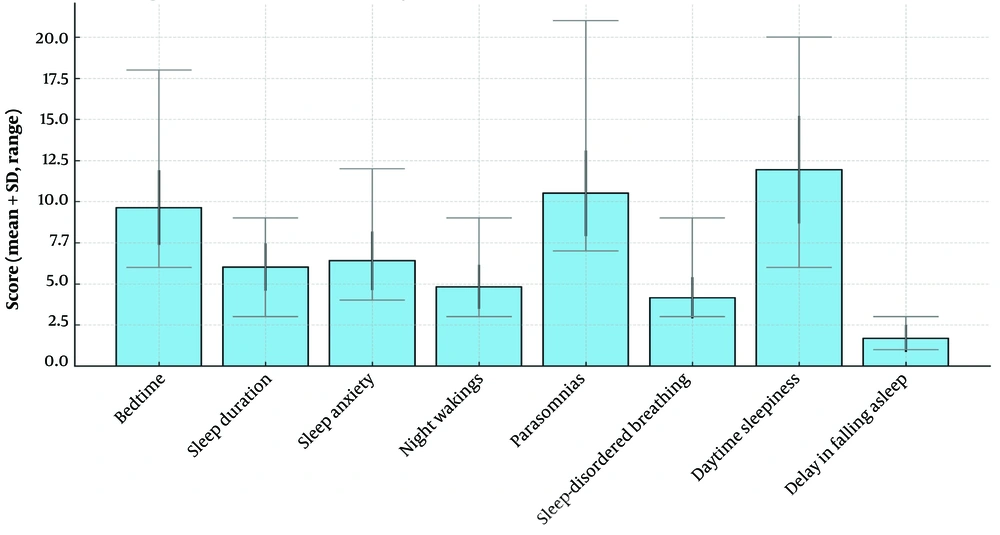
Figure 1.
Sleep habits scale sub-dimension scores
4.1. Parental Gender
Father-reported questionnaires showed statistically significantly higher scores on the bedtime (P < 0.01), sleep anxiety (P < 0.01), and daytime sleepiness (P < 0.05) subscales compared with mother-reported questionnaires. Conversely, mothers reported significantly higher sleep onset delay subscale scores (P < 0.01). Total CSHQ score was also significantly higher in father-completed questionnaires (P < 0.01) (Table 4).
Table 4.
Comparison of Children’s Sleep Habits Questionnaire Total and Subscale Scores According to Parent/Respondent Characteristics
| Variables | Bedtime | Sleep Duration | Sleep Anxiety | Night Wakings | Parasomnias | Sleep Disordered Breathing | Daytime Sleepiness | Sleep Onset Delay | Total Point |
|---|---|---|---|---|---|---|---|---|---|
| Gender | |||||||||
| Female | |||||||||
| Mean ± SD | 9.37 ± 2.34 | 5.99 ± 1.37 | 6.14 ± 1.62 | 4.70 ± 1.28 | 10.38 ± 2.17 | 3.98 ± 0.99 | 11.57 ± 3.35 | 1.79 ± 0.86 | 53.92 ± 7.42 |
| Median (min-max) | 9 (6 - 18) | 6 (3 - 9) | 6 (4 - 10) | 5 (3 - 9) | 10 (7 - 17) | 4 (3 - 6) | 11 (6 - 20) | 1.5 (1 - 3) | 54 (37 - 69) |
| Male | |||||||||
| Mean±SD | 10.01 ± 2.14 | 6.06 ± 1.55 | 6.78 ± 1.92 | 4.97 ± 1.42 | 10.68 ± 3.14 | 4.39 ± 1.55 | 12.48 ± 3.12 | 1.54 ± 0.76 | 56.90 ± 9.35 |
| Median (min-max) | 10 (7 - 16) | 6 (3 - 9) | 7 (4 - 12) | 5 (3 - 9) | 10 (7 - 21) | 4 (3 - 9) | 13 (6 - 18) | 1 (1 - 3) | 58 (39 - 87) |
| P-value | 0.009 a, b | 0.646 a | 0.005 b, c | 0.072 a | 0.828 c | 0.064 c | 0.010 a, b | 0.007 b, c | 0.001 a, b |
| Age | |||||||||
| R | -0.243 | 0.080 | -0.312 d | -0.176 | -0.186 d | -0.157 d | -0.072 | 0.188 d | -0.249 |
| P-value | 0.001 b | 0.134 | 0.001 b | 0.001 b | 0.001 b | 0.003 b | 0.176 | 0.001 b | 0.001 b |
| Education level | |||||||||
| Primary school and below | |||||||||
| Mean ± SD | 9.80 ± 2.60 | 5.80 ± 1.33 | 6.20 ± 1.78 | 4.61 ± 1.42 | 10.37 ± 2.14 | 4.12 ± 1.17 | 10.94 ± 3.26 | 1.73 ± 0.80 | 53.57 ± 7.70 |
| Median (min-max) | 10 (6 - 18) | 6 (3 - 9) | 6 (4 - 10) | 4 (3 - 9) | 11 (7 - 15) | 4 (3 - 8) | 10 (6 - 20) | 2 (1 - 3) | 53 (40 - 73) |
| High school | |||||||||
| Mean ± SD | 9.18 ± 1.85 | 6.37 ± 1.50 | 6.50 ± 1.45 | 4.84 ± 1.03 | 10.24 ± 2.21 | 4.01 ± 1.06 | 12.58 ± 3.21 | 1.50 ± 0.77 | 55.20 ± 7.12 |
| Median (min-max) | 9 (6 - 14) | 6 (3 - 9) | 7 (4 - 9) | 5 (3 - 7) | 10 (7 - 17) | 4 (3 - 6) | 13 (6 - 20) | 1 (1 - 3) | 57 (37 - 67) |
| University | |||||||||
| Mean ± SD | 10.60 ± 2.11 | 5.53 ± 1.32 | 6.78 ± 2.60 | 5.40 ± 1.80 | 11.87 ± 4.40 | 4.73 ± 1.94 | 13.13 ± 2.68 | 2.20 ± 0.92 | 60.24 ± 12.06 |
| Median (min-max) | 10 (6 - 14) | 5 (3 - 8) | 6 (4 - 12) | 5 (3 - 9) | 10 (7 - 21) | 4 (3 - 9) | 14 (6 - 17) | 3 (1 - 3) | 59 (38 - 87) |
| P-value | 0.001 b, e | 0.001 b, e | 0.193 f | 0.021 e, g | 0.314 f | 0.145 f | 0.001 b, e | 0.001 b, f | 0.001 b, e |
Abbreviation: R, Pearson’s Correlation Coefficient.
a Student t test.
b P < 0.01.
c Mann Whitney U test.
d Spearman’s Correlation Coefficient.
e One Way ANOVA test & Bonferroni test.
f Kruskal Wallis test & Dunn Bonferroni test.
g P < 0.05.
4.2. Parental Age
A statistically significant negative correlation was found between parental age and Bedtime (P < 0.01), Sleep Anxiety (P < 0.01), Night Wakings (P < 0.01), Parasomnias (P < 0.01), and Sleep-Disordered Breathing (P = 0.003; P < 0.01) subscales, as well as the total CSHQ score (P < 0.01). A positive correlation was found between parental age and the Sleep Onset Delay subscale (P < 0.01) (Table 4).
4.3. Parental Education Level
The Bedtime subscale showed a significant difference by education level (P < 0.01). Participants with a high school education had lower Bedtime scores than those with primary school or less and university education (P < 0.05).
The Sleep Duration subscale also differed significantly by education level (P < 0.01). Participants with a high school education had higher scores than those with primary school or less and university education (P < 0.05).
The Night Wakings subscale differed significantly across education levels (P < 0.05), with participants with primary school or less education showing lower scores than those with university education (P < 0.05).
The Daytime Sleepiness subscale also differed significantly by education level (P < 0.05), with participants with primary school or less education having lower scores than those with high school or university education (P < 0.01).
The Sleep Onset Delay subscale differed significantly across education levels (P < 0.01). Participants with a high school education had lower scores than those with primary school or less and university education (P < 0.05), and those with university education had higher scores than those with primary school or less education (P < 0.01).
Total CSHQ scores differed significantly by education level (P < 0.01). Participants with university education had higher scores than those with primary school or less and high school education (P < 0.05) (Table 4).
4.4. Economic Status
Total CSHQ scores differed significantly by economic status (P < 0.01). Participants with low-to-moderate economic status had lower scores than those with medium, medium-to-high, and high economic status (P < 0.05). Those with low economic status had lower scores than those with medium-to-high and high economic status (P < 0.05) (Table 4).
4.5. Number of Children
The Bedtime subscale showed a significant difference based on the number of children (P < 0.05). Participants with one child had higher scores than those with two or more children (P < 0.05). The Sleep Duration subscale also differed significantly by number of children (P < 0.01); participants with two children had higher scores than those with three or more children (P < 0.01). Additionally, the Daytime Sleepiness subscale showed a significant difference (P < 0.05); participants with two children had lower scores than those with three or more children (P < 0.05) (Table 4).
4.6. Child Age
A significant negative correlation was observed between child age and the Sleep Anxiety subscale (P < 0.01). In contrast, child age showed a positive correlation with the Night Wakings (P < 0.01), Daytime Sleepiness (P < 0.05), and Sleep Onset Delay (P < 0.01) subscales (Table 5).
Table 5.
Comparison of Children’s Sleep Habits Questionnaire Total and Subscale Scores According to Economic Status and Number of Children
| Variables | Bedtime | Sleep Duration | Sleep Anxiety | Nighttime Awakenings | Parasomnias | Sleep Disordered Breathing | Daytime Sleepiness | Sleep Onset Delay | Total Point |
|---|---|---|---|---|---|---|---|---|---|
| Economic status | |||||||||
| Low | |||||||||
| Mean ± SD | 9.60 ± 1.16 | 5.53 ± 1.38 | 5.93 ± 1.67 | 4.60 ± 1.27 | 9.67 ± 1.80 | 3.87 ± 1.04 | 10.93 ± 3.55 | 1.73 ± 0.86 | 51.87 ± 7.07 |
| Median (min-max) | 10 (8 - 12) | 6 (3 - 9) | 6 (4 - 9) | 5 (3 - 7) | 10 (7 - 13) | 3 (3 - 6) | 11 (6 - 18) | 1 (1 - 3) | 51 (37 - 63) |
| Low-Medium | |||||||||
| Mean ± SD | 8.47 ± 1.63 | 7.16 ± 1.54 | 5.82 ± 1.35 | 3.98 ± 0.76 | 9.98 ± 2.14 | 3.80 ± 1.13 | 11.18 ± 3.14 | 1.41 ± 0.70 | 51.80 ± 7.41 |
| Median (min-max) | 8 (6 - 12) | 8 (3 - 9) | 6 (4 - 8) | 4 (3 - 5) | 9 (7 - 13) | 3 (3 - 6) | 12 (6 - 18) | 1 (1 - 3) | 48 (41 - 67) |
| Medium | |||||||||
| Mean ± SD | 9.89 ± 2.55 | 5.82 ± 1.22 | 6.55 ± 1.83 | 4.88 ± 1.34 | 10.61 ± 2.61 | 4.27 ± 1.31 | 11.75 ± 3.2 | 1.79 ± 0.86 | 55.55 ± 8.03 |
| Medyan (min-max) | 10 (6 - 18) | 6 (3 - 8) | 7 (4 - 12) | 5 (3 - 9) | 10 (7 - 21) | 4 (3 - 9) | 11.5 (6 - 20) | 1.5 (1 - 3) | 56 (39 - 85) |
| Mediım-High | |||||||||
| Mean ± SD | 9.74 ± 2.14 | 6.24 ± 1.83 | 6.71 ± 1.43 | 5.09 ± 1.31 | 10.85 ± 3.16 | 3.88 ± 1.17 | 13.00 ± 3.13 | 1.71 ± 0.76 | 57.21 ± 9.13 |
| Median (min-max) | 10 (7 - 13) | 6 (4 - 9) | 7 (4 - 9) | 5 (3 - 7) | 10 (7 - 15) | 3 (3 - 6) | 14 (8 - 18) | 2 (1 - 3) | 59 (42 - 73) |
| High | |||||||||
| Ort ± Ss | 9.84 ± 2.39 | 5.84 ± 1.28 | 6.67 ± 2.08 | 5.37 ± 1.47 | 11.11 ± 2.98 | 4.47 ± 1.36 | 13.37 ± 3.00 | 1.58 ± 0.82 | 58.25 ± 9.10 |
| Median (min-max) | 10 (6 - 14) | 6 (3 - 8) | 6 (4 - 12) | 5 (3 - 9) | 11 (7 - 21) | 4 (3 - 9) | 14 (6 - 20) | 1 (1 - 3) | 58 (38 - 87) |
| P-value | 0.001 a, b | 0.001 a, b | 0.024 c, d | 0.001 a, b | 0.113 c | 0.004 b, c | 0.001 a, b | 0.055 c | 0.001 a, b |
| Number of children | |||||||||
| 1 | |||||||||
| Mean ± SD | 11.00 ± 3.27 | 5.64 ± 1.75 | 7.24 ± 2.48 | 5.00 ± 1.68 | 10.64 ± 3.58 | 4.18 ± 1.72 | 12.36 ± 3.42 | 1.45 ± 0.67 | 57.52 ± 10.68 |
| Median (min-max) | 10 (7 - 18) | 5 (3 - 9) | 7 (4 - 12) | 5 (3 - 9) | 10 (7 - 21) | 4 (3 - 9) | 13 (6 - 17) | 1 (1 - 3) | 57 (47 - 87) |
| 2 | |||||||||
| Mean ± SD | 9.47 ± 2.16 | 6.24 ± 1.41 | 6.37 ± 1.77 | 4.69 ± 1.39 | 10.44 ± 2.50 | 4.00 ± 1.14 | 11.53 ± 3.31 | 1.74 ± 0.87 | 54.48 ± 8.47 |
| Median (min-max) | 9 (6 - 16) | 6 (3 - 9) | 6 (4 - 12) | 5 (3 - 9) | 10 (7 - 21) | 4 (3 - 9) | 12 (6 - 20) | 1 (1 - 3) | 55 (37 - 85) |
| ≥ 3 | |||||||||
| Mean ± SD | 9.53 ± 2.00 | 5.70 ± 1.34 | 6.21 ± 1.45 | 5.00 ± 1.09 | 10.58 ± 2.49 | 4.43 ± 1.30 | 12.64 ± 3.08 | 1.64 ± 0.79 | 55.73 ± 7.24 |
| Median (min-max) | 9 (6 - 14) | 5 (3 - 8) | 6 (4 - 9) | 5 (3 - 7) | 10 (7 - 15) | 4 (3 - 8) | 13 (6 - 18) | 1 (1 - 3) | 56 (39 - 73) |
| P-value | 0.039 a, d | 0.002 a, b | 0.111 c | 0.101 a | 0.721 c | 0.012 c, d | 0.013 a, d | 0.244 c | 0.104 a |
a One Way Anova test & Bonferroni test.
b P < 0.01.
c Kruskal Wallis test & Dunn Bonferroni test.
d P < 0.05.
4.7. Child Gender
Boys had statistically significantly higher scores than girls on the bedtime (P < 0.01), sleep anxiety (P < 0.01), and daytime sleepiness (P < 0.05) subscales. Conversely, girls had significantly higher sleep onset delay subscale scores (P < 0.01). The total CSHQ score was also significantly higher for boys (P < 0.01) (Table 5).
4.8. Child Education Level
Bedtime, sleep duration, sleep anxiety, night wakings, parasomnias, sleep-disordered breathing, and daytime sleepiness subscales, as well as the total CSHQ score, did not show any statistically significant differences (P > 0.05) (Table 5).
4.9. Independent Predictors of Sleep Habits
A multiple linear regression model was conducted to identify independent predictors of total CSHQ scores. The model significantly explained 28% of the variance (P < 0.001). After adjusting for potential confounders, higher parental education (P < 0.001) and higher child age (P < 0.001) remained significantly associated with higher CSHQ scores (Table 6).
Table 6.
Multiple Linear Regression Analysis of Factors Associated with Total Children’s Sleep Habits Questionnaire Scores
| Variable | β (Unstandardized) | SE | β (Standardized) | t-Value | P-Value | 95% CI for B |
|---|---|---|---|---|---|---|
| (Constant) | 45.12 | 2.34 | - | 19.28 | < 0.001 | [40.52, 49.72] |
| Child's age | 0.85 | 0.21 | 0.24 | 4.05 | < 0.001 | [0.44, 1.26] |
| Gender (boy) | 1.20 | 0.75 | 0.08 | 1.60 | 0.110 | [-0.27, 2.67] |
| Parental education | 2.15 | 0.45 | 0.31 | 4.78 | < 0.001 | [1.26, 3.04] |
| Economic status | 1.95 | 0.52 | 0.26 | 3.75 | 0.002 | [0.93, 2.97] |
5. Discussion
The CSHQ has been widely validated as a reliable tool for identifying both behavioral and medically based sleep problems in school-aged children. In the foundational study by Owens et al., CSHQ subscale and total scores consistently differentiated between community and sleep-disordered groups, demonstrating strong construct validity (5). In this study, internal consistency coefficients were α = 0.644 for bedtime, α = 0.604 for sleep duration, α = 0.569 for sleep anxiety, α = 0.505 for night wakings, α = 0.605 for parasomnias, α = 0.695 for sleep-disordered breathing, and α = 0.576 for daytime sleepiness. The overall Cronbach's alpha was 0.734, indicating good internal reliability and supporting the scale's psychometric robustness within this adolescent sample.
Consistent with the findings of Haylı et al., who reported significant associations between sociodemographic factors (e.g., age, gender, and educational status) and multiple CSHQ subdimensions among adolescents aged 12 - 18 (10), the current study also identified notable gender- and context-based differences in sleep behavior. Boys exhibited higher bedtime, sleep anxiety, and daytime sleepiness scores than girls, while socioeconomic factors such as family income level and the number of children were associated with overall sleep habits. These results underscore the association between social and environmental context and adolescent sleep behaviors.
Çetin et al. found that adolescents with epilepsy exhibited more frequent sleep disturbances and maladaptive behaviors, along with increased caregiver sleep difficulties (11). In contrast, our study excluded participants with chronic illnesses, offering clearer insight into sleep patterns among otherwise healthy adolescents. Similarly, İpar reported that 88.5% of children exhibited sleep disturbances on the CSHQ and that parental sleep quality was closely linked to their children's sleep patterns (12). These findings are consistent with our results, showing that father-completed questionnaires were associated with significantly higher scores on the bedtime, sleep anxiety, and daytime sleepiness subscales. This observed relationship suggests that parental respondent characteristics may be related to differences in the reporting or perception of adolescent sleep difficulties, highlighting the importance of the family context.
Sleep problems remain a common reason for pediatric consultations. Cognitive-behavioral therapy (CBT) has proven effective, particularly in the short term, while evidence supports low-dose melatonin as a useful adjunct for children who fail to respond to behavioral interventions (13). Consistent with this evidence, the identification of sleep difficulties in our study aligns with the need for behavioral guidance and psychological support, which are the primary management strategies in contemporary nonpharmacologic standards.
Cross-national studies provide additional context for interpreting our results. Gios et al. reported a mean total CSHQ score of 46.85 ± 9.43 in Brazilian children, with slightly higher—but nonsignificant—scores in boys (14). Similarly, Silva et al. found a mean score of 47.0 ± 7.2 in Portuguese children, with total scores decreasing as age increased (15). In contrast, our participants' total CSHQ scores were higher overall, and gender differences were statistically significant, though no correlation was observed between age and total sleep quality scores. This suggests that gender-linked behavioral or cultural factors may be more strongly associated with sleep patterns in our cohort than age alone.
Markovich et al. reported lower total CSHQ scores (39.00 ± 3.59) and found limited correspondence between CSHQ subscales and polysomnographic measures, concluding that the CSHQ alone may have limited diagnostic specificity (16). This represents a limitation of our study, as objective sleep measures such as actigraphy or polysomnography were not utilized. Future research would benefit from integrating multimodal assessment to provide a more comprehensive validation of subjective sleep reports.
Dikeos et al. validated the CSHQ among Greek adolescents (mean = 44.47 ± 6.62), confirming its utility across both clinical and community samples (17). Our results are consistent with these findings, reaffirming the CSHQ as a psychometrically sound tool for evaluating adolescent sleep patterns. Similarly, Kanagi et al. observed that older adolescents reported greater bedtime resistance and difficulty initiating sleep, while younger ones experienced shorter sleep duration and more night awakenings (18). These findings align with our results showing significant associations between age and the sleep anxiety, night wakings, and sleep onset delay subscales.
The study by Fulfs et al. demonstrated strong associations between CSHQ-measured sleep disturbances and psychological health, particularly linking parasomnias to hyperactivity/inattention and emotional difficulties to sleep anxiety and daytime sleepiness (19). Our findings align with this perspective, as higher sleep anxiety and daytime sleepiness scores were more common among adolescents from lower socioeconomic backgrounds and among those with fathers as respondents. These results suggest that emotional regulation difficulties and family-related stressors may mediate the relationship between sociodemographic factors and sleep quality.
Baddam et al. emphasized that pediatric sleep disorders remain underrecognized and called for validated screening instruments and innovative tools such as wearable devices and telemedicine (20). Our findings support this view: The CSHQ effectively identified multiple dimensions of sleep difficulties. However, as our study employed traditional data collection methods, future studies may benefit from digital or app-based platforms to capture more real-time sleep-wake behaviors in adolescents.
Lewien et al. reported that younger adolescents experience more bedtime difficulties, while older adolescents show greater daytime sleepiness; gender differences were stronger among girls, and lower socioeconomic status was linked to poorer sleep (21). Contrary to some studies in the literature, our results indicate that higher socioeconomic status and advancing age are associated with increased CSHQ scores, including daytime sleepiness.
A recent meta-analysis demonstrated a bidirectional relationship between adolescents' sleep patterns, mental health, and well-being, suggesting that poor sleep both contributes to and results from psychological distress (22). Our findings resonate with this model: sociodemographic variables such as parental education, gender, and economic status were significantly related to sleep anxiety, bedtime resistance, and daytime sleepiness, possibly reflecting the interplay between emotional well-being, household environment, and adolescent sleep regulation.
Tetik and Kar Şen found that approximately half of adolescents report difficulties such as sleep onset delay, frequent awakenings, and early morning fatigue, with significant implications for physical and emotional health and academic performance (23). Our findings corroborate these patterns, suggesting that sleep disturbances remain a prevalent and clinically meaningful concern among adolescents.
5.1. Conclusions
This study demonstrated that adolescents' sleep habits are significantly influenced by gender, parental characteristics, and socioeconomic status. Boys and adolescents with younger parents had higher levels of sleep disturbance. In this sample, higher parental education and higher economic status were also associated with higher total CSHQ scores. Because of the cross-sectional design, these findings should be interpreted as associations rather than causal relationships. These findings highlight the critical role of family environment and socioeconomic conditions in shaping healthy sleep behaviors among adolescents. Educational interventions targeting sleep hygiene and parental awareness may help improve adolescents' sleep quality and overall well-being. Future research should incorporate longitudinal and multicenter studies to further explore causal relationships between sociodemographic variables and adolescent sleep outcomes.
5.2. Limitations
This study has several limitations. Participants were recruited using convenience sampling from schools and community institutions in Şişli/İstanbul. As participants were recruited through convenience sampling from selected schools and community institutions, the sample may not be representative of the broader adolescent population. Recruiting participants from specific schools in a single district may limit the generalizability of the findings to the broader adolescent population (selection bias). Its cross-sectional design prevents causal inferences between sociodemographic factors and sleep habits. Data were obtained through self-reported questionnaires, which may introduce reporting or recall bias. The sample was drawn from a single center, which may limit the generalizability of the results to other adolescent populations. Longitudinal and multicenter investigations employing objective sleep measurements such as actigraphy or polysomnography are recommended to confirm these findings. A further limitation is that sleep data were obtained through parent/caregiver proxy report. Differences between mother and father respondents may have introduced reporting bias, as perceived sleep problems may vary according to respondent awareness, observation patterns, or interpretation of questionnaire items. The reliance on parent-reported data (CSHQ) is a limitation, as parents may underreport or overreport certain sleep behaviors compared to adolescents' self-reports or objective measures.