
1. Background
Vitamin B12 (cobalamin) is a water-soluble vitamin required for central nervous system development and myelination, as well as for the maturation of hematopoietic stem and progenitor cells (1). It functions as a critical cofactor in DNA synthesis, one-carbon methylation reactions, and the remethylation of homocysteine to methionine. Deficiency disrupts these pathways, leading to the accumulation of methylmalonic acid (MMA) and total homocysteine (tHcy), metabolites associated with reversible bone-marrow failure and demyelination within the nervous system (1, 2). Because circulating concentrations do not always reflect intracellular sufficiency, assessing deficiency solely by total serum B12 is problematic. Functional biomarkers such as MMA and tHcy more accurately capture cellular deficiency; in particular, MMA measured in plasma or urine has been shown to be a reliable indicator in newborns (3).
The neonatal and early-infancy periods are characterized by rapid growth and development, making an adequate B12 supply especially important. B12 is transferred from the mother to the fetus across the placenta, and neonatal stores depend on maternal B12 status (4). Term newborns typically have 25 - 50 mcg of B12 stores, which — given a daily requirement of approximately 0.1 mcg — may suffice for 6 - 12 months (5). If the mother is B12-deficient, the infant’s stores will be inadequate, leading to an earlier onset of deficiency signs. Because the last trimester and the first months of life are critical windows for brain myelination, this is of particular concern. If not detected and treated early, B12 deficiency in infants can result in developmental regression, hypotonia, seizures, and serious, potentially permanent neurologic sequelae (4, 6).
2. Objectives
There is limited evidence regarding very-early neonatal screening (within the first postnatal day), practical functional thresholds when serum B12 falls into a “borderline” range (e.g., 200 - 399 pg/mL), and the clarity of the maternal-infant B12 correlation at birth under routine conditions. This study aimed to evaluate the frequency of B12 deficiency in newborns during the early neonatal period, to identify the lowest B12 threshold that may prompt an increase in MMA, and to investigate the relationship between maternal and neonatal B12 levels.
3. Methods
3.1. Study Design and Setting
This single-center, prospective clinical study was conducted at University of Health Sciences Sultangazi Haseki Training and Research Hospital (Departments of Obstetrics & Gynecology and the Newborn Unit), İstanbul, Türkiye.
3.2. Participants and Recruitment
Serum vitamin B12 levels < 200 pg/mL are considered deficient, while levels between 200 - 400 pg/mL are considered borderline. This is how it is presented for children in both the literature and the kit's user manual. Although we do not examine MMA in all patients, the literature suggests that values above 400 pg/mL are generally considered safe for functional vitamin B12 deficiency, indicating that MMA levels are not elevated. X Mother-infant dyads who presented for delivery between November 2023 and June 2024 were screened. Mothers hospitalized on the postnatal ward were informed about the study; those who provided written informed consent were enrolled. In total, 656 newborns (and their mothers) were included. In our power analysis, with a 99% confidence interval, a 5% margin of error, and 90% power, the minimum number of cases required was found to be n = 558. Since we found 656 newborns who agreed to participate in the study between the specified dates, we determined this number accordingly. The participant flow diagram is shown in Figure 1.
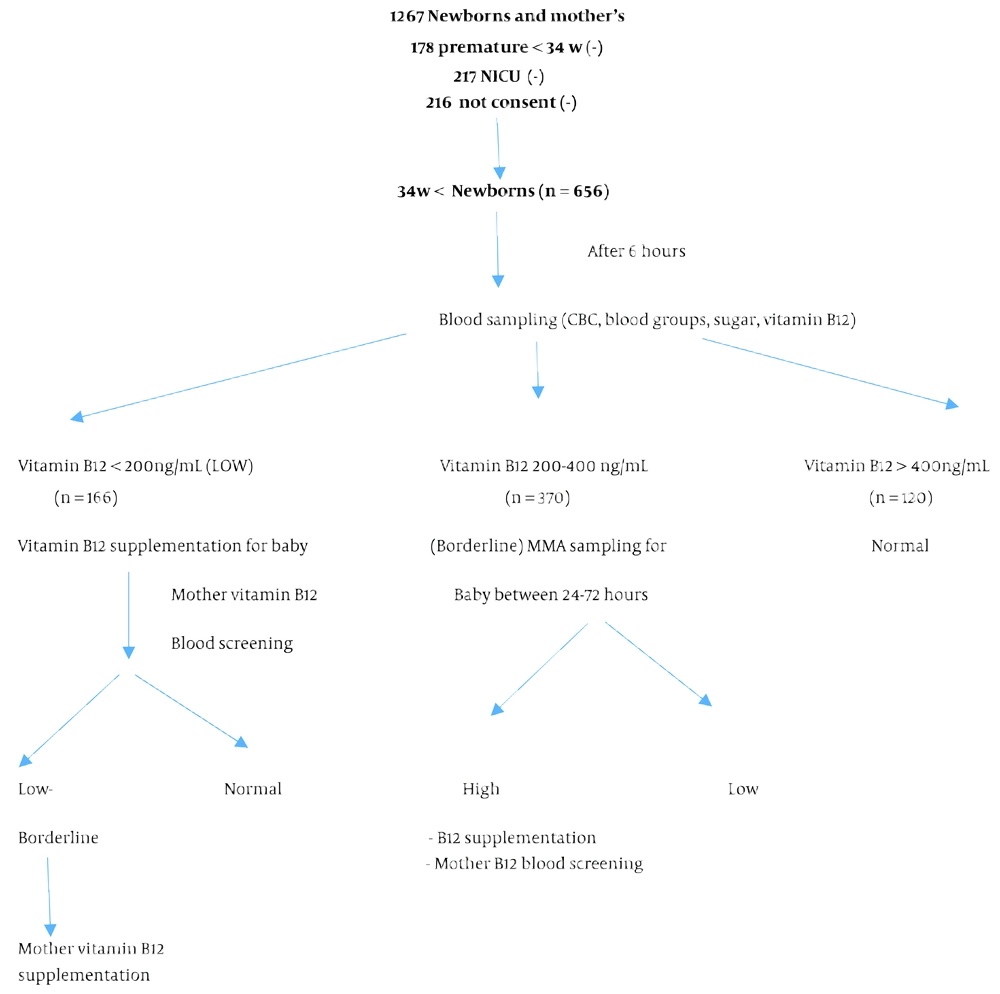
Figure 1.
Flow diagram showing the status of babies and their mothers in the study
3.3. Eligibility Criteria
Inclusion: Birth at the study center, gestational age (GA) ≥ 34 weeks, and feasibility of early postnatal laboratory sampling. Unfortunately, there is no information available regarding vegetarian mothers, and they were not excluded from the study.
Exclusion: Major congenital anomalies; conditions known to affect cobalamin metabolism; absence of parental consent; mothers using vitamin B12 for treatment purposes; and admission to the neonatal intensive care unit (NICU) at birth for acute conditions (e.g., suspected sepsis, pathologic jaundice).
3.4. Specimen Collection and Laboratory Measurements
At the postnatal 6th hour, in addition to routine testing, an extra 1 mL venous blood sample was obtained from each newborn for serum vitamin B12 measurement. Assays were performed according to the manufacturer’s instructions using the Vitamin B12 G2 Elecsys E2G 300 kit. Serum B12 concentrations were measured by chemiluminescent immunoassay (CMIA) on a Siemens Atellica IM 1300 analyzer. Based on the kit’s reference ranges, infant B12 status was categorized as low (0 - 199 pg/mL), borderline (200 - 400 pg/mL), or normal (≥ 401 pg/mL).
In precision studies conducted over 21 days with two measurements per day using the Vitamin B12 G2 Elecsys E2G 300 kit, the average CV values found for 5 human serum samples between 176 pg/mL and 1890 pg/mL in the first series were 2.98%, the CV value for low-level control was 3.4%, and the CV value for high-level control was 3%. In the second series, the average CV values for 5 human serum samples between 130 pg/mL and 1395 pg/mL were 2.98%, the CV value for low-level control was 3.4%, and the CV value for high-level control was 3%.
Around the time of delivery, maternal serum B12 was also obtained to evaluate the maternal-infant correlation. Newborns with low B12 were managed per institutional protocol, and mothers and infants with low or functionally insufficient B12 were started on supplementation when indicated.
3.5. Methylmalonic Acid Protocol
For infants with borderline B12 (200 - 400 pg/mL), a second blood sample was collected between 24 and 72 postnatal hours to measure MMA. Methylmalonic acid analysis was performed by liquid chromatography–tandem mass spectrometry (LC-MS/MS) on an Agilent 6475 system. Based on MMA results, infants (and, when indicated, their mothers) received vitamin B12 supplementation. MMA data were used to explore a pragmatic infant B12 threshold predictive of MMA elevation.
3.6. Outcomes and Definitions
Primary outcomes were: (1) The frequency of vitamin B12 deficiency in the early neonatal period and (2) the correlation between maternal and neonatal B12 at birth. A secondary outcome was to investigate an infant serum B12 threshold below which MMA elevation would be likely.
Statistical analysis
Analyses were performed in IBM SPSS Statistics v27.0. Distributional assumptions were evaluated using Kolmogorov-Smirnov and Shapiro-Wilk tests. Continuous variables were summarized as mean ± standard deviation (SD) or median (IQR) and compared using Student’s t test or Mann–Whitney U test, as appropriate. Categorical variables were compared using χ² or Fisher’s exact test. Pearson or Spearman correlation analyses were used to assess mother-infant B12 relationships. Receiver operating characteristic (ROC) analysis with Youden’s Index was applied to explore a B12 cut-off predictive of MMA elevation. Statistical significance was set at two-sided P < 0.05.
3.7. Ethics and Administrative Details
The study was approved by our hospital Clinical Research Ethics Committee on 24 August 2023 (Approval No.: 2023-152). Written informed consent was obtained from all participating mothers. Institutional project support for the Vitamin B12 G2 Elecsys E2G 300 assay kit was provided (Project Protocol No.: 341).
4. Result
Among the 656 pregnant women included, the mean ±SD maternal age was 27.8 ± 5.7 years and the mean GA at birth was 38.6 ± 1.5 weeks. Of the infants, 44.8% (n = 294) were delivered by spontaneous vaginal delivery and 55.2% (n = 362) by cesarean section; 52.0% (n = 341) were male. The mean birth weight, length, and head circumference were 3219.3 ± 429.4 g, 50.6 ± 2.4 cm, and 34.9 ± 1.6 cm, respectively. Laboratory results for newborns and mothers are presented in Table 1.
Table 1.
Neonatal and Maternal Laboratory Values (n = 656) a
| Parameter | Values |
|---|---|
| White blood cell count (/µL) | 19700 ± 4800 |
| Hemoglobin (g/dL) | 18.5 ± 2.1 |
| Hematocrit (%) | 54.5 ± 6.4 |
| Mean corpuscular volume (MCV) (fL) | 104.9 ± 4.9 |
| Platelets (/µL) | 275300 ± 71800 |
| Total bilirubin (mg/dL) | 3.28 ± 1.02 |
| MMA; (n=370) (nmol/L) | 37.8 (10.8 - 546.0) |
| Infant vitamin B12 (pg/mL) | 269.0 (90.0 - 2050.0) |
| Maternal vitamin B12; (n=536) (pg/mL) | 202.5 (99.0 - 545.0) |
Abbreviation: MMA, methylmalonic acid.
a Values are as expressed as mean ± SD or min-max.
According to serum B12 measured at the 6th postnatal hour, neonates were classified as low (0 - 199 pg/mL; n = 166, 25.4%), borderline (200 - 399 pg/mL; n = 370, 56.4%), and normal (≥ 400 pg/mL; n = 120, 18.2%). Gestational age differed across groups and was higher in the 200 - 399 pg/mL group (P = 0.019). Regarding mode of delivery, the 0 - 199 pg/mL group had a higher frequency of cesarean section (P = 0.020). Sex distribution also differed among groups (P = 0.012). No significant differences were observed in birth weight, length, or head circumference (all P > 0.05) (Table 2).
Table 2.
Comparison of Groups by Infant Vitamin B12 Level a
| Variables | B12 0 - 199 (pg/mL); [No. (%) = 166 (25.3)] | B12 200 - 399 (pg/mL); [No. (%) = 370 (56.4)] | B12 > 399 (pg/mL) [No. (%) = 120 (18.3)] | P-Value b |
|---|---|---|---|---|
| Maternal age (y) | 27.2 ± 5.4 | 27.9 ± 5.9 | 28.4 ± 5.6 | 0.189 |
| Nationality | 0.385 c | |||
| Turkish | 121 (72.9) | 287 (77.6) | 95 (79.2) | |
| Other | 45 (27.1) | 83 (22.4) | 25 (20.8) | |
| GA (wk) | 38.3 ± 1.6 | 39 ± 1.4 | 38.5 ± 1.5 | 0.019 d |
| Method of delivery | 0.020 c, d | |||
| SVD | 59 (35.5) | 179 (48.4) | 56 (46.7) | |
| CS | 107 (64.5) | 191 (51.6) | 64 (53.3) | |
| Gender | 0.012 c, d | |||
| Male | 90 (54.2) | 181 (48.9) | 44 (36.7) | |
| Female | 76 (45.8) | 189 (51.1) | 76 (63.3) | |
| Birth weight (g) | 3239.4 ± 433.4 | 3216.5 ± 430.8 | 3199.9 ± 421.8 | 0.890 |
| Birth length (cm) | 50.6 ± 2.1 | 50.6 ± 2.5 | 50.5 ± 2.2 | 0.968 |
| Head circumference (cm) | 34.9 ± 1.6 | 34.9 ± 1.6 | 34.7 ± 1.4 | 0.261 |
Abbreviations: CS, cesarean section; SD, standart deviation; SVD, spontaneous vaginal delivery; GA, gestational age
a Values are as expressed as No (%) or mean ± SD.
b Kruskal-Wallis (Mann-Whitney U) test.
c Ki kare test.
d P < 0.05 was considered statistically significant.
In laboratory comparisons, there were no significant between-group differences in WBC, HGB, HCT, MCV, or PLT (all P > 0.05). Total bilirubin differed across groups (P < 0.001). Maternal B12 levels did not differ by infant B12 category (P = 0.196) (Table 3).
Table 3.
Laboratory Values Across Infant Vitamin B12 Groups a
| Variables | B12 0 - 199 (pg/mL); (n = 166) | B12 200 - 399 (pg/mL); (n = 370) | B12 > 399 (pg/mL); (n = 120) | P-Value b |
|---|---|---|---|---|
| White blood cell count (/µL) | 19.0 ± 4.6 | 19.9 ± 4.9 | 20.0 ± 4.6 | 0.198 |
| Hemoglobin (g/dL) | 18.2 ± 2.3 | 18.6 ± 2.0 | 18.5 ± 2.1 | 0.404 |
| Hematocrit (%) | 53.2 ± 6.8 | 55.0 ± 6.2 | 54.6 ± 6.5 | 0.082 |
| Mean corpuscular volume (MCV) (fL) | 104.5 ± 5.1 | 109.9 ± 4.8 | 105.5 ± 4.8 | 0.282 |
| Platelets (/µL) | 276.9 ± 71.5 | 276.4 ± 68.6 | 270.0 ± 81.3 | 0.660 c |
| Total bilirubin (mg/dL) | 3.1 ± 0.8 | 3.3 ± 1.1 | 3.4 ± 1.0 | < 0.001 |
| MMA (nmol/L) | - | 62.7 ± 93.1 | - | |
| Maternal vitamin B12 (pg/mL) | 218.5 ± 93.6 | 253.0 ± 113.6 | - | 0.196 |
Abbreviation: MMA, methylmalonic acid.
a Values are as expressed as mean ± SD.
b Kruskal-Wallis (Mann-Whitney U) test.
c ANOVA.
In our study, a total of 52 vitamin B12 levels were measured from mothers, ranging from 99 to 545 pg/mL, with a median value of 202.5 pg/mL. We found that 28 of the 166 mothers whose infants' vitamin B12 levels were < 200 pg/mL also had vitamin B12 levels < 200 pg/mL, 21 had levels between 200 and 399 pg/mL, and 3 had levels above 400 pg/mL. Furthermore, 9 of the mothers whose infants' vitamin B12 levels were between 200 and 399 pg/mL also had vitamin B12 levels < 200 pg/mL. Treatment for vitamin B12 deficiency was initiated for both the infant and the mother with the low B12 level. Between the groups with vitamin B12 levels of 0 - 199 pg/mL and 200 - 399 pg/mL, the mother's vitamin B12 level did not differ significantly (P > 0.05) from the baby's vitamin B12 level.
There were 73 patients, representing 11% of the total number of patients, between 34 - 36 + 6 weeks. Their B12 values were distributed as follows: Below 200 (34.4%), between 200 - 400 (41%), and above 400 (24.6%), indicating a range similar to the overall distribution; therefore, no further statistical analysis was conducted.
5. Discussion
This study demonstrates a high prevalence of vitamin B12 deficiency in the early neonatal period, with 25.4% of infants exhibiting serum concentrations below 200 pg/mL. This finding is consistent with accumulating evidence that cobalamin deficiency is a common and consequential public health issue — even in non-vegetarian populations — affecting mothers and infants across diverse settings (1, 7-9). The high frequency observed in our cohort underscores neonatal vulnerability and suggests that local dietary practices and/or socioeconomic factors may contribute to suboptimal maternal B12 status.
The relationship we observed between GA and neonatal B12 — namely, higher GA among infants with borderline B12 (200 - 399 pg/mL) compared with those with deficiency (< 200 pg/mL) — may suggest that longer gestation permits greater maternal-fetal transfer of cobalamin. This contrasts with European reports describing an inverse correlation (10) and may reflect between-population differences in maternal nutrition and placental transport capacity (11).
Our observation that cesarean delivery was associated with lower neonatal B12 status warrants further study. Prior work suggests that mode of delivery shapes early gut microbiota composition — vaginal birth seeding Bifidobacterium/Bacteroides and cesarean section altering early colonization patterns — which could plausibly influence downstream vitamin metabolism and absorption (11-14). Given rising global cesarean rates, these data argue for careful postnatal B12 surveillance in cesarean-born infants.
A key methodological element of our study was the use of MMA as a functional biomarker. While total serum B12 is an essential first step, its limitations in reflecting intracellular sufficiency are well documented (2). Our protocol to measure MMA among infants with borderline B12 (200 - 399 pg/mL) aligns with recommendations to incorporate functional markers for definitive assessment. Although our sample was insufficient to propose a new neonatal decision threshold, the presence of elevated MMA in some infants with B12 > 200 pg/mL supports the notion that the conventional 200 pg/mL cut-off may not exclude functional deficiency in all newborns (2, 5, 7, 14, 15). MMA was checked in 76 of 370 babies whose vitamin B12 values were 200-399 pg/mL. While MMA was high in 6 babies, the B12 values of these babies were as low as 206 pg/mL and as high as 367 pg/mL. These findings reinforce reports that MMA (and, where available, tHcy) improves diagnostic sensitivity for infant cobalamin deficiency. In newborns with borderline vitamin B12 levels, high MMA values can sometimes also be seen in congenital B12 deficiency. We did not investigate this congenital condition (3, 9, 15).
The neurodevelopmental stakes of early-life B12 deficiency make timely recognition imperative. Cobalamin is essential for myelination; deficiency during late gestation and early infancy may produce serious, sometimes irreversible neurologic injury (4, 6). Although we did not assess long-term outcomes, the high deficiency burden at birth raises concern for subclinical neurodevelopmental risk in this population. Considering that vitamin B12 deficiency may not show clinical signs in the neonatal period except in cases of very severe deficiency, maintaining adequate B12 intake is crucial for newborns who undergo very rapid neuromotor development. Pragmatically, maternal status remains the primary determinant of neonatal stores; dietary patterns low in animal-source foods (e.g., vegetarian diets without supplementation) and economic constraints that limit access to such foods are recurrent contributors (5). Contemporary evidence further suggests that maternal B12 supplementation during pregnancy improves maternal cobalamin status and may confer benefits for child outcomes, bolstering the case for prevention approaches rather than reliance on postnatal detection alone (9).
Several additional observations deserve comment. First, the absence of significant group differences in hemogram indices (e.g., MCV) is unsurprising: Hematologic manifestations typically lag metabolic and neurologic changes, and even infants with deficiency may not show macrocytosis at birth (6, 16, 17). Second, the lower bilirubin levels in the deficiency group, while counterintuitive given the potential for ineffective erythropoiesis to increase bilirubin, require cautious interpretation and external validation; perinatal factors could confound this association. Finally, despite incomplete data precluding robust modeling, the finding that 53.8% of mothers of deficient infants were also deficient supports a strong maternal-neonatal linkage and echoes prior work demonstrating concordance between maternal and cord B12 (17, 18). Together, these points argue for maternal-centered strategies — screening and targeted supplementation in pregnancy, especially in populations with limited animal-source intake — while continuing to refine neonatal functional thresholds (7-9, 15, 19).
Strengths of this study include a prospective design, standardized sampling at a uniform early postnatal time point, and the pragmatic incorporation of MMA in borderline cases (2, 3).
5.1. Study Limitations
Limitations include its single-center setting; lack of homocysteine measurements; absence of maternal dietary profiling; and incomplete MMA testing among all borderline infants, which limited our ability to define an actionable neonatal B12 cut-off. In addition, missing maternal data constrained statistical modeling of mother-infant relationships.The elevated MMA levels observed in a small number of newborns in our study are known to be potentially associated with congenital cobalamin deficiency, a condition not investigated in our studyFuture work should integrate maternal screening/supplementation trials with neonatal functional markers (MMA ± tHcy) and follow neurodevelopmental outcomes to establish clinically useful thresholds and pathways (7-9, 13, 15, 19).
In this single-center cohort, vitamin B12 deficiency was common in the early neonatal period, with roughly one in four infants having < 200 pg/mL and over half falling into a borderline range at 6 hours postnatal. Given that total B12 may miss functional insufficiency, a pragmatic care pathway is to treat clear deficiency and confirm borderline results with MMA, coupled with maternal assessment and supplementation. These findings support antenatal screening and targeted supplementation programs — especially in populations with limited animal-source food intake and for infants born by cesarean section — to reduce preventable risk. Early detection and timely intervention are critical to avert potential neurodevelopmental harm, while larger multi-center studies incorporating homocysteine and long-term follow-up are needed to define actionable neonatal cut-offs.
We found that vitamin B12 was low in 25.4% of newborns and borderline in 56.4%. In this case, it is important to check the B12 status of pregnant women and, for patients with low vitamin B12 levels, to protect newborns by giving them B12-containing vitamins.
Declaration Regarding the Use of Artificial Intelligence and Artificial Intelligence-Assisted Technologies
During the preparation of this work, the author(s) utilized OpenAI’s ChatGPT to support the research process. Specifically, the tool was employed to generate summaries of relevant research articles, refine English language usage, adjust sentence structures, and assist in creating illustrative figures. The generated outputs were carefully reviewed and compared with expert-written materials to ensure accuracy and relevance. Only after thorough verification and necessary editing were these contributions integrated into the manuscript. Full responsibility for the content rests with the author(s). The incorporation of this AI tool primarily enhanced the efficiency of the literature review, the clarity of written expression, and the comprehensiveness of visual presentation.