
1. Background
Mycoplasma pneumoniae pneumonia (MPP) is an acute pulmonary infection characterized by bronchial and interstitial lung lesions and predominantly affects children. Because MPP lacks specific early symptoms, it can progress to severe MPP (SMPP) if systematic anti-infective and anti-inflammatory treatment is not provided promptly (1). SMPP is characterized by severe symptoms and a prolonged disease course and may involve the skin, nervous system, hematologic system, digestive system, and other extrapulmonary systems. In severe cases, patients may develop multiple-organ failure and pulmonary structural or functional sequelae, seriously affecting children’s physical and mental health (2). Therefore, early intervention after an accurate diagnosis of MPP is important for controlling disease progression and improving prognosis. Currently, the "gold standard" for diagnosing MPP in China is a comprehensive clinical approach that includes evaluation of symptoms and signs, imaging examinations, and Mycoplasma pneumoniae (MP) nucleic acid testing. Despite its high accuracy, this process is time-consuming, which may limit early diagnosis and treatment in children with MPP. Therefore, rapid and efficient biomarkers for MPP diagnosis are needed.
After MP infection, C-reactive protein (CRP) levels increase significantly and may serve as a sensitive biomarker of infection and inflammation to aid in MPP diagnosis (3). Procalcitonin (PCT) is an indicator of bacterial, fungal, and parasitic infections and may increase in severe infections (4). MPP activates immune cells and the complement system, causing strong immune responses. Measurement of immunoglobulin M (IgM), IgG, and other immune indicators can help diagnose MPP (5). Therefore, serum CRP, IgM, IgG, and PCT are potential biomarkers for MPP diagnosis, but few reports have evaluated their combined diagnostic performance.
2. Objectives
This study analyzed serum CRP, IgM, IgG, and PCT levels in children with MPP and evaluated the diagnostic performance of their combined use to provide clinically relevant evidence for diagnosis.
3. Methods
3.1. Subjects
Between January 2021 and January 2024, a total of 128 children with suspected MPP were consecutively screened at our hospital. After application of the predefined inclusion and exclusion criteria, 28 children were excluded because of incomplete clinical or laboratory data (n = 12), underlying pulmonary diseases (n = 7), recent use of glucocorticoids, antibiotics, or immunomodulators (n = 5), or severe systemic conditions or complications (n = 4). Finally, 100 children were included in the study and underwent index testing and reference-standard classification. The cohort comprised children aged 6 - 14 years, with a mean age of 8.85 ± 1.25 years; 55 were male and 45 were female. The mean body mass index was 22.86 ± 0.58 kg/m2, within the range of 20 - 24 kg/m2. Body temperature at admission ranged from 38 °C to 39.5 °C, with a mean of 38.25 ± 0.20 °C. This study was approved by the ethics committee of our hospital, and written informed consent was obtained from all patients' guardians.
All included patients completed microbiological testing (MP nucleic acid and/or culture), imaging examinations, and biomarker assessments (CRP, IgM, IgG, and PCT). No patients had missing data that would affect diagnostic classification or statistical analysis.
3.2. Inclusion and Exclusion Criteria
Eligible participants were required to meet the following inclusion criteria: 1) written informed consent was obtained from the patients' guardians; 2) patients had complete clinical data and good treatment compliance; and 3) patients had normal mental status and normal heart, liver, and kidney function. The exclusion criteria were as follows: 1) bronchial asthma, chronic lung disease, tuberculosis, or other pulmonary conditions; 2) congenital airway malformations; 3) immune system disorders or congenital genetic or metabolic conditions; 4) malnutrition; 5) use of glucocorticoids, antibiotics, or immunomodulators within the previous 3 months; and 6) critical illness or severe complications.
These criteria were applied before index testing. Eligible patients subsequently underwent standardized diagnostic evaluation and were included in the final analysis as described above.
3.3. Blood Sample Collection
On the morning after admission, before treatment and within 24 hours of hospital admission, 5 mL of fasting blood was collected from the median cubital vein while the patient was at rest. The exact interval between symptom onset and blood sampling was unavailable because symptom-onset timing was not systematically recorded in the retrospective clinical records. However, all blood samples were collected within 24 hours of hospital admission and before treatment initiation. Blood samples were allowed to stand at room temperature for 30 minutes and then centrifuged at 2500 rpm for 10 minutes with a centrifugal radius of 10 cm. The supernatant was collected into sterile centrifuge tubes. Serum samples were analyzed immediately or stored at -80 °C until analysis. Repeated freeze-thaw cycles were avoided to ensure sample stability. Standardized sample-handling procedures were applied to all patients to minimize preanalytical variability.
3.4. Detection of Serum CRP, IgM, IgG, and PCT Levels
All biomarker levels (CRP, IgM, IgG, and PCT) were measured from the baseline blood sample collected before treatment initiation. Serum IgG and IgM levels were quantified using an immunoturbidimetric assay with Radim Diagnostics kits (Shanghai, China), whereas serum CRP and PCT levels were measured using enzyme-linked immunosorbent assay kits from Shanghai Mlbio Co., Ltd. (China). All assays were performed strictly according to the manufacturers' instructions, with appropriate calibration procedures and internal quality-control samples included in each batch to ensure analytical accuracy and reliability.
The units of measurement were CRP (mg/L), PCT (ng/mL), and IgM/IgG (g/L). The reference ranges provided by the manufacturers were CRP < 10 mg/L, PCT < 0.05 ng/mL, IgM 0.5 - 2.0 g/L, and IgG 7 - 16 g/L. All measurements were performed by experienced laboratory technicians who were blinded to the patients' clinical classification.
3.5. Detection of Serum Laboratory Indicators
A PUZS-300X automatic biochemical analyzer (Perlong Medical, China) was used to measure hematologic parameters, including white blood cell, neutrophil, lymphocyte, monocyte, and eosinophil counts; mean corpuscular volume; mean corpuscular hemoglobin concentration; platelet count; hematocrit; plateletocrit; and platelet-large cell ratio.
3.6. Diagnostic Method for MPP
MPP was diagnosed using a predefined composite reference standard consisting of microbiological evidence, clinical features, and imaging findings. Explicit operational criteria were applied to ensure reproducibility. Specifically, microbiological evidence, defined as a positive MP nucleic acid test or culture, was considered a major (preferred) criterion, although it was not mandatory for diagnosis. Clinical and laboratory findings, including respiratory symptoms (cough, expectoration, and dyspnea), auscultatory abnormalities (medium and coarse rales), mild leukocytosis, and elevated erythrocyte sedimentation rate (ESR), were considered supportive criteria. Imaging evidence based on chest X-ray findings, such as punctate or patchy infiltrates and/or pleural effusion, was also considered a supportive criterion.
Patients were classified as having MPP when they met either of the following conditions: 1) positive MP nucleic acid or culture plus compatible clinical and imaging findings; or 2) negative microbiological results but typical clinical manifestations and imaging findings strongly suggestive of MPP after exclusion of other pathogens. The studied biomarkers (CRP, PCT, IgM, and IgG) were not included in the reference standard and were not used in clinical decision-making for MPP classification. Furthermore, the index-test results (CRP, PCT, IgM, and IgG) were unavailable to clinicians or adjudicators at the time of diagnostic classification.
In cases of discordance among microbiological, clinical, and imaging findings, the final diagnosis was independently adjudicated by 2 senior pediatric pulmonologists, with discrepancies resolved by a third expert. All adjudicators were blinded to the index-test results to minimize bias. This framework, which distinguished major and supportive criteria and excluded index biomarkers from the reference standard, was designed to reduce the risk of incorporation and classification bias.
MP culture was performed by incubating throat-swab specimens in MP-specific medium (Bio-Rad, USA) at 37 °C for 24 hours. A color change in the medium from red to yellow was defined as positive, whereas no significant color change was considered negative. Patients who fulfilled the above criteria were assigned to the MPP group, whereas those who did not meet these criteria were classified as the non-MPP group.
3.7. Collection of General Data
Sex, age, body mass index, body temperature at admission, allergic constitution (yes/no), and premature delivery (yes/no) were recorded for children in both groups.
3.8. Statistical Analysis
Statistical analysis was performed using SPSS version 23.0. Normality tests were conducted for all measurement data. Normally distributed measurement data were described as mean ± standard deviation (x ± s). For intergroup comparisons with homogeneous variances, the independent-samples t-test was used, whereas the paired-samples t-test was used for intragroup comparisons. A corrected t-test (t'-test) was used for heterogeneous variances. Skewed measurement data were expressed as the median (M) and interquartile range (IQR) and analyzed using the Mann-Whitney U test. Multivariable logistic regression analysis was used to investigate the associations between serum CRP, IgM, IgG, and PCT levels and MPP and to construct a combined diagnostic model. The predicted probability derived from the logistic regression model was used as the combined diagnostic score. Receiver operating characteristic (ROC) curves were plotted to analyze the diagnostic values of CRP, IgM, IgG, PCT, and the combined model. The area under the ROC curve (AUC) and corresponding 95% confidence intervals (CIs) were calculated. At the optimal cutoff values determined by the maximum Youden index, sensitivity, specificity, positive predictive value (PPV), and negative predictive value (NPV), together with their 95% CIs, were calculated to evaluate clinical applicability. Model calibration was assessed using calibration plots and the Hosmer-Lemeshow goodness-of-fit test. Internal validation was performed using bootstrap resampling (1000 repetitions) to estimate model stability and reduce potential overfitting. AUC values of > 0.9, 0.71 - 0.9, 0.5 - 0.7, and < 0.5 indicated high, certain, low, and no diagnostic efficiency, respectively. A P value < 0.05 was considered statistically significant.
4. Results
4.1. MP Infections
According to the gold standard, the MPP group comprised 36 cases (36%), whereas the non-MPP group comprised 64 cases (64%).
4.2. Related Indicators in the MPP and Non-MPP Groups
No significant differences were observed between the MPP and non-MPP groups in sex, age, body mass index, premature delivery, admission body temperature, allergic constitution, or hematologic parameters, including white blood cell, neutrophil, lymphocyte, monocyte, eosinophil, and platelet counts; mean corpuscular hemoglobin concentration; mean corpuscular volume; hematocrit; plateletocrit; and platelet-large cell ratio (P > 0.05). Serum CRP, PCT, IgG, and IgM levels were significantly higher in the MPP group than in the non-MPP group (P < 0.05) (Table 1).
Table 1.
Related Indicators of the MPP and Non-MPP Groups a
| Indicators | MPP Group (n = 36) | Non-MPP Group (n = 64) | Statistical Value | P-Value |
|---|---|---|---|---|
| Gender | 0.007 | 0.933 | ||
| Male | 20 (55.56) | 35 (54.69) | ||
| Female | 16 (44.44) | 29 (45.31) | ||
| Allergic constitution | 0.637 | 0.425 | ||
| Yes | 6 (16.67) | 15 (23.44) | ||
| No | 30 (83.33) | 49 (76.56) | ||
| Premature delivery | 0.089 | 0.766 | ||
| Yes | 2 (5.56) | 4 (6.25) | ||
| No | 34 (94.44) | 60 (93.75) | ||
| Age (y) | 8.82 ± 1.85 | 8.84 ± 1.83 | 0.052 | 0.958 |
| Body mass index (kg/m2) | 22.89 ± 0.52 | 22.86 ± 0.53 | 0.274 | 0.785 |
| White blood cell count (×109/L) | 10.92 ± 0.28 | 10.86 ± 0.27 | 1.053 | 0.295 |
| Temperature (°C) | 38.10 ± 0.24 | 38.12 ± 0.26 | 0.379 | 0.705 |
| Neutrophil count (×109/L) | 7.85 ± 1.16 | 7.88 ± 1.18 | 0.123 | 0.903 |
| Lymphocyte count (×109/L) | 6.10 ± 0.52 | 6.13 ± 0.53 | 0.274 | 0.785 |
| Monocyte count (×109/L) | 0.56 ± 0.03 | 0.57 ± 0.04 | 1.306 | 0.195 |
| Eosinophil count (×109/L) | 0.62 ± 0.04 | 0.63 ± 0.05 | 1.028 | 0.306 |
| Platelet count (×109/L) | 180.05 ± 10.25 | 181.07 ± 10.26 | 0.477 | 0.634 |
| Mean corpuscular volume (fL) | 85.02 ± 9.24 | 85.05 ± 9.20 | 0.016 | 0.988 |
| Mean corpuscular hemoglobin concentration (g/L) | 344.21 ± 20.10 | 343.25 ± 20.18 | 0.229 | 0.820 |
| Hematocrit (%) | 36.52 ± 5.21 | 36.58 ± 5.26 | 0.055 | 0.956 |
| Plateletocrit (%) | 0.23 ± 0.02 | 0.22 ± 0.03 | 1.787 | 0.077 |
| Platelet-large cell ratio (%) | 13.55 ± 2.10 | 13.58 ± 2.09 | 0.069 | 0.945 |
| Serum CRP (mg/L) | 16.64 ± 2.87 | 7.62 ± 1.86 | 19.049 | < 0.001 |
| Serum PCT (ng/mL) | 0.85 ± 0.08 | 0.24 ± 0.02 | 46.929 | < 0.001 |
| Serum IgM (g/L) | 2.40 ± 0.44 | 1.34 ± 0.59 | 9.401 | < 0.001 |
| Serum IgG (g/L) | 15.08 ± 2.18 | 9.21 ± 2.52 | 11.720 | < 0.001 |
a Values are expressed as No. (%) or mean ± SD.
4.3. Multivariable Logistic Regression Analysis of Factors Associated With MPP
Multivariable logistic regression analysis identified elevated serum CRP (mg/L), PCT (ng/mL), IgG (g/L), and IgM (g/L) levels as risk factors for MPP, with odds ratios > 1 and P values < 0.05 (Table 2 and Figure 1). The final combined logistic regression model was expressed as follows: logit(P) = -10.186 + 0.275 × CRP + 0.651 × PCT + 0.174 × IgM + 0.476 × IgG, where P represents the predicted probability of MPP, CRP is measured in mg/L, PCT in ng/mL, and IgM and IgG in g/L. The predicted probability was calculated as P = 1 / [1 + exp(-logit(P))]. Patients with predicted probabilities above the optimal threshold were classified as having MPP, whereas those below the threshold were classified as having non-MPP.
Table 2.
Multivariable Logistic Regression Analysis of Factors Associated with MPP a
| Variables | B | SE | Wald | P | OR | 95% CI |
|---|---|---|---|---|---|---|
| Constant | -10.186 | 2.433 | 17.533 | 0.001 | 265.599 | - |
| CRP | 0.275 | 0.083 | 10.978 | 0.001 | 1.317 | 1.119 - 1.549 |
| PCT | 0.651 | 0.214 | 9.254 | 0.002 | 1.917 | 1.261 - 2.917 |
| IgM | 0.174 | 0.076 | 5.242 | 0.022 | 1.190 | 1.025 - 1.381 |
| IgG | 0.476 | 0.163 | 8.528 | 0.004 | 1.609 | 1.169 - 2.216 |
a Abbreviations: SE, standard error; OR, odds ratio; CRP, C-reactive protein; PCT, procalcitonin; IgM, immunoglobulin M; IgG, immunoglobulin G; CI, confidence interval.
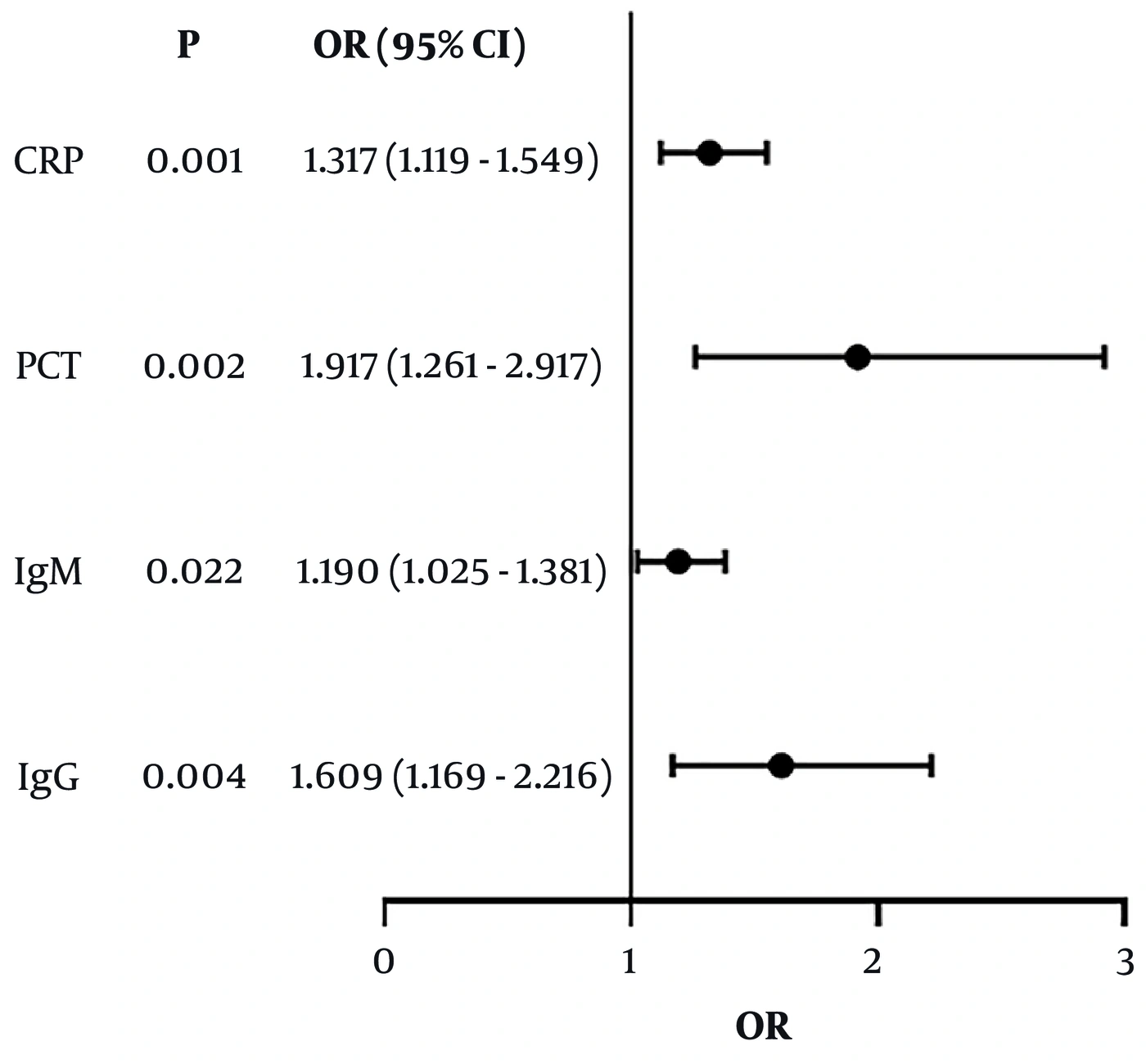
Figure 1.
Forest plot of clinical characteristics based on multivariable logistic regression analysis
4.4. Diagnostic Values of CRP, PCT, IgG, IgM, and Their Combination for MPP
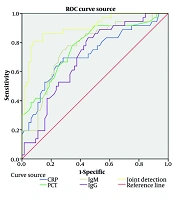
ROC curves were constructed using MPP status as a binary state variable (0 for MPP, 1 for non-MPP) and serum CRP (mg/L), PCT (ng/mL), IgG (g/L), and IgM (g/L) levels as test variables. The AUCs for diagnosing MPP were 0.722 (95% CI, 0.613 - 0.830) for serum CRP, 0.773 (95% CI, 0.676 - 0.871) for PCT, 0.764 (95% CI, 0.667 - 0.861) for IgM, 0.700 (95% CI, 0.598 - 0.803) for IgG, and 0.905 (95% CI, 0.842 - 0.968) for the combination of all 4 markers (Table 3 and Figure 2). The optimal cutoff values for each biomarker were determined based on the maximum Youden index. The cutoff values were 8.520 mg/L for CRP, 0.280 ng/mL for PCT, 1.600 g/L for IgM, and 11.165 g/L for IgG. At these thresholds, CRP showed a sensitivity of 0.806 and specificity of 0.453; PCT showed a sensitivity of 0.917 and specificity of 0.500; IgM showed a sensitivity of 0.861 and specificity of 0.562; and IgG showed a sensitivity of 0.833 and specificity of 0.547. PPV and NPV were also calculated at the optimal cutoff values to assess clinical applicability. For the combined model, predicted probabilities derived from multivariable logistic regression were used to construct the ROC curve, and the optimal cutoff was selected based on the maximum Youden index. The optimal probability threshold for the combined model was approximately 0.112. At this threshold, the combined model showed a sensitivity of 0.889 and specificity of 0.719. The PPV and NPV at the optimal cutoff values were CRP (PPV 0.453, NPV 0.806), PCT (PPV 0.508, NPV 0.915), IgM (PPV 0.525, NPV 0.878), IgG (PPV 0.508, NPV 0.854), and the combined model (PPV 0.640, NPV 0.920).
Table 3.
Diagnostic Values of CRP, PCT, IgG, IgM, and Their Combination for MPP a
| Indicators | Optimal Cutoff | AUC (95% CI) | SE | P | Sensitivity | Specificity | Youden Index | PPV (95% CI) | NPV (95% CI) |
|---|---|---|---|---|---|---|---|---|---|
| CRP | 8.520 mg/L | 0.722 (0.613 - 0.830) | 0.055 | < 0.001 | 0.806 | 0.453 | 0.259 | 0.453 (0.337 - 0.574) | 0.806 (0.650 - 0.902) |
| PCT | 0.280 ng/mL | 0.773 (0.676 - 0.871) | 0.050 | < 0.001 | 0.917 | 0.500 | 0.471 | 0.508 (0.389 - 0.625) | 0.915 (0.776 - 0.970) |
| IgM | 1.600 g/L | 0.764 (0.667 - 0.861) | 0.051 | < 0.001 | 0.861 | 0.562 | 0.423 | 0.525 (0.400 - 0.647) | 0.878 (0.745 - 0.947) |
| IgG | 11.165 g/L | 0.700 (0.598 - 0.803) | 0.052 | < 0.001 | 0.833 | 0.547 | 0.380 | 0.508 (0.384 - 0.632) | 0.854 (0.716 - 0.931) |
| Combination | 0.112 predicted probability | 0.905 (0.842 - 0.968) | 0.032 | < 0.001 | 0.889 | 0.719 | 0.608 | 0.640 (0.501 - 0.759) | 0.920 (0.812 - 0.968) |
a SE, standard error; CRP, C-reactive protein; PCT, procalcitonin; IgM, immunoglobulin M; IgG, immunoglobulin G; AUC, area under the receiver operating characteristic curve; CI, confidence interval; PPV, positive predictive value; NPV, negative predictive value.
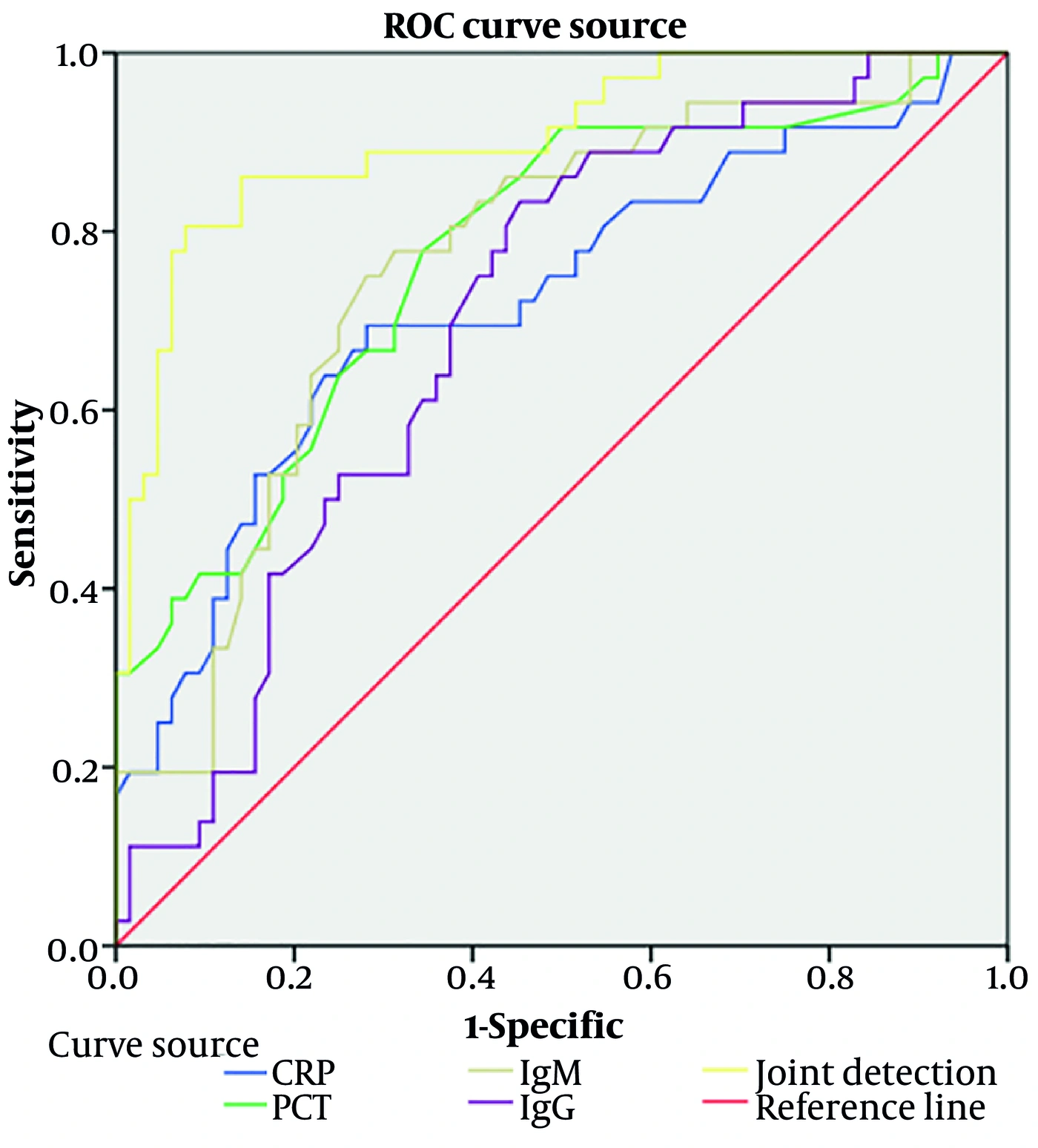
Figure 2.
ROC curves for MPP diagnosis
The calibration performance of the combined model was evaluated using the Hosmer-Lemeshow goodness-of-fit test, which indicated good agreement between predicted and observed outcomes (χ2 = 6.214, P = 0.624). Internal validation using bootstrap resampling demonstrated that the model retained stable discriminative ability, with a bootstrap-corrected AUC of 0.892, suggesting minimal optimism and good model robustness.
5. Discussion
MPP is a common respiratory tract infectious disease in clinical practice. Children are at high risk of MPP because their organs are not yet mature, their respiratory and immune systems are not fully developed, and their resistance is relatively weak (6, 7). Generally, the duration of MPP is 7 - 10 days in patients who receive comprehensive treatment early, with no sequelae and a good prognosis. However, if MPP is not treated promptly, it may progress to SMPP and involve multiple organs and systems, leading to poor outcomes (8, 9). Therefore, accurate diagnosis and timely intervention are necessary.
At present, the clinical diagnosis of MPP is generally based on a composite reference standard integrating clinical features, imaging findings, and microbiological evidence. In this study, we further standardized this reference framework by clearly distinguishing major and supportive criteria and applying blinded adjudication, thereby enhancing diagnostic consistency and reproducibility. Importantly, the studied biomarkers (CRP, PCT, IgM, and IgG) were not incorporated into the reference standard and were not used in clinical decision-making for MPP classification, minimizing the risk of incorporation and classification bias.
CRP is an acute-phase protein produced by the liver in response to pathogen invasion, tissue damage, and various inflammatory stimuli. Under normal conditions, CRP levels are very low in the blood of healthy individuals. After synthesis is stimulated, CRP levels can increase rapidly and peak at approximately 40 hours. CRP is a highly sensitive, although nonspecific, biomarker of inflammation, tissue damage, and infection (10). PCT is a protein released during bacterial infection; it is typically undetectable in healthy individuals but is elevated in severe bacterial, fungal, and parasitic infections (11). Therefore, PCT and CRP measurements can help identify serious bacterial and fungal infections and assess the risk of severe infection. This study found significantly higher serum CRP and PCT levels in the MPP group than in the non-MPP group. Multivariable logistic regression analysis identified elevated levels of these markers as risk factors for MPP, indicating that serum CRP and PCT are potential adjunctive diagnostic markers for MPP. One possible explanation is that MP, a prokaryotic microorganism without a cell wall, can stimulate lymphocytes, monocytes, and macrophages to secrete inflammatory factors after adhering to host cells and can disrupt the expression of respiratory epithelial growth factors, leading to abnormalities in cellular repair and the development of MPP (12, 13). As MPP progresses, various inflammatory cytokines are released, and inflammatory cells in the peripheral circulation migrate to the bronchi, lung interstitium, and alveoli, further aggravating inflammation and potentially triggering a systemic inflammatory response, during which peripheral blood PCT may increase significantly (14). After entering the body, MP can directly damage cell membranes, exposing phosphocholine and CRP-binding sites. This exposure facilitates the transmission of inflammatory signals to the liver through cytokines such as interleukin-6 (IL-6), IL-2, IL-8, IL-10, and tumor necrosis factor α (TNF-α), resulting in substantial CRP production. CRP is less affected by sex, age, anemia, and hyperglobulinemia. Even when the response is weak in children, CRP can increase as infection worsens, making it more responsive than some other acute-phase proteins. Therefore, CRP levels can increase significantly following MP infection and may serve as a marker of the occurrence and progression of MPP (15).
In MPP caused by MP infection, specific immunoglobulin antibodies are produced, and their levels can be measured clinically to assess the occurrence and progression of MPP (16, 17). After MP infection, toxic metabolites are released, damaging the host and triggering immune responses. These responses involve cellular immunity mediated by T lymphocytes and cytokines and humoral immunity mediated by B lymphocytes and immunoglobulins (18, 19). In immunoglobulin-mediated humoral immunity, B lymphocytes proliferate and differentiate to synthesize and secrete specific antibodies. Immunoglobulins synthesized and secreted by plasma cells are globulins that specifically bind antigens and are important immune molecules produced in response to antigenic stimuli such as pathogens (5, 20). This study found higher IgG and IgM levels in the MPP group than in the non-MPP group and identified these elevated levels as risk factors for MPP. It was speculated that numerous antigenic determinants are activated following MP infection; IgM antibodies are produced first, followed by higher-affinity IgG antibodies through somatic hypermutation and antibody class switching (21). IgM emerges earliest and reaches its peak at 3 - 4 weeks, reflecting early infection and rapidly binding to the corresponding antigen to provide early immunity. IgG begins to increase later in the course of MPP but is the most abundant immunoglobulin in serum; it can neutralize free exotoxins and regulate phagocytes to exert antiviral and antibacterial effects. Therefore, both IgM and IgG levels increase significantly after MPP develops.
The AUCs of serum CRP, IgM, IgG, PCT, and the combination of all 4 markers for diagnosing MPP were 0.722, 0.764, 0.700, 0.773, and 0.905, respectively, indicating that the combined model demonstrated higher discrimination than any single biomarker in this dataset. The good calibration and stable performance observed in bootstrap validation further support the robustness of the proposed model. These findings suggest that the identified biomarkers may serve as useful adjunctive tools for early risk stratification rather than as standalone diagnostic criteria. Therefore, serum CRP, PCT, IgG, and IgM levels should be monitored in children with suspected MPP, particularly in those with elevated levels of all 4 markers, to support targeted clinical management and improve prognosis.
5.1. Study Limitations
This study has several limitations. First, the sample size was limited, and the sample source was geographically restricted. Second, the study population was limited to children aged 6 - 14 years, which may reduce the representativeness of younger children, older adolescents, and adults. In addition, patients with chronic lung disease, recent antibiotic exposure, or other clinically relevant conditions were excluded, which may have reduced clinical heterogeneity and limited the applicability of the findings to real-world settings. Therefore, the diagnostic performance of the proposed model should be interpreted within this specific population, and caution is warranted when extrapolating the results to broader or more diverse patient groups. Although efforts were made to minimize diagnostic bias through standardized reference criteria and blinded adjudication, residual bias cannot be completely excluded. These limitations may have affected the findings. Future studies should include larger and more diverse samples to validate these findings.
5.2. Conclusions
Serum CRP, IgM, IgG, and PCT levels were significantly increased in patients with MPP, and the combined model showed higher diagnostic discrimination than any single biomarker in this study.