Innovative Journal of Pediatrics
The Scientific Journal of Growth & Development Research Center
e-ISSN 3117-5341
Image Credit:Inn J Pediatr
Outline
Presepsin (Scd14) as a Marker of Serious Bacterial Infections in Chemotherapy Induced Severe Neutropenia
Authors
Hossein Esfahani1,*, Elham Olad2, Iraj Sedighi3, Azim Mehrvar4, Maryam Tashvighi5, Vahid Fallahazad6, Amirabbas Hedayatiasl7
Published online:Nov 28, 2014
Article type:Research Article
Received:Jan 28, 2014
Accepted:Oct 01, 2014
How to Cite:Esfahani H, Olad E, Sedighi I, Mehrvar A, Tashvighi M, et al. Presepsin (Scd14) as a Marker of Serious Bacterial Infections in Chemotherapy Induced Severe Neutropenia. Inn J Pediatr. 2014;24(6):. doi:
Abstract
Objective: Timely detection of serious bacterial infections or prediction of sepsis and death is of paramount importance in neutropenic patients especially in oncology settings. The aim of this study was to determine a rapid and secure predictor of sepsis in severe neutropenic cancer children. Methods: In addition to blood culture, we have evaluated serum soluble CD14 on this role and measured it in 39 neutropenic episodes in Mahak pediatric oncology center from September 2012 to January 2013. Fifteen episodes had positive bacterial cultures and 18 had fever. The mean sCD14 values were compared in the presence or absence of fever, positive blood culture and other clinical conditions. Also, mean levels compared in different white cell counts and different four combination settings of fever and blood culture. Findings: It was statistically higher in febrile episodes, in the presence of oral mucositis, indwelling catheter infection, otitis media, and post toxic epidermal necrolysis sepsis and in instances of death within 15 days. Leukocyte count did not affect sCD14 level and in combinations of fever and blood culture, mean sCD14 values were ranked as follow: febrile culture negatives, febrile culture positives, afebrile culture positives and afebrile culture negatives. Conclusion: Although sCD14 was not sensitive in detection of bacteremia, in the absence of clinically detectable source of infection, it was significantly higher in culture positives.
Highlights
References
- 1.Reference are available on the PDF.
Copyright
© 2014, Author(s). This open-access article is available under the Creative Commons Attribution 4.0 (CC BY 4.0) International License (https://creativecommons.org/licenses/by/4.0/), which allows for unrestricted use, distribution, and reproduction in any medium, provided that the original work is properly cited.
Similar Articles
21
Feb
2015
Procalcitonin Biomarker Kinetics to Predict Multiorgan Dysfunction Syndrome in Children With Sepsis and Systemic Inflammatory Response Syndrome
Jiri Zurek,
Martin Vavrina
Zurek J, Vavrina M. Procalcitonin Biomarker Kinetics to Predict Multiorgan Dysfunction Syndrome in Children With Sepsis and Systemic Inflammatory Response Syndrome. Inn J Pediatr. 2015;25(1):-. doi: https://doi.org/10.5812/ijp.324
19
Oct
2026
Admission Lactate Shows the Highest Observed Discrimination for Early Septic Shock in Pediatric Sepsis: A Retrospective Cohort Study
Thi Van Vo,
Trinh Van Nguyen,
Nguyen Phat Nguyen,
Huy Quoc Tran,
Dien Minh Thai
Vo TV, Van Nguyen T, Phat Nguyen N, Quoc Tran H, Minh Thai D. Admission Lactate Shows the Highest Observed Discrimination for Early Septic Shock in Pediatric Sepsis: A Retrospective Cohort Study. J Compr Ped. 2026;17(4):e173635. doi: https://doi.org/10.5812/jcp-173635
25
Jan
2024
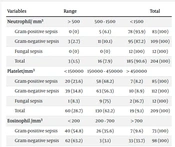
Diagnostic Values of Blood Indices for Neonatal Sepsis
Maryam Saeedi,
Kayvan Mirnia,
Maral Ghassemzadeh,
Razieh Sangsari,
Yasaman Hoseini
Saeedi M, Mirnia K, Ghassemzadeh M, Sangsari R, Hoseini Y. Diagnostic Values of Blood Indices for Neonatal Sepsis. Arch Clin Infect Dis. 2024;19(1):e141795. doi: https://doi.org/10.5812/archcid-141795
31
Dec
2007
The role of C-reactive protein in diagnosis of neonatal early-onset sepsis
Z Eslami,
L Borjian
Eslami Z, Borjian L. The role of C-reactive protein in diagnosis of neonatal early-onset sepsis. J Inflamm Dis. 2024;11(3):e155423. doi:
8
Jul
2025
Comparison of Serum Procalcitonin and C-reactive Protein Levels in Late Onset Neonatal Sepsis
Reza Saeidi,
Mohammad Kazemian,
Shamsollah Noripour,
Minoo Fallahi,
Parinaz Alizadeh,
Mohammad Kordkatouli
Saeidi R, Kazemian M, Noripour S, Fallahi M, Alizadeh P, et al. Comparison of Serum Procalcitonin and C-reactive Protein Levels in Late Onset Neonatal Sepsis. Zahedan J Res Med Sci. 2025;27(3):e163585. doi: https://doi.org/10.5812/zjrms-163585
Cited by
- Scopus by DOI: 0
Last Update: 1 week ago
- Scopus by Title: 19
Last Update: 1 week ago
- Scopus by Title (Ref): 21
Last Update: 1 week ago
- CrossRef: 0
Last Update: 3 hours ago
- OpenAlex: 0
Last Update: 6 hours ago
- OpenCitations: 0
Last Update: 5 days ago
Comments
Number of Comments:0