
1. Context
Pediatric sepsis is a life-threatening condition that can rapidly progress to organ dysfunction and death without timely recognition and treatment (1, 2). Septic shock is characterized by circulatory dysfunction and impaired tissue perfusion and remains associated with substantial morbidity and mortality. Early recognition of shock during the initial assessment is therefore important for treatment prioritization and timely resuscitation.
Routine biomarkers, including white blood cell count (WBC) and C-reactive protein (CRP), are widely available but have limited specificity for pediatric sepsis severity (3, 4). Procalcitonin (PCT) may provide additional information regarding the systemic inflammatory response, whereas lactate may reflect impaired tissue perfusion, adrenergic stress, and altered metabolism or clearance (4, 5). However, the comparative ability of these biomarkers to discriminate early septic shock at pediatric intensive care unit (PICU) admission remains uncertain. Previous pediatric studies have reported variable performance for these biomarkers. Lactate-containing indices have shown diagnostic or prognostic value in pediatric septic shock, whereas PCT has generally demonstrated moderate and context-dependent discrimination. Direct comparisons of these four routinely available biomarkers in pediatric sepsis cohorts remain relatively limited (6, 7).
In Viet Nam, evidence regarding the discriminatory performance of admission biomarkers for pediatric septic shock remains limited, particularly across different clinical settings and operational definitions of shock. A recent multicenter retrospective study involving 245 children in northern mountainous Viet Nam reported areas under the receiver operating characteristic (ROC) curve (AUCs) of 0.713 for lactate, 0.652 for procalcitonin, and 0.485 for CRP, with lactate showing the highest observed discrimination among the three evaluated biomarkers (8). However, differences in biomarker sampling windows, patient populations, clinical settings, and shock definitions limit direct comparisons across studies. These findings highlight the importance of evaluating biomarker discrimination using clearly specified clinical endpoints.
Our previously published study, using the same source cohort, investigated the prognostic performance of admission lactate and procalcitonin for in-hospital mortality, with particular emphasis on differences between shock and non-shock phenotypes (9). However, the ability of routinely available admission biomarkers to discriminate early vasoactive or inotropic support requirements represents a distinct clinical question that was not the primary objective of the previous investigation. The present study therefore addresses this complementary question by directly comparing WBC, CRP, PCT, and lactate for discrimination of an operationally defined early-shock endpoint within the first 24 hours of PICU admission. Its principal contribution is the evaluation of a distinct clinical endpoint using four routinely available biomarkers, although both investigations share the same underlying patient cohort.
Our a priori hypothesis was that routinely available admission biomarkers would differ in their discriminatory performance for early vasoactive/inotropic support requirements among children with sepsis.
1.1. Objectives
This study aimed to describe the clinical and laboratory characteristics of children with sepsis admitted to a tertiary pediatric referral hospital and to compare the performance of admission WBC, CRP, PCT, and lactate in discriminating the operational early-shock endpoint.
2. Evidence Acquisition
2.1. Study Design and Setting
We conducted a retrospective cohort study in the PICU of a tertiary pediatric referral hospital in southern Viet Nam. We reviewed the medical records of eligible children admitted between July 2022 and July 2025. A previous publication from the same source cohort evaluated the prognostic performance of lactate and PCT for in-hospital mortality (9).
2.2. Participants
Children aged 2 months to 15 years were eligible if they had a suspected or confirmed infection and met the 2005 International Pediatric Sepsis Consensus Conference (IPSCC) criteria based on systemic inflammatory response syndrome (SIRS) for pediatric sepsis (10). The 2005 IPSCC criteria were retained because cohort ascertainment began in 2022, before publication of the Phoenix criteria in 2024, thereby maintaining a consistent eligibility definition throughout the study period. All eligible admissions during the study period were consecutively included. Children with underlying conditions were not excluded solely because of an underlying disease; only the prespecified exclusion criteria described below were applied, and previously healthy children were eligible.
2.3. Exclusion Criteria
Children were excluded if they had pre-existing chronic organ dysfunction before the sepsis episode, primary traumatic brain injury, long-term systemic corticosteroid therapy, or a coagulation or hematologic disorder likely to substantially affect peripheral blood counts, such as acute leukemia or bone marrow failure. Among the 21 excluded patients, 13 had pre-existing chronic organ dysfunction, 2 had primary traumatic brain injury, 5 had long-term systemic corticosteroid therapy, and 1 had a coagulation/hematologic disorder likely to substantially affect peripheral blood counts.
2.4. Definitions
Early septic shock was operationally defined as the initiation of continuous vasoactive or inotropic support for sepsis-associated cardiovascular dysfunction at PICU admission or within the first 24 hours. Non-shock sepsis was defined as no vasoactive or inotropic support during that period. Pediatric sepsis was used to define cohort eligibility, whereas cardiovascular dysfunction represented the clinical construct underlying septic shock. For the present analysis, initiation of vasoactive or inotropic support was used as the operational study endpoint. The available retrospective data did not permit uniform independent adjudication of all physiological cardiovascular dysfunction criteria in every participant. This treatment-based endpoint was used for study classification and was not intended to be equivalent to a complete, independently adjudicated physiological definition of pediatric septic shock.
The suspected infection focus was categorized as respiratory, gastrointestinal, or other according to the treating clinician's documentation at PICU admission. Organ dysfunction was defined according to the 2005 IPSCC organ dysfunction criteria. Malnutrition was recorded as present when a diagnosis of malnutrition was documented by the treating physician in the medical record at PICU admission.
2.5. Data Collection and Variables
Data extracted from the medical records included age, sex, malnutrition status, suspected infection focus, organ dysfunction, and early septic shock status. The biomarkers of interest were WBC (×109/L), CRP (mg/L), PCT (ng/mL), and lactate (mmol/L).
Admission biomarkers were defined as the earliest measurements obtained during the initial evaluation of suspected sepsis at PICU admission or within the first 6 hours. Sampling for WBC, CRP, PCT, and lactate preceded sepsis-directed fluid resuscitation, antibiotic administration, and the initiation of vasoactive/inotropic support. All laboratory measurements were performed in the hospital’s Department of Laboratory Medicine under routine standard operating procedures and internal quality-control procedures. WBC was measured from EDTA-anticoagulated venous blood using an automated hematology analyzer and was reported as ×109/L. CRP and lactate were measured using the Hitachi 717 automated biochemistry analyzer (Hitachi Ltd., Japan) and reported as mg/L and mmol/L, respectively. PCT was measured using an automated immunoassay system and reported as ng/mL. Complete patient-level specimen-type metadata for all assays, assay-specific historical reference ranges, and detailed historical quality-control records were not uniformly retained in the retrospective study files; therefore, biomarker values were analyzed as continuous measures rather than categorized using local reference ranges. Although the sampling sequence before sepsis-directed treatment was established, the exact elapsed time from PICU admission to each biomarker measurement was not uniformly retained at the patient level. Therefore, precise admission-to-sampling intervals could not be reported.
Biomarker testing was performed as part of routine clinical care rather than as a protocol-mandated research panel. Initial blood sampling was routinely performed during PICU evaluation, but CRP, PCT, and lactate were not measured in every patient. The specific reason for each missing measurement was not consistently documented in the retrospective records and may have reflected clinician-directed testing, clinical presentation, timing of evaluation, or test availability. Missing data were 0% for WBC, 20.2% for CRP, 14.0% for PCT, and 25.9% for lactate. Baseline characteristics and outcomes were compared between patients with available and missing biomarker measurements to assess potential systematic missingness. Primary descriptive analyses used available observations, whereas ROC and regression analyses used complete cases for the variables included in each analysis. Because missingness was associated with several observed clinical characteristics, missing completely at random was not assumed. The primary outcome was early septic shock, coded as 1 versus 0 for non-shock sepsis. The secondary outcome was in-hospital mortality, defined as death before hospital discharge.
2.6. Statistical Analysis
Statistical analyses were performed using SPSS version 26.0. Categorical variables were summarized as frequencies and percentages and compared using the chi-square test or Fisher's exact test, as appropriate. Continuous variables were summarized as medians and interquartile ranges and compared using the Mann-Whitney U test. All tests were two-sided, and P < 0.05 was considered statistically significant. Age was summarized descriptively in months and converted to years for regression analyses.
Each biomarker was evaluated using ROC curves. AUCs with 95% confidence intervals (CIs) were reported and tested against 0.50. Exploratory cutoffs were derived from the study cohort by maximizing the Youden index; these thresholds were not prespecified. Internal validation of the exploratory cohort-derived Youden cutoffs was performed using 1,000 nonparametric bootstrap resamples. In each resample, the optimal Youden cutoff was re-estimated, cutoff performance was calculated in the bootstrap sample and in the original sample using the bootstrap-derived threshold, and mean optimism was subtracted from the apparent sensitivity, specificity, positive predictive value (PPV), and negative predictive value (NPV). No independent or temporal external validation was performed.
Primary biomarker-specific AUCs were not directly compared because they were based on different patient subsets. As a sensitivity analysis, paired DeLong comparisons were performed in the common complete-biomarker cohort (N = 120), in which all four biomarkers were available. As a sensitivity analysis addressing missing biomarker data, multiple imputation by chained equations (MICE) with predictive mean matching was performed for the expanded multivariable logistic regression model. Fifty imputed datasets were generated, and regression estimates were pooled using Rubin's rules. Complete-case analysis was retained as the primary analytical approach. Because the missing-at-random assumption could not be verified, the multiple-imputation results were interpreted cautiously as a sensitivity analysis rather than as a definitive correction for missing-data bias.
Multivariable logistic regression was used to examine factors associated with the operational early-shock endpoint. Covariates were selected a priori based on clinical relevance, availability at the initial PICU assessment, and the need to limit model complexity relative to the number of outcome events; no automated stepwise variable-selection procedure was used. Model 1 was specified as the primary parsimonious model and included age, sex, malnutrition, lactate, and natural logarithm-transformed PCT, denoted ln(PCT). Model 2 was an exploratory expanded model additionally including WBC, CRP, and infection focus, with respiratory infection as the reference category. Model 1 included 134 patients with 64 early-shock events, whereas Model 2 included 120 patients with 52 events. Because of the lower event-to-parameter ratio in Model 2, estimates from the expanded model were interpreted cautiously. Model discrimination was summarized using the AUC, and overall goodness-of-fit was assessed using the Hosmer–Lemeshow test. Multicollinearity was assessed using variance-inflation factors. Influential observations were assessed using Cook’s distance, leverage, standardized residuals, and leave-one-out sensitivity analyses. The functional form of continuous predictors was examined using spline-based sensitivity analyses. Odds ratios (ORs), 95% CIs, and exact P values were reported.
For the secondary exploratory analysis, factors associated with in-hospital mortality were examined using multivariable logistic regression including age, malnutrition, early septic shock, lactate, and natural logarithm-transformed PCT. Complete-case analysis was used, and ORs with 95% CIs were reported. The complete-case model included 134 patients with 51 in-hospital deaths.
2.7. Ethics Approval and Consent to Participate
This retrospective observational study was approved by the institutional ethics committee on June 28, 2024 (Approval No. 24.286.HV/PCT-HĐĐĐ) and authorized by the participating hospital. The requirement for individual informed consent was waived by the ethics committee because the study involved retrospective analysis of existing medical records. Patient data were anonymized before analysis and handled in accordance with institutional confidentiality requirements.
The study was not registered in a public clinical trial registry because it was a non-interventional retrospective observational study without prospective assignment to interventions.
3. Results
3.1. Study Characteristics
Between July 2022 and July 2025, 214 children with suspected sepsis were screened. Twenty-one patients were excluded: 13 because of pre-existing chronic organ dysfunction, 2 because of primary traumatic brain injury, 5 because of long-term systemic corticosteroid therapy, and 1 because of a coagulation/hematologic disorder. The final analytic cohort therefore comprised 193 children. Of these, 93 (48.2%) met the operational definition of early septic shock, and 100 (51.8%) had non-shock sepsis (Figure 1).
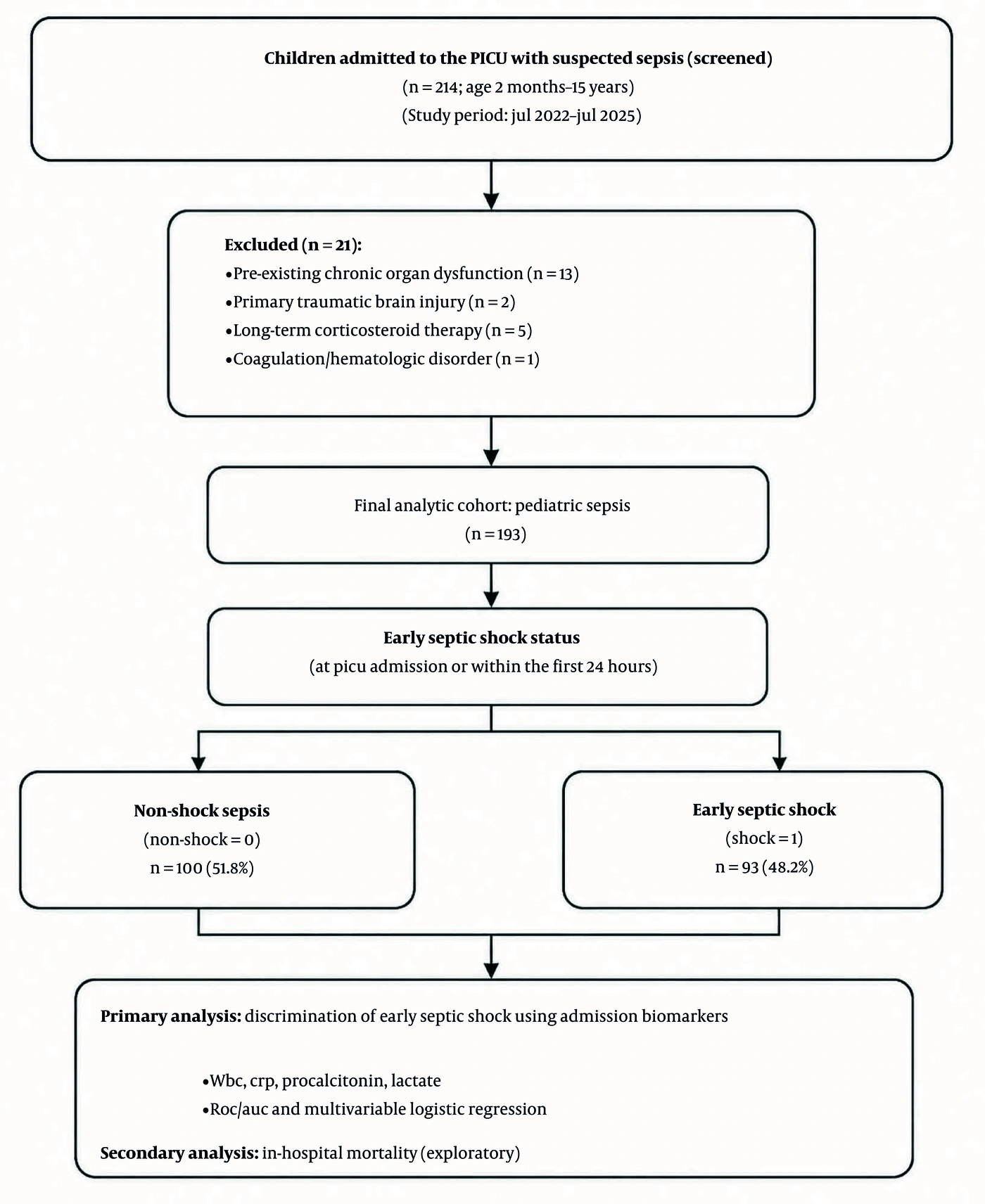
Figure 1.
Flow diagram of patient screening and cohort formation. Flow diagram showing that 214 children with suspected sepsis were screened, 21 were excluded, and 193 were included. Early septic shock was identified in 93 children, while 100 had non-shock sepsis.
The clinical characteristics and admission biomarker levels according to early septic shock status are summarized in Table 1.
Table 1.
Clinical Characteristics and Admission Biomarker Levels by Early Septic Shock Status a
| Variables | Non-Shock Sepsis (n = 100) | Early Septic Shock (n = 93) | P Value |
|---|---|---|---|
| Age (mo) | 43.5 (12.8 - 108.0) | 38.0 (8.0 - 120.0) | 0.856 |
| Male sex | 64 (64.0) | 57 (61.3) | 0.697 |
| Infection focus | 0.014 | ||
| Respiratory | 40 (40.0) | 36 (38.7) | |
| Gastrointestinal | 36 (36.0) | 48 (51.6) | |
| Other | 24 (24.0) | 9 (9.7) | |
| Organ dysfunction | 55 (55.0) | 90 (96.8) | < 0.001 |
| Malnutrition | 14 (14.0) | 22 (23.7) | 0.085 |
| WBC (×109/L) | 15.64 (10.10 - 21.70), n = 100 | 16.38 (10.28 - 21.62), n = 93 | 0.877 |
| CRP (mg/L) | 25.96 (6.55 - 104.20), n = 91 | 12.00 (7.55 - 74.80), n = 63 | 0.553 |
| Procalcitonin (ng/mL) | 2.66 (0.60 - 25.20), n = 87 | 37.20 (6.41 - 85.93), n = 79 | < 0.001 |
| Lactate (mmol/L) | 2.33 (1.67 - 3.47), n = 70 | 5.46 (3.20 - 9.33), n = 73 | < 0.001 |
a Values are presented as median (interquartile range) or No. (%). Biomarker analyses were based on available observations, and valid sample sizes are reported within the corresponding cells. P values were calculated using the Mann–Whitney U test, chi-square test, or Fisher’s exact test, as appropriate. All tests were two-sided, and P < 0.05 was considered statistically significant. Abbreviations: CRP, C-reactive protein; WBC, white blood cell count.
Age and sex distributions were similar between groups. The distribution of infection foci differed significantly by shock status (P = 0.014), and organ dysfunction was more frequent among children with early septic shock (96.8% vs. 55.0%; P < 0.001). Admission PCT and lactate concentrations were significantly higher in the shock group, whereas WBC and CRP did not differ significantly. Biomarker availability varied, with complete data for WBC and lower valid sample sizes for CRP, PCT, and lactate. Comparisons between patients with available versus missing measurements showed evidence of systematic differences for several biomarkers. CRP missingness was associated with organ dysfunction, early shock, and mortality; PCT missingness was associated with older age; and lactate missingness was associated with older age, infection focus, and organ dysfunction. The common complete-biomarker cohort (N = 120) differed from patients outside this subset (N = 73) in age, infection-focus distribution, and in-hospital mortality, whereas sex, malnutrition, organ dysfunction, and early-shock prevalence did not differ significantly (Table S4 in the Supplementary File).
3.2. Diagnostic Performance of Admission Biomarkers
The discriminative performance of the four biomarkers is presented in Table 2. Lactate had the highest observed AUC for early septic shock (0.77; 95% CI, 0.70 - 0.85), followed by PCT (0.71; 95% CI, 0.63 - 0.79). WBC and CRP showed little discriminative ability, with AUCs close to 0.50.
Table 2.
Discriminative Performance of Admission Biomarkers for the Operational Early-Shock Endpoint a
| Performance measure | WBC (×109/L) | CRP (mg/L) | Procalcitonin (ng/mL) | Lactate (mmol/L) |
|---|---|---|---|---|
| Valid N | 193 | 154 | 166 | 143 |
| Early shock/non-shock | 93/100 | 63/91 | 79/87 | 73/70 |
| AUC | 0.49 (0.41 - 0.58) | 0.47 (0.38 - 0.57) | 0.71 (0.63 - 0.79) | 0.77 (0.70 - 0.85) |
| Exploratory cohort-derived cutoff (Youden) | 14.67 | 3.14 | 37.20 | 4.17 |
| Sensitivity, % | 62.4 (51.7 - 72.2) | 95.2 (86.7 - 99.0) | 50.6 (39.1 - 62.1) | 64.4 (52.3 - 75.3) |
| Specificity, % | 47.0 (36.9 - 57.2) | 19.8 (12.2 - 29.4) | 87.4 (78.5 - 93.5) | 80.0 (68.7 - 88.6) |
| PPV, % | 52.3 (42.6 - 61.8) | 45.1 (36.5 - 54.0) | 78.4 (64.7 - 88.7) | 77.0 (64.5 - 86.8) |
| NPV, % | 57.3 (45.9 - 68.2) | 85.7 (63.7 - 97.0) | 66.1 (56.7 - 74.7) | 68.3 (57.1 - 78.1) |
| LR+ | 1.18 (0.92 - 1.50) | 1.19 (1.06 - 1.33) | 4.00 (2.21 - 7.25) | 3.22 (1.96 - 5.30) |
| LR− | 0.80 (0.57 - 1.12) | 0.24 (0.07 - 0.78) | 0.57 (0.45 - 0.72) | 0.45 (0.32 - 0.62) |
| P value | 0.877 | 0.554 | < 0.001 | < 0.001 |
a Values are expressed as (95% CI) unless otherwise indicated. Primary ROC estimates were calculated separately for each biomarker using all available observations; therefore, valid sample sizes differed across biomarkers. AUCs and 95% CIs were estimated separately for each biomarker, and P values test the AUC against 0.50. Cutoffs were determined using the Youden index. Likelihood ratios were calculated at the cohort-derived Youden cutoffs. Formal paired AUC comparisons were performed separately in the common complete-biomarker cohort (N = 120) and are reported in the Results text and Table S3 in the Supplementary File. Sensitivity and specificity confidence intervals were calculated using the exact binomial (Clopper–Pearson) method. All Youden-derived cutoffs are exploratory and were derived from this cohort. Abbreviations: AUC, area under the receiver operating characteristic curve; CI, confidence interval; CRP, C-reactive protein; LR+, positive likelihood ratio; LR−, negative likelihood ratio; NPV, negative predictive value; PPV, positive predictive value; WBC, white blood cell count.
The prevalence of early septic shock differed across biomarker-specific analytic subsets: 48.2% (93/193) for WBC, 40.9% (63/154) for CRP, 47.6% (79/166) for PCT, and 51.0% (73/143) for lactate. Accordingly, the reported PPVs and NPVs should be interpreted in relation to the corresponding subgroup-specific shock prevalence rather than the overall cohort prevalence alone. Because predictive values depend on the underlying pre-test probability, these estimates may not be directly generalizable to clinical settings with different shock prevalence or patient characteristics.
At the exploratory cohort-derived Youden cutoff of 4.17 mmol/L, lactate had a sensitivity of 64.4% (95% CI, 52.3 - 75.3%) and specificity of 80.0% (95% CI, 68.7 - 88.6%). For PCT, the corresponding exploratory cutoff of 37.20 ng/mL had a sensitivity of 50.6% (95% CI, 39.1 - 62.1%) and specificity of 87.4% (95% CI, 78.5 - 93.5%). These thresholds were derived and evaluated in the same cohort and should therefore not be interpreted as validated clinical decision thresholds; external validation is required. Bootstrap internal validation showed modest optimism in cutoff performance. For lactate, the apparent sensitivity and specificity of 64.4% and 80.0% were optimism-corrected to 61.8% and 77.6%, respectively; corrected PPV and NPV were 74.7% and 65.8% (Table S5 in the Supplementary File). The ROC curves are shown in Figure 2. In a sensitivity analysis restricted to the common complete-biomarker cohort (N = 120), the observed AUCs were 0.49 for WBC, 0.50 for CRP, 0.71 for PCT, and 0.78 for lactate, preserving the overall pattern observed in the primary biomarker-specific analyses.
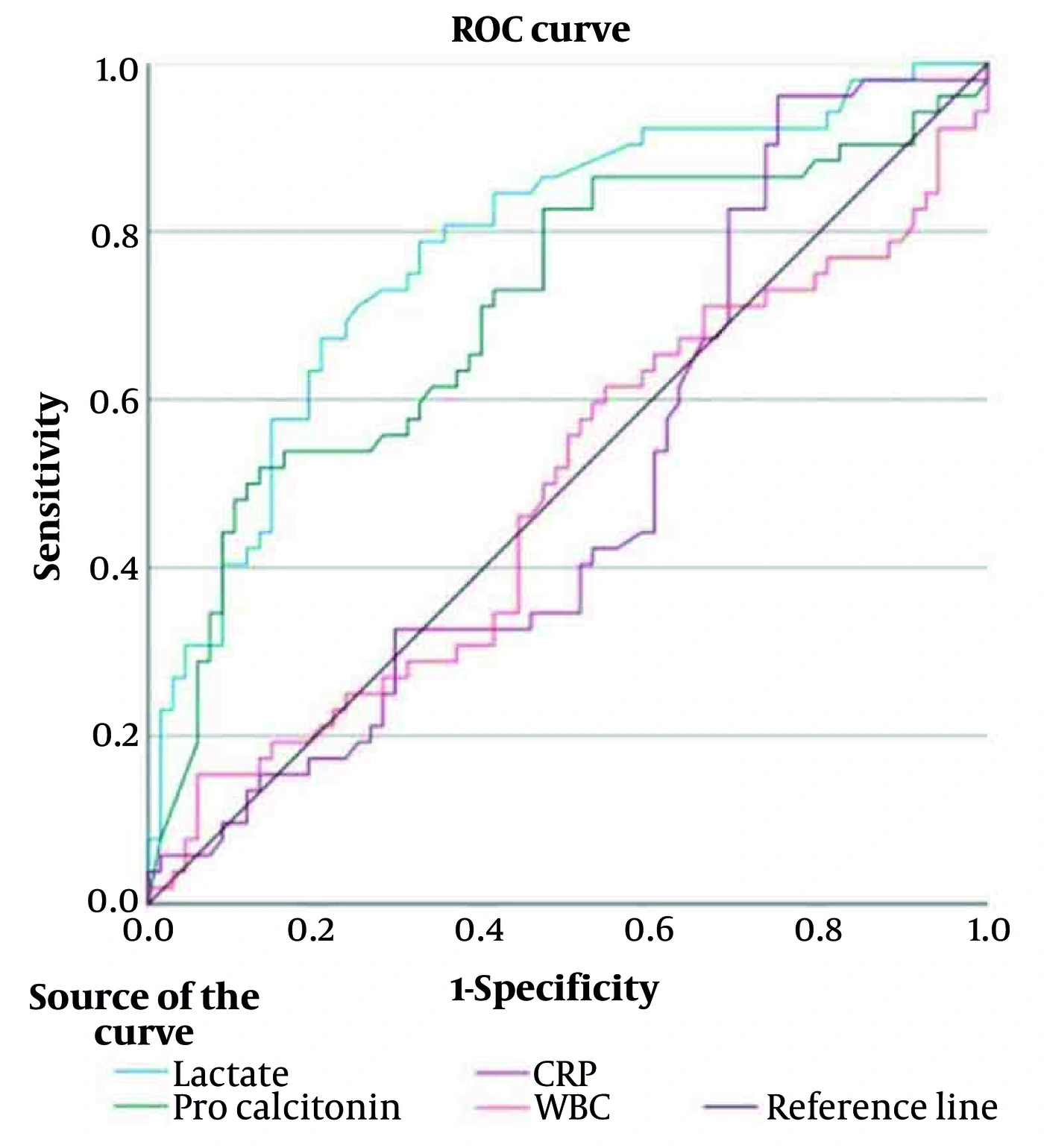
Figure 2.
Receiver operating characteristic curves of admission biomarkers for early septic shock.
Receiver operating characteristic curves comparing white blood cell count, C-reactive protein, procalcitonin, and lactate for early septic shock. Lactate had the highest observed area under the curve, followed by procalcitonin, whereas white blood cell count and C-reactive protein were close to the diagonal reference line.
3.3. Multivariable Analysis
In Model 1, which included age, sex, malnutrition, lactate, and ln-transformed PCT, both lactate (OR, 1.34 per 1-mmol/L increase; 95% CI, 1.14 - 1.58; P < 0.001) and ln-transformed PCT (OR, 1.25; 95% CI, 1.04 - 1.50; P = 0.019) were associated with early septic shock after multivariable adjustment (Table 3).
Table 3.
Multivariable Logistic Regression Models for Early Septic Shock a
| Variables | Model 1 OR | Model 1 95% CI | Model 1 P value | Model 2 OR | Model 2 95% CI | Model 2 P value |
|---|---|---|---|---|---|---|
| Age (y) | 1.00 | 0.91 - 1.10 | 0.958 | 1.01 | 0.90 - 1.13 | 0.878 |
| Male sex | 1.15 | 0.51 - 2.58 | 0.734 | 0.91 | 0.38 - 2.22 | 0.842 |
| Malnutrition | 1.46 | 0.52 - 4.04 | 0.470 | 1.33 | 0.41 - 4.39 | 0.635 |
| Lactate (per 1 mmol/L) | 1.34 | 1.14 - 1.58 | < 0.001 | 1.41 | 1.17 - 1.70 | < 0.001 |
| ln(PCT) | 1.25 | 1.04 - 1.50 | 0.019 | 1.23 | 0.99 - 1.52 | 0.057 |
| WBC (per 109/L) | - | - | - | 0.98 | 0.93 - 1.03 | 0.477 |
| CRP (per 1 mg/L) | - | - | - | 1.00 | 0.99 - 1.00 | 0.313 |
| GI vs respiratory | - | - | - | 1.24 | 0.49 - 3.17 | 0.647 |
| Other vs respiratory | - | - | - | 0.26 | 0.03 - 2.24 | 0.219 |
a Model 1 included age, sex, malnutrition, lactate, and ln(PCT) (N = 134; 64 early-shock events). Model 2 additionally included WBC, CRP, and infection focus (N = 120; 52 early-shock events). Respiratory infection was the reference category. Abbreviations: CI, confidence interval; CRP, C-reactive protein; GI, gastrointestinal; ln(PCT), natural logarithm-transformed procalcitonin; OR, odds ratio; WBC, white blood cell count.
After additional adjustment for WBC, CRP, and infection focus in Model 2, lactate remained associated with early septic shock after multivariable adjustment (OR, 1.41 per 1-mmol/L increase; 95% CI, 1.17 - 1.70; P < 0.001), whereas the association for ln-transformed PCT was attenuated (OR, 1.23; 95% CI, 0.99 - 1.52; P = 0.057); the remaining covariates were not significant. In the multiple-imputation sensitivity analysis, lactate remained associated with the operational early-shock endpoint (pooled OR, 1.37 per 1-mmol/L increase; 95% CI, 1.15 - 1.62). Model 1 and Model 2 showed similar discrimination (AUCs, 0.808 and 0.806, respectively), and Hosmer–Lemeshow tests did not indicate gross lack of fit (P = 0.219 and P = 0.799, respectively). Maximum variance-inflation factors were 1.11 and 1.27, respectively, and leave-one-out analyses showed that the lactate OR remained within 1.32 - 1.45 in Model 1 and 1.38 - 1.56 in Model 2, indicating that no single observation materially altered the principal lactate association. Spline-based sensitivity analyses showed no material evidence of nonlinearity for age, lactate, or ln(PCT) in the primary model; in the expanded model, some evidence of nonlinearity was observed for ln(PCT), but flexible modeling of ln(PCT) did not materially alter the lactate association (OR, 1.43 per 1-mmol/L increase; P < 0.001). In-hospital mortality occurred in 79 of 193 children (40.9%). Among the 79 deaths, 14 (17.7%) occurred within the first 24 hours; 62 (78.5%) occurred in children meeting the operational early-shock definition, and 77 (97.5%) occurred in children with organ dysfunction. Non-survivors more frequently had early septic shock (78.5% vs. 27.2%; P < 0.001) and higher admission PCT and lactate concentrations, whereas age, malnutrition, WBC, and CRP did not differ significantly (Table S1 in the Supplementary File). In the adjusted mortality model, early septic shock (OR, 4.23; 95% CI, 1.75 - 10.23; P = 0.001) and lactate (OR, 1.20 per 1-mmol/L increase; 95% CI, 1.05 - 1.37; P = 0.009) remained associated with mortality after multivariable adjustment, whereas ln-transformed PCT did not (OR, 1.13; 95% CI, 0.92 - 1.38; P = 0.244) (Table S2 in the Supplementary File).
3.4. Discussion
3.4.1. Study Characteristics
Early septic shock occurred in 48.2% of our cohort. Unlike the previous mortality-focused analysis of this cohort (9), the present study focused on biomarker discrimination of the operational early-shock endpoint. Differences from Abdelaziz et al. may reflect variations in PICU admission thresholds, referral patterns, pre-PICU management, and definitions of sepsis and shock (11). Their predominantly respiratory cohort may also have influenced the observed performance of lactate (11). Age and sex were similar between groups, consistent with previous pediatric sepsis reports (4). Although cohort eligibility was defined using the 2005 IPSCC criteria, the Phoenix Sepsis Score could be retrospectively calculated in 143 of 193 patients, with a median score of 2.0 (range, 0 - 12). Because Phoenix scoring was unavailable for the remaining 50 patients and complete patient-level Phoenix reclassification was not possible in the present analysis, this cohort should not be assumed to be directly equivalent to populations prospectively defined using the 2024 Phoenix criteria. The relatively high prevalence of the operational early-shock endpoint (48.2%) should also be interpreted in the context of this tertiary pediatric referral PICU and the treatment-based definition of early shock based on initiation of vasoactive/inotropic support within the first 24 hours. These factors may limit the generalizability of the discrimination estimates and cohort-derived biomarker thresholds to lower-acuity settings or Phoenix-defined populations. Gastrointestinal infection and malnutrition were more frequent among children with early septic shock, although the association with malnutrition did not reach statistical significance. Admission PCT and lactate concentrations were substantially higher in the shock group, whereas WBC and CRP showed little separation. This pattern is consistent with evidence that WBC and CRP are nonspecific and frequently overlap across severity strata (4). PCT may better reflect systemic inflammation, whereas lactate reflects circulatory and metabolic stress; however, the performance of PCT remains context-dependent (6). The observed association between lactate and shock severity is also consistent with previous pediatric severe sepsis research (11).
3.4.2. Diagnostic Performance of Admission Biomarkers
Lactate had the highest observed AUC for early septic shock, followed by PCT, whereas WBC and CRP had limited discrimination. Our findings are broadly consistent with a recent multicenter study from northern mountainous Viet Nam involving 245 children, which reported AUCs of 0.713 for lactate, 0.652 for PCT, and 0.485 for CRP (8). The corresponding estimates in our cohort were 0.77, 0.71, and 0.47, respectively. Although both studies demonstrated a similar pattern of biomarker discrimination, differences in patient characteristics, clinical settings, biomarker sampling, and shock definitions preclude direct conclusions regarding comparative performance between cohorts.
Previous pediatric studies have also reported variable biomarker performance. Zeng et al. reported favorable performance of CRP and PCT for identifying hyperinflammation and organ dysfunction, although their outcome differed from septic shock (12). Studies by Ma et al. and Sitaraman et al. further support the clinical relevance of lactate-containing indices and lactate clearance in pediatric septic shock (7, 13). Conversely, Lautz et al. found only moderate PCT performance without clear superiority over CRP (14). Because the primary biomarker-specific AUCs were estimated from different patient subsets, their numerical ordering was interpreted descriptively. In the common complete-biomarker cohort, paired analysis showed that lactate had significantly greater discrimination than WBC and CRP, whereas its AUC was not significantly different from that of PCT (0.782 vs. 0.708; paired DeLong P = 0.197). Therefore, the higher observed AUC for lactate should not be interpreted as demonstrated statistical superiority over PCT.
Although biomarker sampling preceded sepsis-directed treatment, some children may already have had cardiovascular compromise at the time of initial PICU assessment. Accordingly, these findings represent discrimination of an operational early-treatment phenotype rather than prospective prediction of a future septic shock event.
Furthermore, PPV and NPV depend on the underlying outcome prevalence. Because the prevalence of the operational early-shock endpoint varied across biomarker-specific subsets, the corresponding predictive values should be interpreted within their respective analytic populations. These estimates may differ substantially in lower-acuity settings or populations with different referral patterns and baseline shock probabilities.
3.4.3. In-Hospital Mortality
Admission PCT and lactate concentrations were higher among non-survivors. Hatherill et al. reported associations between PCT, organ failure, and mortality in pediatric septic shock (15), whereas Sitaraman et al. demonstrated that elevated lactate and impaired lactate clearance were associated with adverse outcomes (13). In our adjusted analysis, early septic shock and admission lactate remained associated with mortality after multivariable adjustment, whereas PCT did not. WBC and CRP were not associated with mortality, consistent with their limited specificity for disease severity and outcomes (3, 4, 14). The strong association between early septic shock and mortality also supports the central role of cardiovascular dysfunction in pediatric sepsis outcomes (16). These secondary exploratory findings show an association between lactate and in-hospital mortality after multivariable adjustment but do not establish lactate as a validated prognostic marker; external validation and broader severity adjustment are required.
3.4.4. Multivariable Analysis and Clinical Interpretation
Admission lactate showed the most consistent association with both early septic shock and in-hospital mortality after multivariable adjustment. Elevated lactate in sepsis may reflect impaired tissue perfusion, microcirculatory dysfunction, increased adrenergic glycolysis, altered cellular metabolism, and reduced hepatic clearance rather than anaerobic metabolism alone (1, 5). Lactate concentrations may also be influenced by beta-adrenergic stimulation, including exogenous catecholamines such as epinephrine, and elevated lactate may occur despite preserved systemic blood pressure (17). These mechanisms may partly explain why lactate remained associated with the operational early-shock endpoint after adjustment for inflammatory biomarkers. Nevertheless, lactate is not specific to septic shock and should be interpreted alongside clinical and hemodynamic findings.
PCT was associated with early septic shock in the parsimonious multivariable model (OR, 1.25; 95% CI, 1.04 - 1.50), but its association was attenuated in the expanded model (OR, 1.23; 95% CI, 0.99 - 1.52; P = 0.057). This attenuation may reflect overlapping information between inflammatory and clinical severity-related variables, differences in analytic sample composition, and reduced statistical precision rather than substantial multicollinearity. Consequently, the absence of statistical significance at the conventional threshold in the expanded model should not be interpreted as evidence that PCT has no association with early shock. WBC and CRP showed limited discrimination, potentially because they reflect nonspecific inflammatory responses influenced by infection duration, pathogen characteristics, immune status, and sampling time (3, 4, 6, 14).
Overall, perfusion-related indicators, particularly lactate, may provide complementary information to conventional inflammatory biomarkers during the initial assessment of pediatric sepsis. However, lactate should be used as an adjunct to clinical and hemodynamic evaluation rather than as an isolated diagnostic or treatment threshold. The primary outcome was treatment-based rather than independently adjudicated from a complete set of physiological cardiovascular criteria. Because initiation of vasoactive or inotropic therapy may depend on clinician judgment, resuscitation practices, referral severity, resource availability, and available clinical information, treatment-decision bias and outcome misclassification cannot be excluded.
3.4.5. Strengths and Limitations
This study has several strengths. It directly compared four routinely available biomarkers within a clinically relevant pediatric sepsis cohort, with biomarker measurements obtained before sepsis-directed treatment. Consecutive inclusion reduced selective enrollment, and sensitivity analyses using a common complete-biomarker cohort allowed direct comparison of discriminatory performance. Additional analyses addressing missing data, paired AUC comparisons, bootstrap internal validation of exploratory cutoffs, and multivariable model diagnostics further strengthened the robustness and transparency of the findings.
This study has several limitations. First, early septic shock was defined operationally by initiation of vasoactive or inotropic support, and classification may therefore have been influenced by treatment decisions and may not fully correspond to an independently adjudicated physiological definition of septic shock. Second, although biomarker sampling preceded sepsis-directed treatment, the exact elapsed time from PICU admission to each biomarker measurement was not uniformly available, introducing potential timing-related measurement variability. Third, biomarker availability differed across patients, and missingness was associated with several observed clinical characteristics. Because complete-case analysis was used for the primary regression analyses, residual selection bias cannot be excluded. Fourth, the biomarker cutoffs were derived from the same cohort using the Youden index and should therefore be considered exploratory rather than validated clinical thresholds. Fifth, this was a single-center study conducted in a tertiary pediatric referral PICU, which may limit generalizability to lower-acuity settings or populations with different referral patterns. Finally, no independent external or temporal validation was performed, and the findings require confirmation in other pediatric sepsis cohorts.
Taken together, these limitations reduce the certainty of evidence supporting the clinical application of our findings. Although lactate showed the highest observed discriminatory performance, this should not be interpreted as evidence that lactate-guided clinical decisions improve patient outcomes. Decision curve analysis was not performed because the primary endpoint reflected a clinician-dependent decision to initiate vasoactive or inotropic support rather than an independently adjudicated physiological shock outcome. Furthermore, meaningful interpretation of clinical net benefit requires a clearly specified decision strategy and clinically relevant threshold probabilities (18, 19). Therefore, prospective multicenter studies incorporating independent outcome assessment and prespecified clinical decision thresholds are needed to establish the clinical utility of admission lactate.
4. Conclusions
Admission lactate demonstrated the highest discrimination among the four biomarkers and remained associated with early septic shock after multivariable adjustment. PCT showed moderate but less consistent discrimination, whereas WBC and CRP showed limited discrimination in this cohort. Lactate may support the initial assessment; however, these findings reflect discrimination of an operational early-shock treatment phenotype rather than prospective prediction of subsequent septic shock, and therefore require external validation.