1. Context
Poor nutrition is a key factor in the spread of non-communicable diseases around the world (1); and scientific programs based on regional needs are necessary for its improvement. Studies have shown that teenagers are an important group in this programming due to the fact that many unhealthy behaviors in adulthood are shaped during the teenage years (2). Unhealthy nutritional behaviors are important in developing problems such as obesity during this period of life (3) and suffering from serious disorders such as cardiovascular diseases, cancers, stroke, and type 2 diabetes, later in their lives (4). However, extensive global studies have shown that unhealthy nutritional behaviors are more common among this age group (5, 6). Previous studies have reported that the most common unhealthy nutritional behaviors among Iranian teenagers are consuming foods containing saturated fats and fried foods, white rice and bread, fatty sweets or salty snacks, as well as insufficient consumption of fruits and vegetables (7-9). Each of these behaviors may endanger individuals’ health during pubescence and later in life, and it is necessary to provide programs for preventing them.
For changing, nutritional behaviors of individuals should be recognized to design an effective program (10). Various factors would be effective on different layers and levels of these behaviors (11); hence, having a broad and comprehensive perspective is important in understanding effective factors (4). Ecological models have created a comprehensive approach towards changes in behaviors and decreasing serious and preventable diseases (12). Social-ecological perspective has different levels for affecting health behaviors (13), including intrapersonal level, interpersonal level (processes between individual and groups such as family, friends and peers), organizational level (rules and regulations, policies, and unofficial structures), community level (social norms and standards), and public policy level. The present study is set to recognize determinant factors for teenagers’ nutritional behaviors based on social-ecological model.
2. Evidence Acquisition
In an extensive literature review, all Farsi and English articles adopted quantitative studies, either cross-sectional, longitudinal, or clinical trials; as well as all Farsi and English qualitative studies published from 1990 to 2016 were reviewed. For this purpose, Scopus, Medline, Embase, Cochrane central register of controlled trials and Cochrane database systematic review databases, as well as Farsi databases including Iranmedex, SID, and Magiran were searched. Keywords included nutritional behaviors of teenagers (eating breakfast, fruits, and vegetables, fast foods, unhealthy snacks) and determinant factors. These keywords were looked up in their pure forms using MeSH, Medical subject headings, and EmTree of scopus. Studies, selected for review having the mentioned keywords, were conducted on the teenage population (10 to 19 years old). Studies, which did not consider nutritional behaviors as well as nutritional behaviors of patients, were excluded from the review. After extracting the effective factors, they were categorized into the social-ecological model (13).
3. Results
3.1. Intrapersonal Determinant Factors of Nutritional Behaviors
Intrapersonal factors are unique conditions and personal differences that affect individuals’ tendency to conduct a behavior. Individuals’ perceptions and expectations, derived from experiences through environmental development, create a type of a sensory-affective response for selecting and consuming foods (10).
- Hunger: the physical signal of hunger originates from the stomach and brain. Feeling of hunger as a biologic need is considered the primary determinant for consuming food in teenagers. Eating while one is not hungry (emotional eating) is a common nutritional behavior among teenagers (14). This behavior is an unhealthy nutritional behavior and a factor in obesity (15). Since emotional eating occurs at improper mental conditions such as grieving, loneliness, or anxiety, it could also be an indicator of problems in the teenagers familial relationships (16).
- Gender: lack of nutrients (5) and skipping breakfast as well as lunch (17, 18) have been reported more common among teenage girls than boys. However, girls consumed more fruits and vegetable than boys (19). The idea of boys needing more energy exists among teenage boys and girls and this causes boys to have more meals as well as more fatty and energetic foods. Teenage girls mostly focus on their beauty, thus choosing different nutritional behaviors to achieve the goals of slimness and beauty. In fact, gender as a behavior facilitator could affect teenagers’ changes in attitude toward formation of a behavior and would lead to nutritional behaviors (20).
- Food preferences: the feeding in infancy provides not only nutritional needs for growth and development, but also an opportunity for learning about foods (21). Learning about foods occurs during the transition from the exclusive breast milk diet of infancy to solid food diet of childhood, which can shape food experiences including the preference for some tastes (22). Food preferences in an individual could also be the result of effects of multiple complicated mental factors including the experience of having a certain food in childhood and negative or positive feeling caused by consuming a certain food (23), or learning (24). Many studies have considered the effect of watching television on formation of food preferences in teenagers; teenagers prefer to have food that is advertised on television (25).
- Awareness: in many studies, although teenagers were completely aware of healthy and unhealthy foods, their nutritional behavior did not match their awareness in practice (26, 27). Especially teenage girls, although they had more nutritional awareness than boys, they had more unhealthy nutritional behaviors than boys (26).
- Attitude: attitude through creating behavioral intention leads to formation of nutritional behaviors (28). The value of health for a teenager is directly and indirectly effective on the attitude towards nutrition (29). Furthermore, social-cultural factors, social pressures for being beautiful and skinny in particular, and the attitude of peers and friends are effective on the teenagers’ attitude toward nutritional behavior (30); these are in contrast with the value of health.
- Belief and self-efficacy: teenagers’ positive belief about nutrition (31) is effective on selecting the type of food and their nutritional behavior by affecting their change of behavior (32). Nutritional self-efficacy, i.e., the individual accepted the ability in choosing the appropriate food, would lead to selection of healthy food, even in facing obstacles (33). Self-efficacy could also be the mediator for parents’ support (34) as well as the peers’ and friends’ support of healthy nutritional behaviors (35).
- Value of health: health concerns would make the necessary motivation for selecting the appropriate food; this motivation has an intermediate effect on determination of attitude toward healthy nutritional behavior. Health concerns, especially meal times with family members, are obvious (36), and they show less concern on not following healthy nutritional behaviors during meals they have with their friends; which is originated from the norms of the friend groups (37). Health concern is not an important determinant factor for nutritional behavior of teenagers (38) because teenagers are mostly focused on short-term consequences of nutritional behaviors (36). Health concerns increase among teenagers by aging.
- Mental, spiritual, and religious condition: teenagers’ mental condition is a risk factor for developing psychological development problems such as antisocial behaviors, suicide, and unhealthy nutritional behaviors (39). Symptoms of depression, especially among teenagers, are associated with food intake (38). Emotional eating (eating in response to negative feelings), is caused by teenagers’ lower ability in controlling their emotions or parents’ strict control over teenagers’ emotions (40). Religious beliefs and convictions of teenagers are also effective on their selection of food (38).
- Accessibility to resources: most teenagers feel that they have limited time, therefore expected time for eating and convenience in consuming the meals (41) are effective in their food selection (36). Teenagers are also sensitive to foods’ price, which is also effective on their selection and consumption (42).
3.2. Interpersonal Determinant Factors of Nutritional Behaviors
Each person is surrounded by a network of acquaintances in his/her social circle. The network that an individual interacts with during his/her life, determines his/her health behaviors (13).
- Demographic characteristics of family: Parents’ educational level is more effective on teenagers’ nutritional behaviors than their type of job or income status (45). Mothers’ influence is stronger than fathers’; girls with highly educated mothers skip their breakfast less often than others (46), and mother’s employment through affecting the availability of food for teenagers affects their choice of foods (47). Family income is also effective on consumption of special food groups such as fruits and vegetables (48) as well as fast foods (49, 50). While higher socioeconomic status of families is associated with improvement in the teenager’s nutritional behavior (51), there are also some reports regarding the reverse relation between socioeconomic status of family and teenagers’ nutritional behaviors in Iran (7, 8, 52). This controversy indicates that although socioeconomic status provides potential support for healthy nutrition in the family, it leads to behavior modification if accompanied with practical support in providing the nutritional needs of the teenager (19).
- Influence of family members: teenagers’ imitation of their same-gender parent regarding nutritional behavior is more i.e., girls imitate their mothers and boys imitate their fathers in healthy and unhealthy nutritional behaviors (16). As teenagers grow older, the effect of parents on their nutritional behaviors changes due to the fact that pubescence is a complicated period of life associated with changes in effects of social factors. Parents’ support of healthy eating directly and indirectly, via effecting teenagers’ perceptions (35), and nutritional self-efficacy (34), leads to choices of healthy foods.
- Parenting style: A Parenting style is the method of nurturing children. It has two aspects: accepting and controlling (53), and it is divided into 4 categories of authoritarian parenting, authoritative parenting, permissive parenting, and neglecting parenting (54). Since teenagers would like to be independent, authoritative parenting which considers child’s needs and rights directly leads teenagers towards choosing healthy foods (38, 55). Teenagers’ acceptance of their parents’ parenting style is also a determinant factor in their nutritional behavior. This acceptance is effective on their self-regulation of eating, meaning that the more they accept their parenting style, the more they regulate themselves (55).
- Availability of food in the family: food style of the family (5, 7) is effective on teenagers’ nutritional behaviors. Parents could affect teenagers’ nutritional behaviors by providing appropriate foods available (17, 56). Accessing healthy foods at home would directly determine teenagers’ nutritional habit and their type of food intake (44). Socioeconomic status of parents (demographic characteristics of the family) could be effective on teenagers’ access to different food types at home. Parents with lower socioeconomic status and lower levels of education would usually prefer foods with higher carbohydrate and fat levels for satisfying the energy need (57); furthermore, the leisure time for these families are usually spent at home watching television without having appropriate physical activities (58), which means access to unhealthy foods and an inactive lifestyle, thus unhealthy nutritional behaviors in their teenagers (59). In fact, watching television by affecting food preferences, teenagers’ demand for purchasing the food, and parents’ willingness for buying it would affect accessibility to unhealthy foods (25).
- Applying restrictions by parents: applying food restrictions for teenagers would lead to eating without feeling hungry since restrictions are associated with weakened self-control in appetite, decreased trust in satiety signals, and cravings for restricted foods (60). Overweight teenagers have weaker self-control for appetite, and their parents apply more food restrictions on them (61).
- Peers’ influence: teenagers spend a lot of time with their friends, and eating is an important part of their interactions (62). Exerting pressure by peers’ group is the first mechanism for transition of group’s norms (63). This would be done through rewarding and reinforcing the behaviors that are in line with the groups’ norms (64). Intentional behavior for selecting healthy or unhealthy foods in teenagers could be changed by their friends’ encouragement and support (65). Despite teenagers’ tendency for independence in their behaviors, imitating the members of peers’ group is effective on their choice of foods (66); however, teens are not completely aware of this imitation (62).
- Stresses: stressors for a teenager are usually the environment at home or school, performance at school, or personal problems (67). Individuals’ stressors originated from the internal or external environment would disturb their balance and affect individuals’ physical and mental condition. When stressed, teenagers consume more calories, snacks (68), fatter foods, and less fruits and vegetables and skip breakfast meals (69). Not everybody reacts to stressors the same way. Teenagers’ coping method with stress is a mediator for their nutritional behaviors and mental health. If the teenager is not able to overcome stress, psychological symptoms such as anxiety, unhealthy nutritional behaviors such as overeating become common among them as a result of lack of internal control over stress (incorrect coping) (70).
3.3. Organizational, Community and Public Policy Determinant Factors of Nutritional Behaviors
A few studies have evaluated the effective factors on teenagers’ nutritional behaviors at higher layers; however, the effect of these layers could not be ignored (71).
- School rules: teenagers spend most of their time at school, so the effect of school environment on their nutritional behavior is crucial (62). Regulations and restriction at school are effective on teenagers’ nutritional behaviors (17, 72). These rules are mostly effective on preventing the consumption of unhealthy foods than encouraging healthy food intake. Availability of healthy foods at school (62, 73) is an important determinant of teenagers’ nutritional behaviors; nonetheless, it is not effective on consumption of snacks among teenagers (74). This could be caused by other factors like teenagers’ attitude and their interest in food taste.
- Social norms: social norms in a teenager’s community (friends and family) could directly affect his/her formation of nutritional behavior (75) or through affecting their behavioral intention indirectly leading to formation of a nutritional behavior (20). Subjective norms, teenagers’ perception of actual norms, have a significant predicting role in nutritional behaviors of teenagers. For having an appropriate physical look, teenagers are under social-cultural pressure (76). Having a good physical look is considered more important in girls than boys (77), which is mostly directed toward skinniness and could lead to formation of unhealthy nutritional behaviors (78).
- Food centers: somehow, fast food selling places are considered appropriate for teenagers to spend their time at (62). The number of visits teenagers pay to these places (79) is affected by the so-called conditions. Centers for purchasing foods also determine the food consumption behaviors outside school or home (62). Buying foods from these markets is common among teenagers. These markets are usually close to their school, and their advertisement methods directly affect teenagers in their choice of snacks. Attractive packaging is one of their advertisement methods (26). The distance of these centers from schools is also effective on teenagers’ nutritional behaviors (80).
- Media: teenagers are considered the target population of food commercials. They are exposed to different media for food commercials, and these types of media would affect teenagers at home, school, or restaurants (73). Advertising has an important role in the teenagers’ nutritional behaviors (81). In fact, exposing teenagers to TV commercials is associated with affording to purchase the food (32, 72); the advertised foods are usually fatty and sweet (82) (Figure 1).
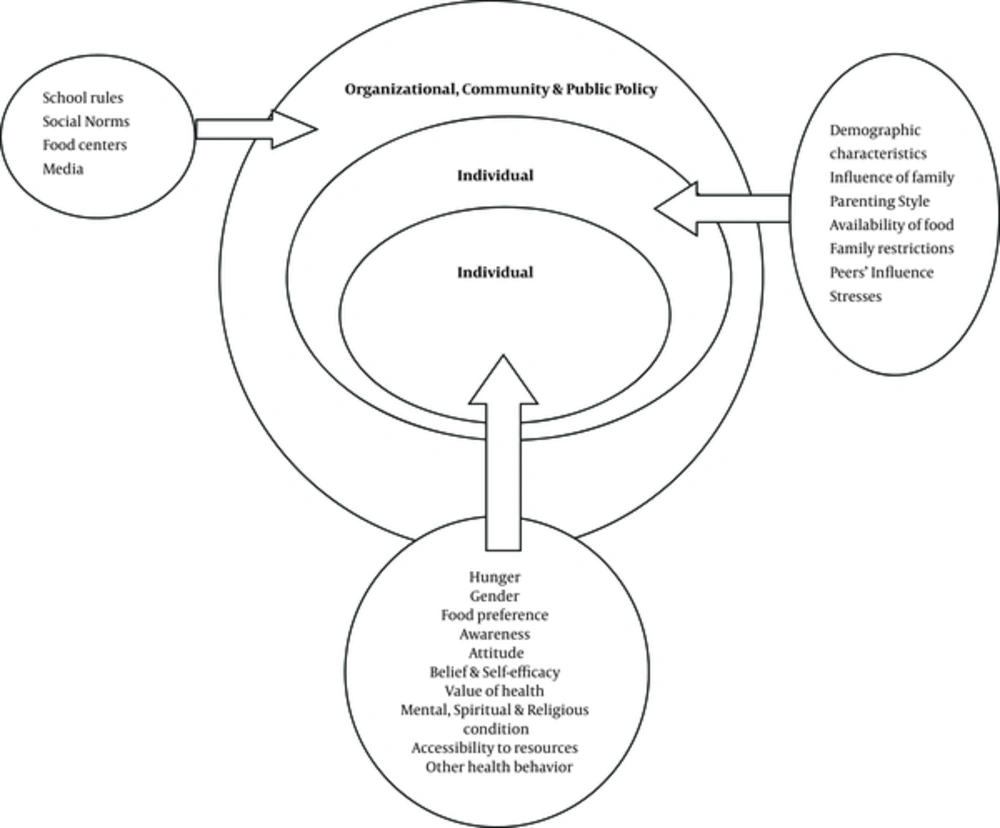
Figure 1.
Figure 1
4. Discussion
Nutrition behaviors formed during the adolescent period are carried into adulthood and, therefore, affect risk for the development of non-communicable disease in later life. Evaluating national programs in Iran has revealed lower effects of nutritional behaviors’ changing programs for teenagers than adults (74), due to the changes in food consumption in the Iranian society (83) and inconsistency between interventions and the so-called changes (74). The findings of the study revealed that paying attention to behavior change in individuals may not improve teenagers’ nutritional condition, since intrapersonal factors are formed through interactions between individuals and organization. Community and public policy factors play direct and indirect roles in the formation of these relations. Teenagers spend most of their time at school with their friends and peers; also due to their special mental condition, they are influenced by these interactions in their relations with their environment. Therefore changes in intrapersonal and environmental factors could have a more effective role in making changes in the teenagers’ nutritional behaviors. Since ecological models are focused on individuals’ interactions with cultural, environmental, and social factors (84), applying them to determine the effective factors, and designing interventions based on these factors could enhance the programs for improvement of teenagers’ nutritional behaviors.
5. Conclusions
Interventions for changing nutritional behaviors in teenagers should be based on key factors of the target population. In conclusion, from a public health perspective, results of this study have potential implications for interventions designed to make improvement in nutritional behaviors among adolescents. Since some of these determinants become key factors in different social-cultural contexts, nutritional changes in societies have a decisive role in their significance. The significance level of factors and their effect on the target society must be considered for designing more effective interventions.