Monitoring Near-Infrared Spectroscopy During Treatment with Ibuprofen to Predict Splanchnic Ischemia in a Newborn with Patent Ductus Arteriosus

Authors

Silvia Foligno1,*, Paola Giliberti1, Francesca Landolfo1, Veronica Pannone1, Pietro Bagolan1, Andrea Dotta1, Guglielmo Salvatori1
1Department of Medical and Surgical Neonatology, Bambino Gesu Children’s Hospital, IRCCS, Rome, Italy
*Corresponding Author: Corresponding author: Silvia Foligno, Department of Medical and Surgical Neonatology, Bambino Gesu Children’s Hospital, IRCCS, Rome, Italy. Tel: +39-668592346, Fax: +39-668592893, E-mail: Email: [email protected]

Innovative Journal of Pediatrics:Vol. 27, issue 2; e8806
Published online:Jan 16, 2017
Article type:Letter
Received:Sep 07, 2016
Accepted:Nov 17, 2016
How to Cite:Foligno S, Giliberti P, Landolfo F, Pannone V, Bagolan P, et al. Monitoring Near-Infrared Spectroscopy During Treatment with Ibuprofen to Predict Splanchnic Ischemia in a Newborn with Patent Ductus Arteriosus. Inn J Pediatr. 2017;27(2):e8806. doi: https://doi.org/10.5812/ijp.8806

Dear Editor,
Necrotizing enterocolitis (NEC) is one of the most common gastrointestinal emergencies in preterm infants. Its etiology is still incompletely understood. The pathogenesis includes prematurity, alteration of innate immunity, genetic predisposition, enteral feeding, intestinal bacterial overgrowth and hypoxia/ischemia. So far, the main objective of NEC researches is to identify both non-invasive methods and biological markers to detect the disease in its early stages (1). Near-infrared spectroscopy (NIRS) could be used as a non-invasive method to measure local tissue hemoglobin oxygen saturation at both capillary and postcapillary venule. Therefore, oximetry assessed via NIRS is proposed as a ‘standard of care’ and it is used in neonatal intensive care units (NICUs) (2). While the cerebral district was thoroughly investigated through NIRS, only few researches were conducted on other body sites in preterm infants (3). Previous studies demonstrated that NIRS measurements in newborns with syndrome of acute abdomen might identify changes in bowel oxygenation and perfusion with lower cerebro-splanchnic NIRS ratios (3, 4). There is a higher risk to develop NEC in preterm newborns with patent ductus arteriosus (PDA). The use of indomethacin or ibuprofen to treat PDA in preterm infants may either decrease (through closing ductus) or increase NEC incidence (through direct constriction effect on mesenteric blood vessels). The fall of roughly 30% - 40% of tissue oxygenation was observed in patients treated with ibuprofen or indomethacin. This decrease was more dramatic for mesenteric oxygenation than renal or cerebral values (4, 5). An 800 g female, born at 26 + 6 weeks of gestational age, affected by PDA with hemodynamic significance, despite 2 courses of ibuprofen, was admitted to Bambino Gesu Children’s hospital. During and after treatment with ibuprofen, intestinal oximetry was used to disclose clinical worsening. Before considering surgical ligation, the first dose of the 3rd course of ibuprofen (10 mg/kg over 2 hours) was administered. The mesenteric regional oxygen saturation (RSO2) was about 60%, before and during the whole administration. Two hours after the end of treatment, a significant decrease was observed in RSO2 values (15% - 20%), without any clinical signs of intestinal hypoperfusion. Furthermore, enteral feeding was reduced to minimal enteral feeding regimen. After 12 hours, severe abdominal distention was observed. The X-ray images showed bowel distension, without pneumatosis (NEC grade I, Bell criteria) (Figure 1). Subsequently, the enteral feeding was stopped and antibiotic therapy was started (amikacin 10 mg/kg/day and ampicillin-sulbactam 75 mg/kg/day). A gradual increase in RSO2 values was observed (RSO2 values were about 50% after 72 hours and about 60% after 96 hours) (Figure 2); 72 hours after beginning of antibiotic therapy, the clinical and image figures went back to normal and then enteral nutrition was gradually reintroduced. This case report suggests that transcutaneous NIRS splanchnic evaluation offers the opportunity to carry out noninvasive monitoring of neonates at risk for intestinal hypoperfusion and NEC and this management could be useful in clinical practice. The literature provided evident that ibuprofen could increase the risk of NEC during PDA closure. Despite some studies, the only by Chocrane reported the efficacy and feasibility of ibuprofen to treat PDA versus indomethacin and surgical procedure, but firstly some of them were not randomized and secondly a lot of biases were in the procedure of randomization; thus, it was difficult to take stable position (6, 7). It is proposed to employ a supportive method to reduce the risk of NEC by a low cost, practical and feasible method to detect the reduction of blood flow in newborns as NIRS. Probably, the reduction of blood flow in the current case was not only a consequence of ibuprofen treatment, and the immediate realization of this possibility helped to have a quick approach. It is also known that different factors such as type of milk or amount of feeding increase the risk of NEC, but the current case suggests the possibility of using NIRS to support the treatment of closures of PDA with ibuprofen. Well-planned studies should be carried out to clarify the role of RSO2 to manage preterm newborns at risk of developing NEC.
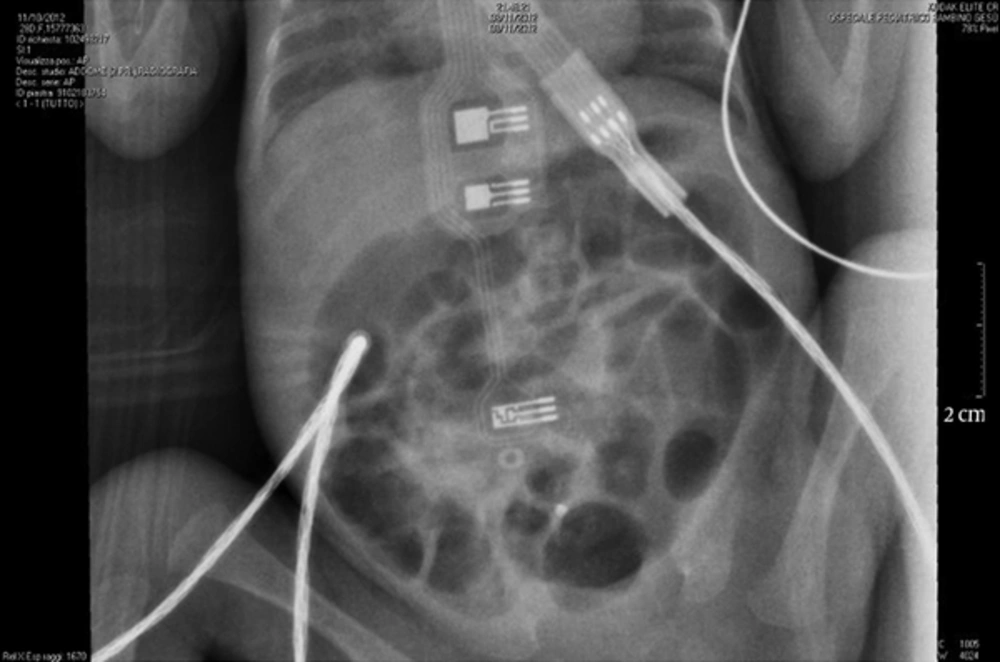
Abdomen X-ray Showed Bowel Distention Without Pneumatosis
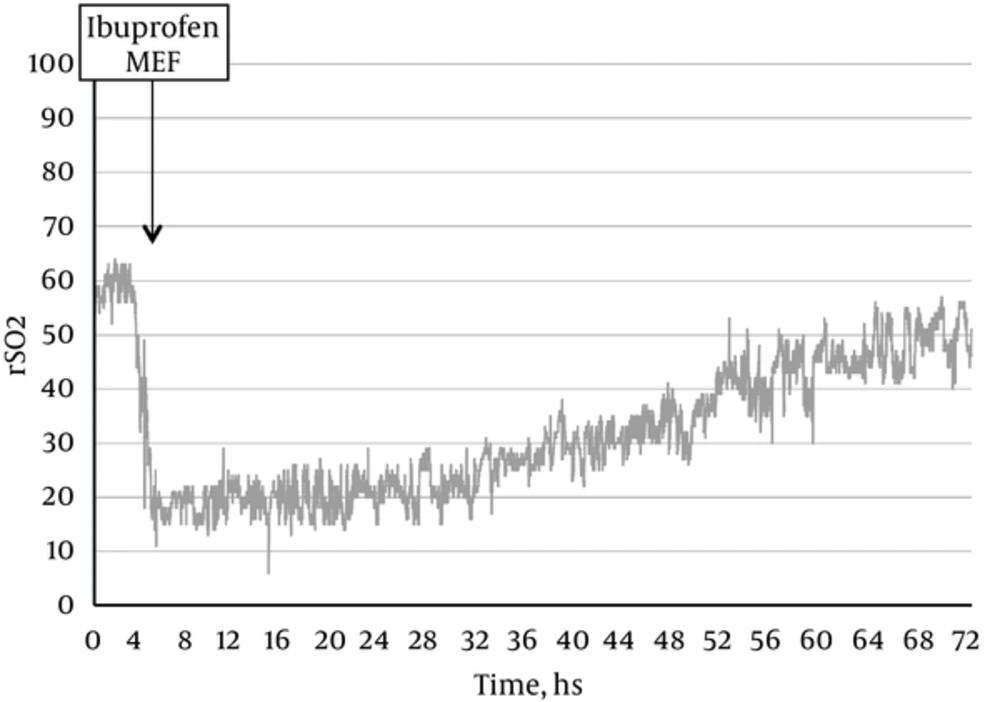
Figure 1.
Abdomen X-ray Showed Bowel Distention Without Pneumatosis
Before starting and during ibuprofen administration, the mesenterical RSO<sub>2</sub> was about 60%. At 2 hours after the end of treatment a significant (15% - 20%) decrease was observed in RSO<sub>2</sub> values.
Figure 2.
Before starting and during ibuprofen administration, the mesenterical RSO2 was about 60%. At 2 hours after the end of treatment a significant (15% - 20%) decrease was observed in RSO2 values.
Footnotes

  • Ethical Statement:Informed consent was obtained from the parents of neonate described in the case report.

References

  • 1.
    Neu J, Walker WA. Necrotizing enterocolitis. N Engl J Med. 2011;364(3):255-64. [PubMed ID: 21247316]. https://doi.org/10.1056/NEJMra1005408.
  • 2.
    Cerbo RM, Cabano R, Di Comite A, Longo S, Maragliano R, Stronati M. Cerebral and somatic rSO2 in sick preterm infants. J Matern Fetal Neonatal Med. 2012;25 Suppl 4:97-100. [PubMed ID: 22958033]. https://doi.org/10.3109/14767058.2012.715030.
  • 3.
    Gay AN, Lazar DA, Stoll B, Naik-Mathuria B, Mushin OP, Rodriguez MA, et al. Near-infrared spectroscopy measurement of abdominal tissue oxygenation is a useful indicator of intestinal blood flow and necrotizing enterocolitis in premature piglets. J Pediatr Surg. 2011;46(6):1034-40. [PubMed ID: 21683194]. https://doi.org/10.1016/j.jpedsurg.2011.03.025.
  • 4.
    Fortune PM, Wagstaff M, Petros AJ. Cerebro-splanchnic oxygenation ratio (CSOR) using near infrared spectroscopy may be able to predict splanchnic ischaemia in neonates. Intensive Care Med. 2001;27(8):1401-7. [PubMed ID: 11511955].
  • 5.
    Hirsch JC, Charpie JR, Ohye RG, Gurney JG. Near-infrared spectroscopy: what we know and what we need to know--a systematic review of the congenital heart disease literature. J Thorac Cardiovasc Surg. 2009;137(1):154-9. 159e1-12. [PubMed ID: 19154918]. https://doi.org/10.1016/j.jtcvs.2008.08.005.
  • 6.
    Ohlsson A, Walia R, Shah SS, Ohlsson A. Ibuprofen for the treatment of patent ductus arteriosus in preterm and/or low birth weight infants. Cochrane Database Syst Rev. 2013;4. CD003481. https://doi.org/10.1002/14651858.CD003481.pub5.
  • 7.
    O'Donovan DJ, Baetiong A, Adams K, Chen A, Smith EO, Adams JM, et al. Necrotizing enterocolitis and gastrointestinal complications after indomethacin therapy and surgical ligation in premature infants with patent ductus arteriosus. J Perinatol. 2003;23(4):286-90. [PubMed ID: 12774134]. https://doi.org/10.1038/sj.jp.7210911.

Copyright

Copyright © 2017, Growth & Development Research Center. This is an open-access article distributed under the terms of the Creative Commons Attribution-NonCommercial 4.0 International License (http://creativecommons.org/licenses/by-nc/4.0/) which permits copy and redistribute the material just in noncommercial usages, provided the original work is properly cited.

Similar Articles

28
Sep
2024

Reduction of Serum Troponin I in Premature Neonates After Closure of Patent Ductus Arteriosus

Ardeshir Tavakoli,
Mehrdad Rezaei,
Mozhgan Moghtaderi

Tavakoli A, Rezaei M, Moghtaderi M. Reduction of Serum Troponin I in Premature Neonates After Closure of Patent Ductus Arteriosus. Shiraz E-Med J. 2024;25(9):e152701. doi: https://doi.org/10.5812/semj-152701

28
Feb
2023
Evaluation of the Relationship Between Perfusion Index and the Improvement of Patent Ductus Arteriosus

Evaluation of the Relationship Between Perfusion Index and the Improvement of Patent Ductus Arteriosus

Razieh Sangsari,
Hosein Dalili,
Maliheh Kadivar,
Maryam Saeedi,
Kayvan Mirnia,
Azam Fathi
,et al.

Sangsari R, Dalili H, Kadivar M, Saeedi M, Mirnia K, et al. Evaluation of the Relationship Between Perfusion Index and the Improvement of Patent Ductus Arteriosus. Inn J Pediatr. 2023;33(2):e134709. doi: https://doi.org/10.5812/ijp-134709

9
Dec
2014

Usefulness of Serum Brain Natriuretic Peptide Level for Screening Hemodynamically Significant Patent Ductus Arteriosus in Preterm Neonates

Keyhan Sayadpour Zanjani,
Ahmad Jameii Khosroshahi,
Ali Kianfar,
Behzad Mohammadpour Aharanjani

Sayadpour Zanjani K, Jameii Khosroshahi A, Kianfar A, Mohammadpour Aharanjani B. Usefulness of Serum Brain Natriuretic Peptide Level for Screening Hemodynamically Significant Patent Ductus Arteriosus in Preterm Neonates. Inn J Pediatr. 2014;24(6):. doi:

11
Jul
2016

The Effects of Oral Ibuprofen on Medicinal Closure of Patent Ductus Arteriosus in Full-Term Neonates in the Second Postnatal Week

Mohammad Reza Alipour,
Mansooreh Mozaffari Shamsi,
Seyedeh Mahdieh Namayandeh,
Zohreh Pezeshkpour,
Fatemeh Rezaeipour,
Mohammadtaghi Sarebanhassanabadi

Alipour MR, Mozaffari Shamsi M, Namayandeh SM, Pezeshkpour Z, Rezaeipour F, et al. The Effects of Oral Ibuprofen on Medicinal Closure of Patent Ductus Arteriosus in Full-Term Neonates in the Second Postnatal Week. Inn J Pediatr. 2016;26(4):e5807. doi: https://doi.org/10.5812/ijp.5807

26
Dec
2021
Age at Surgical Ligation of Patent Ductus Arteriosus Affects Prognosis in Extremely Premature Infants

Age at Surgical Ligation of Patent Ductus Arteriosus Affects Prognosis in Extremely Premature Infants

Qiuping Li,
Tao Han,
Yonghui Yang,
Gengxu Zhou,
Hui Wang,
Haihua Chen
,et al.

Li Q, Han T, Yang Y, Zhou G, Wang H, et al. Age at Surgical Ligation of Patent Ductus Arteriosus Affects Prognosis in Extremely Premature Infants. Inn J Pediatr. 2022;32(1):e115751. doi: https://doi.org/10.5812/ijp.115751

More by these authors

Silvia FolignoPubMedScholar
Paola GilibertiPubMedScholar
Francesca LandolfoPubMedScholar
Veronica PannonePubMedScholar
Pietro BagolanPubMedScholar
Andrea DottaPubMedScholar
Guglielmo SalvatoriPubMedScholar
Share
Cited by
Metrics