Child Developmental Screening in Southern Iran

Authors

Shirin Soltani1, Soghra Kamali1, Nasibeh Roozbeh1,*, Leili Darvish1
1Mother and Child Welfare Research Center, Hormozgan University of Medical Sciences, Bandar Abbas, Iran
*Corresponding Author: Corresponding author: Nasibeh Roozbeh, Mother and Child Welfare Research Center, Hormozgan University of Medical Sciences, Bandar Abbas, Iran. Tel: +98-3334044, E-mail: Email: [email protected]

Innovative Journal of Pediatrics:Vol. 27, issue 2; e7914
Published online:Nov 06, 2016
Article type:Letter
Received:Jul 18, 2016
Accepted:Sep 30, 2016
How to Cite:Soltani S, Kamali S, Roozbeh N, Darvish L. Child Developmental Screening in Southern Iran. Inn J Pediatr. 2017;27(2):e7914. doi: https://doi.org/10.5812/ijp.7914

Dear Editor,
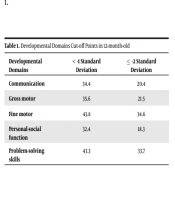
More than 200 million children in low- and middle-income countries suffer from developmental delays and / or debilities worldwide (1). Some risk factors associated with practical damage and mental developmental delay in infants and children in developing countries are as follows: Micronutrient deficiency, malnutrition, poor health and hygiene, and scarce care. Early detection of developmental problems is of importance to the wellbeing of young children and their parents. Therefore, it is essential to decrease the negative outcomes (2). The Ages and stages questionnaire (ASQ), which has largely been used in contemporary studies, is a developmental screening questionnaire designed to be completed by parents or primary caregivers of children. This questionnaire can detect those children who should be further evaluated to decide whether they are qualified for early intervention, or early childhood specific training. Sensitivity, specificity and reliability of this questionnaire (ASQ) have been reported to be 75.8%, 87.5%, and 94%, respectively (3). The ASQ is used for children aged 4 - 60 months, covering five various domains of communication, fine motor, problem solving, gross motor, and personal-social skills (1). In 2015, in a cross-sectional study in Hormozgan province (located in the extreme point of southern Iran) 23,494 twelve-month-old children were screened for development delay, using the ASQ. Among the participants, the ASQ was abnormal in 88 children. Moreover, 25% had a delay in communication domain, 29% in fine motor, 31% in problem solving, 35% in gross motor, and 26% in personal-social skills. The results revealed that ‘delay in gross motor’ and ‘problem solving’ were higher among all the domains. Gross motor development includes control and movement of large muscle groups such as the head, torso, arms, and legs. Gross motor skills are abilities that have been developed during early childhood, and they develop from top to bottom (4). The ‘problem solving domain’ includes child’s knowledge and the ability to play with toys. However, these results should not be interpreted in isolation, and decisions should be made based on other factors and the overall function of children. A systematic review summarized the results of studies and provided the best evidence for judging (5). Therefore these studies can help to identify the effective factors on delay in gross motor and problem solving domains.
References

  • 1.
    Van der Linde J, Swanepoel DW, Glascoe FP, Louw EM, Vinck B. Developmental screening in South Africa: comparing the national developmental checklist to a standardized tool. African Health Sciences. 2015;15(1):188. https://doi.org/10.4314/ahs.v15i1.25.
  • 2.
    Yaghini O, Kelishadi R, Keikha M, Niknam N, Sadeghi S, Najafpour E, et al. Prevalence of Developmental Delay in Apparently Normal Preschool Children in Isfahan,Central Iran. Iran J Child Neurol. 2015;9(3):17-23. [PubMed ID: 26401149].
  • 3.
    Vameghi R, Sajedi F, Kraskian Mojembari A, Habiollahi A, Lornezhad HR, Delavar B. Cross-Cultural Adaptation, Validation and Standardization of Ages and Stages Questionnaire (ASQ) in Iranian Children. Iran J Public Health. 2013;42(5):522-8. [PubMed ID: 23802111].
  • 4.
    Piek JP, Dawson L, Smith LM, Gasson N. The role of early fine and gross motor development on later motor and cognitive ability. Hum Mov Sci. 2008;27(5):668-81. [PubMed ID: 18242747]. https://doi.org/10.1016/j.humov.2007.11.002.
  • 5.
    Abdi F, Roozbeh N. The effects of Humulus Lupulus L. (Hops) on Menopausal Vasomotor Symptoms: A Systematic Review and Meta-analysis. IJOGI. 2016;19(26):9-7. https://doi.org/10.22038/ijogi.2016.7797.

Copyright

Copyright © 2016, Growth & Development Research Center. This is an open-access article distributed under the terms of the Creative Commons Attribution-NonCommercial 4.0 International License (http://creativecommons.org/licenses/by-nc/4.0/) which permits copy and redistribute the material just in noncommercial usages, provided the original work is properly cited.

Similar Articles

6
Jan
2023
Prevalence of Developmental Delay in 12-month-old Infants, Urban Health Centers, Shahid Beheshti University of Medical Sciences, Tehran, Iran, 2018 - 2019

Prevalence of Developmental Delay in 12-month-old Infants, Urban Health Centers, Shahid Beheshti University of Medical Sciences, Tehran, Iran, 2018 - 2019

Nasrin Ezatpanah,
Masoome Nikoo,
Shahnam Arshi,
Narges Gholami,
Latif Gachkar

Ezatpanah N, Nikoo M, Arshi S, Gholami N, Gachkar L. Prevalence of Developmental Delay in 12-month-old Infants, Urban Health Centers, Shahid Beheshti University of Medical Sciences, Tehran, Iran, 2018 - 2019. J Compr Ped. 2023;14(1):e126319. doi: https://doi.org/10.5812/compreped-126319

1
Jan
2012

Inequality in School Readiness and Autism among 6-Year-Old Children across Iranian Provinces: National Health Assessment Survey Results

Masoud Amiri,
Roya Kelishadi,
Mohammad-Esmaeil Motlagh,
Mahnaz Taslimi,
Marziyeh Dashti,
Tahereh Aminaee
,et al.

Amiri M, Kelishadi R, Motlagh M, Taslimi M, Dashti M, et al. Inequality in School Readiness and Autism among 6-Year-Old Children across Iranian Provinces: National Health Assessment Survey Results. Inn J Pediatr. 2013;23(1):. doi:

9
Apr
2022
Changes in the Prevalence of Micronutrient Deficiencies Among Under-2- and 6-Year-Old Children in Two National Surveys in Iran

Changes in the Prevalence of Micronutrient Deficiencies Among Under-2- and 6-Year-Old Children in Two National Surveys in Iran

Mitra Abtahi,
Hamed Pouraram,
Abolghassem Djazayery,
Fereydoun Siassi

Abtahi M, Pouraram H, Djazayery A, Siassi F. Changes in the Prevalence of Micronutrient Deficiencies Among Under-2- and 6-Year-Old Children in Two National Surveys in Iran. Inn J Pediatr. 2022;32(2):e114851. doi: https://doi.org/10.5812/ijp-114851

5
Nov
2016

Comparing the Results of Developmental Screening of 4 to 60-Month-Old Children in Tehran Using Parents Evaluation of Developmental Status and Ages and Stages Questionnaires

Soheila Shahshahani,
Roshanak Vameghi,
Firoozeh Sajedi,
Akbar Biglarian

Shahshahani S, Vameghi R, Sajedi F, Biglarian A. Comparing the Results of Developmental Screening of 4 to 60-Month-Old Children in Tehran Using Parents Evaluation of Developmental Status and Ages and Stages Questionnaires. Inn J Pediatr. 2017;27(2):e6179. doi: https://doi.org/10.5812/ijp.6179

17
Feb
2014

Assessment of Health and Nutritional Status in Children Based on School Screening Programs

Shahab Rezaeian,
Jamal Ahmadzadeh,
Nader Esmailnasab,
Yousef Veisani,
Mina Shayan,
Noorollah Moradi

Rezaeian S, Ahmadzadeh J, Esmailnasab N, Veisani Y, Shayan M, et al. Assessment of Health and Nutritional Status in Children Based on School Screening Programs. Health Scope. 2014;3(1):e14462. doi: https://doi.org/10.17795/jhealthscope-14462

More by these authors

Shirin SoltaniPubMedScholar
Soghra KamaliPubMedScholar
Nasibeh RoozbehPubMedScholar
Leili DarvishPubMedScholar
Share
Cited by
Metrics