
Resilience: A Protective Factor Against Burnout During the COVID-19 Pandemic

Author(s):
Farzad RahmaniFarzad RahmaniFarzad Rahmani ORCID1, Shiva SalmasiShiva SalmasiShiva Salmasi ORCID1,*, Sepideh ZareiSepideh Zarei1
1Emergency Medicine Research Team, Tabriz University of Medical Sciences, Tabriz, Iran
*Corresponding Author: Emergency Medicine Research Team, Tabriz University of Medical Sciences, Tabriz, Iran. Tel: +98-9143094938, Email: [email protected]

IJ Psychiatry and Behavioral Sciences:Vol. 15, issue 3; e114083
Published online:Sep 10, 2021
Article type:Letter
Received:Mar 06, 2021
Accepted:Aug 20, 2021
How to Cite:Rahmani F, Salmasi S, Zarei S. Resilience: A Protective Factor Against Burnout During the COVID-19 Pandemic. Iran J Psychiatry Behav Sci. 2021;15(3):e114083. doi: https://doi.org/10.5812/ijpbs.114083

Dear Editor,
Maslach burnout is a syndrome that is caused by chronic work stress, and it is one of the threats to human resources (1). Emergency personnel provide services in disasters and accidents; as a result, they are highly susceptible to develop burnout (2). Also, direct and continuous communication with patients is a key factor in burnout development (3).
Resilience is one of the main abilities of humans for effective adoption in risks, also a means of flexible response to the pressure caused by everyday life (4). According to the studies, there is a significant negative relationship between resilience and Maslach burnout (5). Different studies have shown that resilience is a crucial factor in controlling work stress, and it has an important preventive effect on the development of various psychological issues (6).
In this cross-sectional study, 173 healthcare workers from prehospital and hospital Emergency Medicine Department of Tabriz University of Medical Sciences participated. During the pandemic, participants in this study provided prehospital emergency care as well as emergency department care for all types of patients, including COVID-19 patients. The instruments used were the Maslach Burnout Inventory (MBI) 1986 and Conner-Davidson Resilience Scale (CD-RIS).
Maslach Burnout Inventory measures three dimensions of burnout, including emotional exhaustion, depersonalization, and personal accomplishment. There are score ranges that define low, moderate, and high levels of each component/scale (7). The validity and reliability of the Persian translation of this inventory have been confirmed in Iranian studies (8-11).
The CD-RIS measures personal competence, trust in one’s instincts and tolerance of negative affect, positive acceptance of change and secure relationships, control, and spiritual influences (4). Psychometric properties of this scale and its Persian version have been confirmed in previous studies (12-14).
The mean age of the studied emergency department personnel was 32.12 (± 7.55). In terms of gender, 74 subjects (42.8% of the study population) were female, and they showed statistically significant more burnout (P < 0.001). In general, emotional exhaustion and depersonalization were more evident in females in comparison to males (P < 0.001).
Maslach burnout was recorded in 54.71% of the study population. The results of this study have shown that 20.2% of emergency department healthcare workers suffered from high emotional exhaustion, and 52.6% had low emotional exhaustion. In terms of depersonalization, 52.6% and 47.4% had moderate and low depersonalization scores, respectively. Only 2.3% of the study group had high personal accomplishments.
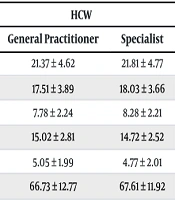
The mean score of resilience was 64.66 (± 15.56). The scores in dimensions of personal competence, trust in one's instincts, positive acceptance of change, control, and spiritual influences were 14.54 (± 3.5), 18.09 (± 4.6), 21.95 (± 5.9), 5.24 (± 1.9), and 8.16 (± 2.7), respectively. Additionally, there was no statistically significant difference in resilience between females and males. Statistically, resilience was significantly higher in married personnel. Regarding the positions in the emergency department, resilience had higher scores among nurses as opposed to general physicians, whose score for resilience was the lowest. Additionally, general physicians had higher scores in Maslach burnout (the higher educational level, the higher burnout scores, which is not true for resilience). Finally, the results of the study have shown that resilience, with a correlation coefficient of 0.397, affects the rate of burnout. It was identified to be significant that burnout decreases with increased resilience.
In the study by Moukarzel, burnout syndrome was seen in 34.6% of emergency department staff, which was correlated to job pressure and low mental component score; especially, emergency department physicians were prone to burnout syndrome (15). Some studies have shown that physicians with high resilience have experienced far less burnout syndrome (16). The results of the study by Edward have revealed that burnout syndrome was less experienced by nurses who had training in resilience boosting techniques (17). Likewise, in the study by Hamdan, emergency department nurses had lower scores of emotional exhaustion in comparison to emergency department physicians (18).
This study has shown that more than half of emergency department staff have shown depersonalization, and almost 20% of them had high scores in emotional exhaustion. The prevalence of burnout syndrome was higher in females and single staff. Also, general physicians had a higher rate of burnout syndrome. One of the main risk factors for Maslach burnout is making sensitive choices and managing critically ill patients, which is usually done by emergency medicine physicians, and it puts them under extreme stress and mental pressure.
One of the limitations of this study was the length of the questionnaires. As a result of time limitation and increased number of patients in the emergency department during the COVID-19 pandemic, in some cases, the study participants could not complete the questionnaire carefully. These cases were carefully assessed and excluded from the study.
We conclude that resilience had a statistically significant relationship with age and gender, with resilience increasing with age. In addition, resilience was higher in married participants. Therefore, by increasing the resilience skills of healthcare workers (in the form of training workshops) and subsequently reducing their Maslach burnout, the quality of their work-lives and the services they deliver to patients improves.

Footnotes

  • Authors' Contribution: Study concept and design: F. R., and S. Z.; Analysis and interpretation of data: S. Z.; Drafting of the manuscript: S. S.; Critical revision of the manuscript for important intellectual content: F. R., S. S.

  • Conflict of Interests: The authors declare that there is no conflict of interest with respect to the research, authorship, and publication of this article.

  • Ethical Approval: This study was approved by the Ethics Committee of Tabriz University of Medical Sciences.

  • Funding/Support: The article is not supported by any funding organization. Also, there is no sponsor of this work.

References

  • 1.
    Schaufeli WB, Buunk BP. Burnout: An overview of 25 years of research and theorizing. In: Schabracq MJ, Winnubst JAM, Cooper CC, editors. The handbook of work and health psychology. West Sussex; 2004. p. 383-425.
  • 2.
    Gomez-Urquiza JL, Aneas-Lopez AB, Fuente-Solana EI, Albendin-Garcia L, Diaz-Rodriguez L, Fuente GA. Prevalence, risk factors, and levels of Burnout among oncology nurses: A systematic review. Oncol Nurs Forum. 2016;43(3):E104-20. [PubMed ID: 27105202]. https://doi.org/10.1188/16.ONF.E104-E120.
  • 3.
    de Oliveira SM, de Alcantara Sousa LV, Vieira Gadelha MDS, do Nascimento VB. Prevention actions of Burnout syndrome in nurses: An integrating literature review. Clin Pract Epidemiol Ment Health. 2019;15:64-73. [PubMed ID: 31015857]. [PubMed Central ID: PMC6446475]. https://doi.org/10.2174/1745017901915010064.
  • 4.
    Green KT, Hayward LC, Williams AM, Dennis PA, Bryan BC, Taber KH, et al. Examining the factor structure of the Connor-Davidson Resilience Scale (CD-RISC) in a post-9/11 U.S. military veteran sample. Assessment. 2014;21(4):443-51. [PubMed ID: 24586090]. [PubMed Central ID: PMC4147024]. https://doi.org/10.1177/1073191114524014.
  • 5.
    Kutluturkan S, Sozeri E, Uysal N, Bay F. Resilience and burnout status among nurses working in oncology. Ann Gen Psychiatry. 2016;15:33. [PubMed ID: 27895699]. [PubMed Central ID: PMC5109709]. https://doi.org/10.1186/s12991-016-0121-3.
  • 6.
    Kalia M. Assessing the economic impact of stress--the modern day hidden epidemic. Metabolism. 2002;51(6 Suppl 1):49-53. [PubMed ID: 12040542]. https://doi.org/10.1053/meta.2002.33193.
  • 7.
    Momeni K, Akbari M, Atshzadeh Shourideh F. [Relationship between reselience and job burnout in nurses]. Teb Va Tazkiey. 2009;37:74-5. Persian.
  • 8.
    Filian A. [The prevalence of depression and its relationship with job coping methods used by nurses. [dissertation]]. Tehran: Tarbiat Modares University; 2010. Persian.
  • 9.
    Akbari R, Ghafar Samar R, Kiany Gholam R, Eghtesadi AR. [Factorial validity and psychometric properties of maslach burnout inventory]. Knowledge and Health. 2011;6(3):1-8. Persian.
  • 10.
    Moalemi S, Kavosi Z, Beygi N, Deghan A, Karimi A, Mohammad Parvizi MM. Evaluation of the Persian version of Maslach Burnout Inventory-Human services survey among Iranian nurses: Validity and reliability. Galen Medical J. 2018;7. e995.
  • 11.
    Sepehri Shamloo Z, Hashemian SS, Khoshsima H, Shahverdi A, Khodadost M, Modares Gharavi M. Validity and reliability of the Persian version of the Maslach Burnout inventory (General survey version) in Iranian population. Iran J Psychiatry Behav Sci. 2017;11(2). https://doi.org/10.5812/ijpbs.8168.
  • 12.
    Connor KM, Davidson JR. Development of a new resilience scale: The Connor-Davidson Resilience Scale (CD-RISC). Depress Anxiety. 2003;18(2):76-82. [PubMed ID: 12964174]. https://doi.org/10.1002/da.10113.
  • 13.
    Samani S, Jokar B, Sahragard N. [Resilience, mental health and life satisfaction]. Iran J Psychiatry Clin Psychol. 2007;13:295-0. Persian.
  • 14.
    Ahangarzadeh Rezaei S, Rasoli M. [Psychometric properties of the Persian Version of "CONNER-DAVIDSON RESILIENCE SCALE" in adolescents with cancer]. J Urmia Nurs Midwifery Fac. 2015;13(9 (74)):739-47. Persian.
  • 15.
    Moukarzel A, Michelet P, Durand AC, Sebbane M, Bourgeois S, Markarian T, et al. Burnout Syndrome among Emergency Department Staff: Prevalence and Associated Factors. Biomed Res Int. 2019;2019:6462472. [PubMed ID: 30800675]. [PubMed Central ID: PMC6360614]. https://doi.org/10.1155/2019/6462472.
  • 16.
    West CP, Dyrbye LN, Sinsky C, Trockel M, Tutty M, Nedelec L, et al. Resilience and Burnout among physicians and the general US working population. JAMA Netw Open. 2020;3(7). e209385. [PubMed ID: 32614425]. [PubMed Central ID: PMC7333021]. https://doi.org/10.1001/jamanetworkopen.2020.9385.
  • 17.
    Edward KL, Hercelinskyj G. Burnout in the caring nurse: learning resilient behaviours. Br J Nurs. 2007;16(4):240-2. [PubMed ID: 17363857]. https://doi.org/10.12968/bjon.2007.16.4.22987.
  • 18.
    Hamdan M, Hamra AA. Burnout among workers in emergency Departments in Palestinian hospitals: prevalence and associated factors. BMC Health Serv Res. 2017;17(1):407. [PubMed ID: 28619081]. [PubMed Central ID: PMC5472878]. https://doi.org/10.1186/s12913-017-2356-3.

Copyright

Copyright © 2021, Author(s). This is an open-access article distributed under the terms of the Creative Commons Attribution-NonCommercial 4.0 International License (http://creativecommons.org/licenses/by-nc/4.0/) which permits copy and redistribute the material just in noncommercial usages, provided the original work is properly cited.

Similar Articles

11
Apr
2021

The Mental Health and Job Burnout of Nurses During the COVID-19 Outbreak: Resilience as a Mediator

Zahra Zanjani,
Sanaz Joekar,
Abdollah Omidi

Zanjani Z, Joekar S, Omidi A. The Mental Health and Job Burnout of Nurses During the COVID-19 Outbreak: Resilience as a Mediator. Iran J Psychiatry Behav Sci. 2021;15(2):e109925. doi: https://doi.org/10.5812/ijpbs.109925

2
May
2020

Stress Reduction Model of COVID-19 Pandemic

Mohsen Khosravi

Khosravi M. Stress Reduction Model of COVID-19 Pandemic. Iran J Psychiatry Behav Sci. 2020;14(2):e103865. doi: https://doi.org/10.5812/ijpbs.103865

4
Jan
2023

Job Burnout and Reduced Personal Accomplishment Among Health Sector Employees During COVID-19 Pandemic

Mahmood Khodadoost,
Alireza Zali,
Saeid Gholamzadeh,
Mehdi Azizmohammad Looha,
Forouzan Akrami,
Sara Rahmati Roodsari
,et al.

Khodadoost M, Zali A, Gholamzadeh S, Azizmohammad Looha M, Akrami F, et al. Job Burnout and Reduced Personal Accomplishment Among Health Sector Employees During COVID-19 Pandemic. Health Scope. 2023;12(1):e129841. doi: https://doi.org/10.5812/jhealthscope-129841

26
Oct
2023

Psychological Symptoms Among Iranian Healthcare Workers During COVID-19 Pandemic

Shiva Eskandari,
Mohammad Rafi Bazrafshan,
Zahra Ziba,
Zahra Shakeri,
Fatemeh Sarvi,
Zahra Sadeghi
,et al.

Eskandari S, Bazrafshan MR, Ziba Z, Shakeri Z, Sarvi F, et al. Psychological Symptoms Among Iranian Healthcare Workers During COVID-19 Pandemic. Iran J Psychiatry Behav Sci. 2023;17(4):e137732. doi: https://doi.org/10.5812/ijpbs-137732

21
Jan
2026
J Arch Mil Med

Resilience Among Healthcare Workers Facing a Severe Crisis; The COVID-19 Outbreak Experiences at Referral Hospitals in Tehran, Iran

Fatemeh Sadat Bateni,
Negar Kiani Yousefzadeh,
Mohsen Vahedi,
Aishatu Yusha'u Armiya'u,
Atefeh Abedini,
Mohammadreza Salehi
,et al.

Bateni FS, Kiani Yousefzadeh N, Vahedi M, Armiya'u AY, Abedini A, et al. Resilience Among Healthcare Workers Facing a Severe Crisis; The COVID-19 Outbreak Experiences at Referral Hospitals in Tehran, Iran. J Arch Mil Med. 2026;14(1):e168609. doi: https://doi.org/10.69107/jamm-168609

Download PDF86.67 KB

Crossmark

Crossmark

Checking

Share on
Cited by
Metrics

Ordering Reprints

Articles are published under the Creative Commons license stated on each article. No permission or royalty fee is required for uses permitted by that license. CCC handles optional bulk and customized reprint orders. Any quotation covers production and delivery services only, not copyright permission. > Request Reprints from CCC 

Search Relations

Author(s):

Related Articles

