
1. Background
The novel coronavirus, known as COVID-19, was first discovered in China in 2019 and quickly spread, leading the World Health Organization to designate it a pandemic on March 11, 2020. This epidemic is still having an impact on some countries ["Report on the Second Convocation of the Emergency Committee of the International Health Regulations (2005) Concerning the Novel Coronavirus Outbreak (2019-NCoV)" World Health Organization, 2020]. The medical team, which consists of physicians, nurses, medical assistants, and other employees at hospitals and healthcare facilities, was under a lot of strain to manage the patients at this time. In addition to the difficulties that individuals encountered as a result of the pandemic, healthcare providers also confront other problems. Getting sick themselves or their family, losing loved ones, working long, hard shifts, and spending a lot of time with critically ill patients are some of their worries (1, 2). All of these might lead to psychological problems and burnout in healthcare workers (HCWs). Reports state that the healthcare staff in COVID-19 referral hospitals had higher rates of somatization, sadness, and anxiety than those at non-reference hospitals. Thereafter, their performance at work declined (3). Resilience is therefore essential for controlling mental stability and advancing mental wellness. Resilience is a positive and protective factor for mental health and is a process for good adaptation in stressful and traumatic situations (4). Resilience is not a personality trait, but it is a process in which a person, in the face of a stressful situation, can maintain her mental balance by properly using thoughts, behaviors, and function (5).
Initially, resilience was thought of as a person's ability to adapt to difficult circumstances and get through them (6). It is a process of appropriate adaptation to adversity or trauma, or even to major causes of stress, according to the American Psychological Association (5). Adapting positively to a hostile environment linked with personal growth is presently recognized to be a complicated process that takes protective variables into account at the cognitive, emotional, and behavioral levels (4). Therefore, when faced with certain unfavorable circumstances such as the COVID-19 pandemic, the interplay of particular protective variables fosters adaptive processes that may lead to resilient rather than psychopathological results (7). People who encounter adversity find themselves within a network made up of many components that support them, and resilient processes are complex (8). The need to identify which protective components modulate high levels of resilience in health professionals exposed to situations of varying adversity is driven by the fact that these protective components are context-specific (9, 10).
Resilience is a critical trait for HCWs in the workplace, according to a growing body of research. It helps them handle challenging events at work and is important for a higher quality of life at work overall. Numerous research studies have demonstrated the inverse relationships between resilience and specific negative consequences, such as worry about negative outcomes, burnout, melancholy, anxiety, negative coping, stress, and intolerance for uncertainty (11-15). There are restrictions to reducing workplace stressors in the healthcare industry, even if steps should be taken to address them from an organizational perspective. Hence, it is important to consider how resilience may safeguard against these negative psychological sequelae (16).
Several investigations have been carried out in Europe to explore mental health issues among healthcare professionals during the first wave. These studies revealed a surge in fear, anxiety, depression, and sleep problems (17). Similarly, healthcare professionals were found to experience a high incidence of anxiety, depression, and posttraumatic stress during the early stages of the pandemic (18). However, the impact of COVID-19 was not uniform among all healthcare professionals, as cross-sectional studies indicated that being a woman, a nurse, and working shifts increased the incidence of anxiety, depression, and posttraumatic stress among participants (12, 19). Cross-sectional studies among professionals have also investigated variables such as resilience, which were found to be associated with lower symptomatology of anxiety, depression, posttraumatic stress, and burnout (11, 18).
2. Objectives
Thus, having medical specialists who can withstand adversity is essential in unforeseen and difficult situations like this pandemic, for which there is now no lasting cure. Finding out how resilient medical staff members are at Tehran's COVID-19 referral hospitals is the aim of this research.
3. Methods
This study examined HCWs’ ability to withstand the COVID-19 epidemic using a cross-sectional design. Two sizable Tehran referral hospitals — Imam Khomeini Hospital, connected to Tehran University of Medical Sciences, and Masih Daneshvari Hospital, connected to Shahid Beheshti University — were used for this study. From early December 2020 to early March 2021, the study was carried out.
The study involved HCWs ranging in age from 18 to 60, including specialist physicians, medical assistants, specialist fellows, general physicians, nurses, and paramedics. The sample size was 250 people using Cochran's formula, taking into account the population of 700 employees working in the wards specified for patients with COVID-19 such as intensive care unit, sub-acute admitting, and respiratory emergency. Participants were selected randomly from available cases.
3.1. Data Collection and Instruments
Data were collected from early December 2020 to early March 2021 by distributing online questionnaires. The questionnaire was distributed in WhatsApp groups of workers and the responses were collected until the calculated sample size was reached. The participants gave informed consent before taking part in the study. Using an online questionnaire helps maintain the physical distance between the researcher and the participants to prevent the spread of COVID-19 disease.
Two parts of the questionnaire must be filled out, namely demographic data and the Connor-Davidson Resilience Scale-25 (CD-RISC-25) Questionnaire. Basic information includes age, gender, marital status, occupation, length of stay in the COVID-19 wards, and history of first-degree relatives with COVID-19, and CD-RISC-25. CD-RISC-25 is a tool used to measure a person’s resilience. It consists of 25 statements and every statement has five response options: (1) Strongly disagree, (2) disagree, (3) slightly agree, (4) agree, and (5) strongly agree. The answers obtained were given a score of 0 - 4 with a minimum total value of zero and a maximum of 100. The score obtained illustrates the level of resilience of the subject (10). The CD-RISC-25 was developed by Jonathan Davidson and Kathryn Connor as a measurement tool for assessing resilience in clinical and research situations. This questionnaire is a valid tool, and its validity has been confirmed in various studies.
This questionnaire has 5 subscales. These five subscales include "Individual Adequacy Competence" (8 phrases), "Tolerance of negative effects and strength against stress" (7 phrases), "Positive acceptance of change" (5 phrases), "Self-control" (3 phrases), and "Spiritual effects" (2 phrases) (11). The Cronbach's alpha coefficient of the Persian version of this scale in students has been determined to be 0.87 (12).
3.2. Ethical Approval
The code of ethics was taken by the Ethics Committee of the University of Social Welfare and Rehabilitation Sciences (IR.USWR.REC.1399.227). An anonymous questionnaire was completed by the participants and their consent to participate in the study was completed.
3.3. Data Analysis
Data processing and analysis procedures were as follows: (1) SPSS version 22 analysis for data, (2) ANOVA table for occupation, (3) Levene and t-test for gender, (4) Pearson correlation test for age, and (5) t-test for how long they stayed in the COVID-19 ward and first-degree relatives suffering from COVID-19.
4. Results
There were 243 respondents (153 women, 63.9%, and 90 men, 36.1%) who filled out the questionnaire online with an average age of 39.22 years. The results revealed 68.2% to be married, 27.5% single, and 4.3% divorced. Specialist physicians were 25.90%, 4.3% had fellowships, 14.9% were medical residents, 16.9% were general practitioners, 33.7% were nurses, while 4.3% were other paramedics. Participants who had first-degree relatives with COVID-19 accounted for 54.7% during the time of the study. The mean value of the respondents’ resilience was 65, the lowest score was 26, while the highest score stood at 100 (range: 26 - 100).
There was a significant difference between gender and subscales of resilience. Four of the subscales (individual adequacy competence, tolerance of negative affect and strength against stress, positive acceptance of change, and self-control) were different, except spirituality (Table 1).
Table 1.
Subtypes of Resilience in Health Care Workers a
| Resilience | Gender | P-Value | |
|---|---|---|---|
| Male | Female | ||
| Individual competency | 22.11 ± 4.96 | 20.53 ± 5.36 | 0.024 |
| Tolerance of negative effect | 18.80 ± 4.17 | 16.67 ± 3.82 | < 0.001 |
| Positive acceptance of change | 8.34 ± 2.34 | 7.57 ± 2.34 | 0.013 |
| Self-control | 15.15 ± 2.57 | 14.05 ± 2.83 | 0.003 |
| Spiritual effects | 4.91 ± 2.15 | 5.09 ± 1.83 | 0.472 |
| Resilience (total) | 69.32 ± 13.25 | 63.92 ± 12.98 | 0.002 |
a Values are expressed as mean ± SD.
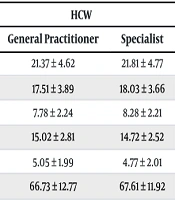
All of the occupations (specialist, fellowship, medical resident, general practitioner, nurse, and other paramedics) in the hospital had the same P-value (P > 0.05) and the total resilience score was the same. There was not any significant difference between resilience and occupation (Table 2).
Table 2.
ANOVA Test for Resilience and Healthcare Workers a
| Resilience | HCW | P-Value | |||||
|---|---|---|---|---|---|---|---|
| Other Paramedics | Nurse | General Practitioner | Specialist | Medical Resident | Fellowship | ||
| Individual competency | 22.91 ± 4.09 | 20.71 ± 6.15 | 21.37 ± 4.62 | 21.81 ± 4.77 | 19.97 ± 4.75 | 21.09 ± 5.80 | 0.462 |
| Tolerance of negative effect | 19.64 ± 4.74 | 17.04 ± 4.17 | 17.51 ± 3.89 | 18.03 ± 3.66 | 16.64 ± 4.52 | 17.55 ± 3.78 | 0.242 |
| Positive acceptance of change | 8.45 ± 1.86 | 7.74 ± 2.72 | 7.78 ± 2.24 | 8.28 ± 2.21 | 7.36 ± 2.02 | 7.55 ± 2.34 | 0.445 |
| Self-control | 14.91 ± 2.39 | 14.26 ± 3.09 | 15.02 ± 2.81 | 14.72 ± 2.52 | 13.97 ± 2.41 | 13.36 ± 3.14 | 0.334 |
| Spiritual effects | 6.18 ± 1.40 | 4.99 ± 1.97 | 5.05 ± 1.99 | 4.77 ± 2.01 | 4.97 ± 1.96 | 5.82 ± 1.47 | 0.231 |
| Resilience (total) | 72.09 ± 11.58 | 64.74 ± 14.42 | 66.73 ± 12.77 | 67.61 ± 11.92 | 62.92 ± 13.35 | 65.36 ± 15.31 | 0.305 |
Abbreviation: HCW, healthcare worker.
a Values are expressed as mean ± SD.
Correlation between age and four resilience subscales (individual adequacy competence, tolerance of negative affect and strength against stress, positive acceptance of changes, and self-control) were analyzed using the Pearson correlation test and the total resilience score was P < 0.05. It was revealed that a correlation coefficient exists between resilience and age. All of the parameters except spirituality had significant correlation with increased age (Table 3).
Table 3.
Resilience Correlation with Age
| Variable | Individual Competency | Tolerance of Negative Effect | Positive Acceptance of Change | Self-control | Spiritual Effects | Total |
|---|---|---|---|---|---|---|
| Age | ||||||
| Pearson correlation | 0.288 | 0.244 | 0.280 | 0.194 | 0.003 | 0.279 |
| P-value | < 0.001 | < 0.001 | < 0.001 | 0.002 | 0.967 | < 0.001 |
| N | 243 | 243 | 243 | 243 | 243 | 243 |
According to Table 4, with t-test analysis, there was not any significant difference in resiliency between people who had first-degree relatives suffering from COVID-19 and people who had no first-degree relatives suffering from COVID-19. The difference between how long the participants stayed in the COVID-19 ward and resilience was analyzed using the t-test, and there was no significant difference between them (P = 0.55).
Table 4.
Subtypes of Resilience in Health Care Workers a
| Resilience | First Degree Relatives Suffering from COVID-19 | P-Value | |
|---|---|---|---|
| No | Yes | ||
| Individual competency | 20.90 ± 5.60 | 21.30 ± 4.99 | 0.483 |
| Tolerance of negative effect | 17.02 ± 3.76 | 17.81 ± 4.29 | 0.559 |
| Positive acceptance of change | 7.80 ± 2.34 | 7.90 ± 2.39 | 0.130 |
| Self-control | 14.54 ± 2.62 | 14.39 ± 2.92 | 0.726 |
| Spiritual effects | 5.00 ± 1.95 | 5.05 ± 1.96 | 0.689 |
| Resilience (total) | 65.25 ± 13.01 | 66.46 ± 13.58 | 0.838 |
a Values are expressed as mean ± SD.
5. Discussion
The HCWs during the pandemic, for various reasons, experience high anxiety and depression (7, 8). COVID-19 referral hospitals' healthcare staff reportedly experienced higher rates of anxiety, depression, and somatization than non-reference hospitals did. Their performance at work subsequently declined (3). Resilience is therefore essential for maintaining mental stability and fostering mental wellness. Resilience is a dynamic and scalable phenomenon and is essential for care HCWs to have fewer psychological problems.
In the Setiawati et al. study, resilience was assessed at a rate of 69 ± 15 for 227 participants. The results of the study show a considerable correlation between anxiety and resilience, with anxiety declining as resilience rises (20). The mean resilience in this sample was 65, which appears to be in line with prior research findings. An analysis of resilience and demographic data revealed a correlation between resilience and aging. A study that reported age as a significant factor came to a similar conclusion as ours. Because younger COVID-19 participants were expected to have limited social contact, older advanced clinical practitioners (ACPs) reported better levels of emotional well-being than younger ACPs (21).
Our findings may also be influenced by Cai et al. (18), who compared experienced and novice frontline workers and discovered that the latter had greater mental health symptoms and scored worse on the overall CR-RISC. Although our participants are seasoned medical professionals, the impact of being transferred to several clinical settings and delivering treatment during a pandemic may have caused these participants to see themselves as 'inexperienced' in this situation. Yuen and Fung also studied coping strategies in three age groups during the SARS pandemic, and the results showed that the older age group responded to crises with more sadness, less anger, and fear (17).
While the role of gender on resilience was not examined in our study, a study that analyzed participant responses revealed gender differences in resilience and well-being, with male ACPs reporting higher levels of emotional well-being and meaning. Nevertheless, given there were only 12% (n = 71) of male respondents, the authors noted that the results should be interpreted cautiously and that further research has to be done. In the present study, there were 90 fewer male participants than female participants (153).
Our findings revealed no discernible variation in the spiritual and religious coping strategies used by HCWs to get through trying times, such as the COVID-19 pandemic, which was marked by a high patient death rate and a hard workload. On the other hand, Rajabipoor Meybodi and Mohammadi (19) conducted a qualitative study and found that spirituality's elements had a significant impact on the fortitude of nurses working in an Iranian coronavirus program. They discovered seven factors that affected nurses' resilience: Moral principles, wisdom, volunteerism, self-awareness, belief in the afterlife, patience, and hope. These elements were inextricably linked to the participants' spiritual worldviews.
In the Corona wards, there was no discernible difference between durability and resilience score. There was no comparable study that looked at resilience levels and how they related to working hours in the corona-center wards.
A constraint of this research was the absence of a comparison of healthcare professionals' resilience prior to the COVID-19 pandemic. However, as past research addressing this idea among HCWs has demonstrated, preparation is crucial for designing successful interventions to support and maintain resilience.
5.1. Conclusions
The HCWs' resilience is a critical factor that affects patient care and the standard of medical care. Even if my research revealed that Iranian HCWs' resilience was not poor during the initial stages of the COVID-19 outbreak, it can still be used as a crucial psychological marker to raise it. Future research should assess HCWs' post-COVID resilience.