
1. Background
There has been a long-standing controversy in the literature of attention regarding the source of attentional processing. Many believe that once information reaches a sensory modality, such as sight or hearing, it is immediately evaluated based on its physical properties. At the very first stage, it is determined whether it is necessary to pay attention to the information or not, which part of it needs to be paid attention to, and which part needs to be ignored to avoid cognitive overload. This group believes in early selection (1). On the other hand, many others believe that information is evaluated in terms of its relevance to the goals, expectations, and background of the individual after reaching higher levels of information processing, and then it is determined whether to pay attention or ignore it. This group believes in late selection (2, 3). A solution that attempts to get closer to the reality of the selection process by considering the viewpoints of both approaches is based on a theory called perceptual load or load theory. The perceptual load theory combines the two approaches with a dialectical view.
Perceptual load theory (4-6) states that exhausting attention capacity through relevant stimuli decreases the chance that distractor stimuli capture attention. The concept of perceptual load has been extensively studied and supported by numerous empirical findings (for a review, see (7)). According to this theory, perceptual load determines the control over attention (8). Thus, when the perceptual load is high, distractor processing is either eliminated or reduced. However, despite evidence supporting this theory, a growing body of research suggests contradictory arguments (for a review, see (9)). Like any other controversial theoretical approach, studies have been conducted during the last three decades to find empirical evidence to confirm, reject, or at least correct and modify the perceptual load theory's explanations after its introduction. There have been conceptual and methodological objections to this theory and its supporting evidence (10). Some tried to limit its generalizability by maintaining its originality (11). Others considered the explanations of the perceptual load theory to be insufficient, imprecise, or incorrect based on the results obtained and offered alternative explanations instead (12). On the other hand, some others doubted the findings and believed they were obtained under false laboratory conditions. For example, it has been demonstrated that even in conditions of high perceptual load, the salient features of distractor stimuli can lead to a dilution (13). This competing hypothesis for the perceptual load—salience hypothesis—states that selective attention and distractor processing are determined by the salience of distractors rather than perceptual load. According to the salience hypothesis, emotional distractors can also overcome the role of perceptual load in selective attention. Several studies have investigated these effects using fearful distractors and have confirmed the salience hypothesis (14, 15).
Perceptual load theory suggests that the amount of attentional capacity required for a task determines the degree to which distractors may interfere with selective attention. Therefore, if the attention capacity required for a task is high, the likelihood that task-irrelevant stimuli will draw a person's attention increases (4). It is believed that perceptual load modulates the early processing of task-irrelevant emotional distractors (16). Recent research has focused on investigating the effect of perceptual load on the processing of facial emotional distractors (e.g., (17, 18)). The evidence suggests that a high perceptual load can reduce the interference of emotional distractors with the selection process, while a low perceptual load can allow the distractor stimulus to occupy the available capacity.
While efforts have been made to address the effect of the emotional nature of distractors on attentional capture, it remains unclear whether other stimulus-driven characteristics, such as spatial cues, can alter the influence of perceptual load on attentional control. Santangelo and Spence suggested through their experiments that, among the three kinds of spatial cueing (i.e., auditory, visual, and audiovisual), audiovisual cueing could capture visuospatial attention in high-load conditions. Therefore, audiovisual spatial cueing by increasing the perceptual salience leads to distractor interference even in the high perceptual load condition (19). This finding was replicated using auditory, tactile, and audio-tactile exogenous cues. It was observed that in conditions with high perceptual load, audio-tactile cues can capture attention (20). White et al. also, in their study, found that sudden changes in the visual periphery (i.e., spatial cues) can automatically draw attention to their locations (21). In contrast, another study suggested that increasing the perceptual load of the task can eliminate the exogenous orienting of visuospatial attention (22). Barnhardt et al. showed that spatial cueing not only does not lead to attentional capture but also slightly improves the performance in the selection at high perceptual load (23). Cosman and Vecera (24) also suggested that attentional capture by abrupt cueing is attenuated when individuals search through high-load displays. Johnson et al. (11) also showed that valid cueing of the target stimulus can lead to early selection under low perceptual load. Anyhow, there is still insufficient evidence regarding the effect of valid or invalid cueing of targets/non-targets or distractor stimuli on distractor processing. In addition to the inconsistent findings of the effect of spatial cueing on attentional capture in high perceptual load conditions, there is also no considerable evidence regarding what role the predictability of cueing plays. For example, one study suggests that the predictability of the target stimulus location eliminates the perceptual load effect (11). Chen and Cave (25) also emphasized the importance of the predictability of the target stimulus in the effect of perceptual load on distractor processing.
In this study, exogenous spatial cueing was utilized to provide either true or false information about the location of the distractor stimulus prior to its appearance. Exogenous attention tasks typically require participants to direct their endogenous attention to a specific target and then investigate how much a particular distractor disrupts the ongoing task (usually measured through reaction time and error rate (26)). According to Carretié, orienting toward emotional distractors depends on three factors: The task itself, the nature of the distractors, and one's state or trait characteristics (26). Several paradigms have been employed to investigate attentional capture due to emotional stimuli, including the dot-probe (27), visual search (28), flanker (29), emotional Stroop (30), and cueing paradigm (31). Since Lavie and Tsal (6) have used the flanker paradigm to support their claim, the same paradigm was used in this study. Various methods have been introduced to manipulate the perceptual load (9, 32). This study used the similarity between target and non-targets due to its consistency with spatial cueing.
The main question of this study is whether the effect of the perceptual load is still observable when one's attention is exogenously oriented toward a threatening distractor. Although others have addressed such a problem (33, 34), it is still unclear what effect perceptual load will have on attentional control when the distractor's location is within a range of predictable situations (predictable to unpredictable). If the information that spatial cues convey about the potential location of the distractor disrupts the perceptual load's attentional control at the high perceptual load condition, this can be considered evidence against the perceptual load effect. In this regard, it has been hypothesized that the predictability of the distractor's location affects the attentional control resulting from the perceptual load.
So far, evidence suggests that increasing perceptual load enhances attentional control. However, the emotional salience of a distractor can also capture attention. Additionally, there is no consensus on the effect of spatial cueing on attentional capture when combined with perceptual load. In this study, we conducted two experiments to investigate the effects of perceptual load and spatial cueing (predictable and unpredictable) on selective attention toward facial stimuli. In the first experiment, the target and distractor were homogeneous. In the second experiment, the target and non-targets were similar but different from the distractor. This design was intended to better reflect real-world demands, as it is uncommon for goal-oriented stimuli and distractors to be homogeneous. An initial investigation of some fundamental assumptions was conducted in pilot studies, including stimuli valence and arousal and manipulation checks (see results). In the load manipulation check, two questions were addressed: First, whether threatening facial stimuli lead to greater attention capture than neutral stimuli under low perceptual load; second, whether attentional capture due to threatening distractors decreases under high perceptual load compared to low perceptual loads.
2. Experiment 1
This experiment used the flanker paradigm, and the perceptual load was manipulated based on the similarity between the target and non-targets. The target, non-targets, and distractors were homogeneous (stimulus kind) in this experiment.
2.1. Methods
2.1.1. Participants
The sample size of the experiment was estimated using the G*Power software package. For a two-way repeated-measures ANCOVA design, assuming satisfaction of the sphericity assumption (i.e., equal variances of the differences between all possible pairs of measurements), a relatively high correlation between measurements (r > 0.5), and utilization of a medium effect size, the number of participants was estimated to be at least 30 (ηp2 = 0.06; α = 0.05; 1 - β = 0.95; Factors N = 2; Measurements N = 8). Due to the possibility that some participants may not meet the inclusion criteria or we must remove some data because of issues with responses, our initial sample size was larger than the minimum (n = 45). Individuals had to meet several criteria to be eligible for participation in the experiment. These included being at least 18 years old, not having any neurological conditions, and having no history of psychiatric and neurodevelopmental problems such as MDD, GAD, ADHD, and ASD. Additionally, the participants were required to abstain from consuming alcohol or any inhibitors or stimulants for 48 hours before the experiment. They also needed to have normal or corrected-to-normal vision and were required to sign an informed consent form. Incompleteness of the data and failure to understand the instructions were grounds for exclusion from the study. The participants were recruited among the psychology students of Shahid Beheshti University and the University of Science and Culture using an online invitation (four were excluded: two because of medical or psychiatric conditions, one for not learning the instructions, and one because of having too many inaccurate responses; n = 41; 19 males; age M = 25.98; age SD = 4.48). None of the participants reported neurological impairments or severe psychiatric conditions, and their vision was normal or corrected to normal. Participation in the experiment required written informed consent, including the right to refuse to continue participating in the research at any time. Details of the descriptive statistics of the sample are reported in Table 1.
2.1.2. Apparatus and Materials
Stimuli were adapted from Kolassa et al. (35). The pictures were schematic faces expressing neutral, angry, and happy emotions by variations in the angle of the eyebrows, the curvature of the mouth, and the shape of the eyes (Figure 1A). Here, these pictures were rated by individuals in a pilot study and compared with the ratings of FACES database pictures (a free database of emotional faces) (36). Similar valence and arousal values were observed between the stimulus classes (see results). This lack of difference, along with the possibility of higher control over schematic stimuli and their irrelevance to gender, led us to select these pictures as experiment stimuli.
A flanker task was designed to manipulate the perceptual load based on the similarity between targets and non-targets (5). Under low perceptual load condition, an angry or happy schematic face (target stimulus) was displayed among five identical neutral stimuli (≈ 3.34° vertically and ≈ 2.38° horizontally of visual angles) in an array in the midline of the display (Since participants had to use their personal computers to complete the task, the screen sizes varied; see procedures). In each trial, the target stimulus was randomly placed among six possible locations. Simultaneously with the presentation of target and non-targets, a facial distractor stimulus (angry or neutral) was presented above or below the horizontal array with a visual angle of approximately 5° vertically and 3.81° horizontally (≈ 208 × 151 pixels). The distance between the distractor face and the nearest target or non-target was approximately 1.5 cm (≈ 1.43° of visual angle). As the object size would vary on screens of different sizes, the visual angles are approximate and based on a 17-inch screen.
To manipulate the perceptual load, five additional neutral stimuli were generated by altering the main neutral face (35) by varying the locations of eyes and eyebrows horizontally and the location of the nose vertically, in addition to rotating the direction of the nose (Figure 1B). Besides, neither condition differed from the other in any other way. The perceptual load is assumed to increase with the increasing similarity between target and non-target stimuli (37). Here, several new neutral stimuli were generated to increase the similarity between target and non-targets. A pilot study was conducted to determine whether new stimuli would indicate the effect of perceptual load (see results). The task was programmed using the Psychopy v3.0 software package (38).
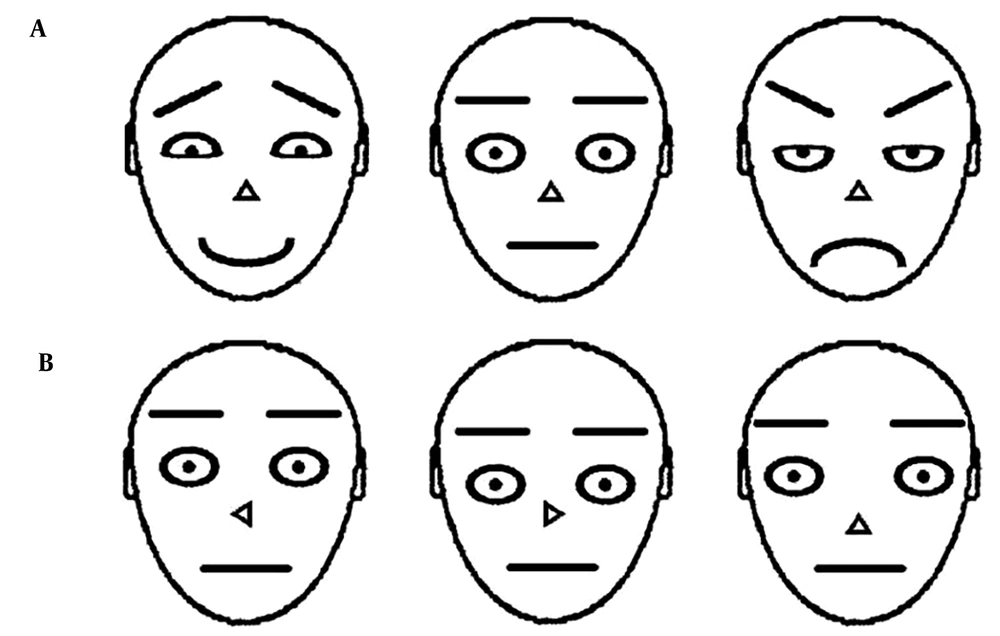
Figure 1.
(A) Schematic stimuli of happy, neutral, and angry faces. (B) samples of generated neutral faces used in high load conditions. Note: Pictures demonstrated in 1a are produced to use as schematic facial emotional stimuli in psychological experiments (35).
2.1.3. Procedure
The experiment was conducted online through https://pavlovia.org. The participants had to perform the task on their personal computers. They received all instructions in the form of a written description at the beginning of the experiment. Instructions were also sent to them via WhatsApp through voice messages. Informed consent was obtained before participation.
There was a total of eight conditions (2 perceptual loads × 4 cueing levels) in experiment 1. In a two-way repeated measures design, all participants were exposed to all conditions in a counterbalanced manner. They were instructed to remove any distractions (e.g., cell phones, open windows, etc.) from their environment, keep their head and neck at a distance of approximately 60 cm from the screen, and wear eyeglasses to see better if needed. The participants then performed 12 training trials. In each trial, they were required to discriminate the emotions of the target faces among six schematic faces in the midline array. One expression of anger or happiness was among the faces, while the other five were neutral. The emotional stimulus was placed in one of six possible locations randomly. Additionally, in each trial, a distractor stimulus (angry or neutral) appeared randomly at the top or bottom of the array. The participants were asked to ignore that. If they answered incorrectly during training trials, a written message appeared on the display that stated, "You answered incorrectly." Because the independent variables were under control in the training part, the perceptual load of the task was low, the distractors were neutral, and no spatial cueing was displayed. The perceptual load could be low or high in the main task conditions. In addition, besides the state of absent cueing, spatial cueing could also take the form of valid, invalid, and ambiguous cues. During spatial cueing, a red asterisk flashed at the top or bottom of the midline array 300 ms after the fixation cross disappeared (150 ms before the display). Cues might indicate the correct direction of the distractor (the distractor was positioned on it after appearing; valid cueing), indicate the opposite direction (invalid cueing), or unpredictably indicate the correct direction of the distractor (opposite direction in half of the trials; ambiguous cueing). The spatial cueing was block-wise. The described states of cueing, along with the state in which there were no cues, in interaction with the two conditions of perceptual load, constituted eight blocks of this experiment (384 trials: 48 trials per block; 2 distractor emotions × 2 target emotions × 2 distractor locations × 6 target locations). The trials were completed in a single session lasting approximately 40 min. Responses were made with the left arrow (for angry targets) and right arrow (for happy targets) keys on the keyboard. No feedback was provided for incorrect responses. Each trial began with a fixation cross (500 milliseconds). Also, 450 ms following its disappearance, a display containing the target, non-targets, and a distractor appeared. The display remained until a response was received (prolonged reactions were removed in data preparation). A schematic illustration of a single trial of the task in experiment 1 is indicated in Figure 2.
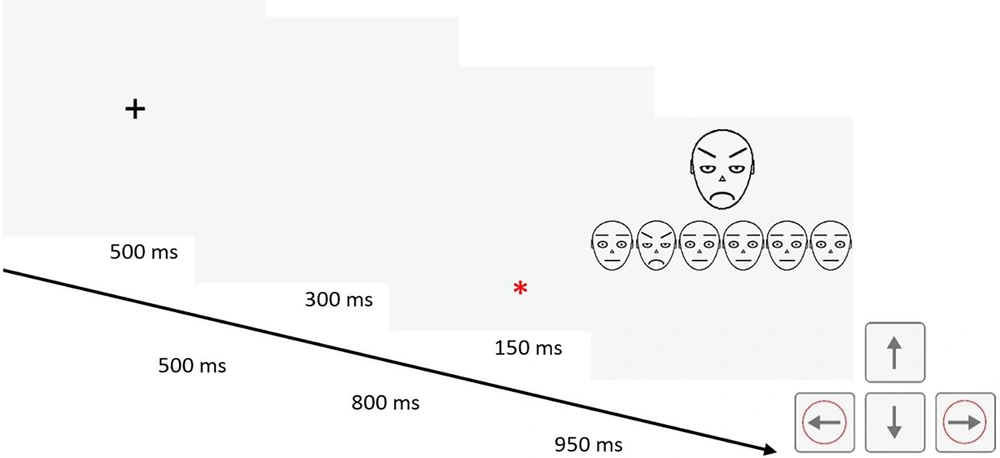
Figure 2.
Schematic illustration of a single trial of the task. Each trial began with a fixation cross (500 ms) and continued with a stimulus. The stimulus remains to be responded to. Note: Figures not drawn to scale.
Angry and neutral distractors were used to calculate the distraction effect. To compute the distraction effect, the mean RTs in trials with emotional distractors were subtracted from those in trials with neutral. No matter what the target stimulus is (e.g., positive/negative, compatible/incompatible), this method can be applied (39). Only the RTs for trials with different distractors were subtracted regardless of the kind of target. To account for perceptual load, mean RTs in trials with either a positive or negative target with an angry distractor were subtracted from the mean RTs in trials with a neutral distractor. The distraction effect indicated how distractor stimuli facilitated or conflicted with the response to target stimuli.
2.2. Results
2.2.1. Stimuli Valence and Arousal Check
Twelve participants aged 19 to 31 years (five female; age M = 24.66; age SD = 3.42) rated nine pictures (three schematic faces from Kolassa et al. (35), three real-male faces, and three real-female faces from FACES) in terms of valence and arousal using the self-assessment manikin (SAM; (40)). Pictures selected from the FACES database (36) were displayed with a gray filter to reduce the effects of racial differences in skin color. The mean rating of each class of stimuli for both valence and arousal was compared using within-subjects ANOVA (Table 1). Comparing the means revealed no significant differences in valence or arousal between the three stimulus classes. Considering these differences between databases, due to the possibility of having more control over schematic faces and their independence from gender and culture, the emotional face database developed by Kolassa et al. was used (35).
| Emotion | Schematic (35) | Faces-male (36) | Faces-female (36) | Statistical Indices | |||
|---|---|---|---|---|---|---|---|
| F | α | df | ηp2 | ||||
| Happy | |||||||
| Valence | 7.16 ± 0.93 | 7.41 ± 0.99 | 7.33 ± 0.88 | 0.15 | 0.85 | 2 | 0.03 |
| Arousal | 3.08 ± 0.79 | 2.83 ± 0.71 | 2.91 ± 0.51 | 0.82 | 0.46 | 2 | 0.14 |
| Neutral | |||||||
| Valence | 4.66 ± 0.65 | 4.75 ± 0.62 | 4.83 ± 0.57 | 0.14 | 0.86 | 2 | 0.02 |
| Arousal | 2.33 ± 0.77 | 2.16 ± 0.57 | 2.25 ± 0.75 | 0.19 | 0.82 | 2 | 0.03 |
| Angry | |||||||
| Valence | 2.58 ± 1.31 | 2.33 ± 0.88 | 2.41 ± 0.51 | 0.12 | 0.88 | 2 | 0.02 |
| Arousal | 5.33 ± 1.23 | 5.58 ± 1.08 | 5.75 ± 0.86 | 1.29 | 0.31 | 2 | 0.20 |
aValues are expressed as Mean ± SD.
b P < 0.05
Since this study used the neutral stimulus provided by Kolassa et al. (35) to generate other neutral stimuli, the degree of valence and arousal of each generated stimulus was compared with the main neutral stimulus. Initially, ten neutral stimuli were generated by altering the eyes, eyebrows, and nose locations. The participants rated stimuli based on valence and arousal. Stimuli that differed from the main stimulus in valence or arousal were excluded. Finally, the five stimuli with the least difference from the main stimulus (F = 2.06; df = 5; α = 0.08; ηp2 = 0.15) were used as neutral stimuli.
2.2.2. Load Manipulation Check
A pilot study was conducted to ensure that the designed flanker with the schematic stimuli could produce a perceptual load effect. The same 12 participants performed the flanker task in high and low perceptual load conditions. To compare the means, the distraction effect was computed. Further analyses also used the same index.
Attentional capture (distraction effect) was measured in low and high perceptual load conditions. The paired-sample t-test resulted in a significant reduction of distraction effect in the presence of the angry distractor in the condition of high perceptual load (t = 4.30; df = 11; P = 0.001; Figure 3). Accordingly, the perceptual load effect was observed in the designed task.
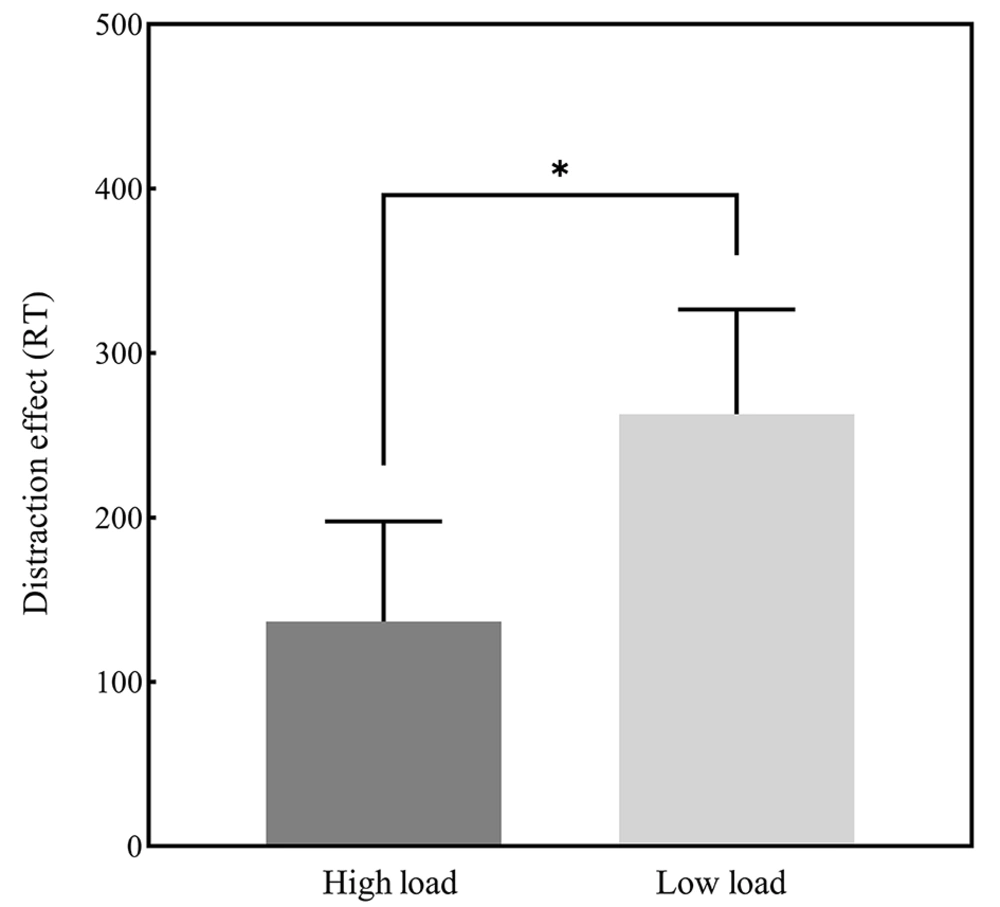
Figure 3.
Comparison of the distraction effects under low and high perceptual loads. * P < 0.05
2.2.3. Descriptive Characteristics
Table 2 summarizes the demographic and descriptive characteristics of the sample.
Table 2.
Socio-demographic Profile and Descriptive Characteristics of Samples
| Variables | n = 41 | Mean ± SD | Percentage |
|---|---|---|---|
| Gender | |||
| Male | 19 | 46.34 | |
| Female | 22 | 53.66 | |
| Age | 25.98 ± 4.48 | ||
| Handedness | |||
| Right | 38 | 92.68 | |
| left | 3 | 7.32 | |
| Handedness | |||
| Normal | 28 | 68.29 | |
| Corrected | 13 | 31.71 | |
| Family SES a | |||
| Low | 8 | 19.51 | |
| Middle | 28 | 68.29 | |
| High | 5 | 12.2 | |
| Educational level | |||
| Bachelor's degree | 22 | 53.66 | |
| Master's degree | 13 | 31.71 | |
| Ph.D. or equivalent | 6 | 14.63 | |
| Conditions: Neutral (load × cueing) | |||
| Low × Valid | 902.22 ± 49.32 | ||
| Low × Invalid | 900.09 ± 49.84 | ||
| Low × Absent | 889.75 ± 41.66 | ||
| Low × Ambigues | 1099.26 ± 48.50 | ||
| High × Valid | 1208.38 ± 63.02 | ||
| High × Invalid | 1200.81 ± 60.99 | ||
| High × Absent | 1162.15 ± 55.48 | ||
| High × Ambigues | 1165.51 ± 68.32 | ||
| Conditions: Angry (load × cueing) | |||
| Low × Valid | 999.062 ± 44.17 | ||
| Low × Invalid | 1003.36 ± 43.37 | ||
| Low × Absent | 1091.40 ± 44.50 | ||
| Low × Ambigues | 1166.98 ± 44.40 | ||
| High × Valid | 1290.56 ± 69.86 | ||
| High × Invalid | 1292.76 ± 61.44 | ||
| High × Absent | 1301.36 ± 58.45 | ||
| High × Ambigues | 1227.53 ± 43.53 |
aSocioeconomic status
2.2.4. Data Preparation
Before computing the distraction effect on the main data, the outlier RTs were removed. To do so, the interquartile range was multiplied by 1.5 for higher outliers, added to the third quartile (= 1574 ms), and for lower outliers, subtracted from the first quartile (= 615 ms). Data above or below the higher and lower outliers, respectively, were excluded from the datasheet. Also, participants who responded to less than 80% of the trials correctly (even in one condition) were excluded. Descriptive analysis showed that only one participant's accuracy rate fell below 80%. For each of the eight blocks, the mean RTs in the trials with a negative distractor were subtracted from the mean RTs in the trials with a neutral distractor. The computed index was used as a basis for comparison between conditions.
2.2.5. Statistical Analyses
The distribution of data was checked using the Shapiro-Wilk test. It was found that normality was violated in no combination of data. Despite efforts to control the experiment through instructions, uncertain confounding factors probably affected the results since the task was performed outside the laboratory setting. Other factors (i.e., computer screen size and handedness) were measured and included in the statistical analysis as covariates.
Two-way repeated-measures ANCOVA was used to analyze the data. The effect of perceptual load and spatial cueing (2 × 4) on the distraction effect was examined. Following adjustment for covariates, it was found that the distraction effect was generally lower in the high perceptual load condition than in the low perceptual load condition (P < 0.00; SE = 1.73). Additionally, the results of cueing level comparisons within perceptual load conditions (adjusted by Bonferroni correction) showed that ambiguous cueing was associated with lower distraction effects in both perceptual load conditions (Table 3).
Table 3.
Pairwise Comparisons of Cueing Conditions Within Perceptual Load Conditions
| Cueing i | Cueing j | MD ± SE | Sig |
|---|---|---|---|
| Perceptual Load: Low | |||
| Valid | Invalid | -6.43 ± 3.04 | 0.96 |
| Valid | Absent | -104.82 ± 2.89 | 0.00 a |
| Valid | Ambiguous | 29.11 ± 3.05 | 0.00 a |
| Invalid | Absent | -98.38 ± 2.79 | 0.00 a |
| Invalid | Ambiguous | 35.55 ± 3.02 | 0.00 a |
| Absent | Ambiguous | 133.93 ± 2.93 | 0.00 a |
| Perceptual Load: High | |||
| Valid | Invalid | -9.76 ± 4.01 | 0.42 |
| Valid | Absent | -57.02 ± 3.91 | 0.00 a |
| Valid | Ambiguous | 20.16 ± 3.96 | 0.00 a |
| Invalid | Absent | -47.25 ± 3.68 | 0.00 a |
| Invalid | Ambiguous | 29.92 ± 3.73 | 0.00 a |
| Absent | Ambiguous | 77.18 ± 3.54 | 0.00 a |
Abbreviations: MD, mean difference; SE, standard deviation.
a P < 0.001
The interaction between perceptual load and spatial cueing was also significant (Wilks' λ = 0.83; F (3, 981) = 66.66; p < 0.00; η2 = 0.16), indicating that the observed differences were not independent of each other. Pairwise comparisons of the interaction effect of the factors revealed that the distraction effect in the low perceptual load condition was higher than that in the high perceptual load condition at all cueing levels, except ambiguity (Figure 4).
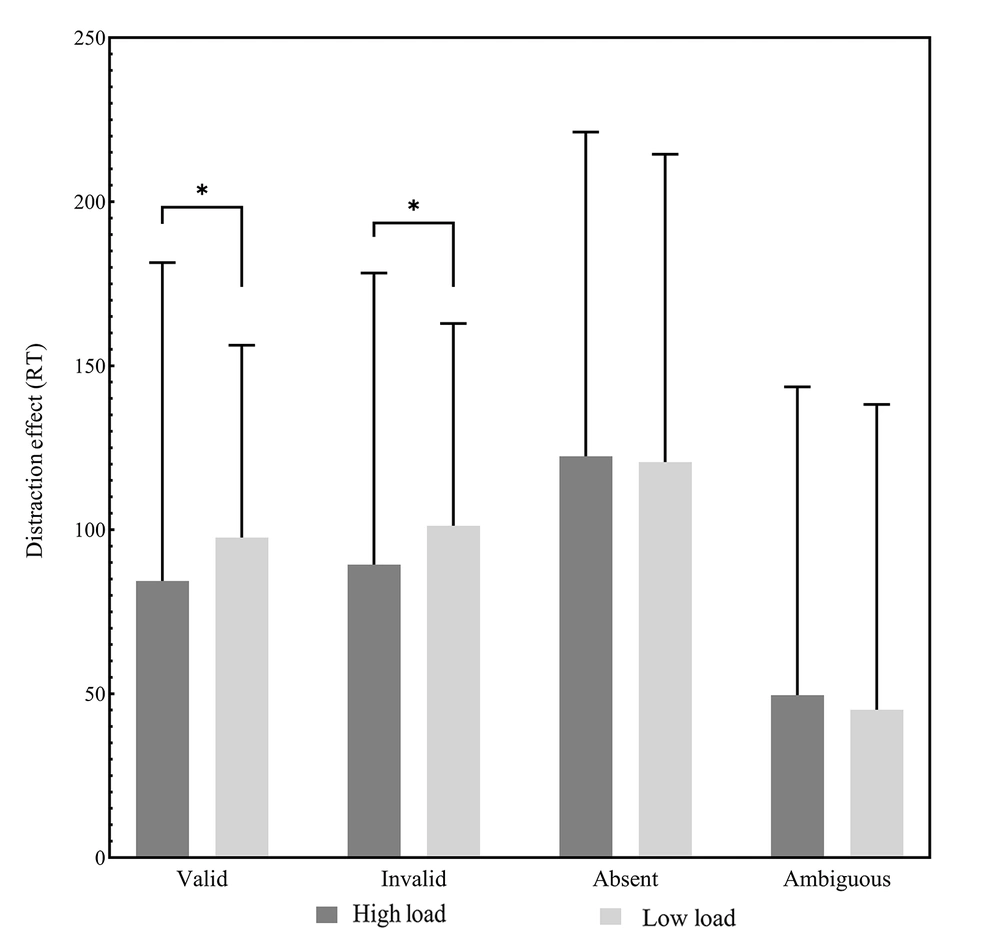
Figure 4.
Pairwise comparisons of distraction effects in each condition of spatial cueing between perceptual load conditions. *P < 0.05; **P < 0.01
2.3. Discussion
The effect of perceptual load and spatial cueing on the distraction effect of anger was examined in this experiment. The perceptual load was manipulated using the similarity between target and non-target stimuli. According to perceptual load theory, distraction decreases with increasing perceptual load (4). Consistently, here, it was found that the distraction effect was lower in the high perceptual load condition. This finding supports the perceptual load theory. Valid and invalid cueing were not significantly different within each of the two perceptual load conditions. Accordingly, if the cueing is always valid or invalid, it presumably leads to getting informed about the distractor's location. This explanation is plausible when evidence shows that the distraction effect is higher in the absent cueing level. In the case of ambiguity, the distraction effect is significantly reduced. A possible explanation for this finding can be that ambiguity in cueing makes it challenging to avoid distractor stimuli (despite their emotion) and reduces the difference between engagement to angry and neutral distractor stimuli. According to this experiment, the perceptual load can reduce distraction without ambiguous cueing (valid, invalid, and absent cueing). However, it appears that the perceptual load cannot reduce distractor processing on the ambiguity.
3. Experiment 2
It is less likely in real life to find homogeneity between the target and distractors. The second experiment was designed to bring the laboratory conditions as closely as possible to the real-life experience. Here, the target stimuli and the distractor were of different kinds.
3.1. Methods
3.1.1. Participants
The participants were the same as in experiment 1 (n = 41; 19 males; age M = 25.98; age SD = 4.48). Since both experiments were performed immediately in a row, the number of participants did not change. The same participants were excluded for the same reasons.
3.1.2. Apparatus and materials
The apparatus and materials in this experiment were similar to those in experiment 1, except that letters were (41) used instead of schematic faces for target and non-targets.
3.1.3. Procedure
The instructions, task characteristics, and other aspects of this experiment were similar to experiment 1, except that the targets were "x" and "z." The participants were asked to press the left arrow key if they saw "z" and the right arrow key if they saw "x." The non-targets included five "o" s at the low perceptual load and "s," "n," "m," "k," and "v" at a high perceptual load. As a means of controlling distracting factors and keeping the conditions constant, the distractor stimuli used in the current experiment were the same ones from the previous experiment.
3.2. Results
Since this task has been used in other studies (41), no manipulation check was performed. The data were prepared in the same manner as in experiment 1, and only scores greater than or equal to 629 ms and less than or equal to 1 593 ms were considered. The analysis methods were the same as in the first experiment (two-way repeated-measures ANCOVA). Since the same sample as experiment 1 was used in this experiment, the demographic characteristics were the same, as shown in Table 2. The descriptive characteristics of the sample in this experiment are presented in Table 4.
Table 4.
Descriptive Characteristics of Samples
| Variables | Mean ± SD |
|---|---|
| Conditions: Neutral (load × cueing) | |
| Low × Valid | 950.34 ± 44.18 |
| Low × Invalid | 946.14 ± 45.24 |
| Low × Absent | 988.19 ± 64.30 |
| Low × Ambigues | 1055.38 ± 62.95 |
| High × Valid | 1206.77 ± 68.35 |
| High × Invalid | 1202.01 ± 59.29 |
| High × Absent | 1178.39 ± 68.98 |
| High × Ambigues | 1201.59 ± 68.74 |
| Conditions: Angry (load × cueing) | |
| Low × Valid | 1047.95 ± 39.61 |
| Low × Invalid | 1047.34 ± 40.72 |
| Low × Absent | 1108.82 ± 64.96 |
| Low × Ambigues | 1100.48 ± 66.31 |
| High × Valid | 1291.16 ± 70.61 |
| High × Invalid | 1291.37 ± 69.22 |
| High × Absent | 1300.75 ± 69.75 |
| High × Ambigues | 1251.12 ± 65.04 |
According to the analysis of the interaction between perceptual load and spatial cueing, the effect of these factors on distraction effect cannot be independent (Wilks' λ = 0.98; F (3, 981) = 5.14; P = 0.002; η2 = 0.02). Comparing the distraction effect between perceptual load conditions, it was found that distraction was reduced under high perceptual load condition (F (1, 983) = 5.50; P = 0.02; η2 = 0.01). Within the low perceptual load condition, pairwise comparisons showed no significant difference between valid and invalid cueing (P = 0.99; SE = 2.73). Compared with absent cueing, valid cueing was different and smaller (P < 0.00; SE = 3.52). Valid cueing was different from and greater than ambiguous cueing (P < 0.00; SE = 3.52). The invalid cueing was different and smaller than absent cueing (P < 0.00; SE = 3.58) and greater than ambiguous cueing (P < 0.00; SE = 3.47). Ambiguous cueing was also different from and smaller than absent cueing (P < 0.00; SE = 4.07). As with the condition of low perceptual load, there was no significant difference between valid and invalid cueing in terms of distraction effect in the high perceptual load condition (P = 0.99; SE = 4.03). Valid cueing differed from absent cueing (P < 0.00; SE = 4.37); valid cueing differed from ambiguous cueing (P < 0.00; SE = 4.41); invalid cueing differed from absent cueing (P < 0.00; SE = 4.15) and ambiguous cueing (P < 0.00; SE = 4.13); and absent cueing differed from ambiguous cueing (P < 0.00; SE = 4.25). A comparison of the distraction effect at each level of spatial cueing under low perceptual load with its corresponding under high perceptual load is demonstrated in Figure 5. Accordingly, there is a significant difference in valid cueing between conditions of low and high perceptual load (P = 0.01; SE = 3.62). A similar difference was also observed in invalid cueing (P = 0.02; SE = 3.49). However, there was no difference between the two conditions in absent cueing level (P = 0.99; SE = 4.19) and ambiguous cueing (P = 0.99; SE = 4.30).
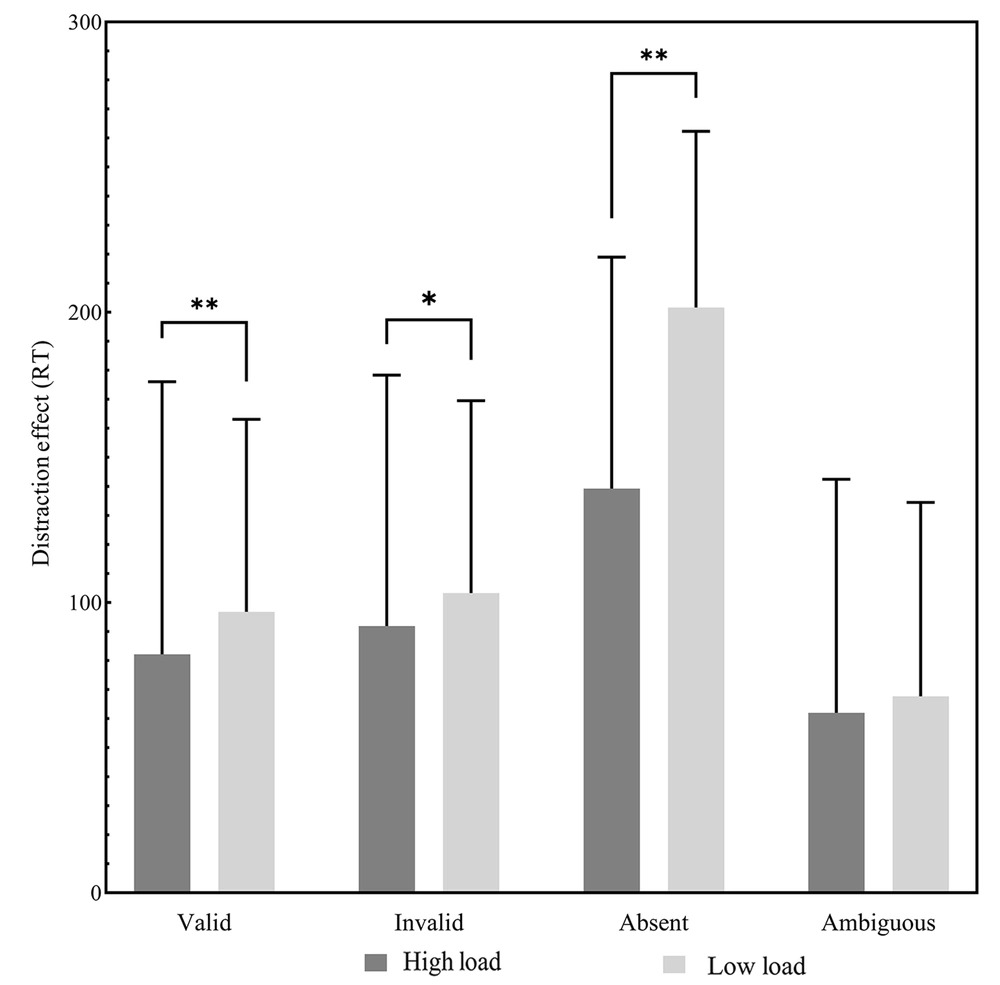
Figure 5.
Pairwise comparisons of distraction effects at each condition of spatial cueing between perceptual load conditions. * P < 0.05
3.3. Discussion
Since there is less likelihood of homogeneity between the target and distractors in everyday life, the target and the distractor stimuli were heterogeneous in this experiment. In the same way as the previous experiment, this experiment also showed a lower distraction effect under the high perceptual load. Similar results were obtained from the pairwise comparisons of distraction effects at different levels of cueing between perceptual load conditions, except that here, at the absent cueing level, the difference between low and high perceptual loads was insignificant. Contrary to previous findings (42), in this very current finding, it seems that the perceptual load effect is eliminated when the target and distractor are heterogeneous. As an interesting finding, under the heterogeneity of the target and distractor, it seems that the emotional salience of the distractor takes precedence. This finding shows that with increasing heterogeneity between the target and the environmental goal-irrelevant stimuli, as in everyday life, neither perceptual load nor its alternative explanation (i.e., perceptual dilution; (43)) can explain attentional control. This reminds us that it is necessary to question the perceptual load theory in everyday life experiences more seriously.
4. General Discussion
Through two experiments, we examined the effect of the predictability of spatial cueing at low and high perceptual load conditions on the capture of attention by threatening social distractors. The two experiments had similar designs, except that there was no homogeneity between the target and distractor in the second one. It was assumed that objects in the field of attention are less likely to be of the same kind in real-life situations. The second experiment was designed to get closer to the setting of real life.
The results showed that in line with the perceptual load theory (4, 44), the attentional capture decreases under high perceptual load when an angry face distractor is presented. Nevertheless, the main effect of perceptual load on attention control was observed when the distractor's location was predictable (valid or invalid). According to the attentional model of associative learning (45), the effectiveness of a cue is not merely determined by its intrinsic salience (e.g., magnitude, intensity, color, etc.), but learning also affects that. Because of experiencing the association between cues and outcomes, organisms learn to pay more attention to some cues than others. Here, since the cues were constantly associated with either the correct or incorrect location of the distractor in half of the experiment blocks, the participants probably had learned not to pay attention to the distractor. Valid target cueing has previously been shown to reduce distractor interference (46, 47). This study showed that whether 100% valid or 100% invalid distractor cueing can be associated with reduced distractor processing. However, when cueing misleads individuals (ambiguous cueing), there will be no difference in attentional capture at low and high perceptual loads. It means that although the distraction effect is reduced in ambiguous cueing, this reduction occurs for both low and high perceptual load conditions. The unpredictability of the distractor's location seems to lead to a kind of spatial salience. This could be an interesting finding because, even when attentional capacity is occupied (assuming a successful manipulation of perceptual load as seen in the no-cue condition), spatial salience can be associated with a change in the selection process. It also seems that in such a situation, the effect of the emotional salience of the distractor stimulus is overshadowed. This is because, in this situation, the difference between reaction times to targets with neutral and angry distractors decreases in both conditions with low and high perceptual load. The lack of difference in attentional capture in ambiguity highlights the importance of the predictability of cues in interaction with the perceptual load (11, 25). Therefore, it is expected that increasing the perceptual load when spatial cues are unpredictable will not significantly lead to control over attention. Due to this, the unpredictability of spatial cueing appears to take precedence over the perceptual load and emotional characteristics of the distractor. Without spatial cueing, the perceptual load can be expected to determine distractor processing if the display is homogeneous. However, there is no difference between low and high perceptual loads if the display is heterogeneous. This contradicts the claim made by Lavie (4). Considering that this experiment was designed to account for the heterogeneity among real-life environmental stimuli, this finding suggests that caution must be exercised when generalizing the effect of perceptual load in real-life situations. However, current studies do support the use of perceptual load in real-life cases such as psychopathology such as schizophrenia (14) and autism (48), pain perception (49), traffic behavior (50), eating behavior (51), addictive behavior (52), eyewitness testimony (53), and consumer behavior (54).
The present study's findings are partly consistent with previous evidence indicating that spatial cueing may not always reduce the effect of perceptual load (22, 24) and partly consistent with other evidence suggesting that spatial cueing can reduce the effect of perceptual load (19, 20). The predictability of the cue is a critical factor in determining its impact on perceptual load. When the cue provides certainty about the location of the distractor stimulus, it is likely to reduce distractor processing and maintain the effect of perceptual load through learning. Conversely, if the cue confuses the location of the distractor stimulus, it will be associated with a reduction in the effect of perceptual load. It can be concluded that alongside the heterogeneity and unpredictability of the environment, predictable exogenous cues contribute more to distractor prevention than either perceptual load or emotional salience of the distractor. Thus, they help to increase attentional control by indicating the location of the distraction, whereas if they are ambiguous, they lead to decreased attentional control.
Studies have shown that presenting low and high-load trials together in a single block rather than in separate blocks reduces the perceptual load effect itself (55, 56). Moreover, Benoni and Tsal (43) suggest that merely increasing the display set size and not the perceptual load reduces distractor processing-perceptual dilution. Also, the number of locations where the distractor appears may influence the perceptual load effect (57). These are several challenges that the perceptual load theory faces. Some believe that perceptual load, the core concept of load theory, is an ill-defined term, causing circularity in the description, manipulation, and reasoning about load (10). In general, we argue that perceptual load, as also mentioned by Chen and Cave (25), should be considered only as one of the factors involved in distractor processing.
The main limitation of this study was its reliance on online experimentation. Although online data collection can facilitate sample access, especially in special situations such as pandemics, it also leads to limitations. Conducting experiments in controlled laboratory settings is associated with the possibility of having more control over variables and increasing internal validity. In this way, in the current study, controlling the factors related to the participant's immediate context (such as physical and social environment and personal status) was impossible. However, an effort was made to prevent the occurrence of bias in the data as much as possible by providing detailed instructions regarding the demands of the experiments and controlling the effects of some variable factors, such as the size of the screen. The present study does not clarify whether, if trials with different perceptual loads are placed in a single block, the effects observed as consequences of predictable and unpredictable cueing will still occur. Additionally, it is unclear at what stage the association between completely valid or invalid spatial cueing and the distractor's location is learned. More research might be required in this area. It is also recommended that similar experiments be performed on non-social threatening stimuli or other characteristics related to stimulus salience (e.g., pain, luminance, etc.). Another potential suggestion for future research could be to investigate the role of spatial cueing in conjunction with perceptual load and the emotional salience of the distractor in real-life settings. Further experiments are needed to study the controlling effects of perceptual load in these sorts of situations.