
1. Background
Cloninger proposed his biosocial model of personality based on neurobiological and psychological findings and how the brain and environment interact to impact behavioral and affective responses in humans (1, 2). This model was investigated in many lines of research, such as individual differences (3), heritability (4), genetics (5), personality, and association with psychological disorders (6). According to the proposed model, personality traits are determined based on 4 temperaments, including novelty seeking (NS), harm avoidance (HA), reward dependence (RD), and persistence (PS), and 3 characters, self-directedness (SD), cooperativeness (C), and self-transcendence (ST). Temperament is often referred to as the emotional responses provoked automatically and remains moderately heritable and stable over time. On the contrary, character, as a self-concept, is generally regarded as the values and differences individuals hold in their lives. Temperament traits are preconscious or unconscious, and character facets are conscious and ego-syntonic (7). Recently, a study has demonstrated that human temperament can be strongly influenced by more than 700 genes that modulate associative conditioning by molecular processes for synaptic plasticity and long-term memory (8). In addition, some studies have evaluated the interaction between genetics and environmental structure and have shown strong correlations between temperament and character subscales in identical twins (9).
The central features of temperament dimensions and characters are elaborated by Cloninger as follows: NS is derived from the behavioral activation system and is regarded as an individual difference in the tendency to pursue rewards and avoid punishment; HA is related to the inhibition system and is the tendency to inhibit responses to aversive and dangerous stimuli; RD concerns the tendency to maintain behaviors related to others' approval and conditional rewards; PS indicates the perseverance and state of hard-working despite frustration and lack of reward; SD describes the capability of regulating and controlling one's behavior to achieve goals, as well as one's competency regarding autonomy and reliability; C is pertinent to social competence such as collaboration and tendency to accept others; finally, ST accounts for a tendency toward spirituality, idealism, and mysticism (7).
The Temperament and Character Inventory (TCI) was designed to assess the dimensions of both temperament and character. It includes 240 statements and 25 items presented in a yes-no format with psychometric features (1). The TCI first found its way to academic publications in 1993 to evaluate 7 dimensions of character and temperament. It was validated in samples that were indicatives of the US general community and those of several other countries (10, 11), yielding notable results similar to those of the original version (2). The four-dimensional temperament model was then developed to design the differentiation of typical personality disorder. For the diagnosis of personality disorders, subject scores (T scores) in the domains of SD and CO should be less than one-third. In this regard, extreme scores in each temperamental dimension were required to indicate a cluster of personality disorders to determine the type of personality disorder. In a study with high scores in novelty seeking and harm avoidance, the lower the scores in reward dependence and explosive temperament profile, the higher the paranoid ideation. According to the studies, TCI was characterized by good predictive validity for Axis II disorders of personality in DSM-III (12) and DSM-IV (13), but it failed to confirm the diagnosis of a personality disorder or its severity (14). In terms of normal personality, some studies remarked that the physical, social, and emotional aspects of well-being were independent of each other, but specific configurations of the TCI, such as SD, CO, and ST, differentially affect different aspects of well-being (15).
The Temperament and Character Inventory-Revised (TCI-R) was published to enhance the psychometric properties and increase the PS subscale to more than 1 subscale. TCI-R is characterized by a 5-point Likert scale format that, after validation, was translated into several languages (16-20), namely Sweden, German, French, Italian, Portuguese, Serbian, Norwegian, Turkish, Czech, and Croatian. The psychometric properties of the TCI-R were found to be satisfactory in all studies and were normalized on a large sample in Mexico (22) and Spain (23). A short form of TCI-R was presented, mainly because its original version was time-consuming. However, it is characterized by excellent psychometric properties and outperforms 11 other modern personality inventories in terms of predictions of behavioral acts, informant reports, and clinical indicators (24). The first 140 statements are used in the short form, known as TCI-140. Few studies have evaluated the psychometric properties of TCI-140 so far, and their findings have remained controversial. Despite the satisfactory psychometric properties of the TCI in the aforementioned studies, some controversies still exist. For example, a study in Spain reported the desirable validity and reliability of the TCI (25), while Farmer and Goldberg demonstrated that exploratory factor analysis (EFA) did not support temperament and character theory-based TCI-140 subscales; in other words, only 5 of the 29 subscales had low internal consistency (26). On the contrary, Zohar and Cloninger reported that the convergent and divergent validity, internal consistency of dimensions, and subscales were all satisfactory (27). These criteria have been recently evaluated in Italy, and the findings revealed that the reliability coefficients could be appropriate for some dimensions, yet they remained low in other dimensions, such as NS (27). Note that principal component analysis (PCA) could not explain all the facets based on the theoretical factors (28). Moreover, to the best of the author's knowledge, the Persian version of the TCI-R applied to an outpatient sample has not been studied yet, which highlights the necessity of conducting such research to address these shortcomings. Further, in line with recent advances in the psychopathology of personality disorders and the dimensional personality traits proposed in DSM-5 (29), assessment of the relationship between DSM-5 personality traits and temperament and character dimensions can illuminate new perspectives on the psychopathology of personality and the vast literature on the development and treatment of personality disorders. Additionally, the psychometric properties of TCI-140 have not yet been evaluated in Iran; as such, the assessment of the validity and reliability of this scale in Iran can provide clinicians and researchers with a scale that is unique in determining characters and temperament, according to Cloninger's theory.
2. Objectives
The overall objective of the current research was to assess the validity and reliability of the TCI-140 using a sample of Iranian psychiatric outpatients. The second objective was to determine the relationship of TCI-140 with the personality dimensions of DSM-5.
3. Methods
3.1. Participants
This was a cross-sectional study. The sample under study consisted of psychiatric outpatients who visited Roozbeh Psychiatric Hospital, Iran, in 9 months in 2021. A total of 471 participants (193 men, 278 women) were selected out of 531 patients at the mentioned hospital to fill out a demographic questionnaire and the research-related instruments. Purposive sampling was performed on volunteers. The inclusion criteria were outpatients diagnosed with a primary psychiatric disorder based on DSM-5 criteria who had undergone clinical interviews conducted by psychiatrists at Roozbeh Hospital. Participants who provided informed consent and were willing to take part in the research were selected. Exclusion criteria were having less than 8 years of schooling, a neurological disorder, an organic mental disorder, an acute psychotic disorder, intellectual disabilities, low comprehension skills, or leaving the questionnaires incomplete. These criteria were used to ensure that the participants could understand and respond to the questionnaires and that their primary diagnosis was not influenced by other underlying conditions.
3.2. Translation Process of TCI-140
Numerous steps were taken to translate TCI-140 into Persian. Initially, the TCI-140 was translated into Persian by a bilingual expert with a Ph.D. in psychology. Then, the Persian translation was back-translated to English by an independent translator, and the result was compared with the original version by the third author for further verification and possible corrections. In a pilot study, the translated version of TCI-140 was filled out by 150 participants to determine its understandability, fluency, and explicitness.
3.3. Measures
3.3.1. Structured Clinical Interview for DSM-5-Research Version
The Structured Clinical Interview for DSM-5-Research Version (SCID-5-RV) (30) is used as a semistructured and valid instrument for the assessment and diagnosis of major DSM-5 disorders. The reliability and validity of SCID-5 were confirmed by the SCID-5 workgroup. In the Persian version of the SCID-5-VR, the internal consistency, test-retest reliability, and Kappa reliability values among psychiatric patients were all in the acceptable ranges of 0.95 - 0.99, 0.60 - 0.79, and 0.57 - 0.72, respectively (31).
3.3.2. Revised Temperament and Character Inventory
The TCI-140 is employed as a self-report questionnaire to assess the dimensions of both character and temperament (32). The TCI-R yielded adequate psychometric properties in the original form and also in several versions in different countries. The present study aimed to assess the psychometric properties of a Persian version of TCI-R.
3.3.3. Personality Inventory for DSM-5
Krueger et al. first developed this self-report inventory to examine the abnormal personality characteristics according to the trait domain of the DSM-5 model, which has been used to diagnose the dimensions of personality disorders since then (33). The Personality Inventory for DSM-5 (PID-5) contains 220 items, which are scored using a 4-point Likert scale ranging from 0 to 3. It assesses 25 personality traits that represent 5 domains, including negative affect, detachment, antagonism, disinhibition, and psychosis. Krueger et al. reported adequate construct validity and Cronbach's alpha 25 traits ranging from 0.72 to 0.96 (33). As a result, the adequate reliability and validity of the Iranian version of the PID-5 were confirmed (34).
3.3.4. Beck's Depression Inventory
This self-report scale has been widely used to evaluate the severity of depression. Beck's Depression Inventory (BID-II) contains 21 items, and the score of each item ranges from 0 to 3. High scores show the highest severity of various depression aspects (physical, cognition, mood, or behavior) for each depression item. The total scores range from 0 to 63 (35). The internal consistency values of the BDI-II in both psychiatric and nonpsychiatric populations were 0.86 and 0.81, respectively (35). The Persian version of BDI-II has a high internal consistency of α = 0.87 and an acceptable test-retest reliability of r = 0.74 (36).
3.3.5. Satisfaction with Life Scale
The Satisfaction with Life Scale (SWLS) scale is a short self-report that contains 5 items designed to assess one's general judgment on life. It was reported to have acceptable internal consistency (0.87) and test-retest reliability (0.82) (37). The Persian version of SWLS yielded satisfactory construct validity and internal consistency (0.88) with other measures of anxiety and depression (38).
3.4. Procedure
The participants were selected from those who visited Roozbeh Hospital through purposive sampling. The patients underwent the primary psychiatric diagnosis that was made based on the DSM-5 diagnostic criteria via clinical interviews conducted by psychiatrists at Roozbeh Hospital. If they were eligible, they were informed of the study objectives and were allowed to ask their questions about the study. After they provided informed consent, they filled out the questionnaires. Note that the participants' anonymity was preserved.
3.5. Statistical Analysis
The statistical analyses were carried out in Statistical Package for Social Science (SPSS) v. 22. In this regard, the values of Cronbach's alpha, standard deviation (SD), and mean were measured for each dimension and subscale. In addition, independent t-tests were conducted to evaluate the sex differences in the TCI-140 dimensions and a one-way analysis of variance (ANOVA) was employed to assess the differences between age and TCI-140 dimensions. Then, Pearson correlation coefficients were examined to evaluate the correlation between TCI-140 dimensions and PID-5 traits. Moreover, interclass correlation was considered while evaluating the test-retest reliability of the TCI-140 two months after performing the primary sampling. Moreover, PCA with Promax rotation was employed to carry out the EFA. The factor structure was then calculated separately for both character and temperament, given the strong nonlinear interactions between temperament and character dimensions.
4. Results
4.1. Descriptive Findings
With regard to the TCI-140 validity items, 4 items with clear, correct answers (more than 1 wrong answer = invalid profile) and identical response strings (more than 15 consecutive strings = invalid profile) were selected. In total, 193 men (41%) and 278 women (59%) (N = 471) participated in the final analysis (the initial sample size in this study was 531). Here, 68%, 27%, and 5% of the participants belonged to the age groups of 18 - 35, 36 - 50, and 51 - 65 years, respectively. Moreover, 52.4%, 45.4%, and 2.2% of the participants were single, married, and divorced, respectively. The prevalence of all diagnoses is illustrated as follows: Major depressive disorder (N = 90, 19%), obsessive-compulsive disorder (N = 45, 9.5%), bipolar mood disorder (N = 80, 17.1%), major depressive disorder with generalized anxiety disorder (N = 34, 7.1%), adult attention deficit disorder (N = 24, 5.1%), major depressive disorder with obsessive-compulsive disorder (N = 22, 4.7%), schizoaffective disorder and schizophrenia (N = 22, 4.7%), generalized anxiety disorder (N = 19, 4%), adjustment disorder (N = 18, 3.8%), major depressive disorder with borderline personality disorder (N = 14, 3%), obsessive-compulsive disorder with generalized anxiety disorder (N = 10, 2.1%), narcissistic personality disorder (N = 8, 1.6%), major depressive disorder with dependent personality disorder (N = 8, 1.6%), substance abuse disorder (N = 7, 1.5%), borderline personality disorder (N = 6, 1.3%), sexual dysfunction (N = 6, 1.3%), anxiety disorder NOS (N = 6, 1.3%), generalized anxiety disorder with panic attack disorder (N = 5, 1%), adult attention deficit disorder with major depressive disorder (N = 5, 1%), panic attack disorder with agoraphobia (N = 5, 1%), obsessive-compulsive personality disorder (N = 5, 1%), adult attention deficit disorder with obsessive-compulsive disorder (N = 5, 1%), obsessive-compulsive disorder with panic attack disorder (N = 4, 0.8%), bipolar mood disorder with obsessive-compulsive disorder (N = 4, 0.8%), avoidant personality disorder (N = 3, 0.6%), and other diagnoses with the prevalence of fewer than 3 persons (N = 18, 4.5%).
Female participants obtained higher scores in harm avoidance (Mfemale 66.54; Mmales 64.14, t = -1.92, P < 0.05), reward dependence (Mfemale66.80; Mmales 63.84, t = -3.37, P < 0.05), and cooperativeness (Mfemale72.98; Mmales 70.14, t = -3.03, P < 0.05). With regards to age, novelty-seeking scores decreased with an increase in age (m = 57.43, f = 9.84, P < 0.01), while cooperativeness scores increased with an increase in age (m = 71.82, f = 9.40, P < 0.01).
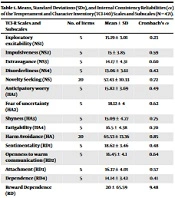
Table 1 lists the means and Cronbach's alpha coefficients of all the dimensions. The lowest and highest Cronbach's alpha coefficients were attributed to reward dependence (α = 0.67) and self-directedness (α = 0.89), respectively. The Cronbach's alpha coefficients were above 0.70 in all dimensions except for reward dependence, indicating a good internal consistency. However, most of the facets had an acceptable internal consistency, except for facets of CO3 (helpfulness) with Cronbach's alpha of 0.14 and NS1 (exploratory excitability) with Cronbach's alpha of 0.23, which had the lowest coefficients.
Table 1.
Means, Standard Deviations (SDs), and Internal Consistency Reliabilities (α) of the Temperament and Character Inventory (TCI-140) Scales and Subscales (N = 471)
| TCI-R Scales and Subscales | No. of Items | Mean ± SD | Cronbach's α |
|---|---|---|---|
| Exploratory excitability (NS1) | 5 | 15.19 ± 3.01 | 0.23 |
| Impulsiveness (NS2) | 5 | 15 ± 3.85 | 0.59 |
| Extravagance (NS3) | 5 | 14.17 ± 4.31 | 0.60 |
| Disorderliness (NS4) | 5 | 13.06 ± 3.61 | 0.42 |
| Novelty seeking (NS) | 20 | 57.43 ± 10.33 | 0.72 |
| Anticipatory worry (HA1) | 5 | 15.82 ± 3.69 | 0.49 |
| Fear of uncertainty (HA2) | 5 | 18.12 ± 4 | 0.62 |
| Shyness (HA3) | 5 | 15.09 ± 4.77 | 0.75 |
| Fatigability (HA4) | 5 | 16.5 ± 4.38 | 0.70 |
| Harm avoidance (HA) | 20 | 65.53 ± 13.36 | 0.85 |
| Sentimentality (RD1) | 5 | 18.62 ± 3.46 | 0.48 |
| Openness to warm communication (RD2) | 5 | 16.45 ± 4.1 | 0.64 |
| Attachment (RD3) | 5 | 16.37 ± 4.01 | 0.57 |
| Dependence (RD4) | 5 | 14.14 ± 3.42 | 0.41 |
| Reward dependence (RD) | 20 ± 65.59 | 9.48 | |
| Eagerness of effort (PS1) | 5 | 16.35 ± 3.88 | 0.64 |
| Work hardened (PS2 ) | 5 | 14.92 ± 4.12 | 0.61 |
| Ambitious (PS3) | 5 | 17.79 ± 3.46 | 0.56 |
| Perfectionist (PS4) | 5 | 16.31 ± 3.48 | 0.52 |
| Persistence (PS) | 20 | 65.39 ± 12.35 | 0.84 |
| Responsibility (SD1) | 5 | 14.29 ± 4.29 | 0.67 |
| Purposefulness (SD2) | 5 | 15.46 ± 4.81 | 0.76 |
| Resourcefulness (SD3) | 3 | 8.56 ± 2.98 | 0.64 |
| Self-acceptance (SD4) | 2 | 4.78 ± 2.32 | 0.67 |
| Enlightened second nature (SD5) | 5 | 12.80 ± 4.25 | 0.71 |
| Self-directedness (SD) | 20 | 55.89 ± 14.77 | 0.89 |
| Social acceptance (CO1) | 4 | 12.30 ± 3.27 | 0.55 |
| Empathy (CO2) | 4 | 14.37 ± 2.99 | 0.53 |
| Helpfulness (CO3) | 4 | 14.64 ± 2.17 | 0.14 |
| Compassion (CO4) | 4 | 14.5 ± 4.40 | 0.83 |
| Pure-hearted conscience (CO5) | 4 | 15.98 ± 2.92 | 0.42 |
| Cooperativeness (CO) | 20 | 71.84 ± 10.11 | 0.75 |
| Self-forgetful (ST1) | 6 | 18.17 ± 4.46 | 0.56 |
| Transpersonal identification (ST2) | 5 | 14.13 ± 4.31 | 0.70 |
| Spiritual acceptance (ST3) | 5 | 16.30 ± 4.68 | 0.70 |
| Self-transcendence (ST) | 16 | 48.42 ± 11.40 | 0.81 |
4.2. Factor Analysis
The main correlations (P < 0.01) among the TCI140 dimensions were as follows. The highest inverse correlations were observed between HA and SD (r = -0.58) and HA and PS (r = -0.57). Moreover, a relatively high positive correlation was detected between PS and ST (r = 0.50), and a moderate inverse correlation was detected between NS and SD (r = -0.41) and between NS and CO (r = -0.31). Besides, there was a moderate positive correlation between SD and CO (r = 0.40) and between PS and SD (r = 0.38).
Exploratory factor analysis was used for temperament and character facets separately. Before conducting the EFA, Bartlett's sphericity and Kaiser-Meyer-Olkin (KMO) tests were performed to examine the adequacy of the sample size and determine whether it was suitable for conducting the EFA. The results of Bartlett's sphericity test (chi-square = 4533.52; Df = 41; P < 0.001) and KMO (0.87) demonstrated suitability for examining EFA. Table 2 presents the EFA results based on Kaiser normalization and Promax rotation for temperament. Four factors were obtained and then used for temperament in our EFA. These factors comprised 29.4%, 14.5%, 10%, and 8.7% of the variance of the cumulative variance (62.8%), respectively. All dimensions (novelty seeking, harm avoidance, reward dependence, and persistence) had robust values, and all the facets were loaded according to the theoretical expectation except for RD1 (sentimentality) and RD4 (dependence). The inverse correlations of some facets with other factors implied the excellent independence of the facets and robust values.
Table 2.
Results of Principal Component Analysis of Temperament Subscales (Promax Rotation, Including Factors with Eigenvalues > 1, N = 471) a
| Temperament Subscales | Factor 1 | Factor 2 | Factor 3 | Factor 4 |
|---|---|---|---|---|
| NS1 | 0.21 | 0.03 | 0.72 | 0.02 |
| NS2 | -0.13 | 0.39 | 0.71 | 0.21 |
| NS3 | -0.57 | -0.00 | 0.62 | 0.31 |
| NS4 | -0.55 | -0.06 | 0.70 | 0.03 |
| HA1 | -0.46 | 0.75 | 0.15 | -0.22 |
| HA2 | -0.30 | 0.79 | -0.11 | -0.09 |
| HA3 | -0.47 | 0.66 | -0.06 | -0.49 |
| HA4 | -0.65 | 0.69 | 0.01 | -0.22 |
| RD1 | 0.23 | 0.49 | 0.32 | 0.30 |
| RD2 | 0.24 | -0.14 | 0.24 | 0.88 |
| RD3 | 0.10 | -0.06 | 0.08 | 0.84 |
| RD4 | -0.34 | 0.31 | -0.06 | 0.15 |
| PS1 | 0.82 | -0.26 | 0.01 | 0.24 |
| PS2 | 0.78 | -0.53 | -0.03 | 0.06 |
| PS3 | 0.81 | -0.24 | 0.12 | 0.21 |
| PS4 | 0.80 | -0.30 | -0.16 | 0.09 |
a Loadings with absolute values of 0.40 or more are shown in bold.
We identified 3 factors for character in our EFA. These factors comprised 28.5%, 16.4%, and 11.6% of the variance of cumulative variance (56.6%), respectively. Table 3 shows our EFA with Kaiser normalization and Promax rotation for character. All of the SD, CO, and ST facets were loaded on the factors according to theoretical expectation, except for empathy (CO2). Although CO facets were loaded on Factor 3 and ST facets on Factor 2, no restrictions on the number of extracted factors were found.
Table 3.
Results of Principal Component Analysis of Character Subscales (Promax Rotation, Including Factors with Eigenvalues > 1) a
| Character Subscales | Factor 1 | Factor 2 | Factor 3 |
|---|---|---|---|
| SD1 | 0.77 | -0.06 | 0.33 |
| SD2 | 0.81 | 0.33 | 0.30 |
| SD3 | 0.82 | 0.18 | 0.25 |
| SD4 | 0.67 | -0.07 | 0.13 |
| SD5 | 0.81 | 0.03 | 0.30 |
| CO1 | 0.42 | 0.08 | 0.57 |
| CO2 | 0.29 | 0.42 | 0.47 |
| CO3 | 0.10 | 0.07 | 0.67 |
| CO4 | 0.36 | 0.08 | 0.68 |
| CO5 | 0.12 | -0.05 | 0.69 |
| ST1 | -0.09 | 0.76 | -0.16 |
| ST2 | 0.13 | 0.87 | 0.04 |
| ST3 | 0.09 | 0.74 | 0.24 |
a Loadings with absolute values of 0.40 or more are shown in bold.
4.3. Test-retest Reliability with Interclass Correlation
Two months after the first completion of the measures, 40 participants who were willing to participate in the test-retest phase completed the TCI-140 again. Table 4 shows the interclass correlations. All dimensions of the TCI-140 exhibited high reliability and consistency. The lowest and highest reliability coefficients were attributed to novelty seeking (r = 0.71) and self-directedness (r = 0.90), respectively.
Table 4.
Test–retest Reliability with Interclass Correlation (N = 40) a
| TIME 1 (Mean & SD) | TIME 2 (Mean & SD) | Inter Class Correlation | |
|---|---|---|---|
| Novelty-seeking (NS) | 58.05 ± 11.64 | 58.94 ± 9.28 | 0.71 |
| Harm avoidance (HA) | 66.35 ± 14.36 | 61.70 ± 13.92 | 0.83 |
| Reward dependence (RD) | 66.32 ± 8.65 | 64.44 ± 9.25 | 0.79 |
| Persistence (PS) | 66.61 ± 12.42 | 67.71 ± 11.14 | 0.85 |
| Self-directedness (SD) | 55.41 ± 13.37 | 58.35 ± 13.49 | 0.90 |
| Cooperativeness (CO) | 70.70 ± 9.83 | 70.41 ± 9.49 | 0.74 |
| Self-transcendence (ST) | 48.14 ± 10.35 | 47.08 ± 1071 | 0.79 |
a Significant correlations at the 0.01 level are shown in bold.
4.4. Concurrent Validity of TCI-140
Table 5 lists the correlations among the TCI-140 dimensions and PID-5 traits, BDI, and SWLS. Moderate positive correlations can be observed for NS with antagonism (r = 0.40), disinhibition (r = 0.40), and psychoticism (r = 0.30). Here, HA had relatively high positive correlations with detachment (r = 0.55) and negative affect (r = 0.48). On the contrary, RD had a weak positive correlation with negative affect (r = 0.23), and PS indicated an inverse moderate correlation with detachment (r = -0.34). In addition, SD demonstrated relatively high inverse correlations with negative affect (r = -0.63), with detachment (r = -0.55), and moderate inverse correlations with psychoticism (r = -0.44), disinhibition (r = -0.42), and antagonism (r = -0.33). Moreover, CO showed an inverse moderate correlation with antagonism (r = -0.36), negative affect (r = -0.32), psychoticism (r = -0.30), disinhibition (r = -0.26), and detachment (r = -0.26). In addition, ST had a positive moderate correlation only with psychoticism (r = 0.29).
Table 5.
Correlation Between Temperament and Character Inventory (TCI-140) Dimensions and Personality Inventory for the DSM-5 (PID-5), Beck's Depression Inventory (BDI), and Satisfaction with Life Scale (SWLS) (N = 150) a
| Negative Affect | Detachment | Antagonism | Disinhibition | Psychoticism | BDI | SWLS | |
|---|---|---|---|---|---|---|---|
| NS | 0.22 | 0.01 | 0.40 | 0.40 | 0.30 | 0.09 | -0.10 |
| HA | 0.48 | 0.55 | 0.05 | 0.13 | 0.17 | 0.50 | -0.49 |
| RD | 0.23 | -0.18 | -0.19 | 0.13 | -0.03 | 0.03 | -0.04 |
| PS | -0.17 | -0.34 | 0.05 | -0.01 | 0.05 | -0.40 | 0.31 |
| SD | -0.63 | -0.55 | -0.33 | -0.42 | -0.44 | -0.57 | 0.53 |
| CO | -0.32 | -0.26 | -0.36 | -0.26 | -0.30 | -0.12 | 0.08 |
| ST | 0.00 | -0.19 | 0.20 | 0.18 | 0.29 | -0.32 | 0.36 |
a Significant correlations at the 0.01 level are shown in bold.
An inverse relatively high correlation between BDI and SD (r = -0.57), a positive relatively high correlation between BDI and HA (r = 0.50), and moderate inverse correlations for BDI with PS (r = -0.40) and ST (r = -0.32) confirmed that the descending SD score. The ascending HA score had a moderate correlation with depression severity.
A positive correlation for SWLS with SD (r = 0.53), an inverse moderate correlation for SWLS with HA (r = -0.49), and positive moderate correlations with SD (r = 0.36) and PS (r = 0.31) highlighted the increase in the SD score and a decrease in the HA score, with strong associations with life satisfaction.
5. Discussion
The current research assessed the validity of the TCI-140 in Iran for the first time. Our results can help extend the applications of this instrument to Iranians and support its valid and reliable use in this population.
5.1. Test-retest Reliability and Internal Consistency of TCI-140
According to the findings, the psychometric properties of the Persian version of TCI-140 were satisfactory. Although the participants were psychiatric outpatients who experienced some changes in their mood, affect, and even personality features over time with partial remission, all dimensions had a high and strong test-retest reliability. However, Vespa et al. reported lower test-retest reliability for TCI-140 in nonpsychiatric patients (28). Sufficient test-retest reliability was supported, denoting the constancy of the measure over time. In terms of internal consistency, all the dimensions were satisfactory (Cronbach's alpha coefficients above 0.70, except for reward dependence). Our analysis at the subscale level showed that NS1, NS4, RD4, CO3, and CO5 had a weak internal consistency, while the other subscales had a relatively high internal consistency. According to some researchers' observations, internal consistency is strongly reliant on the number of items within the scale (39). Cronbach's alpha varied from 0.77 (novelty seeking) in the Spanish validation study to 0.92 (harm avoidance and persistence) in the French validation study. The exception appeared in an Italian validation that demonstrated the lowest reliability for reward dependence. While the lowest Cronbach's alpha in this study was attributed to reward dependence (0.67) and novelty seeking (0.72), the highest Cronbach's alpha belonged to self-directedness (0.89) and persistence (0.84). The lowest reliability values were acquired for the scales of novelty seeking and reward dependence. These scales, particularly novelty seeking, decrease in case individuals suffer from depression or anxiety (7). Of course, the inclusion of subscales for the sake of persistence would significantly enhance the reliability of the studied scales, with no need for perversion in the overarching constructs.
The internal consistency in this study was higher than that of the study by Vespa et al. (28) yet lower than that reported by Zohar and Cloninger (27) and Farmer and Goldberg (26). In general, the dimensions and subscales of character were more reliable and credible compared to temperament in test-retest reliability and internal consistency. The low internal consistency of NS and even RD have been shown in almost all studies on the TCI-R. These dimensions, especially NS, are associated with mood states, anxiety, and depression (7). The findings pertinent to the relationship of age and sex with TCI dimensions were in line with the results from leading studies showing that higher scores were obtained by women in HA, RD, and CO. Note that with an increase in age, the scores on NS and CO decrease and increase, respectively (40), 41). In the sample of this study, the TCI-140 retained a sufficient margin of internal consistency.
5.2. Factor Analysis
Some studies referred to the lack of a one-to-one relationship between the configurations of temperament and character dimensions. Instead, there is broad equifinality (i.e., different temperament configurations being associated with the same character configuration) and multifinality (i.e., one temperament configuration being associated with different character configurations) (7). In this study, owing to the robust nonlinear interactions between temperament and character, separate PCAs were carried out for the subscales of these two personality domains.
The explained variances of temperament and character obtained through factor analysis were 62.8% and 56.6%, respectively. This result was similar to those of other studies that used the TCI-140. In Zohar and Cloninger's study (27), the explained variances of temperament and character were obtained as 60.5% and 57.9%, respectively, while they were 56.4% and 58.2%, respectively, in the study by Vespa et al. (28). Of note, the results of our EFA indicated that in the temperament dimensions, all the facets were loaded according to the theoretical expectation, except for the RD1 and RD4. To be specific, RD1 was loaded on HA; however, it is not yet clear whether these findings were due to the psychometric weakness of the inventory or were related to structural variations caused by cultural impacts. The items of RD1 include the motivation to please others, being more sensational than others, being sensitive to emotional requests, and crying at sad events (7). They are commonly observed among the mainstream within the Iranian culture, who maintain a stoic persona. For an Iranian, being openly sensitive and sentimental can be interpreted as a weakness. However, acceptance of emotional expressions in this culture is more likely to occur in some specific contexts laden with anxiety and negative emotionality, explaining why RD1 is loaded on HA rather than on RD.
Such scattered and often theoretically unexpected loadings have been mentioned in almost all studies on complicated psychological constructs such as personality, according to which, instead of being investigated in isolation, these loadings are generally studied in a context along with other indices of construct validity. It was expected that PS in this study was the most robust factor as it was characterized by the highest factor loadings, thus supporting the incorporation of 3 PS subscales into the TCI-R.
Our results were exactly in line with Zohar and Cloninger's study (27); however, RD4 was not loaded on any factors. Principal component analysis showed that SD, CO, and ST facets loaded according to the theoretical expectation. CO2 (empathy) had a loading on both CO and ST because empathy contributes to cooperative behavior and involves the capacity for introspection; to empathize, one must also be able to be mindful of one's self and participate in what is beyond one's self.
5.3. Concurrent Validity of TCI140
The dimensions of the TCI-140 correlated with most traits of the PID-5. In addition, SD and CO correlated with all PID-5 traits. As Svrakiv et al. (14) and de la Rie et al. (42) showed in their leading studies, low SD and CO scores at the same time are indicative of personality disorders. Other studies have shown that TCI was characterized by good predictive validity for Axis II disorders in both DSM-III and DSM-IV (6, 13). With regards to the good correlations of SD and CO with PID-5 traits, the TCI-140 in this study exhibited satisfactory concurrent validity for PID-5 traits and personality disorders according to the DSM-5, which can be further used to evaluate and diagnose psychopathological conditions.
A relatively high positive correlation between HA and BDI and a relatively high inverse correlation between SD and BDI indicated that depression symptoms were associated with high scores in HA and low scores in SD. Our findings were quite compatible with previous leading studies (43-45).
The results also showed that SWLS had moderate positive correlations with SD, ST, and PS and an inverse moderate association with HA. These findings were also reported in previous studies (18), confirming that well-being and life satisfaction would increase with an increase in the scores of character dimensions (SD and ST). Moreover, our findings about the positive role of PS in life satisfaction, growth, and character maturity were compatible with previous studies (7).
5.4. Study Limitations
One of the limitations of this study was that the participants were in different phases of psychiatric disorders; in other words, some patients were in the early stages of disorders while others were in the final stages. The small sample size, particularly among each type of disorder, also prevented further analysis. Although the psychometric properties of the TCI-140 were reported to be satisfactory in most studies, conducting further studies on different samples using other psychological instruments is still recommended.
5.5. Conclusions
According to the findings, TCI-140 is valid and reliable in the Iranian psychiatric outpatient sample. This is the first study that examined the relationship between PID-5 traits and TCI-140 dimensions, and the findings can pave the way for future research. Future studies can assess the psychometric properties of TCI-140 among patients with more homogenous psychiatric disorders, such as anxiety and mood disorders, examine psychotic patients separately, and evaluate the cut-off point of this scale.