
1. Background
According to the World Health Organization, adolescence encompasses the age range of 10 to 19 years, marking the transition from childhood to adulthood, characterized by significant physical, mental, and psychological growth and development (1). Currently, there are 1.3 billion adolescents worldwide, comprising 16% of the global population (2). This period is marked by identity formation, increasing autonomy and independence, and exposure to new environments and behaviors. Issues related to puberty and adolescents' efforts to achieve autonomy can lead to negative feelings and increased conflicts. Conflict is inevitable in family relationships (3). Therefore, the parent-child interaction evolves into a parent-adolescent interaction, influenced by the child's maturity and puberty, becoming critically important. Parent-adolescent interaction differs significantly from parent-child interaction due to the substantial differences between adolescence and childhood (4).
The communication skills of parents during adolescence are crucial. A lack of understanding can be observed in parent-teen relationships, necessitating appropriate measures to address it (5). Parents' inattention and lack of proper communication with their children can harm the mental and emotional environment, leading to emotional, motivational, and psychological problems. Poor communication can result in dangerous behaviors, including substance abuse (6). Given the many conflicts during puberty and the importance of correct communication skills, a positive perspective on these changes is essential for a healthy transition. Families should provide adolescents with information before puberty to prepare them for these changes (7). Parents should play a central role in educating their children and preparing them for adulthood. Programs should be designed to educate parents to foster effective relationships with teenagers (8, 9). The family is the most important source of puberty health information for teenagers, with the mother often being the first point of contact (10). Recognizing the parent-child relationship as one of the most basic and influential relationships underscores the importance of enriching and promoting it (11).
To apply communication skills with adolescents, an approach that considers the stages of adolescent growth and puberty, along with their mental and psychological changes, is needed. The interaction analysis approach offers a straightforward, understandable, and logical method for parents seeking more effective relationships based on mutual understanding (12). Eric Berne's interaction analysis theory includes four components: Structural analysis of ego states, reciprocal analysis to recognize ego states, game analysis through social solutions, and scenario analysis to reverse initial decisions and inappropriate actions. These interventions emphasize the active aspect of individuals, based on methods learned from parents in childhood (13).
Adolescents often struggle with effective communication. Exercises in this approach, such as altering behavioral patterns in mutual communication, can improve adolescents' communication, especially with parents (14). The interaction analysis approach is expected to increase distress tolerance, improve mothers' communication skills with their daughters, and foster empathy, mutual understanding, and emotional expression in an environment of self-acceptance, control of negative emotions, problem-solving, optimism, and complementary relationships.
2. Objectives
Given the importance of resolving parent-adolescent conflicts and teaching communication skills, and the positive role of the interaction analysis approach highlighted in various studies, preventive measures are needed to enhance parent-adolescent relationships. Intervention programs can effectively help families, parents, and teenagers foster relationships and reduce adjustment problems. Virtual education is an accessible method for community members to receive education with minimal time and cost. This study aimed to determine the effect of virtual communication skills training for mothers, using the interaction analysis approach, on girls' life satisfaction and parent-adolescent relationships.
3. Methods
3.1. Participants and Procedures
The present quasi-experimental study which was conducted in 2022 on 66 mothers with adolescent girls, aimed to determine the effect of virtual communication skills training for mothers, using an interaction analysis approach, on girls' life satisfaction and parent-adolescent relationships. This study was approved by the Ethics Committee of Shahid Sadoughi University of Medical Sciences in Yazd (IR.SSU.REC.1400.024). Initially, after the research proposal was approved (code No. 9937) and the necessary permits were obtained, the researcher visited the Haji Maqsoudi Comprehensive Health Service Center in Yazd. After providing the required explanations, coordination with the center's management was established to collect samples. Sample selection involved assistance from individuals whose household information was registered in the Integrated Health System. Based on this system, households with adolescent girls were identified, and mothers meeting the inclusion and exclusion criteria were contacted. Once 72 eligible participants were identified, the study's conditions and objectives were explained, and 36 participants were randomly assigned to the intervention group and 36 to the control group.
3.1.1. Inclusion Criteria
Iranian women with a daughter aged 12 to 14 years, registered at the Haji Maqsoudi Comprehensive Health Center in Yazd, with the daughter being the result of the current marriage, interest in participating in virtual training sessions, commitment to attending all sessions, basic literacy, internet access, and a mobile phone with an Android or iOS operating system, and familiarity with virtual messenger programs. Participants should not have previously participated in related training programs or life skills courses.
3.1.2. Exclusion Criteria
Simultaneous participation in other counseling programs, addiction and substance abuse as self-declared, and divorce were the exclusion criteria. The study's objectives and methodology were explained to participants, and informed, voluntary consent was obtained. Participants were assured they could withdraw from the study at any stage. The Demographic Information Questionnaire, Life Satisfaction Questionnaire, and Parent-Adolescent Relationship Questionnaire were completed by participants using Porsline (Persian online questionnaire software). At the end of the intervention, the questionnaires were administered again to participants in both groups. The follow-up period was one month, during which the questionnaires were administered once more.
3.2. Sampling
Sampling was conducted according to the inclusion and exclusion criteria. The target group consisted of women referred to the Haji Maghsoudi Comprehensive Health Center in Yazd, Iran. Potential participants were invited to join the study via phone if they met the inclusion and exclusion criteria and were informed of the study's objectives and conditions. The sample size was determined using G*Power statistical software based on an analysis of variance test with repeated measures. To achieve a significance level of 5% (α = 0.05), a power of 90% (β = 0.2), and an average effect size (d = 0.2) with three repetitions, a sample size of 56 participants (2 groups of 28) was calculated. To account for potential attrition, an additional 10% was included, resulting in 36 participants per group. A total of 92 mothers were contacted, and this process continued until the desired sample size (n = 72) was reached. Participants were then randomly assigned to either the intervention group (n = 36) or the control group (n = 36) using randomization software (Figure 1).
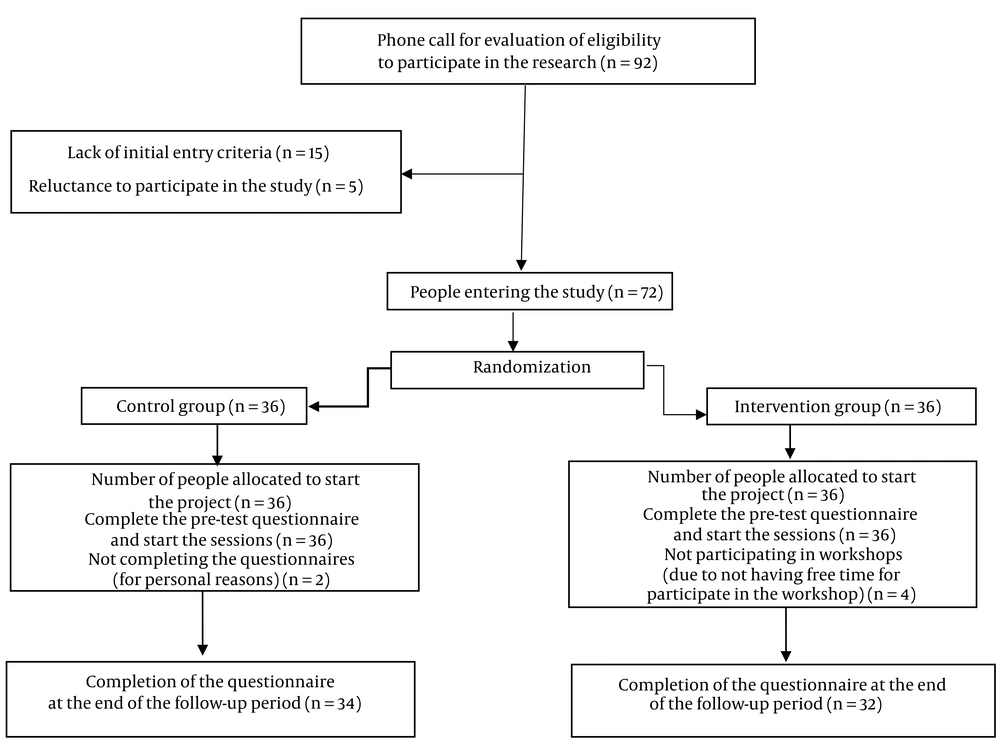
Figure 1.
Participants’ flow diagram
3.3. Interventions
Initially, an online meeting was conducted for the intervention group via Skyroom, where the study's methodology was explained. Participants in the intervention group received virtual training through an authorized messenger network, with one session per week for eight consecutive weeks. The training involved virtual communication skills packages using the interaction analysis approach, based on Eric Berne's theory. These packages were prepared in a multimedia format, including audio files, slide shows, and practical assignments. The educational content was delivered by a researcher pursuing a master's degree in midwifery counseling, who had obtained a certificate in interaction analysis counseling under the supervision of supervisors and psychologists. The content of the sessions is summarized in Table 1.
Table 1.
Practical Guidelines for Research in Collective Training Sessions for Interaction Analysis
| Session No. | Session Content |
|---|---|
| 1 | Acquaintance, introduction, statement of goals and group rules, and expression of gratitude to the members for their cooperation in the implementation of the pre-test. |
| 2 | Familiarization with the psychological structure of human beings and structural analysis of the psychological states of children, parents, and adults. |
| 3 | Review of the previous session's assignments, further exploration of personality components (child, parent, and adult), familiarization with individual differences based on interaction analysis theory, and understanding of complementary relationships, followed by assignment presentation. |
| 4 | Review of the previous session's assignments, instruction on cross-over relationships, angular and double relationships, and presentation of assignments to identify these relationships in everyday life. |
| 5 | Review of the previous session's assignments, familiarization with the skills of blocking one's own parental influences, presentation of the assessment task for the next session, and discussion of the applications of this skill. |
| 6 | Review of the previous session's assignment, instruction on the skill of pushing back the parental influences of others, presentation of the assessment assignment for the next session, and discussion of the applications of this skill. |
| 7 | Review of the previous session's assignments and instruction on caressing skills based on interaction analysis theory. |
| 8 | Review of previous sessions and familiarization with the four states of existence. |
Additionally, participants in the intervention group received a book titled "Reciprocal Interaction Analysis for Fathers and Mothers" for use in weekly sessions and a notebook for recording home exercises. Participants were expected to dedicate 1 hour per day to practice and homework. Sessions were held at designated times. During the third and seventh sessions, in addition to the educational content provided via the messenger network, a Skyroom meeting was held for questions and answers, further explanations, and addressing participants' issues. A final Skyroom meeting was conducted at the end of the eighth session for concluding remarks. Assignments were given at the end of each session to practice skills, and participants submitted these assignments to the researcher before the next meeting. This process facilitated follow-up with the intervention group. Participants could also contact the researcher via a provided phone number or private chat to ask questions or discuss problems, which the researcher was responsible for addressing (Table 1).
For the control group, a virtual group was formed where educational materials on communication skills, without analysis questions, answers, or homework, were uploaded during four sessions every two weeks.
3.4. Data Collection Instruments
The data collection tools in this study included the Demographic Information Questionnaire, the Life Satisfaction Questionnaire, and the Parent-Adolescent Relationship Questionnaire. The Life Satisfaction Questionnaire, developed by Diener et al. in 1985, measures individuals' overall life satisfaction. It comprises 5 items: (1) My life is close to my ideals in most cases; (2) my life conditions are excellent; (3) I am satisfied with my life; (4) I have achieved everything I wanted so far in my life; and (5) if I could have a new life, I would change almost nothing. Responses are recorded on a 7-point Likert scale, ranging from completely agree to completely disagree. The validity and reliability of this questionnaire have been confirmed in various studies (15).
The Parent-Adolescent Relationship Questionnaire, developed by Fine et al. in 1983, contains 24 items used to assess the quality of the relationship between parents and children. This scale has two forms: One for measuring the child's relationship with the mother and the other for the father. Both forms are identical, except for the interchangeable terms "father" and "mother" (16). The validity and reliability of this scale have been confirmed (17). The Life Satisfaction Questionnaires were completed by the daughters, while the Parent-Adolescent Relationship Questionnaires were completed by the mothers.
3.5. Data Analysis
After completing sampling, data collection, and coding, the data were imported into a computer. Upon verifying the accuracy of data entry, data analysis was conducted using SPSS version 16. Descriptive and analytical statistics were employed for data analysis. The normality of quantitative variables was assessed using the Kolmogorov-Smirnov test. To achieve the research objectives, the Mann-Whitney U test, χ² test, paired t-tests, repeated measures ANOVA, and Bonferroni test were utilized. A reliability coefficient of 95% (α ≥ 0.05) was considered for the tests conducted.
4. Results
The present study was conducted on 66 mothers in Yazd. In the intervention group, four participants were excluded due to non-participation in the workshops, and two participants in the control group were excluded for not completing the questionnaires. The mean age of the mothers was 36.21 ± 19.03 years in the intervention group and 35.54 ± 19.30 years in the control group. The majority of participants had a diploma-level education. No significant differences were observed between the two groups regarding demographic details (P > 0.05) (Table 2).
Table 2.
Comparison of Demographic Characteristics of Intervention and Control Groups a
| Parameters | Intervention Group | Control Group | P-Value |
|---|---|---|---|
| Mother's age | 36.21 ± 19.03 | 35.54 ± 19.30 | 0.46 b |
| Daughter's age | 13.02 ± 1.00 | 13.43 ± 1.07 | 0.27 b |
| Mother's education | |||
| Under diploma and diploma | 24 (75) | 26 (76.45) | 0.07 c |
| University degree | 8 (25) | 8 (23.52) | - |
| Mother's job | |||
| Housewife | 27 (84.38) | 30 (88.23) | 0.32 c |
| Employed | 5 (15.62) | 4 (11.77) | - |
a Values are expressed as No. (%) or mean ± SD.
b Mann-Whitney U test.
c χ2 test.
Table 3 demonstrates that the difference in the average score of the parent-adolescent relationship in the intervention group is significant before and immediately after the mothers' training (P < 0.001). Additionally, the results indicate that the difference in the average score of the parent-adolescent relationship before and one month after the mothers' training is significant (P < 0.001). The difference in the average score of the parent-adolescent relationship immediately after and one month following the mothers' education was also significant (P < 0.001).
Table 3.
Comparison of Mean and Standard Deviation of the Parent-Adolescent Relationship in Two Groups a
| Parent-Adolescent Relationship | Intervention Group | Control Group | P-Value b |
|---|---|---|---|
| Before education | 67.94 ± 31.04 | 91.85 ± 25.63 | < 0.001 |
| Immediately after education | 126.19 ± 27.25 | 74.74 ± 28.82 | < 0.001 |
| One month after education | 93.06 ± 15.02 | 78.91 ± 27.34 | < 0.012 |
| P-value c | < 0.001 | 0.057 | - |
a Values are expressed as mean ± SD.
b Independent samples t-test.
c Repeated measure.
Table 4 indicates that the difference in the mean score of life satisfaction in the intervention group is significant before and immediately after the mothers' training (P < 0.001). Furthermore, the results show that the difference in the average score of life satisfaction before and one month after the mothers' training is significant (P < 0.001). Additionally, the difference in the average score of life satisfaction immediately after and one month following the mothers' education was significant (P < 0.005). No significant changes were observed in the control group.
Table 4.
Comparison of Mean and Standard Deviation of Life Satisfaction in the Two Groups a
| Life Satisfaction | Intervention Group | Control Group | P-Value b |
|---|---|---|---|
| Before education | 15.06 ± 5.35 | 13.05 ± 5.68 | > 0.146 |
| Immediately after education | 26.63 ± 4.63 | 15.44 ± 6.18 | < 0.001 |
| One month after education | 22.44 ± 5.06 | 15.03 ± 5.75 | < 0.001 |
| P-value c | < 0.001 | 0.118 | - |
a Values are expressed as mean ± SD.
b Independent samples t-test.
c Repeated measure.
To determine at which stage there is a difference in the average score of life satisfaction and the parent-adolescent relationship—before, immediately after, and one month following the mothers' training in the intervention group—a Bonferroni post hoc test was conducted (Table 5).
Table 5.
Ben Feroni's Post Hoc Test Results for Pairwise Comparison of the Mean Score of Parent-Adolescent Relationship and Life Satisfaction
| Variables and Time | Mean ± SD | P-Value a |
|---|---|---|
| Parent adolescent relationship | ||
| Before the intervention- immediately after intervention | -58.25 ± 5.34 | < 0.001 |
| Before the intervention-one month after | -25.125 ± 5.65 | < 0.001 |
| Immediately after-one month after | 33.125 ± 5.44 | < 0.001 |
| Life satisfaction | ||
| Before the intervention- Immediately after | -11.56 ± 1.36 | < 0.001 |
| Before the intervention-one month after | -7.38 ± 1.13 | < 0.001 |
| Immediately after-one month after | 4.19 ± 1.22 | < 0.005 |
a P < 0.05 was considered statistically significant.
5. Discussion
This study revealed that virtual training of communication skills using an interaction analysis approach for mothers positively affects the parent-adolescent relationship and the life satisfaction of their daughters up to one month post-intervention. Various studies support the findings of the present study, indicating that teaching communication skills to parents can improve parent-adolescent relationships (18). For instance, the study by Smygwaty found a significant improvement in parent-adolescent relationships and a reduction in conflicts following an 8-session positive parenting program (19). Given the importance of positive mother-daughter relationships during adolescence, several studies have explored interventions aimed at enhancing mothers' communication skills, aligning with the results of the present study (20, 21).
Supporting these findings, Martiani et al. demonstrated that communication skills training significantly enhances the quality of the mother-teenager relationship, with teenagers feeling more comfortable and understood in their interactions with their mothers after such training (22). Similarly, a study by Bigdeli et al. showed that teaching communication skills to parents using the substitution learning model improves mother-daughter relationships (23). Although the approach to teaching communication skills differed between these studies, their results were consistent with the present study. Additionally, Hosseini et al. found that communication and parenting skills training based on choice theory improved mother-daughter relationships (24). Ziaei et al. reported that communication skills training significantly increased the frequency of sexual conversations between mothers and daughters (25).
The results underscore the importance of teaching communication skills to mothers through various approaches, including the substitution learning model and choice theory, to enhance mother-daughter relationships in Iran. Javadnoori et al.'s study highlighted that a majority (63%) of teenage girls had an average level of communication with their mothers, emphasizing the role of non-verbal communication dynamics in individuality, behavior, and comfort in relationships (26). The intervention also showed improvements in girls' life satisfaction (27). Students who received life skills training reported significantly higher satisfaction with school, friends, self, family, and living environment compared to those with only life knowledge (28).
Research indicates that factors such as effective communication, self-expression, cooperation, self-disclosure, relationship termination, active listening, emotional reflection, and clear explanation improve teenagers' mental health and satisfaction (29). Communication skills, essential for interpersonal interactions, involve sharing information, thoughts, and feelings through verbal and non-verbal exchanges. These skills encompass sub-skills like understanding verbal and non-verbal messages, emotion regulation, listening, communication process insight, and assertiveness. Their inadequacy can lead to loneliness, social anxiety, depression, low self-esteem, and lack of success in career and education (30).
The mother-daughter relationship, one of the most dynamic family relationships, can be fraught with conflict. Mothers play a crucial role in shaping girls' identities, and during adolescence, this conflict can intensify due to mothers' lack of communication skills. Parents' inability to relate to adolescents may stem from poor interpersonal communication or coping skills (22). After mothers participate in communication skills training, teenagers feel better understood and can express their problems more easily. The present intervention, using the Interaction Analysis Approach, enhances mothers' communication skills by improving listening, reducing illogical expectations, and fostering better mother-teenager relationships, ultimately leading to increased life satisfaction for girls.
5.1. Conclusions
The results of the present study demonstrated that virtual training in communication skills using the transactional analysis (TA) approach for mothers can enhance girls' life satisfaction and parent-adolescent relationships. Given the importance of these components for adolescents' mental health, this approach can be utilized to improve adolescents' mental health and strengthen the relationship between adolescents and their parents.
5.2. Limitations
One limitation of the study is that, due to the COVID-19 pandemic, participants received education virtually. The researchers endeavored to maintain high educational quality and effectively present the content by facilitating question-and-answer sessions.