
1. Background
Teenagehood is one of the most critical and sensitive stages of life for formal education. Teenagers are highly curious about different issues and have a preoccupied state of mind for life issues and concerns (1). During this period, they need to strike a balance between emotions, wisdom, self-perception, self-awareness, and selection of their goals (2). Interpersonal skills are the ones that engage individuals in interpersonal interactions and communication processes to share their thoughts and feelings through verbal and nonverbal exchanges (3).
As previously shown, interpersonal skills are essential in teenager students to adapt them to outdoor and social occasions (1). In this view, adaptation refers to the ability of individuals to adjust to the environment (4). In terms of education, adaptation is a set of learned behaviors when an individual has not learned the necessary skills to adapt to the problems in life (5). Previous studies suggested that the lack of adaptive communication skills can negatively can exacerbate learning difficulties and often lead to adjustment problems. When it comes to interpersonal skills, we simply think of simple behaviors in various social situations (6). It is acknowledged that the lack of interpersonal skills relate to short-term and long-term risks, including academic, psychological, and social relationship problems as well as low self-esteem, anxiety, and depression in the long run (7).
Some studies have found that the treatments of children with failure in adaptive interpersonal skills can improve other skills, including leaving the class in an orderly manner, taking turns, rejecting a request politely, helping others, greeting, accepting failures, and saying congratulations (8, 9).
Teenagers, especially female students, face several difficulties, so social interactions are quite essential for them because they have a greater tendency towards personal autonomy to widen the circles of their relationships with others (6). Interpersonal skill training can create healthy social interactions (10) in order for people to easily communicate with one another and develop a positive relationship with school staff and teachers (11).
2. Objectives
The present study aimed to investigate the efficacy of interpersonal skill training on female teenagers.
3. Methods
In this interventional study, we used a pretest-posttest design with the control group. The statistical population consisted of all female students aged 15 - 18 in Ilam. A multi-stage cluster method sampling was utilized for the selection of samples. Thus, among all of the eligible schools, two schools were randomly selected, and finally, two classes were randomly chosen from all of the classes. Inclusion criteria were agreement to participate in the research project, age range from 15 to 18 years, studying in secondary school, and low score on inventory of interpersonal problems (IIP-32). The exclusion criteria were unwillingness to participate in the research project and any acute or chronic condition that would limit the ability of the subject to participate in the study. The pre-test was taken during school time, so the questionnaires were distributed among the students in the classroom and collected after the completion. One week after the pre-test, a female instructor, with a master’s degree in clinical psychology and sufficient experience in conducting life skills training courses, began teaching the experimental group at the school. The post-test was taken after one week of training. Then, we selected 60 students for whom we explain the aims of the study. Finally, we obtained their informed consent and divided them into two groups of 30.
3.1. Inventory of Interpersonal Problems (IIP-32)
IIP has 32 items with 5 point Likert scale, ranging from 0 (not at all) to 4 (extremely). The high score on this questionnaire indicates the high levels of interpersonal difficulty. Where the lower bound is score 0, the average Score 64; the upper score 128, accordingly; a score of 0 to 32 indicates low interpersonal problems; a score of 32 to 64 average interpersonal problems, and a score above 64 interpersonal problems high. The subscales of IIP include assertiveness and sociability, openness, caring, aggression, supportiveness, involvement, and dependency (12). In the present study, Cronbach’s alpha coefficient for these above-mentioned subscales has been calculated 0.83, 0.63, 0.60, 0.83, 0.71, 0.63, respectively and 0.82 for the total scores.
3.2. Social Skills Training Program
Adapted from the book on student’s social skills training (13), this program is based on the theory of social learning, role play, and use of art therapy techniques (music, storytelling, and creative performance). Each technique was performed on the experimental group of eight 90-minute sessions twice a week.
In the first step, both groups received a pretest by IIP32. Then, the interventional group received eight 90-minute training sessions per week. Post-test was performed on both groups after completing the training course.
3.3. Statistical Analysis
After the data collection, the data was analyzed by SPSS software version 20. Descriptive methods were used to estimate frequency in groups. Two-way ANOVA was used for the comparison of frequencies. Also, Spearman’s and Friedman correlation coefficient tests were used for other correlations. In all analyses, P-value was considered lower than 0.05 (Table 1).
Table 1.
Summary of Training for Social Skills Training Program
| Sessions | Descriptions | Time Period |
|---|---|---|
| First | Get acquainted with the members in the group, presenting group regulations, discussing the importance of life skills, practicing on how to get acquainted. | Ninety minutes |
| Second | Give a briefing on the assignments of the previous session, and giving feedback, practicing on the ways of exchanging everyday courtesies, effective and conversation skills. | - |
| Third | Give a briefing on the assignment, giving feedback, practice on how to request from others, providing a template on how to deal with a person who has rejected our request, giving a homework assignment, and providing appropriate answers. | - |
| Fourth | Give a briefing on the previous assignment and giving feedback, practicing on how to express feelings, providing a template for how to express different feelings, such as joy, anger, grief, and giving an assignment on how to express feelings and skills related to asking others for help. | - |
| Fifth | Give a briefing on the previous assignment, giving feedback, assertiveness, discussing the causes for the inability to say “no”, and providing feedback to others and skills to say no. | - |
| Sixth | Give a briefing on the previous assignment, giving feedback, discussing about the reasons for critiques, providing feedback to others, and apologizing skills and accepting an apology of others. | - |
| Seventh | Give a briefing on the previous assignment, giving feedback, and problem solving skills, and coping with failures. | - |
| Eight | Give a briefing on the previous assignment, giving feedback, offering a synopsis of the issues presented, and evaluating the results of the sessions and self-assessment. | - |
3.4. Ethical Approval
Observing the human rights of the subjects is one of the most significant features of research in behavioral sciences and related disciplines. Therefore, to protect the rights of the subjects and protect their privacy and human rights, the following considerations were observed:
1) The processor and the time required were fully explained to the participants.
2) The participants signed the written consent to participate in the study.
3) The questionnaires and reports did not mention the names of the subjects in order to respect the privacy of the subjects.
4) Subjects were free to withdraw from the study at any time.
This article is the result of a Master’s thesis in Clinical Psychology from Islamic Azad University, Ilam Branch (the approval code of 63920701941008).
3.5. Patient Consent
The informed consent was earned by participants before completing the questionnaire.
4. Results
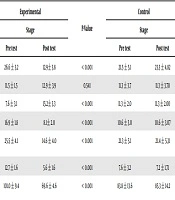
The results of the descriptive statistics show that the mean and standard deviation of students’ age criteria were respectively 17.11 and 2.28, in the experimental group and 16.87 and 2.05 in the control group. Table 2 shows the mean ± SD scores of inventory of interpersonal problems. According to these mean scores, the pre-test and post-test scores in the experimental group were higher than the control group in the pre-test. However, the mean score of all IIP32 dimensions was significantly higher in the post-test in the experimental group (P < 0.001). Therefore, training leads to learning the adaptive interpersonal skills in interventional group.
Table 2.
Descriptive Statistics for Pre-Test and Post-Test in Both Groupsa
| Variables | Experimental | P-Value | Control | ||
|---|---|---|---|---|---|
| Pre Test | Post Test | Pre Test | Post Test | ||
| Assertiveness | 26.6 ± 3.2 | 12.9± 3.8 | < 0.001 | 21.5 ± 5.1 | 23.3 ± 4.82 |
| Openness | 11.5 ± 1.5 | 12.9 ± 3.9 | 0.541 | 11.3 ± 3.7 | 11.3 ± 3.70 |
| Caring | 7.6 ± 3.1 | 15.2± 3.3 | < 0.001 | 11.3 ± 2.0 | 11.3 ± 2.00 |
| Aggression | 16.9 ± 1.8 | 8.1± 2.0 | < 0.001 | 10.6 ± 3.0 | 10.6 ± 3.07 |
| Supportiveness and involvement | 25.5 ± 4.1 | 14.6 ± 4.0 | < 0.001 | 21.3 ± 5.1 | 21.4 ± 5.31 |
| Dependency | 12.7 ± 1.6 | 5.6 ± 1.6 | < 0.001 | 7.6 ± 3.2 | 7.2 ± 1.71 |
| Adaptive interpersonal communication | 101.0 ± 9.4 | 69.6 ± 4.6 | < 0.001 | 83.8 ± 13.6 | 85.3 ± 14.2 |
aValues are expressed as mean ± SD.
According to the results of Table 3, there is a significant difference between the linear composition of the studied variables with regard to the training provided to students (F = 17.753, P < 0.001). Based on Eta coefficient, there is a significant difference between the two Experimental and control groups regarding the total dependent variables (0.55). That is, 55% of the variance is related to the difference between the two interventional and control groups due to the dependent variables.
Table 3.
Multivariate Analysis of Variance (MANOVA) on the Scores of the Studied Variables
| Variables | Value | f | df | Eta Coefficient | P-Value |
|---|---|---|---|---|---|
| Pillais trace | 0.555 | 17.7 | 3 | 0.555 | < 0.001 |
| Wilks lambda | 0.455 | 17.7 | 3 | 0.555 | < 0.001 |
| Hotelling’s trace | 1.249 | 17.7 | 3 | 0.555 | < 0.001 |
| Roy’s largest root | 1.249 | 17.7 | 3 | 0.555 | < 0.001 |
Table 4 shows the analysis of variance with control of the pre-test scores. There is a statistically significant difference between the mean scores of assertiveness and sociability, caring, aggression, supportiveness, and involvement and dependence variables in both groups (P < 0.01). Therefore, training can improve assertiveness and sociability (59%), and caring (34%), involvement and supportiveness (35%), and decreased aggression and dependency (19%) among female high school students.
Moreover, the analysis of variance with control of pre-test scores showed the statistically- insignificant difference between the mean score of openness in both experimental and control groups (P < 0.01). Therefore, according to the results, training does not enhance openness among female high school students. Eta coefficient suggests that training improves openness (5%) among female high school students.
Table 4.
The Effect of Training on Variables of Assertiveness and Sociability, Openness, Caring, Aggression, Supportiveness, Involvement, and Dependency in Female High School Students
| Statistics | Source of Changes | Sum of Squares | df | Average Squares | f | P-Value | Eta Square |
|---|---|---|---|---|---|---|---|
| Assertiveness and sociability | Intergroup | 19729.067 | 1 | 19729.067 | 10.413 | 0.000 | 0.947 |
| Intragroup | 1601.667 | 1 | 1601.667 | 84.508 | 0.000 | 0.953 | |
| Error | 1099.267 | 58 | 18.953 | ||||
| Openness | Intergroup | 8857.350 | 1 | 8857.350 | 783.557 | 0.000 | 0.931 |
| Intragroup | 40.017 | 1 | 40.017 | 3.540 | 0.065 | 0.058 | |
| Error | 655.633 | 58 | 11.304 | ||||
| Caring | Intergroup | 10640.017 | 1 | 10640.017 | 14.063 | 0.000 | 0.960 |
| Intragroup | 228.150 | 1 | 228.150 | 30.154 | 0.000 | 0.342 | |
| Error | 438.833 | 58 | 7.566 | ||||
| Aggression | Intergroup | 5301.600 | 1 | 5301.600 | 782.159 | 0.000 | 0.931 |
| Intragroup | 91.267 | 1 | 91.267 | 13.465 | 0.000 | 0.188 | |
| Error | 393.133 | 58 | 6.778 | ||||
| Supportiveness and involvement | Intergroup | 19512.067 | 1 | 19512.067 | 874.125 | 0.000 | 0.938 |
| Intragroup | 707.267 | 1 | 707.267 | 31.685 | 0.000 | 0.353 | |
| Error | 1294.667 | 58 | 22.322 | ||||
| Dependency | Intergroup | 2483.267 | 1 | 2483.267 | 898.313 | 0.000 | 0.939 |
| Intragroup | 38.400 | 1 | 38.400 | 13.891 | 0.000 | 0.193 | |
| Error | 160.333 | 58 | 2.764 |
5. Discussion
The present study aimed to examine the effectiveness of training on adaptive interpersonal skills learning among female teenager students. Training can ameliorate the assertiveness and sociability, caring and supportiveness, involvement scores, decreased aggression, and dependency traits among female high school students. The first finding suggests that social skills training can enhance adaptive interpersonal skill learning. This finding is consistent with the results of the studies by Albertyn et al. (14), Bieber-Schut (15), and Fallahchai (16). Communication skill training can help students better identify their emotions and feelings with others, so they can receive greater social and emotional support from their environment (17).
In the pre-test, we found that interpersonal skills were higher in the interventional group than the control group. The students in the interventional group could evaluate their mental beliefs and perceptions during training, so being aware of these trainings can contribute to successful adaptation to their own inner and outer world (18).
Adaptability reflects a person’s willingness to interact constructively with others, especially friends and peers. Life skills training, especially interpersonal skills, helps students to understand a variety of psychological traits in themselves and others and accept them more transparently (5).
This process makes it clear that intimacy and companionship should be developed in spite of some of the key differences between them and others (4). Thus, various training programs should be facilitated to strengthen the adjustment level among students (19).
In this study, the analysis of IIP32 components suggested a significant difference between interventional and control groups in terms of “caring” and “adaptive interpersonal communication” before and after the intervention, which was in line with the results of other studies (6, 20, 21). This finding suggested that social skills training contributed to the high level of social adjustment among students and ultimately positively affected their academic performance (13).
One of the significant goals of education is to help students achieve adaptability and build a useful and effective relationship with others as well as accept their social responsibility. Thus, it was necessary to pay attention to the development of social skills training among students (22). Behpaxho et al. (6) reported that social skills training would help promote the children’s adaptation in different aspects of life and was regarded as the most basic preventive program. Social skills training helped students reflect on their personal characteristics and be able to identify their weaknesses, make an attempt to modify them, and rely on these positive aspects, and improve their thoughts and emotions towards others.
On the other hand, considering the mean score of openness, no difference among students before and after training was seen, and openness did not improve in female high school students (23). Students with higher openness were more intelligent and had better academic performance than other students. Life skills training can enhance academic performance and intelligence (24). Students who had a higher degree of openness in interpersonal relationships benefited from their active imagination power to improve their academic performance (25).
Also, we found that training assertiveness and sociability, aggression, supportiveness, and dependency traits were improved in female teenager’s students after intervention. This finding is consistent with the results of other studies (24, 26-29). Those skills helped the students experience more successful personal and interpersonal relationships because they have a reciprocal enhance the acceptance and a more friendly relationship, increase self-confidence, and ultimately maximize individual’ adaptability (30).
Social skill training is a technique through which people learn how to expand an appropriate and enjoyable relationship in a variety of situations (25). Most scholars agree that social skills can be learned because children raised in unsuitable environments have socially unconscionable behaviors and cannot speak effectively (31). The development of social skills is a part of the socialization process in individuals, and the training should be exclusively offered on the basis of this process (32). Training of emotional, social skills bring several benefits for individuals, including regulated emotions, stress control, emotional management, self-control, and interaction and subsequently lead to a decrease in non-social and aggressive behaviors and an improvement in interactions and desirable behaviors due to the person-environment interactions (33).
In summary, the results of this study indicated that life skill training could affect the interpersonal skills of teenager students. Thus, those students who received a life skill training had more effective and better performance in their interpersonal relationships. For example, those who find themselves incompetent, unattractive, and boring in interpersonal relationships may tend to avoid communication with others. However, those who think of themselves as attractive, amiable, and valuable show more interest to communicate with others and build a friendly relationship. Also, students with poor interpersonal skills are less likely to be accepted by their peers.
5.1. Limitations
The limitations of this study are the small sample size and the existence of control variables. Also, factors such as economic status, single parenthood, parental education, and child rearing were undesirable variables that have undoubtedly influenced the results. Finally, the length of the measurement which causes fatigue could affect the results.