
1. Background
Hypersexuality is a prevalent and complex phenomenon that adversely affects individual health and overall quality of life (1). It is defined by the ICD-10 as “excessive sexual drive” (F52.7) and by the DSM-5 as an abnormally intense and persistent urge for sexual activity (2, 3). Over the decades, the conceptualization of hypersexuality has evolved. Historically, early research on excessive sexual behavior emerged in the late twentieth century, driven by clinicians aiming to understand its association with various psychiatric conditions (4). As research progressed through the 1990s and 2000s, frameworks expanded to incorporate perspectives of impulse control (IC) and behavioral addiction (BA).
To provide a stronger theoretical foundation, it is useful to anchor hypersexual behavior within two well-established models. First, the impulse control perspective treats hypersexuality as a deficit in inhibitory control over sexual urges (5). According to the Dual Control Model, two complementary neural systems regulate sexual response: An excitation system (responsible for sexual arousal) and an inhibition system (responsible for suppressing inappropriate sexual impulses). When inhibition is insufficient or excitation is excessively high, individuals are prone to engage in high-risk or uncontrolled sexual behaviors (6). In this framework, hypersexual individuals lack the top-down regulatory control needed to resist immediate sexual gratification, even in the face of negative consequences (7).
Second, the behavioral addiction model conceives hypersexuality as analogous to substance-related addictions, driven by dysregulated reward circuits in the brain (8, 9). The interaction of person affect cognition execution (I-PACE) model integrates four interacting domains — person (e.g., impulsivity, emotion regulation deficits), affect (e.g., anxiety, depression), cognition (e.g., positive expectancies of sexual activity, attentional biases), and execution (e.g., impaired inhibitory control) — to explain addictive behaviors, including hypersexuality (10). When personal vulnerability (e.g., high impulsivity), negative affect (e.g., stress), distorted cognitions (e.g., “sex will relieve my anxiety”), and weak executive functioning coincide, a self-reinforcing cycle of craving and compulsive sexual behavior develops. Over time, this cycle becomes difficult to interrupt despite mounting negative life or relationship-related consequences (11, 12).
In summary, the present study’s conceptual model synthesizes the dual control and I-PACE frameworks to articulate how hypersexual behavior emerges from the interaction of neural, cognitive, affective, and contextual factors. Specifically, we posit that hypersexuality in university students arises when heightened sexual excitation and dysregulated reward processing combine with impaired inhibitory control (dual control) and are further fueled by personal traits (e.g., impulsivity, poor emotion regulation) and psychosocial stressors (e.g., academic pressure, anxiety, depression) (I-PACE). Cultural norms — such as gender segregation, religious beliefs, and limited sex education — are expected to modulate both the expression of hypersexual behavior and individuals’ willingness to disclose such tendencies.
This integrated model underpins our adaptation of the Hypersexual Behavior Scale (HBS), which is designed to capture five core dimensions (increased sexual interest, post-sex regret, negative impact, emotional arousal, and uncontrolled behavior) reflecting these underlying mechanisms. Despite varied definitions — some considering hypersexuality a symptom of disorders such as bipolar disorder, obsessive–compulsive disorder, or personality disorders, and others positing it as a distinct condition — there is consensus that hypersexuality involves a recurrent pattern of sexual thoughts, urges, or behaviors that cause marked distress or impair functioning (13).
The significance of hypersexuality lies not only in its psychological burden — manifested through emotional distress, low self-esteem, guilt, shame, regret, and even suicidal ideation — but also in its broader societal impacts. Affected individuals may engage in risky sexual behaviors that increase the likelihood of sexually transmitted infections, unintended pregnancies, or legal issues (5, 14). Moreover, hypersexuality can undermine interpersonal relationships by affecting marital satisfaction, intimacy, and communication, while also interfering with academic and occupational performance (5, 15).
University students, as a vulnerable population undergoing significant personal, social, and academic transitions, may be particularly susceptible to hypersexual behavior (16). Stress, anxiety, and depressive symptoms common in this group can lead to the use of sexual activity as a maladaptive coping strategy (11, 17, 18). Empirical evidence indicates that poor emotion regulation and elevated anxiety/depression strongly predict hypersexual tendencies (11, 12). Similarly, students experiencing high academic stress often resort to sexual activity to alleviate negative affect, thereby perpetuating a reinforcing cycle (19). Moreover, cultural and social norms — such as strict gender segregation, limited sex education, and prevailing religious attitudes — shape how Iranian youth perceive and manage sexual urges, often fostering secrecy, guilt, and subsequent compulsive patterns (20).
Epidemiological studies have noted a high prevalence of hypersexuality among university students in various cultural contexts, including Iran (21). However, reliable prevalence estimates are hindered by the absence of culturally validated measurement tools. This notable prevalence underscores the urgent necessity for culturally validated assessment tools. Accurately capturing hypersexual behaviors in diverse populations is critical for early intervention and effective treatment planning, thereby addressing a significant gap in current research (19).
In Iran, the socio-cultural landscape over the past fifty years has been profoundly shaped by a major revolution, an eight-year war, and subsequent economic challenges — such as soaring inflation and rising unemployment — which have altered social structures (22). Additionally, international sanctions have deepened these hardships. Importantly, the education system from schools to universities is conducted in a gender-segregated manner, a practice that uniquely influences social norms and sexual behaviors within the country (23). Given these contextual factors, existing hypersexuality measures developed abroad may not fully capture the nuances of Iranian cultural expression.
Given the importance of accurately diagnosing hypersexual behaviors and providing appropriate therapeutic interventions, several instruments have been developed in recent years. These include the Hypersexual Behavior Inventory (HBI) (24), the sexual addiction screening test (SAST) (25), the Sexual Compulsivity Scale (SCS) (26), the Hypersexual Disorder Screening Inventory (HDSI) (27), and the Compulsive Sexual Behavior Disorder Diagnostic Inventory (CSBD DI) (9). However, a clear research gap remains in their cultural adaptation and validation for the Iranian context.
In this regard, Jia and colleagues developed the HBS in 2021 — a multidimensional tool grounded in clinical observations and theoretical models (28). The HBS demonstrated strong content validity, a robust factor structure, and excellent reliability in a Chinese university sample (28). Nevertheless, its initial validation was confined to China, raising concerns about its generalizability to other cultures such as Iran. Moreover, the HBS has not yet been tested for optimal cut-off scores to identify clinically significant hypersexuality.
Bridging this research gap, the present study aims to evaluate the psychometric properties of the HBS among Iranian university students. Unlike previous studies that primarily validated HBS in Western or East Asian populations, this research is the first to adapt and validate the HBS in the Iranian cultural context. Given Iran’s unique socio-cultural landscape — including gender-segregated education, evolving social norms, and economic challenges — this study provides a novel contribution by assessing the applicability of the HBS within a distinct and underexplored population. Moreover, this study goes beyond standard validation procedures by determining an optimal cut-off score using receiver operating characteristic (ROC) analysis, a feature not previously reported for this scale. These methodological advancements enhance the practical utility of the HBS for identifying hypersexual behavior in non-Western settings, making this research an important step toward culturally sensitive psychometric assessment.
2. Objectives
The objective is to examine the factor structure and validate the HBS to provide a reliable, culturally sensitive instrument for both research and early intervention initiatives aimed at mitigating the adverse effects of hypersexual behavior.
3. Methods
This cross-sectional psychometric study evaluated the factor structure and validity of the HBS among Iranian university students during the 2023 – 2024 academic year. Stratified random sampling was employed across five universities in Bandar Abbas: Hormozgan University, Hormozgan University of Medical Sciences, Islamic Azad University (Bandar Abbas), Payame Noor University (Bandar Abbas), and Razavi Non-profit Higher Education Institute (Bandar Abbas). The sample size was determined based on literature recommendations: 200 for concurrent validity (exceeding the minimum of 100), 550 for Exploratory factor analysis (EFA) (20 per item for 20 items), 300 for confirmatory factor analysis (CFA) (within the advised range of 200 - 1000), and 200 for reliability (well above the minimum of 40) (29). Overall, more than 1,250 participants were recruited to ensure a robust psychometric evaluation.
3.1. Sampling Process and Participant Recruitment
Stratified random sampling was utilized by dividing the population according to universities. Sample sizes for each stratum were calculated using the formula:
where nh represents the required sample size for each stratum, Nh is the total number of students in each university, nis the overall sample size, and N is the total population (30). The calculated samples were as follows: Hormozgan University (N = 6000, n = 206), Hormozgan University of Medical Sciences (N = 4000, n = 137), Islamic Azad University Bandar Abbas (N = 15000, n = 514), Payame Noor University Bandar Abbas (N = 10000, n = 342), and Razavi Higher Education Institute (N = 1500, n = 51). Participants were randomly selected using student IDs via Excel. Formal permissions were obtained from university administrations. Recruitment was coordinated with officials who invited students through official channels, providing study details and emphasizing voluntary participation.
3.2. Ethical Considerations
Ethical approval was granted by the Research Ethics Committee and the Institutional Review Board of Islamic Azad University, Bandar Abbas Branch (Approval Code: IR.IAU.BA.REC.1402.075) on November 21, 2023. Written permissions were obtained from all participating universities. Participants received detailed information about the study’s aims, procedures, confidentiality, and their right to withdraw without penalty. Electronic informed consent was secured prior to data collection. Confidentiality was strictly maintained, with all data anonymized to protect participants’ identities.
3.3. Eligibility Criteria
Eligibility for participation required that individuals be currently enrolled as students at one of the participating universities in Bandar Abbas and willing to participate in the study. The only exclusion criterion was the incomplete submission of the questionnaire.
3.4. Supplementary Data
To promote transparency and facilitate data verification, the entire dataset (processed in Excel) has been made available as supplementary material in the provided link.
3.5. Measurement: The Data Collection Tools Used Were the HBS and the Hypersexual Behavior Inventory
The HBS is a questionnaire designed to measure hypersexual behavior in Chinese university students, developed and validated by Jia et al. in 2021. This questionnaire consists of 20 questions divided into five dimensions: Negative impact (questions 1 to 4), emotional arousal (questions 5 to 8), uncontrolled behavior (questions 9 to 12), post-sex regret (questions 13 to 16), and increased interest (questions 17 to 20). Each question is scored on a five-point Likert scale from one to five, resulting in minimum and maximum total scores of 20 and 100, respectively. Additionally, the minimum and maximum scores for each dimension are 4 and 20, respectively (28).
The HBS was first published in July 2021, and in the present study, it underwent forward–backward translation for Persian adaptation. The questionnaire demonstrated strong validity and reliability, with an overall Cronbach’s alpha of 0.90, ranging from 0.81 to 0.86 for subscales (28). Validated for the first time in this study, it showed excellent content validity (Content Validity Ratio [CVR], Content Validity Index [CVI]) and concurrent validity with the HBI (r = 0.56, P < 0.001). Exploratory factor analysis identified five factors explaining 57.95% of the variance, which was confirmed by CFA. Internal consistency (α = 0.959), split-half reliability (0.909), and test-retest reliability (r = 0.89) were all high.
3.6. Translation and Cultural Adaptation
A rigorous forward–backward translation procedure was applied to adapt the HBS for Persian speakers. Two bilingual experts independently translated the scale into Persian, and discrepancies were resolved through a consensus meeting. Two other translators, blinded to the original, back-translated it into English. This version was compared with the original, and inconsistencies were discussed with the research team and, if needed, the original developers, ensuring both linguistic accuracy and cultural appropriateness (31).
3.7. Hypersexual Behavior Inventory Instrument
The HBI by Reid et al. includes 19 items across three subscales, rated on a five-point Likert scale (13). The total Cronbach’s alpha was 0.90, with subscales ranging from 0.89 to 0.95. Its structural validity was confirmed via CFA with a Comparative Fit Index (CFI) of 0.95, and a score of ≥ 53 indicates hypersexuality (14). In Iran, reliability was confirmed with alpha values of 0.90 for the total scale, and 0.82, 0.80, and 0.86 for the denial, consequences, and coping subscales, respectively. Confirmatory factor analysis also supported its structural validity (21).
3.8. Procedure
Data were collected through Google Forms, accessed via QR codes distributed after recruitment. Participants provided informed electronic consent before proceeding. To boost participation, each received a small gift (a clear book, notebook, and pen). The response rate was 89.36%. Data were stored in a secure, encrypted database.
3.9. Validity and Reliability
3.9.1. Content Validity
Assessed via CVR and CVI based on ratings from 10 experts (3 psychologists, 2 psychometricians, 5 PhD-level sexual health counselors). The CVR and CVI were calculated using established formulas (32).
3.9.2. Concurrent Validity
Evaluated through Pearson and Spearman correlations between HBS and HBI scores (33).
3.9.3. Construct Validity
Both EFA and CFA were performed. The EFA used principal axis factoring with varimax rotation; only factors with eigenvalues greater than 1 were retained. Adequacy was supported by a Kaiser-Meyer-Olkin (KMO) measure greater than 0.7 and Bartlett’s test (34). CFA examined model fit using multiple indices, including chi-square (χ2), root mean square error of approximation (RMSEA), CFI, Normed Fit Index (NFI), standardized root mean square residual (SRMR), Goodness of Fit Index (GFI), Adjusted Goodness of Fit Index (AGFI), Akaike information criterion (AIC), Incremental Fit Index (IFI), Relative Fit Index (RFI), Critical N (CN), and Parsimony Goodness of Fit Index (PGFI) (34).
3.9.4. Internal Reliability
Assessed using split-half reliability, test–retest reliability, and Cronbach’s alpha coefficients (34).
3.9.5. Cut-off Determination
The ROC curve was used to define an optimal cut-off score by comparing HBS with HBI responses. Scores from 20 to 100 (in steps of 10) were evaluated for true positive rate (TPR), false positive rate (FPR), true negative rate (TNR), false negative rate (FNR), and Youden Index, with the optimal cut-off maximizing accuracy (35).
3.10. Study Assumptions
The psychometric analysis assumed linearity, normality, homogeneity of variance, and independence of observations to ensure valid and reliable results (34).
3.11. Data Analysis
Data were analyzed using SPSS version 25 and AMOS version 24. Descriptive statistics, including mean, standard deviation, frequency, and percentage, were used to summarize demographic characteristics. Inferential statistics — including Pearson and Spearman correlation coefficients, EFA, CFA, Cronbach's alpha, and test–retest analyses — were employed to evaluate the validity and reliability of the questionnaire. A significance level of 0.05 was used for all tests.
4. Results
Among 1177 university students, 416 (35.34%) had an associate’s degree, 600 (50.98%) a bachelor’s degree, and 161 (13.68%) a master’s or higher degree. Females comprised 66.02% (n = 777) of the sample, and males 33.98% (n = 400). Most participants were aged 20 - 25 (50.04%, n = 589). Students were from five fields: Arts, foreign languages, humanities, basic sciences, and engineering, with the largest group being humanities (51.32%, n = 604). The majority were single (79.61%, n = 937), with 240 (20.39%) married (Table 1).
Table 1.
Frequency and Percentage of Participants' Demographic Characteristics and Responses to the Questionnaire a
| Variables | Total | Concurrent | Exploratory | Confirmatory | Reliability |
|---|---|---|---|---|---|
| Educational level | |||||
| Associate degree | 416 (35.34) | 78 (41.27) | 186 (36.40) | 89 (29.77) | 63 (35.39) |
| Bachelor's degree | 600 (50.98) | 86 (45.50) | 270 (52.84) | 159 (53.18) | 85 (47.75) |
| Master's degree and higher | 161 (13.68) | 25 (13.23) | 55 (10.76) | 51 (17.06) | 30 (16.85) |
| Gender | |||||
| Female | 777 (66.02) | 127 (67.20) | 335 (65.56) | 189 (63.21) | 126 (70.79) |
| Male | 400 (33.98) | 62 (32.80) | 176 (34.44) | 110 (36.79) | 52 (29.21) |
| Age (y) | |||||
| < 20 | 402 (34.15) | 60 (31.75) | 181 (35.42) | 104 (34.78) | 57 (32.02) |
| 20 - 25 | 589 (50.04) | 95 (50.26) | 256 (50.10) | 147 (49.16) | 91 (51.12) |
| > 25 | 186 (15.80) | 34 (17.99) | 74 (14.48) | 48 (16.05) | 30 (16.85) |
| Field of study | |||||
| Art group | 108 (9.18) | 17 (8.99) | 47 (9.20) | 24 (8.03) | 20 (11.24) |
| Foreign languages group | 36 (3.06) | 13 (6.88) | 3 (0.59) | 6 (2.01) | 14 (7.87) |
| Humanities group | 604 (51.32) | 93 (49.21) | 267 (52.25) | 149 (49.83) | 95 (53.37) |
| Basic sciences group | 246 (20.90) | 42 (22.22) | 101 (19.77) | 68 (22.74) | 35 (19.66) |
| Engineering group | 183 (15.55) | 24 (12.70) | 93 (18.20) | 52 (17.39) | 14 (7.87) |
| Marital status | |||||
| Single | 937 (79.61) | 151 (79.89) | 415 (81.21) | 232 (77.59) | 139 (78.09) |
| Married | 240 (20.39) | 38 (20.11) | 96 (18.79) | 67 (22.41) | 39 (21.91) |
a Values are expressed as No. (%).
The study was based on assumptions of linearity (via scatterplots), normality (Shapiro-Wilk test), homogeneity of variance (Levene’s test), and independence (stratified random sampling). Content validity was assessed by 10 experts. Item 12 was excluded due to a low CVR of 0.50; the remaining items showed acceptable CVRs (0.70 - 0.90) and CVIs (0.80 - 0.95), confirming content validity (Table 2).
Table 2.
Correlation Matrix Between Hypersexual Behavior Inventory, hypersexual Behavior Scale, and Subscales of Hypersexual Behavior Scale a
| Variables | HBI | HBS | Negative Impact | Emotional Arousal | Uncontrolled Behavior | Postsex Regret | Increased Interest |
|---|---|---|---|---|---|---|---|
| HBI | 1 | 0.558** | 0.433** | 0.427** | 0.382** | 0.521** | 0.466** |
| HBS | 0.558** | 1 | 0.790** | 0.822** | 0.754** | 0.825** | 0.825** |
| Negative Impact | 0.433** | 0.790** | 1 | 0.562** | 0.450** | 0.538** | 0.583** |
| Emotional Arousal | 0.427** | 0.822** | 0.562** | 1 | 0.552** | 0.612** | 0.579** |
| Uncontrolled Behavior | 0.382** | 0.754** | 0.450** | 0.552** | 1 | 0.576** | 0.548** |
| Postsex Regret | 0.521** | 0.825** | 0.538** | 0.612** | 0.576** | 1 | 0.575** |
| Increased Interest | 0.466** | 0.825** | 0.583** | 0.579** | 0.548** | 0.575** | 1 |
Abbreviations: HBI, Hypersexual Behavior Inventory; HBS, hypersexual behavior scale.
a ** indicates significance at P < 0.01.
Concurrent validity was confirmed through significant correlations between the HBS and the HBI (r = 0.56, P < 0.001), and between HBI and HBS subscales, such as negative impact (r = 0.433), emotional arousal (r = 0.427), uncontrolled behavior (r = 0.382), post-sex regret (r = 0.521), and increased interest (r = 0.466), all P < 0.001 (Table 2).
Exploratory factor analysis using principal axis factoring with varimax rotation on 20 items yielded a Kaiser-Meyer-Olkin (KMO) measure of 0.840 and a significant Bartlett’s test (χ2 = 4305.859, P < 0.001). Five factors with eigenvalues greater than 1 explained 57.01% of the total variance: Factor 1 (14.10%), factor 2 (12.95%), factor 3 (10.88%), factor 4 (10.40%), factor 5 (8.69%) (Table 3).
Table 3.
Rotated Factor Matrix
| Variables | Factor | Mean ± SD | ||||
|---|---|---|---|---|---|---|
| Increased Interest | Postsex Regret | Negative Impact | Emotional Arousal | Uncontrolled Behavior | ||
| i1 | 0.08 | 0.12 | 0.10 | 0.63 | 0.12 | 2.12 ± 1.17 |
| i2 | 0.05 | 0.11 | 0.09 | 0.68 | 0.09 | 2.12 ± 1.18 |
| i3 | 0.10 | 0.12 | 0.10 | 0.63 | 0.12 | 2.05 ± 1.12 |
| i4 | 0.16 | 0.08 | 0.07 | 0.74 | 0.01 | 2.11 ± 1.14 |
| i5 | 0.11 | 0.04 | 0.66 | 0.09 | 0.14 | 2.19 ± 1.17 |
| i6 | 0.09 | 0.08 | 0.73 | 0.10 | 0.09 | 2.17 ± 1.18 |
| i7 | 0.15 | 0.08 | 0.68 | 0.08 | 0.10 | 2.17 ± 1.20 |
| i8 | 0.11 | 0.11 | 0.67 | 0.10 | 0.08 | 2.22 ± 1.18 |
| i9 | 0.10 | 0.12 | 0.12 | 0.08 | 0.79 | 2.16 ± 1.18 |
| i10 | 0.06 | 0.11 | 0.14 | 0.11 | 0.62 | 2.12 ± 1.16 |
| i11 | 0.06 | 0.12 | 0.12 | 0.12 | 0.70 | 2.17 ± 1.16 |
| i13 | 0.04 | 0.75 | 0.10 | 0.12 | 0.10 | 2.18 ± 1.19 |
| i14 | 0.10 | 0.73 | 0.06 | 0.15 | 0.07 | 2.25 ± 1.20 |
| i15 | 0.08 | 0.78 | 0.08 | 0.10 | 0.14 | 2.18 ± 1.19 |
| i16 | 0.12 | 0.78 | 0.10 | 0.12 | 0.10 | 2.23 ± 1.22 |
| i17 | 0.77 | 0.09 | 0.15 | 0.09 | 0.10 | 2.13 ± 1.16 |
| i18 | 0.82 | 0.07 | 0.11 | 0.14 | 0.04 | 2.13 ± 1.19 |
| i19 | 0.80 | 0.12 | 0.11 | 0.10 | 0.05 | 2.13 ± 1.16 |
| i20 | 0.79 | 0.07 | 0.13 | 0.13 | 0.08 | 2.14 ± 1.18 |
| Mean ± SD | 8.53 ± 4.07 | 8.84 ± 4.06 | 8.76 ± 3.76 | 8.40 ± 3.60 | 6.45 ± 2.91 | - |
Confirmatory factor analysis showed acceptable fit indices: χ2/df = 2.20, RMSEA = 0.062 (90% CI: 0.053 - 0.072), CFI = 0.98, NFI = 0.97, NNFI = 0.98, SRMR = 0.054, GFI = 0.90, AGFI = 0.87, AIC = 418.16, IFI = 0.98, RFI = 0.96, CN = 167.73. Factor loadings ranged from 0.54 to 0.88, and inter-factor correlations from 0.32 to 0.67 (Figure 1) (Table 4).
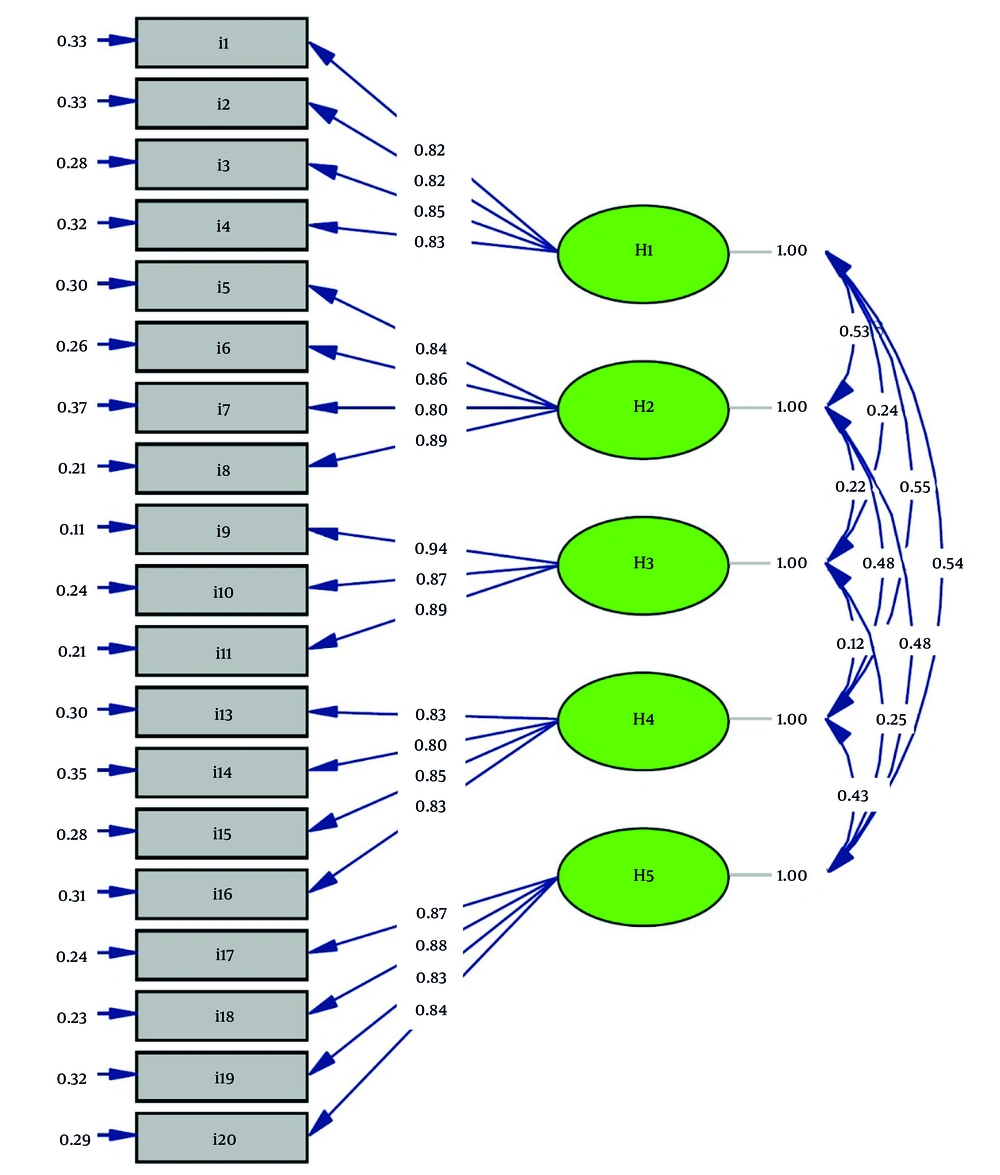
Figure 1.
Standardized coefficient model of the hypersexual behavior scale (HBS) for University Students in Bandar Abbas city in 2023
Table 4.
Confirmatory Factor Analysis Fit Indices
| Fit Index | Value | Acceptable Range/Comment |
|---|---|---|
| Chi-square (χ2) | 312.15 a | Significant (expected with large samples) |
| Normed Chi-square (χ2/df) | 2.20 | 1 - 3 |
| RMSEA | 0.062 | < 0.08 |
| 90% CI for RMSEA | 0.053 - 0.072 | |
| CFI | 0.98 | > 0.95 |
| NFI | 0.97 | > 0.90 |
| NNFI (TLI) | 0.98 | > 0.95 |
| SRMR | 0.054 | < 0.08 |
| GFI | 0.90 | ≥ 0.90 |
| AGFI | 0.87 | Marginally acceptable |
| IFI | 0.98 | > 0.95 |
| RFI | 0.96 | > 0.90 |
| AIC | 418.16 | Lower values indicate better fit |
| Critical N | 167.73 | – |
Abbreviations: CFI, comparative fit index; CN, critical N; RMSEA, root mean square error of approximation.
a df = 142; P < 0.001.
Reliability was strong: Cronbach’s alpha = 0.959, split-half reliability = 0.909, with first half α = 0.928 and second half α = 0.914. Subscale alphas ranged from 0.775 to 0.849. Test-retest reliability after two weeks was r = 0.89 (P < 0.001), confirming high temporal stability (36).
In the ROC analysis, the optimal HBS cut-off was 61, where the Youden index peaked at 0.989, with sensitivity of 0.989 and a false positive rate (FPR) of 0.000. Scores below 61 reduced sensitivity, while higher scores raised the FPR, lowering accuracy. Thus, 61 offers the best balance of sensitivity and specificity for identifying hypersexual individuals (Figure 2) (Table 5).
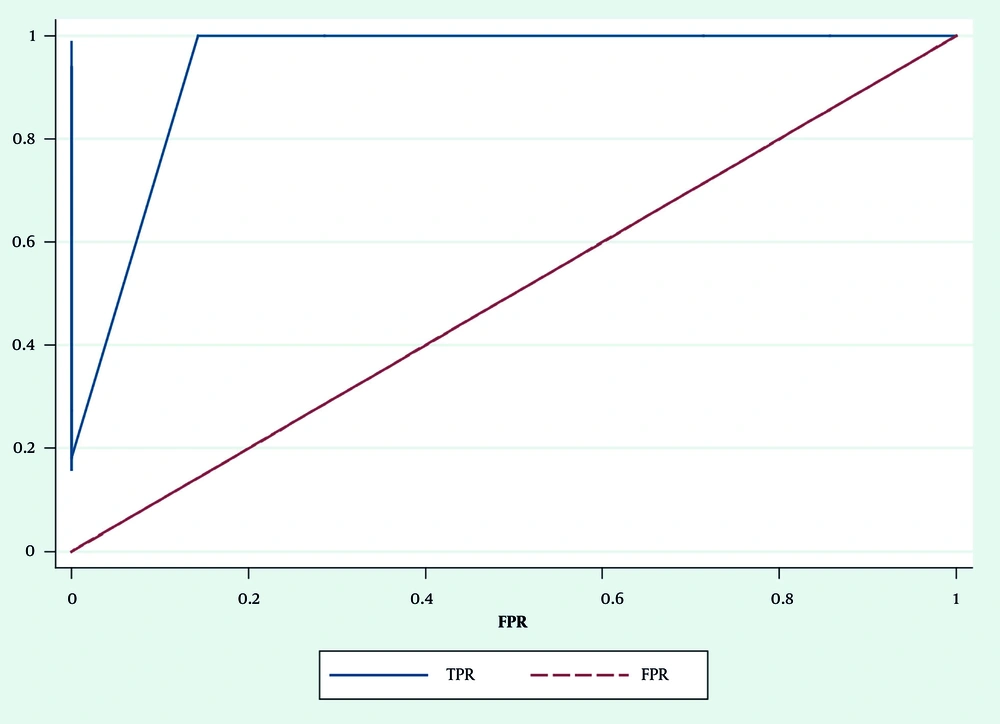
Figure 2.
Receiver operating characteristic (ROC) Curve for determining cut-off point for hypersexual behavior scale (HBS)
Table 5.
Receiver Operating Characteristic for Determining the Cut-off Point for Hypersexual Behavior Scale
| Cut-off Point | TP (True Positive) | FN (False Negative) | FP (False Positive) | TN (True Negative) | TPR (True Positive Rate) | FPR (False Positive Rate) | Youden Index |
|---|---|---|---|---|---|---|---|
| 20 | 182 | 0 | 7 | 0 | 1.000 | 1.000 | 0.000 |
| 30 | 29 | 153 | 0 | 7 | 0.159 | 0.000 | 0.159 |
| 40 | 33 | 149 | 0 | 7 | 0.181 | 0.000 | 0.181 |
| 50 | 50 | 132 | 0 | 7 | 0.274 | 0.000 | 0.274 |
| 60 | 171 | 11 | 0 | 7 | 0.939 | 0.000 | 0.939 |
| 61 | 180 | 2 | 0 | 7 | 0.989 | 0.000 | 0.989 |
| 62 | 182 | 0 | 1 | 6 | 1.000 | 0.143 | 0.857 |
| 63 | 182 | 0 | 2 | 5 | 1.000 | 0.286 | 0.714 |
| 64 | 182 | 0 | 5 | 2 | 1.000 | 0.714 | 0.286 |
| 65 | 182 | 0 | 6 | 1 | 1.000 | 0.857 | 0.143 |
| 66 | 182 | 0 | 7 | 0 | 1.000 | 1.000 | 0.000 |
| 67 | 182 | 0 | 7 | 0 | 1.000 | 1.000 | 0.000 |
| 68 | 182 | 0 | 7 | 0 | 1.000 | 1.000 | 0.000 |
| 69 | 182 | 0 | 7 | 0 | 1.000 | 1.000 | 0.000 |
| 70 | 182 | 0 | 7 | 0 | 1.000 | 1.000 | 0.000 |
| 80 | 182 | 0 | 7 | 0 | 1.000 | 1.000 | 0.000 |
| 90 | 182 | 0 | 7 | 0 | 1.000 | 1.000 | 0.000 |
| 100 | 182 | 0 | 7 | 0 | 1.000 | 1.000 | 0.000 |
5. Discussion
The results confirm that the HBS is a valid and reliable tool among Iranian university students. It demonstrated excellent content validity, except for item 12, which was removed due to a low content validity ratio (CVR = 0.50). The scale showed strong concurrent validity with the HBI (r = 0.56, p < 0.001) and a five-factor structure explaining 57.011% of the variance, supported by solid fit indices (e.g., RMSEA = 0.062, CFI = 0.98). Internal consistency was high (α = 0.959), with strong split-half reliability (0.909) and test-retest reliability (r = 0.89). The ROC analysis identified an optimal cut-off of 61, with a maximum Youden Index (0.989), balancing sensitivity (0.989) and specificity (1.000).
The removal of item 12 suggests that Iranian experts found it culturally misaligned — a divergence from Jia et al., who retained all items (28). This may reflect socio-cultural differences, emphasizing the need for culturally adapted items. Despite this, overall content validity remained strong. The strong correlation with the HBI supports concurrent validity, consistent with Jia et al. and Walton et al. (28, 37), affirming conceptual coherence across instruments.
CFA confirmed the five-factor structure with comparable indices to prior studies, though the Adjusted Goodness of Fit Index (AGFI) was slightly lower (0.87 vs. 0.89), possibly due to differences in sample composition. The structure aligns well with theoretical models, reinforcing construct validity. Each dimension (e.g., increased interest, post-sex regret, emotional arousal, negative impact, uncontrolled behavior) mirrored those in related scales, including those by Kalichman and Carnes (7, 38), underscoring structural and theoretical alignment. This coherence enhances the scale’s validity and suggests broad applicability.
The optimal cut-off point of 61, not previously reported, is a novel contribution. However, cultural variations in defining hypersexuality may affect threshold accuracy across populations. Thus, while 61 appears suitable for Iran, further cross-cultural validation is necessary. Overall, findings align with prior research, with minor variations likely due to cultural or methodological factors. The HBS shows promise as a culturally valid tool for hypersexuality screening in Iran. Future studies should explore its applicability in broader and more diverse Iranian samples, ideally using longitudinal designs to clarify temporal dynamics.
A key strength of this study is its establishment of a culturally specific cut-off point, offering practical diagnostic utility. The robust methodology, including stratified random sampling and comprehensive psychometric evaluation, reinforces its credibility and relevance for both national and international contexts. Nonetheless, the sample’s restriction to Bandar Abbas students limits generalizability. Broader studies across regions and populations are recommended to validate and refine these findings (35).
5.1. Conclusions
This study was conducted to examine the factor structure and validity of the HBS for Iranian university students. The results indicated that the HBS comprises five factors: Increased interest, post-sex regret, negative impact, emotional arousal, and uncontrolled behavior. These findings are consistent with similar results from other hypersexual behavior questionnaires. Additionally, the HBS demonstrated appropriate content validity, concurrent validity, and construct validity, providing a good fit for the data. The reliability of the scale was also confirmed using various methods, such as split-half correlation, test-retest correlation, and Cronbach's alpha coefficient. Therefore, the HBS is a useful and reliable tool for measuring and identifying hypersexual behaviors in the Iranian student population.