


1. Background
Emotion regulation is crucial in the onset and continuance of emotional disorders (1-3). In various models, emotion dysregulation has been considered the core and perpetuating factor of psychological disorders. Emotion regulation has been defined as a group of processes through which individuals can influence not only the emotions they experience but also the time, quality, and expression of these emotions (4). Gross introduces several stages for emotion regulation: Attention deployment, cognitive reappraisal, situation selection, expressive suppression, and situation modification. Therefore, individuals are expected to respond differently to their emotions (such as avoidance, escaping, suppression, distraction, reappraisal, or substance use) (4).
Adaptive emotion regulation requires awareness of emotions, experiencing emotions, healthy and functional emotional assessment, and developing proper behavioral reactions to emotions (5). According to Gratz and Roemer (6), awareness, understanding, and acceptance of emotions precede other emotion regulation strategies. Gaining emotional awareness through identifying or labeling techniques is suggested as an initial step for emotion regulation (7). Similarly, as a secondary step in emotional awareness, Leahy emphasizes involvement in interpretive and strategic processes when unpleasant emotions arise (8, 9). Furthermore, Garnefski et al. (10) differentiated the adaptive (refocusing positively, acceptance, putting into perspective, positive reappraisal, and refocus on planning) and maladaptive strategies (other-blame, self-blame, catastrophizing, and rumination), while focusing on the role of cognitive processing in emotion regulation.
In addition to how individuals connect to their emotions and the cognitions they develop with/in response to their emotions, behavioral responses used for emotion regulation are of great importance. Similar to cognitive emotion regulation strategies, there are possible healthy or unhealthy behavioral strategies. Problem-solving (11), acting against negative emotions (12), behavioral activation (13), and seeking social support in dealing with stress (14, 15) are known as adaptive emotion regulation strategies. Although psychopathology literature has placed focus on healthy (like behavioral activation, gaining social support, distraction, and committed action) and unhealthy behavioral strategies (namely avoidance and withdrawal) when experiencing negative emotions (16-18), no specific measurement has been yet designed for integrative assessment of behavioral emotion regulation strategies.
However, in 2019, the Behavioral Emotion Regulation Questionnaire (BERQ) was created by Kraaij and Garnefski as the behavioral version of the Cognitive Emotion Regulation Questionnaire (CERQ) to assess the adaptive and maladaptive strategies for emotion regulation: Distraction (getting involved in some activities to cope with a stressful situation), seeking social support (sharing feelings and asking for advice and help), actively approaching (to find solutions to problems actively), withdrawal (distancing one's self mentally or physically from the stressor), and ignoring (to act as if no negative experience has occurred) (19).
The five-factor structure of the BERQ was confirmed in the initial research of Kraaij and Garnefski (19) and another article (20). Nevertheless, more studies are required to determine the psychometric properties of the BERQ. Our knowledge regarding emotion regulation results from studies conducted on populations of Western countries (21). However, cultural factors are believed to affect emotion regulation strategies considerably (21, 22).
Since emotional dysregulation is the main feature in 75% of mental disorders (23) and given the fact that some emotional disorders in Iran constitute 35% to 45% of all mental illnesses (24), investigating emotional dysregulation in Persian-speaking populations could be a significant necessity not only for clinical and therapeutic purposes but also for expanding research and assessment opportunities and obtaining a clearer understanding of how emotion regulation operates.
2. Objectives
The current study aimed to assess the psychometric properties of the BERQ in an Iranian student sample.
3. Methods
The design of this study was factor analysis. This study was conducted from September 2020 to May 2021 at Kermanshah University of Medical Sciences. With an age of 18 to 34 years old (mean ± standard deviation = 23.37 ± 3.04), the participants included 301 students (150 men, 49.8% and 151 women, 50.2%) from Kermanshah University of Medical Sciences selected by multi-stage cluster sampling. Inclusion criteria were being a university student at least 18 years old and giving informed consent for research. Exclusion criteria were suffering from severe medical illnesses and substance abuse.
3.1. Procedure
Initially, permission was obtained from the developer of the BERQ to investigate the psychometric properties of the Persian version of the BERQ. The BERQ was compiled according to the guidelines for cultural tailoring of measurements (25, 26). Initially, the original design of the BERQ was translated into Persian by three clinical psychology professors. Afterward, two other mental health experts, fluent in both languages, translated all the Persian items into English. This step was followed by reviewing the final translated version to check the scale regarding acceptability and comprehensibility. As a pilot assessment and to correct the errors in the statements, the questionnaire was performed on a sample of 30 students at Kermanshah University of Medical Sciences. The final sample had more than 200 members because, in confirmatory factor analysis (CFA), a sample size greater than 200 is acceptable (27).
Three Kermanshah University of Medical Sciences faculties were randomly selected in the next stage. Afterward, four classes from each faculty were randomly selected, and the class members were asked to complete the questionnaires. After obtaining the consent of the subjects in the present study, the participants completed the following tools: (a) BERQ; (b) Depression Anxiety Stress Scale (DASS); (c) CERQ; and (d) Penn State Worry Questionnaire (PSWQ). The research did not impose any financial burdens on the participants.
3.1.1. Behavioral Emotion Regulation Questionnaire
All 20 items in this self-report questionnaire assess how individuals respond to stressful situations to regulate emotions. A five-point Likert scoring system was used to rate the items. The BERQ consists of five subscales (19) (each having four statements), and the total score of each subscale fluctuates between 4 and 20. The studies of Kraaij and Garnefski indicated the high Cronbach's alpha coefficients of this questionnaire for all subscales, varying from 0.86 to 0.93 (19). Moreover, test-retest reliability was suitable (0.47 to 0.75) for all subscales, and factor analysis results supported the five-factor structure of this scale.
3.1.2. The Depression Anxiety Stress Scales
Lovibond and Lovibond developed the DASS in 1995 (28). The reliability values of the DASS were reported to be 0.70 (depression), 0.66 (anxiety), and 0.76 (stress) in the general population (Mashhad, Iran) (29). Moreover, the construct validity of the short form of this scale was considered satisfactory in an investigation using confirmatory factor analysis (three-factor model) (30).
3.1.3. Cognitive Emotion Regulation Questionnaire
This measurement was created to examine the cognitive strategies employed by individuals after undergoing stress-provoking life events (31). Garnefski et al., (cited in Mohsenabadi and Fathi-Ashtiani) who developed the CERQ, calculated the instrument's reliability using Cronbach's alpha (0.91, 0.89, and 0.93). The internal consistency of the Persian version of the CERQ (the short form) was 0.74 in an investigation, and its divergent and convergent validity was confirmed (32).
3.1.4. Penn State Worry Questionnaire
3.2. Data Analysis
The multivariate analysis of variance (MANOVA) test was applied to examine the differences in the BERQ subscales between males and females. In addition to the CFA, the numerical divergent and convergent validity were used to evaluate the construct validity of the BERQ. The fitness of the BERQ (the five-factor model) was investigated through the CFA. Pearson correlations between the BERQ subscales and DASS, CERQ, and PSWQ were calculated to examine the divergent and convergent validity. Cronbach's alpha was used to evaluate the reliability of the BERQ subscales. Data were analyzed using SPSS 20 and LISREL version 8.80.
3.3. Ethical Considerations
All participants indicated their informed consent by signing a form before the commencement of the research. The instruments were completed anonymously, and all participants were given codes to maintain confidentiality. This study was approved (IR.KUMS.REC.1398.131) by the Ethics Committee of Kermanshah University of Medical Sciences.
4. Results
The results of MANOVA showed that the scores of the BERQ subscales were not significantly different between men and women: Hoteling's Trace F (2, 406) = 1.58, P = 0.17, partial eta squared = 0.03. The results regarding inter-correlations between the BERQ scales, reliability, and validity were as follows: As indicated in Table 1, the correlation between the subscales of the BERQ varied from 0.16 (between actively approaching and ignoring - negatively) to 0.45 (between actively approaching and seeking social support - positively). Cronbach's alpha coefficients for the BERQ subscales were as follows: Seeking distraction (0.80), withdrawal (0.82), actively approaching (0.82), seeking social support (0.83), and ignoring (0.82). The validity assessment of the BERQ was done through two procedures: Confirmatory factor analysis and convergent and divergent validity rates.
Table 1.Pearson Inter-Correlations Between Behavioral Emotion Regulation Questionnaire Subscales a
| Variables | Mean ± SD | Seeking Distraction | Withdrawal | Actively Approaching | Seeking Social Support | Ignoring |
|---|---|---|---|---|---|---|
| Seeking distraction | 9.35 ± 2.69 | - | ||||
| Withdrawal | 8.45 ± 3.46 | -0.21** | - | |||
| Actively approaching | 12.64 ± 3.38 | 0.28** | -0.31** | - | ||
| Seeking social support | 11.57 ± 3.72 | 0.27** | -0.23** | 0.45** | - | |
| Ignoring | 8.28 ± 3.10 | -0.19** | 0.41** | -0.16** | -0.30** | - |
a ** P < 0.01.
The fitted value of the BERQ (the five-factor model in Figure 1) was examined through several indices, such as the comparative fit index (CFI), normed fit index (NFI), and root mean square error of approximation (RMSEA). Table 2 provides information on the fit indices of the model, which can confirm the suitability of the model. As indicated in Table 3, among all the BERQ subscales, seeking social support, actively approaching, and distracting were significantly and negatively correlated with depression, while withdrawal and ignoring had a significant positive correlation with them. Moreover, seeking distraction and social support in addition to actively approaching were negatively and significantly related to anxiety, whereas withdrawal and ignoring had a significant positive correlation with anxiety. Stress and worry had a significant negative correlation with actively approaching and seeking social support, while only withdrawal was positively and significantly correlated with stress and worry.
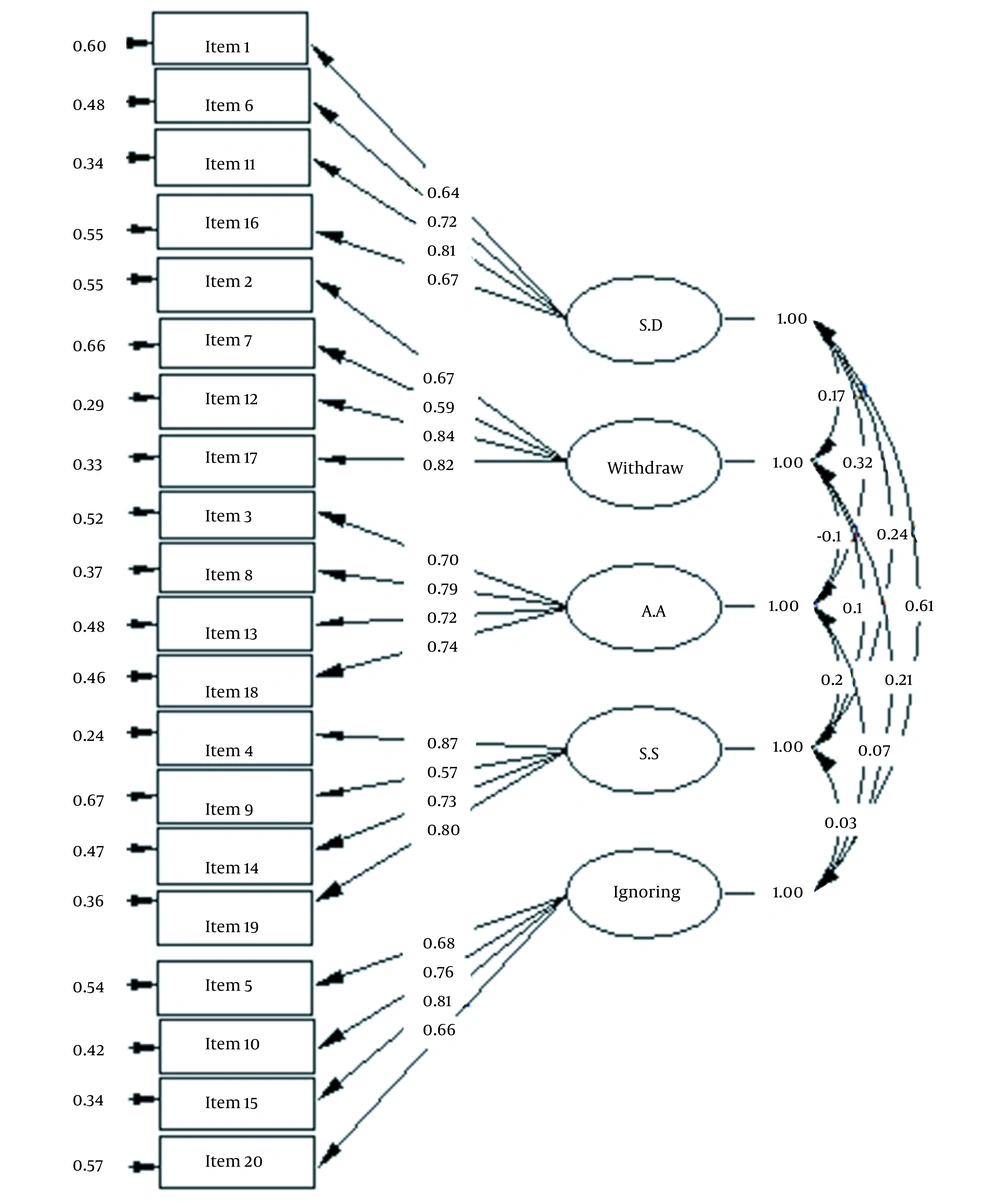
Figure 1.
Five-factor model of behavioral emotion regulation questionnaire. S.D, seeking distraction; A.A, actively approaching; S.S, seeking social support.
Table 2.Fit Indices of Behavioral Emotion Regulation Questionnaire
| Fit Indices | χ2 | P | χ2/F | RMR | GFI | AGFI | NFI | CFI | IFI | NNFI | RMSEA |
|---|---|---|---|---|---|---|---|---|---|---|---|
| BERQ | 392.48 | 0.001 | 2.45 | 0.07 | 0.88 | 0.85 | 0.90 | 0.94 | 0.94 | 0.92 | 0.07 |
Abbreviations: AGFI, the adjusted goodness of fit index; BERQ, Behavioral Emotion Regulation Questionnaire; CFI, the comparative fit index; GFI, the goodness of fit index; IFI, the incremental fit index; NFI, the normed fit index; NNFI, the non-normed fit index; RMR, the root mean square residual; RMSEA, the root mean square error of approximation.
Table 3.Convergent and Divergent Validity of Behavioral Emotion Regulation Questionnaire Subscales a
| Variables | CERQ Subscales | Depression | Anxiety | Stress | PSWQ | ||||||||
|---|---|---|---|---|---|---|---|---|---|---|---|---|---|
| Self-blame | Acceptance | Rumination | Positive Refocusing | Refocus on Planning | Positive Reappraisal | Putting into Perspective | Catastrophizing | Blaming Others | |||||
| Seeking distraction | -0.13* | 0.17** | -0.14* | 0.25** | 0.19** | 0.21** | 0.17** | -0.10 | -0.11* | -0.18** | -0.14* | -0.03 | -0.10 |
| Withdrawal | 0.07 | -0.08 | 0.11* | -0.24** | -0.26** | -0.25** | -0.16** | 0.19** | 0.16** | 0.52** | 0.45** | 0.43** | 0.51** |
| Actively approaching | -0.18** | 0.35** | -0.19** | 0.41** | 0.49** | 0.46** | 0.39** | -0.27** | -0.24** | -0.24** | -0.20** | -0.15** | -0.23** |
| Seeking social support | -0.20** | 0.30** | -0.29** | 0.22** | 0.18** | 0.20** | 0.27** | -0.17** | -0.12* | -0.17** | -0.13* | -0.17** | -0.27** |
| Ignoring | 0.09 | -0.18** | 0.09 | -0.01 | -0.13* | -0.14* | -0.16** | 0.19** | 0.15* | 0.19** | 0.19** | 0.06 | 0.08 |
Abbreviations: CERQ, Cognitive Emotion Regulation Questionnaire; PSWQ, Penn State Worry Questionnaire.
a * P < 0.05, ** P < 0.01.
According to Table 3, among the subscales of the BERQ, not only actively approaching but also seeking distraction and social support had a significant positive correlation with adaptive cognitive emotion regulation strategies (for instance, acceptance or positive reappraisal). However, withdrawal and ignoring were negatively associated with maladaptive cognitive emotion regulation strategies. Moreover, there was a significant negative association between items related to distraction, support, and active approaching and maladaptive strategies of regulating emotions cognitively (for instance, rumination or other-blame), while ignoring and withdrawal had significant positive correlations with maladaptive cognitive emotion regulation strategies.
5. Discussion
The current study assessed the psychometric properties of the BERQ in an Iranian student sample. The confirmatory factor analysis supported the five-factor structure of the BERQ. Furthermore, in the present study, seeking distraction, actively approaching, and pursuing support in social contexts were considered adaptive behavioral emotion regulation strategies, and withdrawing and remaining in ignorance were known as maladaptive behavioral emotion regulation strategies. Regarding the obtained factors, the present research results concord with Kraaij and Garnefski (19), and Tuna's (20) studies.
Furthermore, the present research showed that the BERQ had suitable internal consistency. A high Cronbach's alpha coefficient was observed for the total scale and all factors. These findings agree with Kraaij and Garnefski (19), and Tuna's (20) findings. In all three studies, high Cronbach's alpha coefficients were obtained. Moreover, to determine the convergent and divergent validity of the BERQ, we utilized the CERQ, PSWQ, and DASS. The results indicated that the positive factors of the BERQ were significantly and positively correlated with the positive cognitive emotion regulation strategies. Also, they had a significant negative correlation with anxiety, depression, stress, and worry. On the other hand, withdrawal and ignoring were correlated significantly and positively with negative cognitive emotion regulation strategies, anxiety, stress, worry, and depression. These results show the suitable convergent and divergent validity of this questionnaire.
Among the positive factors, actively approaching had the highest positive correlation with positive emotion regulation strategies. Simultaneously, seeking distraction and social support were also correlated with positive cognitive emotion regulation strategies significantly and positively. Actively approaching had an adaptive role when dealing with most emotions. According to Lazarus and Folkman, actively addressing a problem or stressful situation is a problem-solving coping strategy. This strategy might reduce distress and stress because it focuses on changing the undesirable situation (11).
At the same time, adaptive distraction has been known as a suitable technique for dealing with emotions and uncomfortable situations. Distracting could reduce rumination and cognitive-attentional syndrome (17, 35). A study by Roelofs et al. (17) indicated that rumination styles are correlated with higher anxiety, and depressive symptoms and distraction are correlated with fewer anxiety and depressive symptoms. According to Wells (35), the cognitive-attentional syndrome is the reason for the continuation of many psychopathological symptoms, and attention training could be a potential solution.
Moreover, many research articles have emphasized the importance of social support (14, 15). Seeking social support refers to the efforts actively made to share negative feelings with others and ask for their advice for coping with challenging situations (19). Seeking social support is positively correlated with a higher quality of life in children and adolescents (36), higher resilience against stress (37), lower reactivity in adolescents (38), and lower stress and depression levels (39).
Overall, actively approaching, seeking social support, and distraction are considered adaptive because they could facilitate the adoption of active approaches against adverse events, reduction of emotions, and elimination of distressing circumstances. On the other hand, ignoring is somewhat similar to the denial mechanism. Here, the individuals act as if they are not troubled by stressors. Therefore, no practical actions are taken to reduce distress or modify behaviors. According to Lazarus and Folkman (11), withdrawal is an emotion-based defense through which individuals stay away mentally or physically from stressful situations.
This investigation had some limitations that future studies could consider. First, this study was done on a non-clinical student population. Given that the sample of this study included educated non-clinical participants, future studies may focus on this scale's psychometric properties in general or clinical populations. Second, the data obtained by this research is based on self-report measurements, which could be a source of bias (like social desirability bias). Therefore, using objective assessments as supplementary scales would be beneficial. Also, this study used positive cognitive emotion regulation strategies to measure the convergent validity of the adaptive behavioral emotion regulation strategies. In future studies, the convergent validity of these strategies could be measured concerning other variables indicating psychological well-being. The last thing to mention is that the test-retest reliability of the scale was not measured, which is suggested for future studies.
5.1. Conclusions
This study showed that the Persian version of the BERQ had a relatively suitable factor structure, validity, and reliability in an Iranian student sample. Therefore, the Persian version could be used as a valid and reliable scale in clinical or research projects.


