
1. Background
Over the past centuries, alcohol has been widely consumed as a medication to relieve pain, reduce stress, and bring joy and happiness (1). Recently, alcohol consumption has drastically increased among youth for reasons such as stress relief, joy, and happiness. A recent study discovered that young adults aged 18 to 25 are the highest alcohol consumers, with 60% of them consuming alcohol for entertainment and pleasure (2). It was further expressed that the increase in drug and alcohol habits among youngsters has led to a rise in negative consequences such as academic failure, legal conflicts, and mortality due to accidents, suicide, including unintentional injury, and loss of behavioral control. Additionally, numerous past studies have detected that alcohol consumption causes social, physical, and psychological problems (3-5).
An individual's ability to experience and tolerate negative emotions is known as distress tolerance (DT) (6). Low distress tolerance may lead to anxiety disorders, poor quality of life, and maladaptive behaviors such as self-harm. An individual with low distress tolerance needs to put in more effort to prevent negative emotions and regulate his or her emotional state (7). Furthermore, it is explained that an individual's ability to tolerate psychological distress (for example, distress tolerance) may lead to moderation of emotional monitoring functions on his/her behavior. Therefore, alcohol and drug users who have poor distress tolerance can be easily provoked and demonstrate high-risk behaviors (8, 9). Findings also showed that difficulty in distress tolerance is a reason for substance abuse (10). Therefore, based on past studies, it can be concluded that there is a positive relationship between drug and alcohol use and the rate of distress tolerance (11).
This surge is concerning, as it correlates with a myriad of adverse outcomes, including academic failure, legal issues, and unintentional injuries, indicating a clear public health crisis (12). Furthermore, low DT is emerging as a critical predictor of maladaptive drinking behaviors among youth, linking poor emotional regulation with increased substance use (13). Understanding the relationship between DT and alcohol consumption is essential for developing targeted interventions that can mitigate the negative consequences associated with substance use in this vulnerable population. As such, comprehensive research into DT's role in alcohol use is indispensable because it can pave the way for evidence-based practices aimed at promoting healthier coping strategies and reducing reliance on substances for emotional relief (14).
Since alcohol consumption and drug habits are cultivated during adolescence and youth, the absence of proper monitoring may burden the community from health and socio-economic aspects. Therefore, educational programs need to play a crucial role in creating awareness among youth on distress tolerance strategies to prevent and reduce students' high-risk behaviors. To identify the affected youth alcohol and drugs with low distress tolerance, an appropriate questionnaire will be necessary in the native language to detect the distress tolerance of young alcoholics and drug addicts. For this purpose, one of the appropriate tools is the Distress Tolerance Scale (DTS) Questionnaire, which was designed and validated in 2005 by Jeffrey S. Simons and Gaher (6). It is a self-reported indicator of emotional distress tolerance with 15 items and four subscales that focus on Tolerance, Appraisal, Absorption, and Regulation.
2. Objectives
Thus, this study is designed to translate the DTS by Simons and Gaher (6) into the Persian language and then validate the translated questionnaire among alcoholic and drug-addicted young adults. The availability of a culturally adapted DTS provides therapists with a valuable resource to assess and understand the psychological functioning of their clients. The insights gained from using this scale can inform therapeutic approaches, enabling professionals to focus on specific behavioral and emotional aspects of distress tolerance that are particularly relevant to their clients' experiences. Consequently, this can lead to more effective treatment plans that address both psychological and social functioning.
In summary, the Persian version of the DTS is necessary not only for its cultural relevance but also for its validated psychometric properties, its role in addressing treatment outcomes, and its practical implications in therapeutic settings. This scale serves as a critical tool in understanding and improving the mental health of drug addicts and alcoholics within the Iranian context.
3. Methods
3.1. Design
This study was a cross-sectional methodological study designed to assess the psychometric properties of the Persian version of the DTS among young adult alcoholics and drug addicts. The first stage involved translating all items in the questionnaire. Subsequently, exploratory and confirmatory factor analyses, as well as reliability tests, were conducted on the translated items.
3.2. Study Participants and Sample
In this study, 470 drug and alcohol users were selected using a convenient sampling method from Iranian sample populations in prisons, addiction rehabilitation camps, hospitals, addiction treatment clinics that dispense methadone, and NA centers in one of the cities in the north of Iran in the year 2021. The inclusion criteria for participation were as follows: Respondents had a minimum education level (elementary), were aged between 20 and 45 years, both alcohol and drug use were detected through urine tests, and participants were non-dependent on stimulants. Additionally, opioid users were diagnosed by psychiatrists and clinical psychologists using the Structured Clinical Interview for DSM-5 Disorders Clinician Version (SCID-I/SCID-II) results. Based on exclusion criteria, responses from individuals who did not sign the consent form, failed to answer all survey items, or were diagnosed with psychotic symptoms, cerebral organic disorder, and poisoning with stimulants were excluded from this study.
3.3. Sample Size
Based on the rule of thumb, 200 participants are considered an adequate sample size for performing construct analysis. Aligning with this suggestion, the researcher utilized a sample size consisting of 470 drug and alcohol users in this study, which they split into two groups: 235 for evaluating exploratory factor analysis (EFA) and 235 for evaluating confirmatory factor analysis (CFA).
3.4. Instrument
In this study, we used a two-part questionnaire. The first section gathered demographic information, including age, gender, and type of drug used. The second part featured the DTS, developed and validated by Jeffrey S. Simons and Raluca M. Gaher in 2005. This self-reported questionnaire consists of 15 items divided into four subscales: Tolerance (3 questions), Appraisal (3 questions), Absorption (6 questions), and Regulation (3 questions). Responses are scored on a five-point Likert scale, where higher scores indicate greater distress tolerance. The DTS demonstrates strong internal consistency, with Cronbach's alpha values typically exceeding 0.70, and good test-retest reliability. Construct validity is reinforced through significant correlations with measures of psychopathology and emotional regulation strategies. Overall, the DTS is a sensitive and effective tool for assessing distress tolerance across various clinical and non-clinical populations (4).
3.5. Translation Process
Initially, all 15 items of the questionnaire were translated into Persian by two well-known experts fluent in both English and Persian. In the second step, a team of related specialists, including a psychiatrist, counselor, and researcher, reviewed the translated Persian version of the DTS, compared it with the original manuscript, and developed a comprehensive Persian version of the DTS Questionnaire.
3.6. Construct Validity
Typically, exploratory and confirmatory factor analyses are employed by researchers to investigate construct validity (15). A sample size of 200 is essential to perform factor analysis. Initially, a Maximum Likelihood EFA (MLEFA) with Promax rotation was employed to assess construct validity. Kaiser-Meyer-Olkin (KMO) and Bartlett hypothesis tests were calculated to evaluate the quality of the data. Factors were extracted based on Horn's parallel analysis, Exploratory Graph Analysis, and considering the value of eigenvalue higher than one as the factor retention criterion (16). Additionally, to maintain each item, we used the formula:
In this formula, 'CV' refers to the number of extractable factors, and 'n' is the sample size. The value of CV should be approximately 0.3 for each item.
Upon completing exploratory factor analysis, CFA was conducted by assessing goodness of fit indexes such as Parsimonious Normed Fit Index (PNFI), Parsimonious Comparative Fit Index (PCFI), including Adjusted Goodness of Fit Index (AGFI) > 0.5; Comparative Fit Index (CFI) and Incremental Fit Index (IFI) > 0.9; root mean square error of approximation (RMSEA) < 0.08; and minimum discrepancy function divided by degrees of freedom (CMIN/df) < 3 (17).
3.7. Reliability
Reliability was assessed using internal consistency in this study. The internal consistency evaluation was undertaken through average inter-item correlation (AIC), Cronbach's alpha, and McDonald's omega (Ω) (18). According to the reference (19), internal consistency is considered acceptable when Cronbach's alpha and Ω values are higher than 0.7. Additionally, AIC values between 0.2 and 0.4 are deemed acceptable (20).
3.8. Multivariate Normality and Outliers
In this study, the normal distribution was examined separately using univariate and multivariate distribution methods. Univariate distribution was examined by skewness (± 3) and kurtosis (± 7). The normality of multivariate distribution was assessed using the Mardia coefficient (> 8) (21). At the same time, the existence of multivariate outliers was examined using Mahalanobis d-square (P < 0.001). Finally, all missing data were identified through multiple imputations and then substituted accordingly with the participant's mean response (22). SPSS, AMOS25, and JASP0.9.0.1 software were utilized to perform all relevant statistical analyses for this study.
3.9. Ethics Approval
The Committee of Mazandaran University of Medical Sciences, Sari, Iran, reviewed this study’s research proposal and its survey tools with the ethic code IR.MAZUMS.REC.1399.792. A consent letter was included in the questionnaire to inform participants that all identities would be kept confidential, the research objectives of this study, and that research results would be shared with all officials as well as participants.
3.10. Informed Consent
All procedures adhered to the ethical standards set by the committee on human experimentation (institutional and national), aligning with the Helsinki Declaration of 1975, revised in 2000 (5). Informed consent was obtained from all participants in this study.
4. Results
In total, 470 drug and alcohol users participated in this study. The mean age of the participants was 31.91 years with a standard deviation (SD) of 9.37. In terms of gender, 98.7% of participants were male and 1.3% were female. Among these participants, 85.5% were drug users, 11.7% were stimulant drug users, and 2.8% were alcohol consumers (Table 1).
Table 1.
Exploratory Factors Extracted from Distress Tolerance Scale (N = 235)
| Factors | Factor Loading | H2 | Eigenvalue | Variance (%) |
|---|---|---|---|---|
| Behavioral reactions | 2.812 | 28.121 | ||
| 13. I’ll do anything to stop feeling distressed or upset. | 0.764 | 0.543 | ||
| 14. When I feel distressed or upset, I must do something about it immediately. | 0.701 | 0.423 | ||
| 12. My feelings of distress or being upset scare me. | 0.610 | 0.372 | ||
| 8. I’ll do anything to avoid feeling distressed or upset. | 0.533 | 0.291 | ||
| 11. I am ashamed of myself when I feel distressed or upset. | 0.462 | 0.337 | ||
| 7. My feelings of distress or being upset are not acceptable. | 0.402 | 0.259 | ||
| Perceived feelings | 2.197 | 21.967 | ||
| 3. I can’t handle feeling distressed or upset. | 0.664 | 0.388 | ||
| 1. Feeling distressed or upset is unbearable to me. | 0.649 | 0.412 | ||
| 5. There’s nothing worse than feeling distressed or upset. | 0.631 | 0.404 | ||
| 2. When I feel distressed or upset, all I can think about is how bad I feel. | 0.442 | 0.375 |
The KMO value was 0.858, indicating that the sampling is adequate. Bartlett’s test outcome was 1120.034 (P < 0.0001), which indicated homogeneity of variances. Furthermore, the result of the MLEFA extracted two factors: “Behavioral reactions” and “Perceived feelings,” with eigenvalues of 2.812 and 2.197, respectively, which explained 50.08% of the total variance. The EFA analysis provided factor loadings greater than 0.51 for all items (P < 0.0001), indicating significance, which means both factors strongly influence the variable. The above-mentioned results are shown in Table 1.
Table 2.
Fit Indices of the First and Second-Order Confirmatory Factor Analysis of the Distress Tolerance Scale (N = 235) a
| Indices | χ2 | df | P-Value | CMIN/df | RMSEA (CI 90%) | PNFI | PCFI | TLI | IFI | CFI |
|---|---|---|---|---|---|---|---|---|---|---|
| First order after structure modification | 92.109 | 34 | < 0.0001 | 2.709 | 0.060 (0.046 to 0.075) | 0.919 | 0.715 | 0.929 | 0.947 | 0.947 |
Abbreviations: df, degree of freedom; PCFI, Parsimonious Comparative Fit Index; PNFI, Parsimonious Normed Fit Index; CMIN/df, minimum discrepancy function divided by degrees of freedom; RMSEA, root mean square error of approximation; TLI, Tuker-Lewis Index; CFI, Comparative Fit Index; IFI, Incremental Fit Index.
a Fitness indexes: PNFI, PCFI (> 0.5); TLI, IFI, CFI (> 0.9), RMSEA (< 0 .08), CMIN/df (< 3 good, < 5 acceptable).
Moreover, Table 2 and Figure 1 exhibit the results of the CFA. The CFA results confirmed the model extracted by the EFA, and all goodness of fit indices were within acceptable limits. In addition, as shown in Table 3, the internal consistency of the two factors for the DTS was considered acceptable, with values greater than 0.7 (Table 3 and Figure 1).
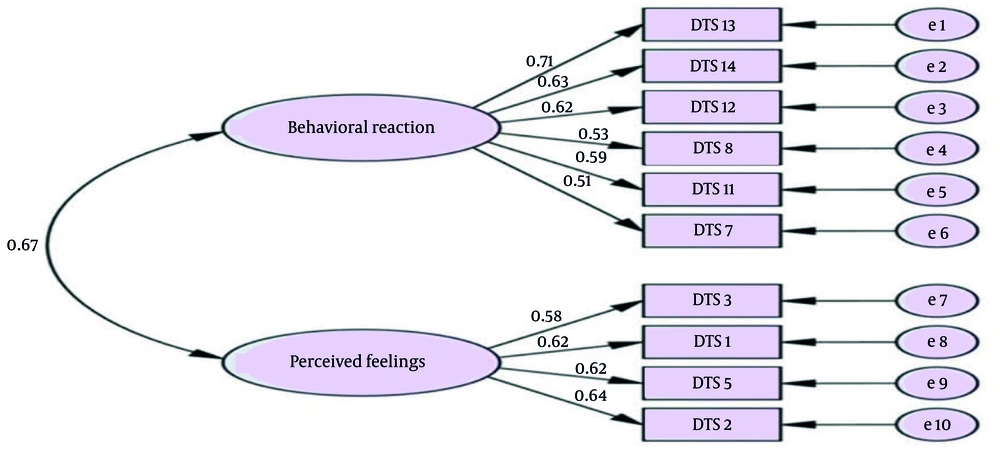
Figure 1.
First order confirmatory factor analysis (CFA) of Distress Tolerance Scale (DTS) (n = 235)
Table 3.
The Indices of Internal Consistency of Distress Tolerance Scale for the First-Order Confirmatory Factor Analysis (N = 235)
| Variables | Alpha | Omega | AIC |
|---|---|---|---|
| Behavioral reactions | 0.76 (0.73 to 0.80) | 0.77 | 0.35 |
| Perceived feelings | 0.71 (0.66 to 0.75) | 0.71 | 0.38 |
Abbreviation: CFI, average inter-item correlation.
5. Discussion
The main purpose of the present study was to translate the DTS, developed by Simons and Gaher in 2005 (6), into the Persian language and validate its psychometric properties. This study was conducted among alcohol consumers and drug users. The findings indicated that among alcohol consumers and drug users, the DTS includes two distinct and stable factors: “Behavioral reactions” and “Perceived feelings,” which explain 50.08% of the total variance. This outcome is consistent with You & Leung's 2012 study (23), which extracted two factors, “General Distress Intolerance” and “Regulation subscale,” using EFA with 55.85% of the total variance. Other similar studies include Hsu et al. in 2013 (24), which extracted one factor with 59.13% variance, and Raykos et al. in 2009 (25), which extracted four factors, including "Anticipating and Managing Effect,” “Anticipating and Managing Loneliness,” “Cognitive Avoidance of Effect,” and “Behavioral Avoidance of Positive Effect,” with 52% of the total variance. These variations in past findings were possibly due to demographic differences, such as targeted populations and culture, which is somewhat consistent with our findings.
This study found two profound constructs of the DTS among the surveyed alcoholics and drug addicts: “Behavioral reactions” and “Perceived feelings.” Such findings indicate that alcoholics and drug addicts are more influenced by the behavioral and emotional aspects of distress tolerance. This is consistent with Pedrelli et al. in 2018 (9), which disclosed a positive relationship between drug addicts and alcoholics with the rate of distress tolerance. Hence, behavioral and emotional responses related to distress tolerance are considered important constructs in this questionnaire. Besides that, the CFA results confirmed a good fit, and similar results were also found in previous studies (23, 26).
Finally, the internal consistency was evaluated through AIC, Cronbach's alpha, and McDonald's omega, exhibiting an acceptable level of outcome. The value of AIC in this study was greater than 0.4, which is considered acceptable. Additionally, the results confirmed a high value of Cronbach's alpha (27). A high Cronbach's alpha is indicative of the internal stability of the scale and the correlation among items that measure a structure. According to our findings, Sandín et al. in 2017 (26) and Hsu et al. (24) also highlighted the importance of having a Cronbach's alpha value greater than 0.8 for each construct. Finally, the CR value of this study was good. According to Sharif Nia et al. study (27), CR is not influenced by the volume of items but is based on the factor load of each latent variable item.
5.1. Conclusions
The present study successfully translated and validated the DTS into Persian among alcohol consumers and drug users. The findings revealed two significant factors: "Behavioral reactions" and "Perceived feelings," which accounted for over 50% of the total variance. This scale highlighted the emotional and behavioral dimensions of distress tolerance in these populations. Overall, the DTS's strong internal consistency and CFA results suggest that it is a reliable tool for assessing distress tolerance in Persian-speaking individuals.
5.2. Limitations
The first limitation was that the Persian version of the DTS was not able to fully convey the cultural differences and language nuances. Secondly, a past study has suggested that the credibility of the DTS can be assessed using alternative distress tolerance measures (e.g., behavioral measures) or standard criteria (e.g., physician-level tools, clinical interviews) (26). Thirdly, this questionnaire will only be useful for investigating non-English speaking Iranians.
5.3. Suggestions
In alignment with the study by Sandin et al. (26), it is suggested that future studies should focus on measuring possible relationships between DTS and factors such as anxiety sensitivity, emotional avoidance, intolerance to distress, impact on intensity, ambiguity tolerance, and other related structures.
5.4. Implications
The findings of this study may attract the attention of physicians and therapists, encouraging them to focus on and find appropriate medical diagnoses and care for all drug and alcohol users. Based on the results of this psychometric study, therapists should concentrate on the psychological and social functioning of alcohol and drug abuse victims to provide more effective treatment services.