
1. Background
The term emotion refers to a feeling accompanied by specific thoughts, psychological and physiological states, and a range of action tendencies associated with that feeling. Emotions can vary in intensity from mild to severe, in valence from positive to negative, and in type from primary to secondary. From an evolutionary perspective, emotions are inherited traits passed down from early humans. Because of their adaptive functions, emotions have been preserved in the human species. They enable individuals to respond adaptively to the challenges and opportunities encountered in daily life (1).
Almost all contemporary theories of emotion emphasize its adaptive and constructive role in human behavior (2). At the same time, it is important to recognize that, despite their positive and functional contributions, emotions can also have a destructive dimension in an individual’s life. In fact, an emotion becomes problematic and potentially harmful when it is expressed inappropriately, occurs in an unsuitable context, is excessively intense, or persists for an extended period (3).
Disgust, or revulsion, is a basic and primary emotion that is typically triggered by stimuli associated with illness or malaise (4). From an evolutionary perspective, disgust is an aversive reaction and an intense feeling of repulsion that stems from the threat-detection system. It serves a warning function aimed at protecting the body from harm (5).
Although historically considered a neglected emotion in psychiatry, recent studies have demonstrated that disgust plays a significant role in psychopathology (6). In this regard, research has linked self-directed disgust to various physical and psychological dysfunctions, including disability (7), chronic physical illnesses (8), sexual dysfunction (9), depression (10), obsessive-compulsive disorder (OCD) (11), eating disorders (12), traumatic experiences (13), rejection and betrayal (14), self-harm and suicide, schizophrenia (15), and bipolar disorder (16). In a study titled Disgust as a Transdiagnostic Marker of Psychopathology, Culicetto et al. (17) suggested that altered disgust may serve as a transdiagnostic indicator of mental illness.
In contrast, the role of self-conscious emotions—such as jealousy, shame, and guilt—has received comparatively less attention in psychiatric disorders. Recent theories and empirical findings suggest that self-conscious emotions serve important adaptive interpersonal functions. From an adaptive perspective, the self-reflective and self-evaluative processes associated with these emotions are considered essential tools for resolving adaptive challenges related to social valuation (18).
Fowke et al. (19) showed that individuals diagnosed with bipolar disorder reported more childhood maltreatment and higher levels of shame than a control group. Individuals with bipolar disorder may experience shame either in response to, or as a consequence of, engaging in purposeless behaviors during manic episodes (20), as well as because of the psychological consequences of mania.
Keen et al. (21) demonstrated that individuals with schizophrenia and depression exhibited higher levels of external shame—that is, perceiving others as shameful—than a rheumatoid arthritis control group. In patients with schizophrenia, perceiving others as shameful was associated with higher levels of depression (21). The development of depression following psychosis is linked to negative evaluations, including loss of social role, humiliation, self-blame, shame, and entrapment (22).
Vivas et al. (23) found that trait levels of self-disgust and guilt were, respectively, higher and lower in patients with schizophrenia than in control participants.
Highfield et al. (24) investigated the experience of self-conscious emotions in individuals with bipolar disorder, unipolar depression, and non-psychiatric controls. They found that the bipolar group exhibited higher levels of shame and a lower tendency toward guilt. The unipolar depression group showed higher levels of shame than both the bipolar and control groups.
Jealousy is another self-conscious emotion whose role in psychiatric disorders has been largely overlooked. It is considered one of the most powerful motivational forces across the lifespan and is a universal emotional experience that occurs in nearly all close interpersonal relationships, including those with parents, siblings, friends, and romantic partners (25).
In one study, the prevalence of delusional jealousy was reported to be 1.1% among 8,134 hospitalized psychiatric patients. The highest prevalence rates were found among patients with organic psychoses (0.7%), paranoid disorders (6.7%), alcohol-induced psychosis (5.6%), and schizophrenia (2.5%). In contrast, only 0.1% of patients with affective disorders exhibited delusional jealousy (26).
In a cross-sectional descriptive study, Singh et al. (27) examined the phenomenology and predisposing factors of morbid jealousy in an open psychiatric setting. Their results showed that morbid jealousy was twice as prevalent in men as in women. The highest prevalence was observed among participants with higher secondary education, middle socioeconomic status, and psychiatric diagnoses of schizophrenia, followed by major depressive disorder (27).
To date, self-conscious emotions have been neglected in research, and their importance in the development and maintenance of mental disorders such as schizophrenia, depression, and bipolar disorder has not been adequately considered. The clinical and research relevance of disgust, jealousy, shame, and guilt, alongside their substantial theoretical and practical implications, prompted the present study to investigate and compare these emotions among individuals diagnosed with major depressive disorder, bipolar disorder, and schizophrenia, relative to a group of healthy controls. These psychiatric disorders have complex and profound impacts on individuals’ lives. However, limited research has addressed the role and significance of disgust, jealousy, shame, and guilt in these clinical populations. These emotions have been largely overlooked in contemporary psychiatric research, and their potential contribution to the psychopathology of depressive, bipolar, and schizophrenic disorders remains underexplored.
Given the considerable overlap among these disorders, a clearer understanding of these emotions is important. If any of the clinical groups exhibit significantly elevated levels of these emotions, further research may pave the way for the development of targeted therapeutic interventions tailored to their specific needs. Disgust, jealousy, shame, and guilt remain relatively unexplored domains within the field of psychopathology.
2. Objectives
Therefore, the present study aimed to compare these emotional constructs among individuals diagnosed with schizophrenia, bipolar disorder, or major depressive disorder, as well as a group of healthy controls.
3. Methods
3.1. Study Design, Participants, and Sampling
This study employed a descriptive, causal-comparative design. The statistical population comprised all patients diagnosed with major depressive disorder, bipolar disorder, and schizophrenia who visited the psychiatric outpatient clinic of Golestan Hospital, Ahvaz Jundishapur University of Medical Sciences, in 2024. In total, 160 participants were enrolled, including 40 patients with major depressive disorder, 40 patients with bipolar disorder, 40 patients with schizophrenia, and 40 healthy controls.
Based on prior research (23, 24) and recommendations that 30 participants per group are adequate for causal-comparative studies, 40 participants were recruited per group to enhance representativeness and external validity. Convenience sampling was used. Eligible patients were recruited according to the inclusion and exclusion criteria from among those attending the psychiatric clinic at Golestan Hospital. The healthy control group was recruited from staff members working at the Golestan healthcare center.
After obtaining ethical approval from Ahvaz Jundishapur University of Medical Sciences and securing the necessary permissions, the researcher entered the study setting. Participants were fully informed about the study objectives before providing informed consent and completing the questionnaires. All participants received detailed explanations of the study purpose, procedures, and ethical considerations. Participants were then asked to complete a written informed consent form. Participation imposed no costs or financial burden on the participants.
Inclusion criteria for participants in the clinical groups (depression, bipolar disorder, and schizophrenia) were as follows: a confirmed diagnosis of major depressive disorder, bipolar disorder, or schizophrenia based on the Structured Clinical Interview for DSM-5 (SCID-5) conducted by a board-certified psychiatrist; being in a non-acute phase of the disorder; provision of written informed consent; absence of intellectual disability; a minimum education level of fifth grade; age 18 - 60 years; and no history of electroconvulsive therapy (ECT) during the study period. Participants with bipolar disorder were required to be in a manic or hypomanic phase but not in an acute phase of illness, as determined by the psychiatrist.
Exclusion criteria for the clinical groups included a history of brain injury, a diagnosis of dementia, the presence of neurological disorders requiring specialized care, and being under the influence of, or undergoing withdrawal from, any psychoactive substances at the time of assessment. Routine use of nicotine or caffeine was not considered an exclusion criterion.
Inclusion criteria for the healthy control group were the absence of any history of intellectual disability, no diagnosis of neurological disorders associated with cognitive decline (e.g., Parkinson's disease or Alzheimer's disease), and no psychiatric disorders, as determined by clinical examination and interview. The exclusion criterion for the healthy control group was unwillingness to participate in the study.
3.2. Instruments
3.2.1. Structured Clinical Interview for DSM-5, Clinical Version
The Structured Clinical Interview for DSM-5, Clinical Version (SCID-5-CV), was developed by First et al. in 2015 based on DSM-5. The SCID-5-CV is a semi-structured diagnostic interview designed to assess the major Axis I disorders outlined in the DSM-5. It is administered by trained clinicians who are familiar with the diagnostic criteria and classification system of the DSM-5. The SCID-5-CV is appropriate for use with psychiatric patients, individuals with general medical conditions, and members of the general population who may not identify themselves as having a mental disorder (e.g., participants in epidemiological studies or relatives of patients). The diagnostic coverage and language used in the SCID-5-CV make it suitable for individuals aged 18 years and older. However, with minor modifications to the phrasing of certain questions, it may also be used with adolescent populations. Sharifi et al. (28) reported acceptable diagnostic reliability and satisfactory operability for the Persian version of the SCID. The kappa coefficient for all diagnoses was above 0.40.
3.2.2. Short Form of the Multidimensional Jealousy Scale
This scale comprises 15 items that measure jealousy across three dimensions (cognitive, emotional, and behavioral), each represented by five items. Diotaiuti et al. validated the scale in Italy in 2022. The scale includes cognitive, emotional, and behavioral subscales, each comprising five items. Responses are rated on a 7-point Likert scale ranging from 1 (Always) to 7 (Never). The minimum score is 15 and the maximum score is 105. Scores are summed separately for each subscale to yield dimension-specific scores, as well as a total jealousy score. Reported Cronbach's alpha coefficients indicate acceptable internal consistency: 0.76 for cognitive jealousy, 0.82 for emotional jealousy, 0.70 for behavioral jealousy, and 0.79 for the total scale (29).
Findings from a study by Rahimi et al. (30) in Iran further confirmed the reliability of the Persian version of the Multidimensional Jealousy Scale, reporting Cronbach’s alpha coefficients ranging from 0.83 to 0.94 across the three subscales.
3.2.3. State Shame and Guilt Scale
The original version of the State Shame and Guilt Scale, developed by Marschall et al. (31), consists of 15 items distributed across three subscales (shame, guilt, and pride), with five items per subscale. Respondents rate each item on a 5-point Likert scale ranging from 1 (Not feeling this way at all) to 5 (Feeling this way very strongly). Five items measure shame and five items measure guilt. The minimum score for feelings of guilt is 5 and the maximum is 25. The minimum score for feelings of shame is 5 and the maximum is 25. Reported Cronbach’s alpha coefficients indicate high internal consistency: 0.89 for the shame subscale, 0.82 for guilt, and 0.87 for pride (31).
In a study conducted by Varmaghani et al. (32) in an Iranian sample, the 10-item version of the SSGS demonstrated a two-factor structure corresponding to shame and guilt, reflecting the cultural context. Varmaghani et al. (32) reported Cronbach's alpha coefficients of 0.93 for the entire scale and 0.88 and 0.93 for the shame and guilt factors, respectively.
3.2.4. Self-Disgust Scale
The Self-Disgust Scale is a 14-item instrument developed by Schienle et al. (33) in 2014 to assess disgust directed toward specific aspects of oneself. The scale was standardized in a sample of 895 participants aged 15 - 71 years. It is considered a reliable, valid, and cost-effective tool for measuring self-disgust (33). Items are rated on a 5-point Likert scale ranging from 0 (Not at all true of me) to 4 (Very true of me). The minimum score is zero and the maximum is 56. The scale has demonstrated satisfactory psychometric properties (33). In this study, Cronbach's alpha coefficient for the Self-Disgust Scale was 0.78.
3.3. Statistical Analysis
In addition to descriptive statistics, the data were analyzed using one-way analysis of variance (ANOVA), analysis of covariance (ANCOVA), and the chi-square test. All statistical analyses were conducted using SPSS software, version 26.
3.4. Ethical Considerations
This study was approved by the Ethics Committee of Golestan Hospital, Ahvaz Jundishapur University of Medical Sciences, with the ethics code IR.AJUMS.HGOLESTAN.REC.1403.024.
4. Results
4.1. Sample Characteristics and Group Comparisons
A total of 160 individuals participated in this study. As shown in Table 1, each group comprised 40 participants.
Table 1.
Demographic Characteristics of the Participants by Group (N = 160) a
| Variables | Healthy (n = 40) | Schizophrenia (n = 40) | Bipolar (n = 40) | Depression (n = 40) | χ2 (P-Value) |
|---|---|---|---|---|---|
| Gender | 6.68 (P = 0.08) | ||||
| Male | 14 (8.75) | 21 (13.12) | 24 (15.00) | 24 (15.00) | |
| Female | 26 (16.25) | 19 (11.87) | 16 (10.00) | 16 (10.00) | |
| Marital Status | 13.30 (P = 0.004) | ||||
| Single | 10 (6.25) | 25 (15.62) | 20 (12.50) | 23 (14.37) | |
| Married | 30 (18.75) | 15 (9.37) | 20 (12.50) | 17 (10.62) | |
| Education | 80.05 (P < 0.001) | ||||
| Below diploma | 0 (0.00) | 29 (18.12) | 17 (10.62) | 13 (8.12) | |
| Diploma | 12 (7.50) | 11 (6.87) | 10 (6.25) | 22 (13.75) | |
| Associate | 5 (3.12) | 0 (0.00) | 0 (0.00) | 2 (1.25) | |
| Bachelor | 10 (6.25) | 0 (0.00) | 8 (5.00) | 3 (1.87) | |
| Master+ | 13 (8.12) | 0 (0.00) | 5 (3.12) | 0 (0.00) | |
| Employment | 35.00 (P < 0.001) | ||||
| Employed | 34 (21.25) | 8 (5.00) | 17 (10.62) | 21 (13.12) | |
| Unemployed | 6 (3.75) | 32 (20.00) | 23 (14.37) | 19 (11.87) | |
| Living Status | 5.22 (P = 0.15) | ||||
| With family | 38 (23.75) | 39 (24.37) | 40 (25.00) | 36 (22.50) | |
| Alone | 2 (1.25) | 1 (0.62) | 0 (0.00) | 4 (2.50) | |
| Medical Illness | 5.68 (P = 0.45) | ||||
| Yes | 4 (2.50) | 4 (2.50) | 7 (4.37) | 7 (4.37) | |
| No | 36 (22.50) | 36 (22.50) | 33 (20.62) | 33 (20.62) | |
| Hospitalization | 54.48 (P < 0.001) | ||||
| Yes | 0 (0.00) | 26 (16.25) | 30 (18.75) | 23 (14.37) | |
| No | 40 (25.00) | 14 (8.75) | 10 (6.25) | 17 (10.62) |
a Values are expressed as No. (%).
As shown in Table 1, the chi-square test indicated no significant differences among the groups in terms of gender, living status, or the presence of medical illness (P > 0.05). However, significant group differences were observed in marital status, education level, employment status, and history of hospitalization (P < 0.05). One-way ANOVA showed no significant difference in age among the groups (P > 0.05).
Descriptive statistics for shame, guilt, jealousy, and self-disgust across the study groups are presented in Table 2.
Table 2.
Descriptive Statistics of Shame, Guilt, Jealousy, and Self-Disgust Across Study Groups a
| Variables | Healthy | Schizophrenia | Bipolar | Depression |
|---|---|---|---|---|
| Guilt | 7.42 ± 2.79 | 17.17 ± 6.84 | 13.65 ± 7.51 | 23.05 ± 3.52 |
| Shame | 5.25 ± 0.58 | 16.15 ± 6.88 | 7.70 ± 5.31 | 22.57 ± 4.03 |
| Jealousy | 40.05 ± 10.25 | 76.70 ± 20.80 | 72.77 ± 22.67 | 79.52 ± 18.37 |
| Self-Disgust | 4.35 ± 4.60 | 34.85 ± 13.57 | 12.70 ± 15.38 | 47.71 ± 8.43 |
a Values are expressed as mean ± SD.
The results of the Kolmogorov-Smirnov test for guilt, shame, jealousy, and self-disgust were not significant (P > 0.05), indicating that the scores for these variables were normally distributed. Given that educational status, employment status, and marital status differed significantly between groups, analysis of covariance (ANCOVA) was used. To examine differences in guilt across groups, ANCOVA was conducted. The assumptions of ANCOVA were met. The results of the ANCOVA for between-group differences in guilt are presented in Table 3. According to Table 3, there was a significant between-group difference in guilt (P < 0.05). The Bonferroni test was used for post hoc comparisons (P < 0.05).
Table 3.
Results of Analysis of Covariance (ANCOVA) for the Variable of Guilt Among Groups
| Source of Variation | Sum of Squares | Degrees of Freedom | Mean Square | F | P Value | Effect Size (η2) | Power |
|---|---|---|---|---|---|---|---|
| Between Groups | 3755.928 | 3 | 1251.97 | 41.53 | < 0.001 | 0.44 | 1.00 |
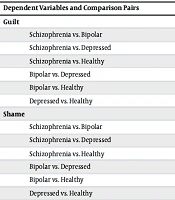
The results of pairwise comparisons between groups for guilt are shown in Table 4. Pairwise comparisons showed that the mean guilt score in individuals with schizophrenia was significantly higher than that in those with bipolar disorder (P < 0.05). The mean guilt score in individuals with depression was significantly higher than that in those with schizophrenia (P < 0.05). The mean guilt score in individuals with schizophrenia was significantly higher than that in healthy controls (P < 0.05). The mean guilt score in individuals with depression was significantly higher than that in those with bipolar disorder (P < 0.05). The mean guilt score in individuals with bipolar disorder was significantly higher than that in healthy controls (P < 0.05). Finally, the mean guilt score in individuals with depression was significantly higher than that in healthy controls (P < 0.05).
Table 4.
Results of Pairwise Comparisons Between Groups for Shame, Jealousy, Guilt, and Disgust
| Dependent Variables and Comparison Pairs | Mean Difference | Standard Error | Significance (P) | Lower Bound | Upper Bound |
|---|---|---|---|---|---|
| Guilt | |||||
| Schizophrenia vs. Bipolar | 3.56 | 1.33 | 0.04 | 0.17 | 7.14 |
| Schizophrenia vs. Depressed | -6.28 | 1.29 | < 0.001 | -9.73 | -2.82 |
| Schizophrenia vs. Healthy | 9.74 | 1.72 | < 0.001 | 5.13 | 14.36 |
| Bipolar vs. Depressed | -9.84 | 1.25 | < 0.001 | -13.20 | -6.48 |
| Bipolar vs. Healthy | 6.18 | 1.41 | < 0.001 | 2.41 | 9.95 |
| Depressed vs. Healthy | 16.02 | 1.50 | < 0.001 | 12.01 | 20.04 |
| Shame | |||||
| Schizophrenia vs. Bipolar | 8.22 | 1.14 | < 0.001 | 5.16 | 11.28 |
| Schizophrenia vs. Depressed | -7.09 | 1.10 | < 0.001 | -10.05 | -4.13 |
| Schizophrenia vs. Healthy | 10.13 | 1.48 | < 0.001 | 6.17 | 14.09 |
| Bipolar vs. Depressed | -15.31 | 1.07 | < 0.001 | -18.19 | -12.43 |
| Bipolar vs. Healthy | 1.91 | 1.20 | 0.69 | -1.31 | 5.14 |
| Depressed vs. Healthy | 17.22 | 1.28 | < 0.001 | 13.79 | 20.66 |
| Disgust | |||||
| Schizophrenia vs. Bipolar | 21.44 | 2.78 | < 0.001 | 14.01 | 28.88 |
| Schizophrenia vs. Depressed | -13.64 | 2.70 | < 0.001 | -20.87 | -6.42 |
| Schizophrenia vs. Healthy | 28.69 | 3.59 | < 0.001 | 19.08 | 38.29 |
| Bipolar vs. Depressed | -21.44 | 2.78 | < 0.001 | -28.88 | -14.01 |
| Bipolar vs. Healthy | 7.24 | 2.93 | 0.08 | -0.59 | 15.08 |
| Depressed vs. Healthy | 42.33 | 3.13 | < 0.001 | 33.95 | 50.72 |
| Jealousy | |||||
| Schizophrenia vs. Bipolar | 3.67 | 4.52 | 1.000 | -8.42 | 15.77 |
| Schizophrenia vs. Depressed | -2.74 | 4.37 | 1.000 | -14.44 | 8.95 |
| Schizophrenia vs. Healthy | 36.91 | 5.84 | < 0.001 | 21.28 | 52.54 |
| Bipolar vs. Depressed | -6.41 | 4.25 | 0.801 | -17 - 79 | 4 - 95 |
| Bipolar vs. Healthy | 33.23 | 4.77 | < 0.001 | 20.48 | 45.99 |
| Depressed vs. Healthy | 39.65 | 5.08 | < 0.001 | 26.07 | 53.24 |
The results of the ANCOVA, presented in Table 5, indicated a significant between-group difference in shame (P < 0.05). The results of pairwise comparisons between groups for shame are shown in Table 4. Pairwise comparisons showed that the mean shame score in individuals with schizophrenia was significantly higher than that in individuals with bipolar disorder (P < 0.05). Additionally, the mean shame score in individuals with depression was significantly higher than that in those with schizophrenia (P < 0.05). The mean shame score in individuals with schizophrenia was also significantly higher than that in healthy controls (P < 0.05). Furthermore, the mean shame score in individuals with depression was significantly higher than that in those with bipolar disorder (P < 0.05). Although the mean shame score in individuals with bipolar disorder was higher than that in healthy controls, this difference was not statistically significant (P > 0.05). Finally, the mean shame score in individuals with depression was significantly higher than that in healthy controls (P < 0.05).
Table 5.
Analysis of Covariance (ANCOVA) Results for the Variable of Shame Across Groups
| Source of Variation | Sum of Squares | Degrees of Freedom | Mean Square | F | P-Value | Effect Size | Power |
|---|---|---|---|---|---|---|---|
| Group | 5683.21 | 3 | 1894.40 | 85.66 | < 0.001 | 0.62 | 1.0 |
The results of the ANCOVA, presented in Table 6, indicated significant between-group differences in disgust (P < 0.05). The results of pairwise comparisons between groups for disgust are shown in Table 4. Pairwise comparisons showed that the mean level of disgust in individuals with schizophrenia was significantly higher than that in those with bipolar disorder (P < 0.05). Additionally, individuals with depression exhibited significantly higher levels of disgust than those with schizophrenia (P < 0.05). The mean disgust score in individuals with schizophrenia was also significantly higher than that in the normal group (P < 0.05). Moreover, individuals with depression reported significantly higher levels of disgust than those with bipolar disorder (P < 0.05). Although the mean disgust score in individuals with bipolar disorder was higher than that in healthy controls, this difference was not statistically significant (P > 0.05). Finally, individuals with depression showed significantly greater feelings of disgust than those in the normal group (P < 0.05).
Table 6.
Results of Analysis of Covariance (ANCOVA) for the Variable Disgust Among Groups
| Source of Variation | Sum of Squares | Degrees of Freedom | Mean Square | F | P-Value | Effect Size | Power |
|---|---|---|---|---|---|---|---|
| Group | 31718.74 | 3 | 10572.91 | 81.08 | < 0.001 | 0.61 | 1.00 |
The results of the ANCOVA in Table 7 indicated that between-group differences in jealousy were statistically significant (P < 0.05). The results of pairwise comparisons between groups for jealousy are shown in Table 4. Pairwise comparisons showed that the mean jealousy score in individuals with schizophrenia was higher than that in those with bipolar disorder; however, this difference was not statistically significant (P > 0.05). The mean jealousy score in individuals with depression was higher than that in those with schizophrenia, but this difference was also not statistically significant (P > 0.05). The mean jealousy score in individuals with schizophrenia was significantly higher than that in normal individuals (P < 0.05). The mean jealousy score in individuals with depression was higher than that in those with bipolar disorder, but this difference was not statistically significant (P > 0.05). The mean jealousy score in individuals with bipolar disorder was significantly higher than that in normal individuals (P < 0.05). Finally, the mean jealousy score in individuals with depression was significantly higher than that in normal individuals (P < 0.05).
Table 7.
Analysis of Covariance (ANCOVA) Results for the Jealousy Variable Among Groups
| Source of Variation | Sum of Squares | Degrees of Freedom | Mean Square | F | P-Value | Effect Size | Power |
|---|---|---|---|---|---|---|---|
| Group | 23483.14 | 3 | 7827.71 | 22.66 | < 0.001 | 0.30 | 1.00 |
5. Discussion
Overall, the findings of the present study indicated that shame, guilt, jealousy, and disgust differed significantly among the studied groups. Levels of shame, guilt, disgust, and jealousy were highest in patients with depression, followed by those with schizophrenia, those with bipolar disorder, and healthy individuals.
Lo et al. (34) showed that individuals with major depressive disorder (MDD) exhibit a more pronounced emotional response to guilt than those with bipolar I disorder. Their results also showed that subjective reports and neural correlates of guilt in ambiguous social situations could serve as a potential biomarker to help differentiate between bipolar I disorder and major depressive disorder, even during remission. These findings are consistent with the results of the present study.
Given that over 25% of individuals with bipolar disorder (BD) are misdiagnosed with major depressive disorder (MDD) (35), there is an urgent need for a reliable biomarker to distinguish BD from MDD. Different manifestations and intensities of maladaptive guilt processing may uniquely contribute to the pathogenesis of BD compared with MDD. Furthermore, a study by Ghatavi et al. (36) demonstrated that lower expressions of guilt, shame, and pride distinguish acute depression from other groups, including patients with chronic heart disease and healthy controls.
Although previous research has shown that excessive explicit feelings of guilt may be associated with the development of depression (37), it has also been demonstrated that guilt and its related neural mechanisms in individuals with remitted major depressive disorder can predict the risk of relapse (38). Vivas et al. (23) reported higher trait self-disgust but lower guilt in patients with schizophrenia than in control participants; the lower guilt level contrasts with our findings. The higher guilt scores in our study compared with those reported by Vivas et al. (23) may reflect differences in guilt-assessment instruments and cultural context, including the importance attached to guilt in Islamic culture in Iran.
A major factor contributing to the failure of treatment programs for psychiatric patients is insufficient attention to emotional responses associated with the experience of stigma, particularly shame, across mental disorders. Evidence suggests that shame is the most salient emotional reaction to the stigma surrounding mental illness (39). This emotion not only deters individuals from seeking psychological assistance but also emerges at various stages of treatment. It is well established that many individuals avoid seeking care because of fear of being labeled as mentally ill or because of the internalized shame associated with such labeling (40). A study involving psychiatric patients, including 20 individuals diagnosed with psychotic disorders, indicated that shame—considered a more pathological emotion than embarrassment—may be elevated in individuals with schizophrenia (41).
Guimón et al. (42) conducted a study comparing five groups in terms of shame and guilt. The five groups included 20 individuals with depressive disorder, 12 with bipolar disorder, 15 with anxiety disorder, 15 with psychotic disorder, and 17 with personality disorders (either borderline or antisocial). The mean age of the psychiatric sample was 40.25 years. The comparison group consisted of 93 medical students selected from second- and third-year cohorts. According to the findings of Guimón et al. (42), the mean shame scores were highest among individuals with depression, followed by the comparison group, those with antisocial or borderline personality disorders, those with bipolar disorder, and finally individuals with schizophrenia. Regarding guilt, the mean scores were highest in the depressive group, followed by the comparison group, then the bipolar group, the schizophrenia group, the antisocial or borderline personality disorder group, and lastly the anxiety disorder group. The study by Guimón et al. (42) aligns with the current study in that individuals with depression reported higher levels of shame and guilt than the normal group. However, it diverges from our findings in that individuals with bipolar disorder and schizophrenia in their study reported lower levels of shame and guilt than the comparison group.
In individuals with major depressive disorder (MDD), elevated tendencies toward both shame and guilt have been reported using various assessment tools (36). Guilt and self-disgust grounded in empathy have been associated with depressive symptoms, and this association remained significant even after controlling for levels of shame (43). Self-disgust was found to be related to overly generalized forms of guilt, such as omnipotent responsibility guilt and survivor guilt (44).
Highfield et al. (24) investigated the experience of self-conscious emotions in individuals with bipolar disorder, unipolar depression, and non-psychiatric controls. In the bipolar group, higher levels of shame and lower levels of guilt proneness were observed. Higher levels of shame were found in the unipolar group compared with both the bipolar and control groups. Depression scores were positively correlated with trait shame and shame proneness, accounting for a significant portion of the variance. Bipolar scores were negatively correlated with trait shame (internalized) and guilt proneness. In Highfield et al.'s study (24), trait shame was higher in the unipolar group than in the bipolar group, and higher in the bipolar group than in the control group—findings consistent with our study. Similarly, shame proneness was highest in the unipolar group, followed by the bipolar group, and lowest in the control group, which also aligns with our findings. However, guilt proneness in the unipolar group was higher than in the control group, supporting our results, whereas it was lower in the bipolar group than in the control group, which is inconsistent with our findings. Evidence in the literature suggests that individuals diagnosed with bipolar disorder tend to score in a defensive and self-serving manner on explicit measures, while exhibiting self-deprecating bias on implicit measures (24).
Recent studies in other psychotic populations, although using different criteria to assess shame, have linked the experience of shame to social rank. For example, in a study on first-episode psychosis, Birchwood et al. (45) argued that social anxiety, which is often observed in schizophrenia, may be associated with a perceived loss of status resulting from mental health stigma. Individuals who experience social anxiety tend to report greater shame about their diagnosis, perceiving such a label as something that separates them from others. Recent research on social rank in bipolar disorder (46) has associated mania with a heightened perception of elevated status. The differences observed between the bipolar and unipolar groups in terms of shame may be related to manic processes that foster an exaggerated sense of social rank. This may also align with other theories of bipolar disorder, such as the manic defense hypothesis.
Miller et al. (47) investigated the experience of shame and guilt in individuals with first-episode schizophrenia and schizoaffective disorders. The first episode of schizophrenia—typically defined as the initial five years of illness—constitutes a particularly challenging period of acceptance and adjustment for both patients and their families. As part of this process, feelings of shame and guilt regarding the diagnosis of schizophrenia are common and must be addressed by clinicians in ways that are sensitive to the deeply rooted emotions patients may have about being stigmatized. Miller and colleagues (47) described therapeutic approaches and provided examples based on their work with 71 patients in the early stages of schizophrenia, many of whom experienced intense feelings of worthlessness that were reflected in their speech and behavior as expressions of guilt and shame. In a related study, Park et al. (48) found that external shame, internal shame, and guilt were more prevalent in the psychiatric control group (individuals with depression) than in the schizophrenia group. Moreover, in the medical control group (patients with arthritis), levels of external shame, guilt, and internal shame were lower than in the psychiatric control group but higher than in those with schizophrenia.
Two emotions that are often overlooked during the early phase of treatment are shame and guilt—feelings that frequently persist even after the successful management of psychotic symptoms. Shame, typically distinguished from guilt by its stronger association with harsh self-condemnation, may be more prevalent among patients. Nevertheless, both emotions are likely to occur in young individuals diagnosed with schizophrenia or schizoaffective disorder. Although most clinicians are likely aware of the presence of shame or guilt in their patients, they may not fully grasp the intensity or clinical consequences of these emotions for successful treatment outcomes (47). In countries such as India and Japan, social stigma driven by feelings of guilt and shame has been identified as a major factor influencing patients and their families to avoid seeking treatment (49).
A diagnosis of mental illness—particularly schizophrenia—is often accompanied by social stigma and the emotions of shame and guilt. Shame appears to be closely tied to social ideals and values that are internalized by the individual. From an early age, children learn the significance of exposure and quickly become aware of how they are perceived by others (50).
Stigma and cultural norms may have influenced shame in our study. Collectivist cultures may intensify shame, and modesty and shame are often socially valued in Iranian culture, potentially increasing feelings of shame. Stigma is a social issue rather than an individual problem or an inherent component of illness. Stigma may be a major barrier to initiating and continuing treatment and rehabilitation for mental illness.
Malhi et al. (51) demonstrated that individuals with bipolar disorder exhibit greater difficulty recognizing expressions of disgust than healthy control groups. Experiences of disgust and hatred are considered distinct affective states characterized by parasympathetic activation, avoidant behavior, and feelings of repulsion. Throughout cultural evolution, additional factors have been associated with the emotion of disgust (51). Specific phobias, obsessive-compulsive disorder (OCD), depression, and eating disorders are among the common syndromes believed to involve altered disgust processing (52). In the most commonly used experimental approach, psychiatric patients are shown facial expressions depicting disgust alongside other facial expressions. In a study by Lembke and Ketter (53), individuals with bipolar disorder in a manic phase showed impaired ability to recognize expressions of disgust and fear compared with healthy controls. In contrast, Harmer et al. (16) observed selective recognition of disgust in euthymic individuals with bipolar disorder. Compared with the healthy group, bipolar patients demonstrated facilitated recognition of disgust, which is consistent with our findings.
Schienle et al. (54) investigated disgust sensitivity in psychiatric disorders using a questionnaire-based study. Their findings indicated that disgust sensitivity and hatred were higher in both men and women with schizophrenia than in those with depression, and higher in depressed individuals than in the healthy population. Ille et al. (15) examined increased tendencies toward hatred in schizophrenia. They compared disgust proneness, trait anger, trait anxiety, and hatred among 69 patients with schizophrenia, 68 with depression, and 70 psychologically healthy individuals. Patients with schizophrenia reported greater overall disgust proneness than healthy individuals. While food-related disgust was particularly salient in schizophrenia, death-related disgust was more pronounced in depressed patients. Women reported higher proneness to hatred than men. Both clinical groups showed elevated trait anxiety and trait anger compared with the control group. Moreover, depressed patients reported higher levels of expressed anger and even anger suppression than those with schizophrenia. Ille et al. (15) also found a positive correlation between proneness to hatred and disgust sensitivity in both patient and control groups. The level of hatred was higher in schizophrenia than in depression, which is inconsistent with our findings, whereas it was higher in depression than in bipolar disorder, aligning with our results.
Culicetto et al. (17), in a review study, examined hatred and disgust as transdiagnostic markers of mental illness in clinical populations. Disgust is a fundamental emotion of rejection, functioning as an ancestral defense mechanism against disease. It may serve as a transdiagnostic indicator of psychopathology. Compared with healthy populations, individuals with psychiatric disorders exhibit abnormal processing of disgust (17). Evidence suggests that individuals diagnosed with major depressive disorder (MDD) are more likely to report feelings of self-directed hatred than guilt or shame (55). A study conducted by Ypsilanti (56) investigated the mediating role of self-disgust in the relationship between loneliness and depression. The findings indicated that higher levels of loneliness were associated with greater self-disgust, suggesting that self-disgust may mediate the link between loneliness and depressive symptoms.
Simpson et al. (57) demonstrated that self-disgust mediates the relationship between childhood adversity and psychosis. Theoretically and clinically, self-disgust may be useful for understanding the development and persistence of psychotic experiences (57). Joiner et al. (58) examined the relationship between self-hatred and suicidality in individuals exhibiting symptoms across the schizophrenia spectrum. In Study 1, involving 243 outpatient military-affiliated individuals with suicidal ideation, self-hatred and suicidality were more strongly associated among those with schizotypal symptoms than among other patients. In Study 2, which included 113 psychiatric inpatients, self-hatred and suicidality were more prominent among individuals with schizophrenia than among those diagnosed with major depressive disorder. Joiner et al. (58) suggested that self-hatred should be considered a central factor in suicide risk assessment among individuals with schizophrenia.
When individuals with bipolar disorder experience jealousy, it may be intensified by the symptoms of their illness. They may construct entirely imaginary scenarios centered on perceived injustices. Instead of expressing gratitude, they may nurture feelings of anger and distress. Masiran et al. (59) demonstrated that pathological jealousy can be reactivated during mood episodes. Despite its potential risks for both homicide and suicide, pathological jealousy is a rare and often underestimated condition. Early identification and treatment of pathological jealousy, as well as the underlying primary psychiatric disorder, are crucial for preventing serious consequences—particularly in individuals with a significant forensic psychiatric history. Interviews with individuals presenting with jealousy should include an assessment of marital relationships, sexual history, and past incidents of domestic violence.
Singh et al. (27), in a cross-sectional descriptive study, examined the phenomenology and predisposing factors of pathological jealousy in an open psychiatric setting. Their results indicated that pathological jealousy was twice as prevalent in men as in women. The highest prevalence was observed among participants with higher secondary education, middle socioeconomic status, and psychiatric diagnoses of schizophrenia, followed by depression. The absence of a significant difference in jealousy between the schizophrenia and bipolar groups may relate to the use of a total jealousy score without separate examination of cognitive, emotional, and behavioral dimensions. Disgust sensitivity is positively correlated with the spontaneous activity of the right superior frontal cortex and negatively correlated with the spontaneous activity of the right cerebellum crus II, which are inhibition-related brain regions (60). Activations for both shame and guilt are found in the temporal lobe. Specific activations for shame are found in the frontal lobe (middle and inferior frontal lobes) and for guilt in the amygdala and insula (61).
5.1. Study Limitations
Our findings may have been influenced by differences in the characteristics of the psychiatric sample compared with the control group. Nevertheless, it is generally preferable to select a comparison sample with minimal sociodemographic differences relative to the study cohort. To facilitate a more nuanced understanding of behavioral patterns across psychiatric disorders, there is increasing advocacy for adopting dimensional diagnostic approaches along a continuum, rather than relying exclusively on categorical diagnoses as employed in current classification systems. Such an approach better captures the heterogeneous nature of symptoms, the absence of clear diagnostic boundaries, and enables improved symptom characterization.
Despite the inclusion of a control group, sample sizes remain relatively modest; however, the data retain clinical relevance. Key variables such as illness duration and socioeconomic status were not assessed, potentially influencing variations in emotional experience. The present study did not differentiate among manic subtypes, as further stratification would have undermined statistical power given the sample size. Differences among groups in marital status, education level, and employment status may also have affected the results and should be considered in future research. The study did not examine the effects of psychotropic medications, such as selective serotonin reuptake inhibitors and antipsychotics, on emotion scores. Future studies should examine the potential impact of medications on emotions of disgust, shame, guilt, and jealousy. Further research should use a larger sample size and consider the limitations of our study, particularly the types and doses of medications used by patients.
5.2. Future Directions
Future research should integrate dimensional diagnostics alongside categorical classifications. A more refined understanding of the experiences of shame, guilt, jealousy, and disgust within these disorders may support the implementation of compassionate mind training as an adjunctive psychotherapeutic intervention. Future investigations with larger cohorts allowing for subtype analyses are warranted. Although these findings should be considered preliminary until replicated by further studies, they offer valuable theoretical insights and hold promise for informing targeted intervention strategies. Specifically, they underscore the potential utility of disgust, shame, guilt, and jealousy as transdiagnostic constructs in psychiatric research and treatment. Given that the type and dose of medications may affect mood and emotional processing, future studies should consider the type and dose of medications used by patients.
5.3. Conclusions
The findings of this study demonstrated significant differences in the experiences of shame, guilt, jealousy, and disgust across the examined groups. Specifically, feelings of shame, guilt, disgust, and jealousy were highest among patients with depression, followed by those with schizophrenia, then bipolar disorder, and lowest among healthy controls. Based on these results, there is a clear need to develop and implement targeted psychological interventions addressing these emotional experiences—particularly guilt, shame, jealousy, and disgust—in these patient populations.