


1. Background
Suicide is a major global public health challenge and a leading cause of years of life lost (YLL), resulting in premature mortality and imposing substantial social and economic burdens on society (1). Suicide results from a complex interplay of factors involving the individual, family, and community (2).
Although Asian countries account for approximately 60% of global suicides, the relationships between underlying causes differ substantially from those in Western countries. In Asia, acute life stressors, such as family conflicts, job insecurity, and financial problems, play a more prominent role and are often exacerbated by access to lethal means, such as pesticide poisoning and jumping from heights. This pattern contrasts with that in Western countries, where different socioenvironmental factors predominate. These differences likely arise from a complex interplay among traditional value systems, cultural systems, rapid economic transitions under market globalization, the availability and acceptability of suicide methods, and sociocultural permissions or prohibitions regarding suicide. Collectively, these factors shape distinct patterns of suicidal behavior in Asian contexts compared with those in Western contexts (3).
In Iran, one of the main public mental health challenges over the past decade has been the increasing rate of suicide, particularly in certain provinces. Studies conducted in Iran indicate that, over a 10-year period (2006 - 2015), YLL due to suicide amounted to 34.52 per 100,000 population across both genders. This trend is more pronounced among men than among women and is especially common in young and adult age groups (4). Although progress has been made in reducing suicide mortality in recent decades, suicide remains a significant contributor to the burden of noncommunicable public health outcomes in the global burden of disease across all regions (2).
2. Objectives
This study was conducted to evaluate trends in completed suicide deaths and to calculate YLL from 2015 to 2021 in Mazandaran Province, northern Iran. These findings may inform regional suicide prevention planning and help identify high-risk demographic groups within the province.
3. Methods
3.1. Study Design and Setting
This study, approved under the ethics code IR.SEMUMS.REC.1401.250 by Semnan University of Medical Sciences, examined YLL and trends in deaths due to suicide. The crude death rate was considered the dependent variable, and time was treated as the independent variable.
This retrospective, registry-based descriptive trend study included all registered suicide deaths in Mazandaran Province from March 2015 (Farvardin 1394) to March 2022 (Esfand 1400), using data from the Legal Medicine Organization registry. Suicide deaths were systematically ascertained by the Legal Medicine Organization through mandatory forensic autopsy of all suspicious or unnatural deaths, using standardized national protocols that include: 1) external/postmortem examination by certified forensic pathologists; 2) toxicological analysis of bodily fluids for poisons and substances, such as aluminum phosphide and opioids; 3) scene investigation reports; and 4) classification according to ICD-10 codes X60-X84 for intentional self-harm. Eligible cases were those explicitly confirmed as suicide through these procedures (n = 1,237). Deaths of unknown cause, deaths of undetermined intent, and cases with incomplete records, such as missing age, gender, or method, were excluded to ensure data quality. No sampling was performed because the data represented the complete forensic registry for Mazandaran Province from March 2015 to March 2022.
This retrospective longitudinal study used registry data from the Legal Medicine Organization of Mazandaran Province. The study population included all individuals who died by suicide over a 7-year period in Mazandaran Province, from the beginning of March 2015 (Farvardin 1394) to the end of March 2022 (Esfand 1400). All accessible cases were reviewed. Inclusion criteria comprised all deaths referred to forensic medicine as suicide. Cases with unknown causes or incomplete registry data were excluded. Permission to access the registered data was obtained through a formal request to the Forensic Medicine Organization. Variables considered in the study included age at death, gender, season of death, location of death (county of occurrence), and type of death, including accidental poisoning, poisoning of undetermined intent, suicide or self-harm, drug adverse effects, and other causes.
3.2. Trend and YLL Analysis
To analyze trends in suicide mortality rates, calculations were performed separately for different age groups, and YLL calculations followed WHO methodology using Excel spreadsheets with a standard life expectancy table. YLL quantifies the burden of premature mortality by subtracting age at death from standard life expectancy for each decedent. In addition to identifying the precise timing of joinpoints, the AAPC, APC, and regression-line slope were estimated with their 95% confidence intervals for the annual trend in suicide mortality between 2015 and 2021 (1394 to 1400 in the Iranian calendar) using the Joinpoint Regression Program version 4.9.0.0.
3.3. Statistical Analysis
Suicide was operationally defined according to Iranian Legal Medicine Organization standards using ICD-10 codes X60-X64.9, X66-X84.9, and Y87.0 for intentional poisoning or injury, as documented in the registry. Verification required confirmation by mandatory forensic autopsy, and cases classified as undetermined intent or accidental were excluded according to the inclusion criteria.
Registry data cleaning was limited to applying the prespecified inclusion and exclusion criteria. Cases with an unknown cause of death or incomplete essential variables, including age, gender, and method, were excluded to ensure analytical rigor.
Joinpoint version 4.9.0.0 was selected because of its validated ability to detect trend inflection points in time-series count data with small annual samples, using permutation testing with 0 - 2 joinpoints permitted and log-linear models assuming Poisson-distributed rates. The assumptions of temporal independence and stable variance were satisfied according to the software diagnostics. Crude rates used official census denominators from the Statistical Center of Iran for Mazandaran Province. Selection bias was minimized through complete provincial registry coverage. Misclassification bias was reduced by including only autopsy-confirmed cases. Joinpoint regression was used as a descriptive trend analysis method to examine temporal changes in suicide mortality rates over time. Age- and sex-stratified YLL estimates and population-based denominators were reported to provide additional descriptive context.
3.3.1. Joinpoint Regression Analysis
To evaluate trends in the percentage of deaths due to substance abuse, joinpoint regression analysis was performed using Joinpoint software version 4.9.0.1. This software is freely available from the Surveillance Research Program. Joinpoint regression analysis identifies continuous breakpoints in the trend of an event’s occurrence, enabling detection of both overall and subtle changes by segmenting the trend into distinct intervals for more detailed examination.
This study analyzed the complete census of all forensically confirmed suicide deaths registered in Mazandaran Province from March 2015 to March 2022 (n = 1,237 cases), eliminating the need for sample size calculations. This exhaustive approach ensured adequate power for joinpoint regression to detect meaningful APC values with 95% confidence intervals across 6 annual observation points.
APC quantifies the yearly percentage change, whereas AAPC reflects the average percentage change over a specified period. If APC and AAPC values are equal for a given timeframe, this indicates no significant change in the trend during that interval. In this regression, suicide mortality, expressed as the crude rate, was treated as the dependent variable, and time of occurrence was treated as the independent variable (5). The cumulative crude suicide mortality rate was calculated as the number of deaths during a defined period divided by the total population at risk at the start of that period. Data analysis was conducted using joinpoint regression analysis via the Joinpoint Regression Program version 4.9.0.0. In this study, the cumulative crude suicide mortality rate for deaths due to substance abuse was calculated for each study year across Mazandaran Province. These data were then analyzed using joinpoint regression analysis to report APC and AAPC indices, along with the corresponding graphical representations.
Confounding control was not applied as multivariable adjustment because this study targeted crude suicide mortality trends across the full provincial population using joinpoint regression with time as the independent variable. No additional confounding adjustment was applied because the method inherently captures population-level trends without requiring covariate modeling. Sensitivity analyses for age- and sex-specific subgroups were conducted descriptively using stratified YLL calculations to explore potential effect modification.
3.3.2. Years of Life Lost Analysis
YLL values were determined annually and for different gender subgroups using Excel spreadsheets. YLL calculations involved subtracting age at death from standard life expectancy for each individual. Data were categorized by age groups (0 - 4, 5 - 14, 15 - 29, 30 - 44, 45 - 59, 60 - 69, 70 - 79, and ≥ 80 years) and by sex. YLL per 100,000 population was also analyzed.
4. Results
A total of 1,237 individuals were included in this study, with a mean age of 37.5 years and a standard deviation of 15.9. Table 1 summarizes the demographic characteristics and suicide-related variables in the study population. Most cases were men (66%), and most deaths occurred between 2018 and 2021, with 2019 and 2021 recording the highest frequencies. Regarding marital status, married individuals constituted the largest group (40.7%), followed by single individuals (37.1%). Only a small proportion of cases (9.8%) had a known history of previous suicide attempts. Regarding suicide methods, the most common category was “other” methods (58.5%), followed by rice pill (aluminum phosphide) ingestion (37.3%), whereas hanging, self-immolation, and cyanide were rare. These findings highlight important demographic patterns and preferred methods in the study population (Table 1).
Table 1.Demographic Variables
| Variables | Frequency | % |
|---|---|---|
| Gender | ||
| Men | 817 | 66 |
| Women | 420 | 34 |
| Year of death | ||
| 2016 | 167 | 13.5 |
| 2017 | 199 | 16.1 |
| 2018 | 224 | 18.1 |
| 2019 | 235 | 19 |
| 2020 | 185 | 15 |
| 2021 | 227 | 18.4 |
| Marital status | ||
| Single | 290 | 37.1 |
| Married | 504 | 40.7 |
| Divorced | 81 | 6.6 |
| Widow | 51 | 4.2 |
| Unknown | 64 | 4.5 |
| History of suicide | ||
| Yes | 117 | 9.8 |
| No | 852 | 68.9 |
| Type of suicide | ||
| Hanging | 4 | 0.4 |
| Self-immolation | 1 | 0.1 |
| Drug poisoning (tramadol or opioids) | 14 | 1.4 |
| CO gas | 4 | 0.4 |
| Poison, insecticide, or herbicide | 15 | 1.5 |
| Rice pill (aluminum phosphide) | 373 | 37.3 |
| Ingestion of acid or oil | 3 | 0.3 |
| Cyanide | 1 | 0.1 |
| Other | 822 | 58.5 |
Table 2 presents the crude suicide mortality rate and YLL per 1,000 individuals across different age groups in Mazandaran Province between 2016 and 2021. The data are categorized by gender and age group (Table 2).
Table 2.Crude Incidence Rate and YLL per 1,000 in the Age-Group Population Due to Suicide in Mazandaran Province from 2016 to 2021
| Year and Sex | Fatalities, No. | Fatalities, crude incidence rate | Mean age of death | Total YLL per decedent | 10 - 14 | 15 - 19 | 20 - 24 | 25 - 29 | 30 - 34 | 35 - 39 | 40 - 44 | 45 - 49 | 50 - 54 | 55 - 59 | 60 - 64 | 65 - 69 | 70 - 74 | 75 - 79 | 80+ |
|---|---|---|---|---|---|---|---|---|---|---|---|---|---|---|---|---|---|---|---|
| 2016 | |||||||||||||||||||
| Total | 171 | 0.06 | 35.2 (15.2) | 3929000 | |||||||||||||||
| Male | 111 | 37.8 (16.4) | 2402000 | 0.001 | 0.002 | 0.002 | 0.003 | 0.002 | 0.001 | 0.002 | 0.002 | 0.002 | 0.001 | 0.001 | 0.001 | 0.001 | 0 | 0.001 | |
| Female | 160 | 30.4 (11.6) | 1527000 | 0.000 | 0.003 | 0.002 | 0.002 | 0.002 | 0.001 | 0.001 | 0.001 | 0.001 | 0.001 | 0 | 0 | 0 | 0 | 0 | |
| 2017 | |||||||||||||||||||
| Total | 198 | 0.05 | 37.1 (14.0) | 4641000 | |||||||||||||||
| Male | 140 | 38.2 (13.7) | 3159000 | 0 | 1.62 | 3.39 | 3.58 | 3.26 | 2.77 | 3.00 | 1.92 | 1.81 | 0.94 | 0.84 | 0.89 | 0.66 | 0.11 | 0.61 | |
| Female | 58 | 34.6 (14.6) | 1482000 | 0.56 | 1.70 | 1.76 | 1.97 | 1.30 | 1.32 | 0.37 | 0.94 | 0 | 1.03 | 0.71 | 0.27 | 0.36 | 0 | 0 | |
| 2018 | |||||||||||||||||||
| Total | 223 | 0.06 | 38.3 (16.2) | 5073000 | |||||||||||||||
| Male | 50 | 40.2 (16.7) | 3085000 | 0.81 | 2.16 | 3.48 | 3.62 | 2.61 | 2.32 | 1.90 | 2.08 | 1.93 | 1.11 | 1.00 | 1.93 | 0.83 | 0.11 | 0.18 | |
| Female | 173 | 35.1 (14.8) | 1988000 | 0.84 | 2.55 | 2.32 | 1.71 | 1.75 | 2.02 | 1.29 | 0.56 | 1.33 | 0.60 | 0.22 | 0.79 | 0.67 | 0 | 0 | |
| 2019 | |||||||||||||||||||
| Total | 234 | 0.06 | 37.4 (15.6) | 5140000 | |||||||||||||||
| Male | 166 | 39.7 (16.6) | 3505000 | 0.009 | 0.14 | 0.23 | 0.13 | 0.12 | 0.15 | 0.08 | 0.10 | 0.07 | 0.10 | 0.04 | 0.05 | 0.01 | 0 | 0.005 | |
| Female | 68 | 37.0 (15.6) | 1635000 | 0.03 | 0.07 | 0.06 | 0.05 | 0.06 | 0.06 | 0.04 | 0.05 | 0.04 | 0 | 0.03 | 0.02 | 0 | 0 | 0 | |
| 2020 | |||||||||||||||||||
| Total | 185 | 0.05 | 8.3 (17.5) | 4206000 | |||||||||||||||
| Male | 109 | 39.7 (16.6) | 2358000 | 0 | 0.12 | 0.10 | 0.06 | 0.07 | 0.08 | 0.04 | 0.10 | 0.05 | 0.06 | 0.01 | 0.03 | 0.03 | 0.01 | 0.005 | |
| Female | 76 | 36.2 (18.5) | 1848000 | 0.01 | 0.16 | 0.10 | 0.04 | 0.04 | 0.04 | 0.04 | 0.02 | 0.04 | 0.03 | 0.03 | 0.06 | 0 | 0.03 | 0.01 | |
| 2021 | |||||||||||||||||||
| Total | 227 | 0.05 | 38.3 (16.7) | 5129000 | |||||||||||||||
| Male | 156 | 40.4 (17.1) | 3311000 | 0 | 0.11 | 0.17 | 0.09 | 0.14 | 0.12 | 0.08 | 0.09 | 0.08 | 0.05 | 0.03 | 0.04 | 0.05 | 0.01 | 0.01 | |
| Female | 71 | 33.9 (14.9) | 1818000 | 0.09 | 0 | 0.14 | 0.10 | 0.05 | 0.03 | 0.08 | 0.06 | 0.04 | 0.02 | 0.01 | 0 | 0.01 | 0 | 0 |
4.1. Overall Data Analysis
The mean age at death due to suicide among males (37.8 to 40.4 years) was consistently higher than that among females (30.4 to 37.0 years). Annual fatalities increased from 171 cases in 2016 to 227 cases in 2021. The highest number of fatalities was recorded in 2019, with 234 cases. Regarding gender differences among the deceased, the number of male fatalities was substantially higher than the number of female fatalities in all years.
4.2. Years of Life Lost Index
Among males, the highest YLL was observed in the 25 - 29-year age group, with 3.62 years per 1,000 individuals in 2018, indicating a substantial impact of suicide on the young workforce. Among females, the highest YLL was recorded in the 15 - 19-year age group, with 2.55 years per 1,000 individuals in 2019, highlighting the vulnerability of adolescent girls. Peak vulnerability among males was observed in the 20 - 34-year age range, with a gradual decrease in YLL after age 35 years and substantial values even in age groups older than 65 years. A notable observation was the sudden increase in YLL in the 65 - 69-year age group among males in 2019 (1.93) compared with the preceding and subsequent years. Among females, vulnerability was concentrated in the 15 - 29-year age range, with a sharp decrease in YLL after age 35 years and values close to zero in age groups older than 55 years.
4.3. Joinpoint Regression Analysis
4.3.1. Total Model: Trends in Completed Suicides in Northern Iran
Based on the joinpoint regression analysis results, the trend in completed suicides in northern Iran from 2016 to 2021 showed no statistically significant change points, with zero joinpoints identified. The overall APC was approximately 4.19%, but this increase was not statistically significant (P = 0.22). The data indicate a slight upward trend over the period, with the crude suicide mortality rate rising from approximately 5.07 in 2016 to 6.91 in 2021; however, the trend remained relatively stable, with no significant shifts. Both males and females showed increases around 2018, but these changes were also not statistically significant. Overall, the analysis suggests a generally stable trend with minor fluctuations, underscoring the importance of ongoing monitoring and prevention efforts (Figure 1A).
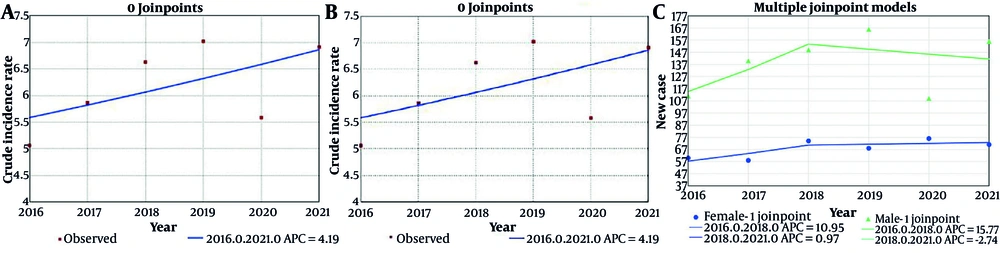
Figure 1.
A, Trends in completed suicides in northern Iran; B and C, Trends in new cases of completed suicide by total, gender, and year (2016 - 2021)
4.3.2. Trends in New Cases of Completed Suicide by Total, Gender, and Year
Based on the joinpoint regression analysis results, the trend in completed suicides in northern Iran from 2016 to 2021 showed no statistically significant joinpoints. The selected model was the permutation test, with 0 joinpoints, 6 total observations, 2 parameters, and 4 degrees of freedom. The APC was estimated at 4.19%, with a slope of 0.041 (95% CI, -3.67 to 127.70), indicating a slight upward trend. However, the estimate was not statistically significant and should be interpreted cautiously given the short time series. This increase was not statistically significant (P = 0.22). These findings suggest that although there was a modest increase in the rate of completed suicides over the study period, the change was not significant enough to indicate a meaningful shift in the trend. Overall, the trend remained relatively stable, highlighting the importance of ongoing surveillance and targeted interventions to prevent potential future increases (Figure 1B).
Although a slight upward fluctuation was observed around 2018, no statistically significant joinpoint was identified. APC estimates indicated increases for both sexes; however, these changes were not statistically significant. Specifically, the APC was 10.95% (95% CI, -74.49% to 382.55%; P = 0.534) for females and 15.77% (95% CI, -99.60% to 336.10%; P = 0.793) for males. Similarly, APCs for the segmented periods did not demonstrate significant trends: females had an APC of 0.97% (95% CI, -48.70% to 98.75%; P = 0.886), and males had an APC of -2.73% (95% CI, -91.93% to 107.00%; P = 0.910). The AAPC over the entire period was 4.85% (95% CI, -6.09% to 17.07%; P = 0.3999) for females and 4.28% (95% CI, -31.43% to 58.59%; P = 0.845) for males, indicating no statistically significant overall trend. Overall, although the analysis suggests possible increases around 2018, the trends were not statistically significant for either sex over the study period (Figure 1C).
5. Discussion
A total of 1,237 suicide cases were analyzed, with a mean age of 37.5 years (SD = 15.9), predominantly among males (66%). The highest number of deaths occurred between 2018 and 2021, peaking in 2019. Married individuals constituted the largest marital-status group (40.7%), and only 9.8% had a previous suicide attempt. The most common suicide methods were categorized as "other" methods (58.5%) and rice pill (aluminum phosphide) ingestion (37.3%). Across all years, males consistently had higher mean ages at death and suicide rates than females. YLL was greatest among males aged 25 - 29 years and females aged 15 - 19 years, indicating vulnerable age groups. Joinpoint regression analysis revealed no statistically significant changes or joinpoints in suicide trends from 2016 to 2021, with a modest but nonsignificant annual increase in suicide rates (APC ≈ 4.19%; P = 0.22). A slight, nonsignificant year-to-year fluctuation was observed around 2018 in both sexes. Overall, the suicide trend in northern Iran remained relatively stable during this period, underscoring the need for continued monitoring and targeted prevention efforts.
The analysis of 1,237 suicide cases in northern Iran, with a mean age of 37.5 years and a predominance of male victims, is consistent with the broader literature on suicide mortality and YLL, which often shows marked demographic differences across age and sex groups. The higher suicide mortality among men observed in this retrospective, registry-based descriptive trend study (66%) aligns with global and Iranian evidence indicating greater suicide mortality and YLL among males, particularly during young adulthood (25 - 29 years) (6). Patterns such as the high mean age at suicide (37.5 years) and low previous-attempt rate (9.8%) should be interpreted cautiously, given potential confounders, including underreporting bias, stigma surrounding mental health disclosure, and limited access to psychiatric care in rural provinces. In Iran, cultural stigma may lead to the misclassification of suicides as accidental deaths or deaths of undetermined intent, which can artificially lower reported attempt rates compared with Western contexts, where previous attempts exceed 20% - 30% (6). Family conflicts, marital discord, and economic pressures, which are common contributors to suicidal behavior in Iran, may drive impulsive fatal acts without previous attempts, particularly among males facing societal expectations of provider roles, higher risk-taking behaviors, and reduced mental health service utilization. These sociocultural factors contribute to gender disparities and highlight the need to strengthen vital registration systems to reduce reporting bias.
This age group is among the most economically and socially active in society, and this harm leads to the loss of the country's most important social capital and many potential years of life (7). The substantial proportion of cases among married individuals also echoes recent research suggesting that although marriage is generally a protective factor, sociofamilial stressors, especially those related to addiction or economic hardship, can increase vulnerability even in this group (8 - 10). Furthermore, the prominent use of rice pills (aluminum phosphide) and other lethal means underscores the unique epidemiological patterns of suicide in Iran, where means restriction remains a key preventive strategy (8). These demographic patterns align with recent Iranian research documenting suicide characteristics and their association with family history, further emphasizing the role of heritable and familial risk factors in regional suicide epidemiology (6). Mazandaran's stable suicide trend (APC = 4.19%; P = 0.22) and crude rates (5 - 7 per 100,000) contrast with higher-burden western provinces, such as Ilam (28.9 per 100,000), Kermanshah (13.5 per 100,000 males), and Hamedan, where firearms and self-immolation predominate compared with pesticide-related methods in Mazandaran, highlighting regional variation in suicide methods across Iran. Nationally, Iran's suicide rate is below WHO global averages, yet the YLL burden remains substantial among youth, as documented in Kohgiluyeh and Boyer-Ahmad, where 9,248 male YLL were reported over 6 years (11, 12).
The stable suicide trend in Mazandaran (APC = 4.19%; P = 0.22) aligns with national patterns showing a persistent YLL burden. A recent Iranian study reported total YLL due to suicide over 4 years as 611,068 years (15.97 per 1,000 persons) among males, 286,847 years (7.65 per 1,000 persons) among females, and 897,915 years (11.86 per 1,000 persons) overall, demonstrating substantially higher national YLL rates than the localized burden in Mazandaran during 2016 - 2021. This consistency underscores the sustained public health impact across Iran despite stable trends, contrasting with global declines in rates but persistent YLL among youth (13).
Despite careful examination using joinpoint regression, this study found no statistically significant change points or substantial annual increases in suicide mortality rates from 2016 to 2021. This stable but persistent trend, with only a modest and nonsignificant APC of approximately 4.19%, is consistent with longitudinal findings from both global and Iranian data (14), suggesting that although the suicide burden, as measured by YLL, remains high and persistent, overall rates have not increased sharply in recent years. However, certain age groups, particularly males aged 25 - 29 years and females aged 15 - 19 years, continue to experience disproportionately high YLL due to suicide, highlighting ongoing public health priorities for youth-focused and gender-sensitive prevention efforts (13, 14). The persistence of these demographic patterns and the lethality of available means indicate the need for comprehensive, context-specific suicide prevention strategies that address both individual- and population-level risk factors, as underscored by YLL analyses in Iran and internationally (15).
5.1. Limitations
Although this registry-based analysis provides robust provincial trend estimates for Mazandaran, several limitations temper its generalizability. These include potential underascertainment of suicides due to the misclassification of undetermined deaths, exclusion of incomplete records introducing selection bias, lack of individual-level confounders such as psychiatric history and socioeconomic status, and a 7-year timeframe that limits long-term trend detection. These provincial findings, emphasizing stable rates and high YLL among young males with pesticide predominance, may extend to similar rural northern Iranian contexts but may be less applicable to urban areas where different methods are more common. Therefore, multiregional studies are needed to confirm national relevance.
This study has several limitations inherent to registry-based research. The registry-based design is prone to underascertainment and misclassification bias because deaths of undetermined intent and cases with incomplete information were excluded, and some suicides may have been coded as accidental or of unknown cause.
First, to minimize these biases, all cases with unknown causes or incomplete registry data were excluded according to the inclusion criteria described in the Methods section. Although necessary for analytical rigor, this exclusion may have omitted latent suicide trends captured in undetermined deaths, a recognized issue in countries with underreporting or misclassification, including Iran. Such cases often represent conservative indicators of the true suicide burden, potentially underestimating overall rates and YLL in Mazandaran. Future studies should incorporate sensitivity analyses that include cases of undetermined intent (ICD-10 codes Y10-Y34) to assess this bias. Second, reliance on forensic registry data precluded the capture of nonfatal attempts or psychosocial risk factors. Third, the 7-year timeframe limited the detection of long-term trends. Despite these constraints, joinpoint regression provides robust trend estimation from verified completed suicides.
The limited number of annual observations reduced statistical power, and the wide confidence intervals indicate that APC estimates are imprecise. Therefore, these findings should be interpreted as descriptive trends rather than definitive evidence of change.
5.2. Conclusions
Overall, the suicide trend in northern Iran remained relatively stable but persistent during the study period, underscoring the need for continued monitoring and targeted prevention efforts. The stable suicide trend, combined with high YLL among young adults, indicates a substantial public health burden and the need for targeted prevention. Therefore, the government should adopt appropriate health policies.
