


1. Background
Approximately half of the world’s population is female, and women’s health remains a global priority. Menstrual-related problems are among the most commonly reported health concerns among women. Menstruation occurs monthly from approximately ages 12 to 51 years and is accompanied by various physical and psychological changes (1). Premenstrual syndrome is a recurrent condition that occurs during the luteal phase and usually subsides with the onset of menstruation, presenting with a range of physical, cognitive, emotional, and behavioral symptoms. Nearly 90% of women report experiencing at least 1 PMS-related symptom (2), and its global prevalence has been estimated at 47.8% (3).
More than 200 symptoms have been identified for PMS, including depressed mood, anxiety, irritability, emotional lability, reduced interest in activities, concentration difficulties, fatigue, appetite and sleep disturbances, feelings of loss of control, and physical complaints such as headaches, bloating, breast tenderness, and weight gain (4). These symptoms may lead to considerable psychological and functional impairment, depending on individual tolerance (5). In conservative contexts such as Iran, where menstruation is often stigmatized, awareness of and help-seeking for premenstrual disorders may be limited, underscoring the importance of identifying both contributing and protective factors associated with PMS.
The etiology of PMS has not been fully established; however, fluctuations in reproductive hormones and serotonergic functioning are widely considered important contributors (6). Beyond biological mechanisms, PMS has been linked to a range of psychosocial and environmental factors, including stress, adverse life events, gender-role expectations, and nutritional patterns (2). Among these correlates, childhood trauma has attracted particular attention. Childhood trauma refers to early adverse experiences, such as emotional, physical, or sexual abuse, neglect, and exposure to domestic violence, and has been associated with persistent consequences for both mental and physical health (7). Early trauma can produce neurobiological alterations that affect emotional and cognitive regulation; for example, Teicher and Samson (8) reported a 17% reduction in corpus callosum size among individuals with a history of maltreatment. These effects may persist into adulthood, contributing to emotional vulnerability and dysregulated stress responses (9, 10).
An increasing body of research indicates a direct association between childhood trauma and both PMS and premenstrual dysphoric disorder (PMDD). Women with these conditions often report more emotional, physical, and sexual abuse in childhood than those without such disorders (11). Research indicates that childhood trauma can increase the likelihood and intensity of PMS symptoms (2) and is associated with altered late-luteal cortisol patterns in women with PMDD (12). Findings across populations further support these associations: early-life trauma is strongly related to PMDD (13), adverse childhood experiences increase PMDD symptoms, women with PMS report greater childhood deprivation (14), and adolescents with PMS report higher trauma exposure (1). Evidence suggests that women with a history of childhood abuse are more likely to report PMS, with emotional and physical abuse showing particularly strong associations (15). Overall, previous studies have linked childhood trauma to greater severity of PMS and PMDD, highlighting the importance of considering trauma history in women with more severe symptoms. Nevertheless, not all individuals exposed to childhood adversity experience subsequent psychological difficulties, suggesting that certain protective factors may reduce vulnerability (1). One protective factor is perceived social support, defined as the sense of being cared for, valued, and connected to supportive relationships (16). Social support is generally divided into received support, which refers to actual supportive behaviors, and perceived support, which reflects individuals’ beliefs about the availability of support (17). Greater social support is consistently associated with better mental and physical health outcomes.
Research shows that people who have experienced childhood trauma often report lower levels of perceived social support (18). Evidence also suggests that social support can mitigate the psychological impact of childhood trauma, with higher support associated with reduced post-traumatic stress disorder, anxiety, and depression among trauma-exposed individuals (19), and can mediate the impact of early maltreatment on adult psychological distress (20). Notably, higher social support has been linked to less severe premenstrual symptoms (21). These findings suggest that perceived social support may moderate the association between childhood trauma and PMS, helping to attenuate the harmful impact of early trauma by providing emotional reassurance and supportive relationships.
Given the considerable impact of PMS on women’s health and quality of life, it is important to identify factors associated with its severity. Despite a growing international literature, no study in Iran has specifically examined the relationship between childhood trauma and PMS severity or evaluated the moderating role of perceived social support in this association. Therefore, the present study investigated whether perceived social support moderates the association between childhood trauma and PMS severity among women.
2. Objectives
This study evaluated whether perceived social support modifies the association between childhood trauma and PMS severity among women aged 18 - 45 years.
3. Methods
A descriptive correlational design was used, and the proposed model was evaluated using SEM. The study population comprised women aged 18 - 45 years residing in Tehran, Iran, and data were collected between December 2023 and July 2024. Although there is no universally fixed sample size requirement for SEM, a commonly used rule recommends 10 - 20 participants per estimated parameter and a minimum of 200 cases. Accordingly, the final sample of 629 participants was considered adequate for SEM analysis. Participants were selected using purposive sampling.
Data were collected using online questionnaires developed in Porsline and distributed via social media platforms. A total of 901 responses were initially received and screened for eligibility before analysis. Because all survey items were configured as mandatory, no incomplete questionnaires were submitted. Of the 901 responses, 104 were excluded because of duplicate submissions, 85 were excluded because respondents were outside the eligible age range of 18 - 45 years, and 83 were excluded for not meeting the diagnostic criteria for moderate to severe PMS based on the PSST.
According to the standard PSST algorithm, moderate to severe PMS was identified when all 3 of the following conditions were met: at least 1 of the first 4 symptom items was rated as moderate or severe, at least 4 of the first 14 symptom items were rated as moderate or severe, and at least 1 of the 5 functional impairment items was rated as moderate or severe. Respondents who did not meet all of these criteria were excluded from the final sample. After the eligibility criteria were applied, 629 participants were retained for the final analysis. The PSST diagnostic algorithm was used to establish eligibility for study inclusion, whereas the total PSST score was treated as a continuous indicator of PMS symptom severity in the statistical analyses. The analyses were conducted using SPSS version 28 and AMOS version 24. Inclusion criteria were being a girl or woman aged 18 - 45 years, having regular menstruation, having PMS confirmed by the PSST, being literate, providing informed consent, and having access to at least 1 social media platform. Exclusion criteria included patterned or invalid responses, identical answers to all items, and the absence of PMS according to the PSST. Ethical considerations were fully observed. Participation was voluntary, confidentiality was assured, and no identifying information was collected. The study received approval from the National Ethics System for Biomedical Research.
3.1. Research Instruments
3.1.1. Childhood Trauma Questionnaire
The CTQ, originally developed by Bernstein et al. (22) and later shortened in 2003, is a 28-item self-report measure comprising 25 items assessing experiences of childhood trauma and 3 items evaluating denial or minimization. The instrument assesses 5 domains of maltreatment, including emotional, physical, and sexual abuse, as well as emotional and physical neglect, using a 5-point Likert scale. Higher scores indicate greater exposure to childhood trauma. Scores for each subscale range from 5 to 25, whereas the total score ranges from 25 to 125. The CTQ has demonstrated satisfactory reliability across international studies (7), and the Persian version has shown Cronbach alpha coefficients ranging from 0.81 to 0.98. In the present study, the scale demonstrated excellent internal consistency (alpha = 0.92).
3.1.2. Premenstrual Symptoms Screening Tool
The PSST, developed by Endicott and later revised (23), is a DSM-IV-based measure used to screen for PMS and PMDD. It consists of 19 items, including 14 symptom items and 5 impairment items, rated on a 4-point scale. Moderate to severe PMS is identified when 1 core symptom (items 1 - 4), at least 4 of the first 14 symptoms, and 1 impairment item are rated as moderate or severe. The PSST has demonstrated solid psychometric support in Hariri et al. (24), and internal consistency in this study was acceptable (alpha = 0.84).
3.1.3. Multidimensional Scale of Perceived Social Support
The MSPSS, created by Zimet et al. (25), evaluates perceived social support from family, friends, and significant others. This scale contains 12 items rated on a 5-point Likert scale. Scores of 12 - 24 denote low support, 24 - 36 denote moderate support, and scores above 36 denote high perceived social support. The Persian MSPSS showed high reliability in an Iranian study, with a total Cronbach alpha of 0.91 and subscale alphas of 0.87, 0.83, and 0.89. In this study, internal consistency was also strong (alpha = 0.89).
3.2. Data Analysis
Analyses were conducted using parametric methods in SPSS version 28 and AMOS version 24. Pearson correlations were used to assess bivariate associations; covariance-based SEM was used to test direct effects; and moderation was examined using Hayes' PROCESS macro version 4.1 (Model 1) with the trauma x social support interaction (Durbin-Watson = 1.86 for the regression model). No covariates were included because the analyses were designed to test the hypothesized associations among the main study variables. Descriptive statistics for the main study variables, including the mean, median, standard deviation, and score range, are presented in Table 1.
Table 1.Descriptive Statistics of the Main Variables
| Variables | Mean | Median | Standard Deviation | Lowest | Highest | Skewness | Kurtosis |
|---|---|---|---|---|---|---|---|
| Emotional abuse | 8.32 | 7 | 3.61 | 5 | 24 | 1.50 | 2.14 |
| Physical abuse | 7.67 | 7 | 2.77 | 5 | 22 | 1.74 | 3.49 |
| Sexual abuse | 8.10 | 6 | 4.14 | 5 | 24 | 1.52 | 1.64 |
| Emotional neglect | 11.35 | 10 | 4.80 | 5 | 25 | 0.69 | -0.33 |
| Physical neglect | 7.81 | 7 | 3.09 | 5 | 22 | 1.48 | 2.52 |
| Denial of childhood problems | 6.60 | 6 | 1.78 | 3 | 14 | 0.95 | 1.25 |
| Childhood trauma (total) | 49.87 | 45 | 15.42 | 28 | 110 | 1.15 | 1.10 |
| Friends | 13.05 | 14 | 4.58 | 4 | 20 | -0.59 | -0.55 |
| Family | 15.29 | 16 | 4.10 | 4 | 20 | -1.15 | 0.73 |
| Significant other | 16.94 | 18 | 3.29 | 4 | 20 | -1.61 | 3.11 |
| Perceived social support (total) | 45.29 | 47 | 9.43 | 12 | 60 | -0.95 | 0.68 |
| Mood, physical, and behavioral symptoms | 25.00 | 26 | 8.10 | 0 | 42 | -0.45 | -0.32 |
| Impact of symptoms on life | 7.45 | 8 | 2.53 | 0 | 15 | -0.37 | 0.01 |
| PMS (total) | 32.45 | 33 | 8.51 | 9 | 52 | -0.36 | -0.34 |
4. Results
All 629 participants were women, with a mean age of 29.94 years (range, 19 - 45 years); 61.2% were single and 38.8% were married. Most participants had an undergraduate education (52.6%), followed by diploma/associate degrees (27.2%).
Table 1 summarizes the descriptive statistics of the main variables. The overall mean scores were 49.87 for childhood trauma, 45.29 for perceived social support (friends = 13.05, family = 15.29, significant other = 16.94), and 32.45 for PMS (symptoms = 25.00; functional impairment = 7.45). Skewness and kurtosis values indicated approximate normality (generally within +/-2), supporting the use of parametric analyses.
Table 2 presents the Pearson correlations among the main variables. Childhood trauma was positively related to PMS (r = 0.22, P < 0.05), whereas perceived social support was negatively correlated with PMS (r = -0.15, P < 0.05). Childhood trauma was also negatively associated with perceived social support (r = -0.49). Among the trauma subscales, emotional abuse (r = 0.26), physical abuse (r = 0.18), and emotional neglect (r = 0.17) showed the strongest associations with PMS. For social support, all subscales except friend support showed significant negative correlations with PMS; friend support was nonsignificant.
Table 2.Pearson Correlation Matrix for the Study Variables
| Variables | 1 | 2 | 3 | 4 | 5 | 6 | 7 | 8 | 9 | 10 | 11 | 12 | 13 |
|---|---|---|---|---|---|---|---|---|---|---|---|---|---|
| 1) Emotional abuse | 1 | ||||||||||||
| 2) Physical abuse | 0.70a | 1 | |||||||||||
| 3) Sexual abuse | 0.38a | 0.47 a | 1 | ||||||||||
| 4) Emotional neglect | 0.63 a | 0.63 a | 0.23 a | 1 | |||||||||
| 5) Physical neglect | 0.63 a | 0.59 a | 0.29 a | 0.67 a | 1 | ||||||||
| 6) Denial of childhood problems | 0.45 a | 0.49 a | 0.15 a | 0.57 a | 0.47 a | 1 | |||||||
| 7) Childhood trauma | 0.84 a | 0.84 a | 0.59 a | 0.84 a | 0.80 a | 0.63 a | 1 | ||||||
| 8) Friends | -0.15 a | -0.18 a | -0.09 b | -0.22 a | -0.15 a | -0.11 a | -0.20 a | 1 | |||||
| 9) Family | -0.47 a | -0.47 a | -0.16 a | -0.61 a | -0.49 a | -0.44 a | -0.58 a | -0.30 a | 1 | ||||
| 10) Significant other | -0.32 a | -0.33 a | -0.09 b | -0.44 a | -0.38 a | -0.27 a | -0.40 a | 0.41 a | 0.61 a | 1 | |||
| 11) Perceived social support | -0.38 a | -0.41 a | -0.15 a | -0.53 a | -0.42 a | -0.34 a | -0.49 a | 0.76 a | 0.79 a | 0.82 a | 1 | ||
| 12) Mood, physical, and behavioral symptoms | 0.29 a | 0.20 a | 0.13 a | 0.21 a | 0.18 a | 0.12 a | 0.26 a | -0.01 | -0.17a | -0.17 a | -0.14 a | 1 | |
| 13) Impact of symptoms on life | -0.06 | -0.05 | -0.02 | -0.10b | -0.04 | -0.05 | -0.08 | 0.14a | -0.09b | 0.04 | 0.12a | 0.43a | 1 |
| 14) PMS | 0.26a | 0.18a | 0.12a | 0.17a | 0.16a | 0.11a | 0.22a | 0.03 | -0.14a | -0.15a | -0.15a | 0.95a | 0.51a |
a P < 0.01.
b P < 0.05.
Structural equation modeling was conducted using AMOS, and Figure 1 illustrates the final model with standardized coefficients.
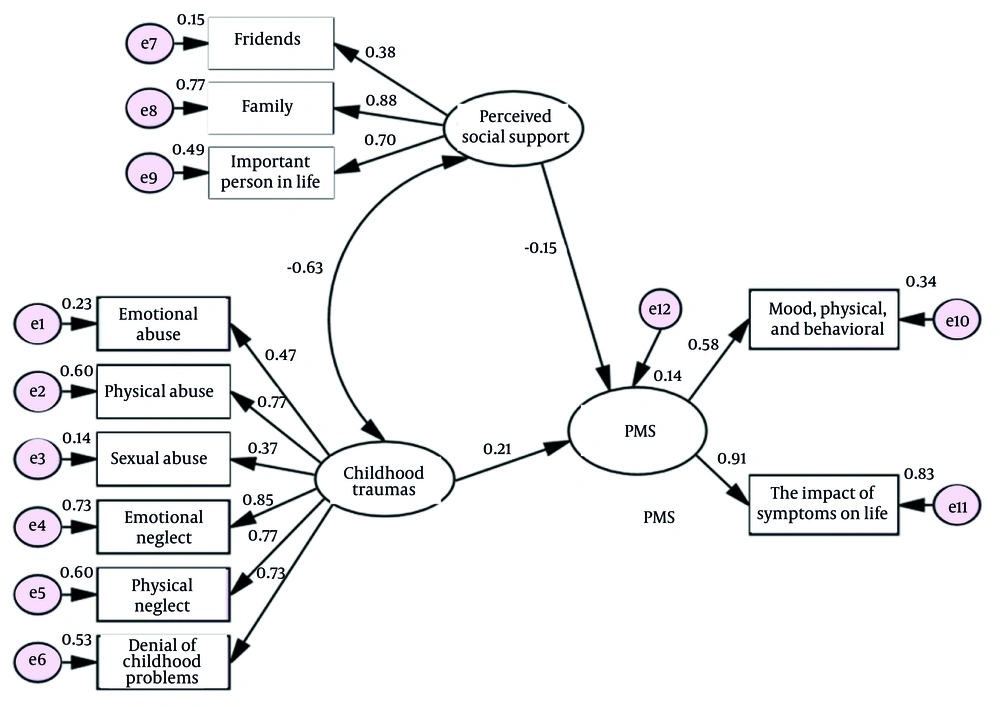
Figure 1.
Standardized path coefficient model
Figure 1 shows that childhood trauma had a standardized coefficient of 0.21 for PMS, whereas perceived social support had a coefficient of -0.15. Model fit statistics are presented in Table 3.
Table 3.Model Fit Indices
| Fit Index | Acceptable Range | Result |
|---|---|---|
| χ2/df | 1 - 5 | 3.97 |
| RMSEA | < 0.08 | 0.076 |
| GFI | > 0.90 | 0.88 |
| AGFI | > 0.90 | 0.85 |
| CFI | > 0.90 | 0.93 |
| IFI | > 0.90 | 0.92 |
| NFI | > 0.90 | 0.87 |
| PGFI | > 0.70 | 0.73 |
| R2 (PMS) | No fixed cutoff | 0.14 |
Table 3 indicates that most fit indices were acceptable. Despite slightly lower GFI, NFI, and AGFI values, the remaining indices (RMSEA, CFI, IFI, PGFI, χ2/df) indicated a satisfactory model fit. The model explained 14% of the variance in PMS (R2 = 0.14). Moderation analysis using Hayes' PROCESS macro (Model 1) is summarized in Table 4.
The SEM results for the direct effects of childhood trauma and perceived social support on PMS are presented in Table 4.
Table 4.SEM Results: Childhood Trauma and Perceived Social Support Predicting PMS
| Effects | Standardized Coefficient | Standard Error | Lower Limit | Upper Limit | t-Value | P-Value |
|---|---|---|---|---|---|---|
| Childhood trauma -> PMS | 0.21 | 0.62 | 0.088 | 0.332 | 3.56 | < 0.001 |
| Perceived social support -> PMS | -0.15 | 0.063 | -0.173 | -0.027 | -2.38 | 0.018 |
Table 5.Regression Results for the Moderating Role of Perceived Social Support
| Criterion | Source of Influence | Coefficient | SE | LLCI | ULCI | t-Value | P-Value |
|---|---|---|---|---|---|---|---|
| PMS | Fixed value | 29.24 | 5.325 | 18.78 | 39.70 | 5.49 | < 0.001 |
| PMS | Childhood trauma | 0.128 | 0.031 | 0.067 | 0.189 | 4.13 | < 0.001 |
| PMS | Perceived social support | -0.074 | 0.036 | -0.145 | -0.003 | -2.05 | 0.041 |
| PMS | Trauma x social support | -0.021 | 0.008 | -0.037 | -0.005 | -2.62 | 0.009 |
Moderation analysis was conducted using Hayes' PROCESS macro (Model 1) to examine whether perceived social support moderated the association between childhood trauma and PMS severity. The interaction term between childhood trauma and perceived social support was estimated in this model. The PROCESS macro (Model 1) automatically mean-centered the continuous predictor variables when estimating the interaction term. The results are presented in Table 4.
As shown in Table 4, the interaction between childhood trauma and perceived social support was significant (P < 0.05), confirming moderation. The negative coefficient indicates that greater social support attenuates the positive association between childhood trauma and PMS. Accordingly, the main hypothesis was supported.
5. Discussion
This study examined whether perceived social support statistically moderates the association between childhood trauma and PMS. Higher perceived social support was associated with an attenuated association between childhood trauma and PMS, suggesting that perceived support may function as a statistical buffer in this relationship. These findings are consistent with prior studies (1, 12, 15, 19) reporting associations between childhood trauma and premenstrual difficulties and suggesting a potential buffering role of perceived social support. Because childhood trauma may impair psychological development and disrupt emotional and cognitive processing, affected individuals may struggle to perceive available support. This finding highlights perceived social support as a potentially important correlational buffer. Evidence further indicates that different types of childhood abuse may be associated with alterations in neural circuits involved in emotion regulation (8), which may help explain heightened vulnerability to PMS among individuals with such histories.
Childhood trauma may be associated with alterations in cortical and subcortical regions, reduced gray matter in some areas, and difficulties in emotion regulation, which may increase vulnerability to mood-related problems, including PMS. Neurodevelopmental theories propose that trauma during sensitive periods may lead to long-lasting neural changes and heightened stress reactivity. Epigenetic models similarly suggest that environmental stressors interact with genetic predispositions; exposure to invalidating or unsupportive caregivers may foster emotional hyper-reactivity, poor affect regulation, and difficulties in goal-directed behavior, which are patterns associated with PMS. Genetic factors may also influence stress reactivity and psychological outcomes following childhood abuse (10).
Trauma is also linked to interpersonal difficulties, anxiety, and depression in adulthood, which may contribute to PMS. Greater perceived social support may be associated with better psychological adjustment and lower trauma-related distress. Although childhood neglect may be associated with cognitive deficits and reduced positive affect, perceived social support may also be associated with lower vulnerability among individuals with trauma histories; however, the present design does not allow for conclusions about causal processes.
Our results support an association between childhood trauma and PMS and indicate that perceived social support statistically moderated this association. Higher levels of perceived support were associated with a weaker trauma-PMS association, whereas lower perceived support was associated with a stronger association.
Previous research suggests that childhood trauma has been associated with a higher likelihood of PMS and has also been linked to early puberty, psychiatric disorders, and physical health problems. Trauma-related alterations in emotional processing have been proposed as factors that may contribute to persistent difficulties in managing emotional fluctuations and greater vulnerability to mood disturbances, including PMS.
This study has several limitations. Importantly, the observed moderating effect should be interpreted as a statistical association identified in cross-sectional data rather than as evidence of a causal or temporally ordered buffering effect. In addition, childhood trauma was assessed retrospectively, whereas PMS severity and perceived social support were measured concurrently, limiting conclusions regarding temporal ordering. The sample was restricted to women aged 18 - 45 years residing in Tehran, and online purposive recruitment may have introduced selection bias. Therefore, the findings may be more generalizable to urban women in Tehran with internet and social media access than to all Iranian women aged 18 - 45 years. Furthermore, potentially relevant contextual factors, including family dynamics, sociocultural conditions, personality traits, and health-related indicators, were not assessed. Future studies should use longitudinal designs, more diverse and representative samples, and a broader range of psychological, sociocultural, and health-related variables.
Overall, these findings highlight the relevance of both childhood trauma and perceived social support in understanding premenstrual symptoms. In this cross-sectional sample, perceived social support statistically moderated the association between childhood trauma and PMS, such that the association was weaker at higher levels of perceived support. However, these results should not be interpreted causally. Because the study was cross-sectional, childhood trauma was assessed retrospectively, and PMS and perceived social support were measured concurrently, the findings indicate association rather than causation. Future longitudinal and intervention studies are needed to determine temporal ordering and clarify whether strengthening social support may contribute to reduced PMS severity among women with trauma histories.
