


1. Introduction
Emotions are generally conceptualized as multidimensional responses to internal or external events, comprising subjective, physiological, and behavioral components (1). Research on the structure of affect has consistently identified two dominant and relatively independent dimensions: positive affect and negative affect (2). While negative affect reflects distress and aversive mood states, positive affect encompasses enthusiasm, energy, and pleasurable engagement. In neurotic disorders (such as anxiety, depression, and obsessive-compulsive disorder), elevated negative affect is well documented, yet deficits in positive affect have received less therapeutic attention (3). Positive affect therapy (PAT), a newer intervention specifically designed to upregulate positive affect, has emerged as a potential adjunct or alternative to traditional symptom-reduction approaches. This systematic review synthesizes the available clinical trial evidence on the effects of PAT across a range of neurotic disorders, providing a focused update on its empirical support (4). Watson et al.'s (5) two-factor model of affect posits that positive affect (PA) and negative affect (NA) are not opposite ends of a single continuum but rather two largely independent dimensions. This independence has important clinical implications: reducing a patient's negative affect (e.g., anxiety or depression) does not automatically increase positive affect (e.g., joy or interest). In neurotic disorders, although high NA is a core feature, deficits in PA are often overlooked and may require distinct therapeutic strategies. Positive affect therapy directly targets the PA dimension, offering a complementary pathway to improve well-being beyond merely alleviating distress (6).
The inability to experience pleasure, displeasure, or interest in activities is characteristic of depression, suicidal ideation or behavior, anxiety, stress, posttraumatic stress disorder, and other mental health conditions (7). In neurotic illnesses, reduced positive emotions and apathy predict poor long-term outcomes, and conventional psychological treatments have only modest effects on positive emotions (8). The purpose of positive affect therapy is to engage reward anticipation, motivation, and learning achievement. In other words, reward anticipation and motivation are targeted by planning pleasurable activities and imagining positive future outcomes (9). The rationale for this treatment is that it represents a paradigm shift from interventions focused primarily on reducing negative emotions to those emphasizing reward processing and positive emotions. In this regard, increasing treatment response and quality of life in people with mental health problems is valuable (10). Positive affect therapy is an essential resource for therapists who aim to help individuals effectively and efficiently regain interest and enjoyment in their usual activities while improving quality of life. In other words, positive affect therapy is effective in neurotic disorders by altering sensitivity within the brain's reward mechanism, increasing reward sensitivity, and fostering positive emotions rather than focusing solely on reducing negative emotions (11). Self-assessment tests, homework exercises, and interactive forms included in the intervention guidelines allow clients to participate in treatment on an ongoing basis while monitoring their progress and recording their symptoms. Therefore, this treatment approach is also an essential resource for individuals who wish to regain interest and pleasure in their usual activities effectively and efficiently while improving their quality of life (12).
Positive affect therapy targets reward anticipation and motivation through planning pleasurable activities and visualizing positive future outcomes. Measures of reward anticipation motivation typically include physiological anticipation of social or financial reward during guessing or performance tasks, behavioral effort to obtain rewards, and self-report of interest and motivation for rewarding activities (13). The response to reward attainment, or the hedonic effect of rewarding stimuli, is another important component of this psychotherapeutic approach. During this treatment, activation in the striatum and orbitofrontal cortex changes, which is associated with reduced feelings of anhedonia in neurotic individuals (14). Learning occurs when individuals learn which actions lead to rewards and which stimuli are rewarding (15). From another perspective, a growing body of neuroimaging evidence has identified the striatum, particularly its ventral subdivision (nucleus accumbens), as a core hub for reward anticipation and motivational processes. A large-scale meta-analysis of 129 neuroimaging studies (438 contrasts, 4308 foci) demonstrated transdiagnostic hypoactivation of the ventral striatum during reward and loss anticipation across neuropsychiatric conditions, including depression and anxiety disorders, which are often accompanied by elevated negative affect and diminished positive affect (16). This striatal hypoactivation is thought to reflect impaired dopaminergic signaling, which plays a critical role in reinforcement learning, effort mobilization for reward acquisition, and the allocation of attention to reward-predictive cues. Consistent with this view, behavioral activation and positive affect interventions (which encourage planning pleasurable activities and imagining positive future outcomes) have been shown to engage striatal circuitry. For instance, a randomized controlled trial of Amplification of Positivity (AMP) treatment found significant increases in striatal activation during anticipation of social rewards, with a large effect size (17). Moreover, preliminary evidence indicates that such interventions strengthen neural connectivity between the ventral striatum and prefrontal, limbic, and occipital regions during reward anticipation, suggesting enhanced integration of reward processing, emotion regulation, and attentional networks. Collectively, these findings point to a mechanistic pathway: deficits in striatal dopaminergic function contribute to reduced reward anticipation and motivation in neurotic disorders, and positive affect therapy may exert therapeutic effects by upregulating striatal reactivity and functional connectivity, thereby remediating anhedonia and fostering behavioral activation. This neurobiologically grounded framework provides a rationale for directly targeting the positive valence system in the treatment of neurotic disorders, an approach that complements traditional symptom-reduction strategies focused primarily on the negative valence system (18).
There is empirical evidence supporting the effectiveness of positive affect therapy for neurotic disorders, some of which is mentioned here. For example, one study showed that positive affect therapy was effective in reducing anorexia nervosa, depression, and anxiety (15). A randomized controlled trial examining reward sensitivity in positive affect therapy showed that positive affect therapy was effective in increasing positive affect and reducing feelings of anhedonia, depression, and anxiety (7). One study indicated that a transdiagnostic intervention based on negative and positive emotion regulation delivered via the internet was effective in significantly improving depression, anxiety, and quality of life (16). Another study showed that positive affect therapy is effective for symptoms of depression, anxiety, and stress (11). Another study reported that positive affect-based psychotherapy is effective in reducing depression (17). A more recent study conducted during the COVID-19 pandemic showed that positive affect-based psychotherapy was effective for overall mental health (18).
Several lines of empirical evidence have examined the efficacy of positive affect therapy (PAT) and related positive affect-based interventions across neurotic disorders. A synthesis of the available controlled trials reveals three thematic clusters. First, interventions explicitly grounded in neurobiological models of reward processing have shown promising but preliminary results. The pilot randomized controlled trial (RCT) by Haynos et al. (19) adapted PAT for anorexia nervosa (PAT-AN) and reported medium-to-large within-group improvements in eating disorder symptoms, depressive and anxiety symptoms, and reward indices (Cohen’s d= 0.56 - 0.87), while the waitlist control showed negligible changes (d < 0.20). However, the very small sample (N= 20) and permitted concurrent enrollment in other treatments limit causal inference and generalizability. In a larger-scale RCT, Díaz-García et al. (20) evaluated a transdiagnostic internet-based protocol that added a positive affect component to a core treatment focused on downregulating negative affect. The TIBP+PA condition produced large effect sizes for depression (d= 1.42) and anxiety (d= 0.91), but between-group comparisons revealed no statistically significant advantage over the protocol without the positive affect component on the primary positive affect measure, suggesting that the incremental benefit of explicitly targeting positive affect remains unclear. Second, manualized PAT protocols for depression and anxiety have been codified in treatment workbooks (21), yet the evidence base for these standardized protocols still relies heavily on open trials and small-scale comparisons rather than large multi-site RCTs. Third, two proof-of-concept studies provide initial support for PAT in specific contexts: Arora and Sharma (22) reported that integrating discrete positive affect techniques (e.g., Duchenne smile, pleasurable activity scheduling) into child psychotherapy reduced depressive symptoms, but the pre-post design without a control group precludes attribution of improvement to the positive affect component. Bryant et al. (23) tested a brief six-session group-based positive affect training during the COVID-19 pandemic and found a significant, moderate effect on depression reduction (Cohen’s d= 0.5) at three-month follow-up compared to enhanced usual care, but no significant effects on anxiety, anhedonia, or positive mood, indicating domain-specific rather than broad efficacy. Collectively, this evidence base is characterized by substantial heterogeneity in intervention formats (individual, group, internet-based), control conditions (waitlist, enhanced usual care, active treatment), outcome measures, and sample populations. Importantly, most studies are underpowered, lack long-term follow-up assessments, and do not systematically examine which patient subgroups benefit most. These methodological limitations and gaps in the literature underscore the need for a systematic review that synthesizes the available controlled trial evidence on PAT across the full spectrum of neurotic disorders, critically appraises study quality, and identifies directions for future rigorous research (24).
Despite growing neuroscientific evidence implicating reward-sensitive striatal circuits in the pathophysiology of neurotic disorders, and despite the development of positive affect therapy (PAT) as a targeted intervention to upregulate reward anticipation (25), reward attainment, and reinforcement learning, the existing evidence base has three critical gaps. First, most published studies are small-scale, underpowered, and heterogeneous in outcome measures, control conditions, and treatment formats, making it difficult to draw generalizable conclusions. Second, no prior systematic review has synthesized controlled trial evidence of PAT across the full spectrum of neurotic disorders (e.g., major depression, generalized anxiety disorder, obsessive-compulsive disorder, posttraumatic stress disorder, eating disorders, and somatic symptom disorders). Third, the domestic literature (Persian-language research) has notably neglected this intervention, leaving a substantial knowledge gap regarding its applicability in local clinical contexts. Consequently, the mechanisms underlying PAT's effectiveness and the consistency of its effects across different neurotic conditions remain poorly understood. The present systematic review addresses these gaps by critically appraising and synthesizing all available clinical trial evidence on the efficacy of positive affect-based psychotherapy for a variety of neurotic disorders, thereby providing a comprehensive, methodologically rigorous foundation for future research and clinical practice.
2. Methods
2.1. Protocol Registration
The protocol for this systematic review was prospectively registered in the International Prospective Register of Systematic Reviews (PROSPERO) under registration number CRD420251120957. The protocol was prepared in accordance with the PRISMA-P (Preferred Reporting Items for Systematic Review and Meta-Analysis Protocols) checklist and is accessible at the following permanent link: https://www.crd.york.ac.uk/prospero/display_record.php?RecordID=1120957. No amendments to the registered protocol were made during the conduct of the review; however, any future deviations, if necessary, will be documented and justified in the final report. Compliance with the PRISMA 2020 statement for reporting systematic reviews was maintained throughout. This prospective registration ensures transparency, minimizes duplication, and enables readers to compare the a priori design with the final conduct of the review.
2.2. Literature Search
This systematic review was conducted in accordance with the PRISMA 2020 guidelines. A comprehensive search was performed on March 15, 2024 (the last search date) across six electronic databases: PubMed, Web of Science, and Google Scholar for English-language articles, and SID, Magiran, and IranMedex for Persian-language articles. No gray literature (e.g., dissertations, conference proceedings, preprints) was searched, which is acknowledged as a limitation. The search strategy combined controlled vocabulary (MeSH terms, where applicable) and free-text keywords using Boolean operators (AND, OR). The following search string was applied to PubMed; analogous adaptations were used for other databases: ("Positive Affect Treatment"[Title/Abstract] OR "positive affect therapy"[Title/Abstract] OR "Positive Affect Training"[Title/Abstract] OR "Positive Affect Intervention"[Title/Abstract]) AND ("neurotic disorders"[MeSH] OR "depression"[MeSH] OR "anxiety"[MeSH] OR "suicide"[Title/Abstract] OR "stress"[Title/Abstract] OR "eating disorders"[MeSH] OR "posttraumatic stress disorder"[MeSH] OR "obsessive-compulsive disorder"[MeSH])
2.3. Inclusion and Exclusion Criteria
The inclusion criteria comprised clinical trials including participants with neurotic disorders according to DSM-5. Accordingly, studies were eligible if they evaluated treatment or any type of positive affect intervention for neurotic disorders (depression, anxiety, stress, obsessive-compulsive disorder, posttraumatic stress disorder, eating disorders, sleep disorders, suicidal tendencies). Eligible interventional studies were required to have published results as full-text articles. The exclusion criteria were: studies published in a format other than an article; articles published only as extended abstracts; studies with inconsistencies in data analysis due to reporting p-values without corresponding effect sizes or measures of variance (e.g., SD, SE, CI) for primary outcomes; use of inappropriate statistical tests (e.g., t-test for repeated measures without addressing within-subject correlation; ANOVA for non-independent data without correction); omission of key statistical assumptions (normality, homogeneity of variance) for parametric tests without justification or a non-parametric alternative; discrepancies between reported numbers (e.g., sample sizes in text vs. tables; degrees of freedom inconsistent with group sizes); and imputation of missing data without sensitivity analysis or a clear description of the imputation method. Studies without a control group, including participants aged below 18 years, or published in a language other than English/Persian were excluded.
2.4. Data Extraction
A standardized data extraction form was developed a priori by the first author, pilot-tested on three randomly selected included studies, and refined accordingly. The final form captured the following variables for each study: (1) bibliographic information (authors, year, country); (2) study design (e.g., randomized controlled trial, quasi-experimental); (3) participant characteristics (sample size per group, age, sex, diagnosis according to DSM-5); (4) intervention details (format, number of sessions, duration, control condition); (5) outcome measures for neurotic disorders (depression, anxiety, stress, suicidal ideation, sleep disorders, eating disorders, OCD, PTSD); (6) key findings, including direction and magnitude of effect; (7) risk of bias assessment using the Cochrane Risk of Bias 2 (RoB 2) tool; and (8) study limitations as reported by the authors.
Data extraction was performed independently by two reviewers (first and second authors). Upon completion, the two extractions were compared item by item. Inter-rater agreement was calculated for a random 20% sample of the included studies (three articles) using percent agreement (initial agreement = 89%). All discrepancies (e.g., differences in extracted effect sizes or risk of bias ratings) were resolved through discussion; if consensus could not be reached, a third reviewer (third author) made the final decision. No disagreements remained unresolved. The extracted data were then verified by the second author against the original full-text articles to ensure accuracy. Finally, the third author reviewed the complete dataset for consistency. The entire extraction process was documented in an audit trail (available upon request). From an initial pool of 215 articles, after duplicate removal and application of the inclusion/exclusion criteria, 15 full-text articles were retained for the final systematic review. The PRISMA flow diagram (Figure 1) details the screening process. Figure 1 presents the article identification, screening, eligibility, and inclusion process.
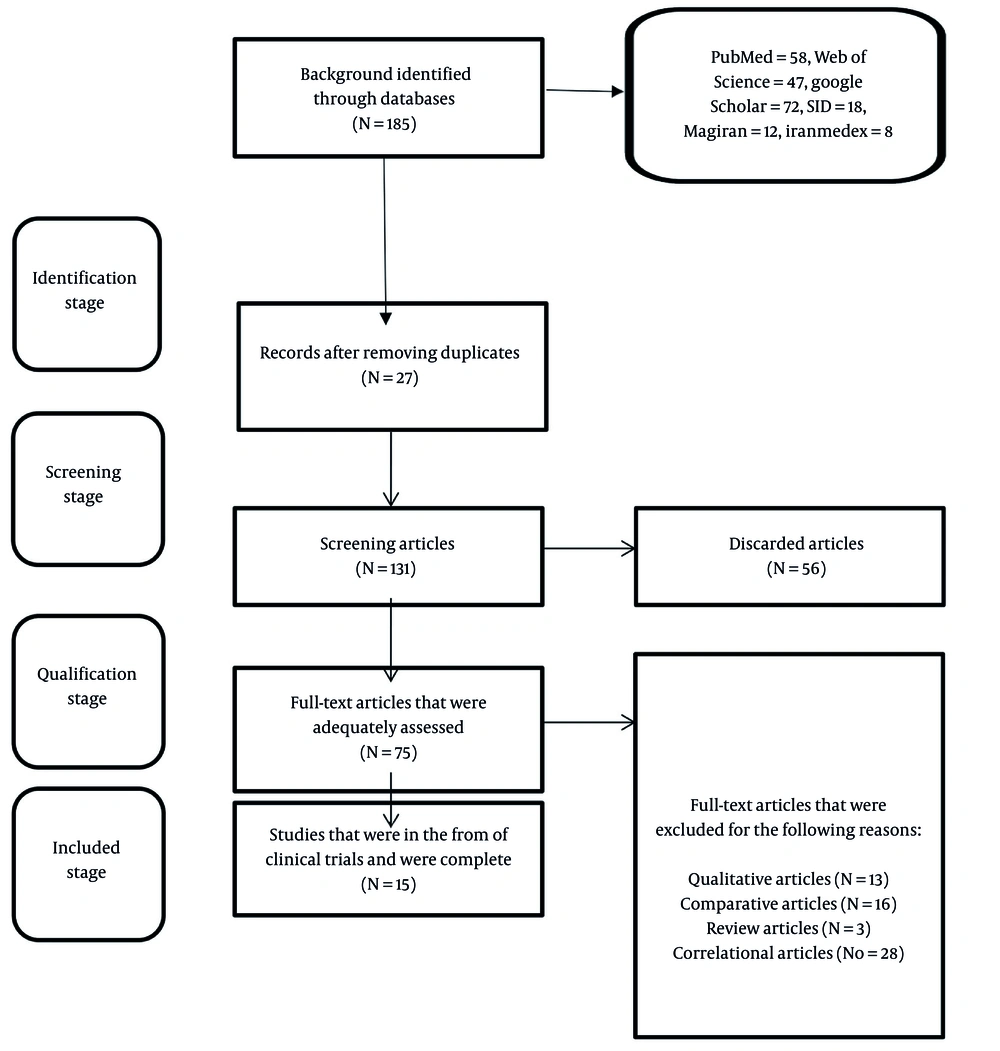
Figure 1.
Input and output chart of articles
3. Results
3.1. Study Description
To provide fuller context for interpreting the main findings, we expanded the descriptive summary beyond geographical distribution and article counts. Across the 15 included studies, sample sizes ranged from 12 to 170 participants (median = 46, mean ≈ 57). Most studies were conducted in the United States (13 out of 15), with one in Australia and one in Iran. Regarding study design, nine were randomized controlled trials (RCTs), three were semi-experimental or nonrandomized pilot trials, and three were uncontrolled or open-label pilot studies. Participant demographics varied considerably: most studies recruited adults (approximately 18 - 85 years, where reported), with specific populations including people with HIV, type 2 diabetes, fibromyalgia, metastatic breast cancer, anorexia nervosa, dementia caregivers, and individuals with treatment-resistant depression or anxiety. Gender distribution, when reported, was predominantly female (ranging from 60% to 100% across studies). Intervention durations ranged from 4 to 12 weeks, with follow-up periods (when available) of 1 to 6 months post-intervention. Only a minority of studies reported longer-term follow-up (e.g., 6 months).
3.2. Main Findings
After searching, screening, and evaluating the literature, we found that 11 articles assessed the effects of positive emotion-based interventions on depression and reported that this treatment was effective in reducing depression. Most of these studies examined depression in specific contexts, such as during the COVID-19 pandemic, or in specific populations, including women with breast cancer, patients with fibromyalgia, individuals with a history of moderate to severe depression, people with eating disorders, and caregivers of people with dementia whose mental health is impaired. Seven articles assessed the effects of positive emotion-based interventions on anxiety and indicated that this treatment was effective in reducing anxiety. Most of these studies examined anxiety in specific contexts, such as during the COVID-19 pandemic, or in specific populations, including individuals with a history of moderate to severe anxiety, people with eating disorders, and caregivers of people with dementia whose mental health is impaired. Five articles examined the effects of positive emotion-based interventions on stress and reported that this treatment was effective in reducing stress. Most of these studies examined stress in specific populations, including individuals with a history of severe anxiety, people with specific diseases such as type 2 diabetes, people with HIV, and caregivers of people with dementia whose mental health is impaired. Two studies examined the effects of positive affect-based interventions on suicidal tendencies, and one study each examined sleep disorders, eating disorders, obsessive-compulsive disorder, and posttraumatic stress disorder; these studies reported that this treatment reduced all of these disorders. A summary of the findings of the systematic review is presented in Tables 1 and 2.
Table 1.Summary of Findings from a Systematic Review of Positive Affect Intervention on Neurotic Disorders
| Author, Year | Title of Study | Country | Disorder(s) | Study Design and Sample | No. | Main Results |
|---|---|---|---|---|---|---|
| Bryant et al., 2023 (23) | Positive affect training to reduce mental health problems during the COVID-19 pandemic | Australia | Depression; anxiety; suicidal tendencies; sleep disorder | RCT; adults older than 18 years | 87 | Reduced depression, anxiety, suicidal tendencies, and sleep disorders; improved quality of life |
| Zandkarimi et al., 2023 (26) | Compilation and validation of positive affect system training protocol in obsessive-compulsive disorder | Iran | Obsessive-compulsive disorder | Semi-experimental; OCD clients | 16 | Positive affect system training protocol was effective for OCD |
| Moskowitz et al., 2012 (27) | A positive affect intervention for people experiencing health-related stress | United States | Stress | Nonrandomized pilot; newly diagnosed HIV patients | 12 | Increased positive affect; decreased negative affect and stress |
| Cohn et al., 2014 (28) | An online positive affect skills intervention reduces depression in adults with type 2 diabetes | United States | Perceived stress | RCT; adults with type 2 diabetes | 49 | Increased positive affect; decreased negative affect and perceived stress |
| Ong et al., 2023 (29) | Positive affect skills intervention for adults with fibromyalgia | United States | Depression | RCT; fibromyalgia patients | 95 | Increased positive affect; decreased negative affect, depression, and pain catastrophizing |
| Cheung et al., 2017 (30) | Positive affect skill intervention for women with metastatic breast cancer | United States | Depression | Randomized pilot; women with metastatic breast cancer | 39 | Reduced negative affect and depression |
| Contractor et al., 2023 (31) | Positive affect processes and PTSD symptoms | United States | PTSD | Open-label uncontrolled pilot; trauma-exposed participants | 16 | Improved PTSD symptoms and positive affect regulation |
| Taylor et al., 2017 (32) | Upregulating the positive affect system in anxiety and depression | United States | Anxiety; depression | Semi-experimental; treatment-seeking individuals | 29 | Reduced negative affect, anxiety, and depression |
| Hartmann et al., 2015 (33) | Experience sampling-based personalized feedback and positive affect | United States | Depression | RCT; depressed patients | 102 | Reduced depressive symptoms |
| Craske et al., 2023 (34) | Positive affect treatment targets reward sensitivity | United States | Depression; anxiety | RCT; adults with low positive affect | 85 | Improved reward anticipation and clinical status |
| Craske et al., 2019 (12) | Positive affect treatment for depression and anxiety | United States | Depression; anxiety; stress | RCT; individuals with severe symptoms | 96 | Decreased negative affect, depression, anxiety, and stress |
| Haynos et al., 2024 (19) | Positive affect treatment adapted for anorexia nervosa | United States | Eating disorder; depression; anxiety | RCT; adults with anorexia nervosa | 40 | Improved BMI, eating disorder symptoms, depression, and anxiety |
| Meuret et al., 2022 (21) | Positive affect treatment for reward sensitivity deficits | United States | Depression; suicidal ideation | RCT; adults with depression and suicidal ideation | 45 | Increased positive affect and reduced suicidal tendency |
| Verstaen et al., 2018 (35) | Life-enhancing activities for family caregivers of people with dementia | United States | Depression; stress; anxiety | RCT; dementia caregivers | 46 | Improved well-being, coping, and mental and physical health |
| Moskowitz et al., 2019 (36) | Online positive emotion regulation intervention for dementia caregivers | United States | Depression; stress; anxiety | RCT; dementia caregivers | 170 | Reduced anxiety and depression; improved quality of life and positive emotion |
Table 2.Quality Assessment Table (Risk of Bias) of Studies
| Study (Author, Year) | Disorder(s) | Design | No. | Risk of Bias | Reason |
|---|---|---|---|---|---|
| Bryant et al., 2023 (23) | Depression, anxiety, suicidal tendencies, sleep disorder | RCT | 87 | Low | Adequate sample size; multiple outcomes |
| Zandkarimi et al., 2023 (26) | OCD | Semi-experimental | 16 | High | Small sample; no randomized control group |
| Moskowitz et al., 2012 (27) | Stress (HIV) | Nonrandomized pilot | 12 | High | Small sample; no control group |
| Cohn et al., 2014 (28) | Perceived stress (type 2 diabetes) | RCT | 49 | Moderate | Moderate sample size; blinding unclear |
| Ong et al., 2023 (29) | Depression (fibromyalgia) | RCT | 95 | Low | Good sample size; clear outcomes |
| Cheung et al., 2017 (30) | Depression (metastatic breast cancer) | Randomized pilot | 39 | Moderate | Small sample; blinding unclear |
| Contractor et al., 2023 (31) | PTSD | Open-label uncontrolled pilot | 16 | High | No control group; small sample |
| Taylor et al., 2017 (32) | Anxiety, depression | Semi-experimental | 29 | Moderate | Quasi-experimental; small sample |
| Hartmann et al., 2015 (33) | Depression | RCT | 102 | Low | Large sample; effect sizes reported |
| Craske et al., 2023 (34) | Depression, anxiety | RCT | 85 | Low | Well-designed RCT |
| Craske et al., 2019 (12) | Depression, anxiety, stress | RCT | 96 | Low | Good sample size; standard outcomes |
| Haynos et al., 2024 (19) | Eating disorder, depression, anxiety | RCT | 40 | Moderate | Small RCT; controlled design |
| Meuret et al., 2022 (21) | Depression, suicidal tendency | RCT | 45 | Moderate | Small sample; incomplete blinding |
| Verstaen et al., 2018 (35) | Depression, stress, anxiety | RCT | 46 | Moderate | Moderate sample; blinding unclear |
| Moskowitz et al., 2019 (36) | Depression, stress, anxiety | RCT | 170 | Low | Large sample; strong design |
4. Discussion
This study aimed to evaluate evidence regarding the effectiveness of positive affect psychotherapy across a range of neurotic disorders. Of the included studies, 11 examined the effects of positive emotion-based interventions on depression and reported that this treatment was effective in reducing depression (12, 19, 21, 23, 29, 25, 30, 33, 34, 35, 36). Thus, this treatment appears to be effective not only in reducing depression but also in preventing depressive relapse by shifting affect from negative to positive emotion.
These findings may be explained by the fact that many neurotic disorders, such as depression, which often have cognitive, emotional, and even verbal origins (37), may improve through positive affect therapies. The goal of positive affect therapy is to address three main elements: anticipation and motivation for reward, responding to achieve reward, and learning the association between actions and reward outcomes. This mechanism may explain its effect on depression because it seeks to expand adaptive behaviors toward rewarding stimuli and increase reward-seeking in treatment seekers (38). As a result of treatment, a person’s knowledge and awareness of depression may improve spontaneously. Because depressed patients exhibit a different learning style than non-depressed individuals (39), positive affect therapy aims to change patients’ associations and modify their learning style.
In depressed patients, evidence suggests a lack of motivation and reduced reward anticipation at neural and behavioral levels. Specifically, reduced ventral striatum activation during reward anticipation is associated with more severe symptoms of anhedonia in depressed samples. Lower ventral striatal responses lead to inattention to tasks and a response bias toward stimuli that are often rewarded, which is associated with symptoms of anhedonia. Therefore, positive affect therapy targets learning by attributing positive consequences to oneself and strengthening the association between actions (e.g., pleasurable activities) and positive mood, thereby improving behavior regulation (40).
Other findings indicated that seven articles examined the effects of positive affect-based interventions on anxiety (12, 19, 23, 32, 34, 35, 36), four articles examined stress levels (12, 23, 27, 28, 35), two studies examined suicidal tendencies (23, 21), one study examined sleep disorders (23), one study examined eating disorders (19), one study examined obsessive-compulsive disorder (26), and one study examined posttraumatic stress disorder (26). These studies showed that this treatment approach was effective in reducing all of the aforementioned neurotic disorders.
These findings are consistent with the view that anxiety is the root of most neurotic disorders. In other words, obsessions, sleep disorders, and eating disorders represent transformed anxiety. Therefore, they initially follow a specific path in the brain, eventually reaching their original path and manifesting clinically (41). However, evidence to date for this therapeutic mechanism is sparse and limited to isolated changes in neural circuits involved in reward-related paradigms and resting-state connectivity. Frontal-occipital lobe networks have been implicated in anxiety (42), stress (43), and even obsessive-compulsive disorder (44). Therefore, by understanding the underlying processes or mechanisms responsible for treatment outcomes, treatment strategies can be refined to be more precisely targeted and, thus, more effective (45).
The limitations of this study include the novelty of positive affect-based therapy and its lack of widespread application across neurotic disorders. In addition, these limited studies have mostly been conducted in the United States. It is believed that the frequency of use, prevalence, and effectiveness of this therapy in the United States are related to the dominance of positive psychotherapies based on common humanistic philosophical insights in the field of therapy in this region. Therefore, researchers and therapists in different countries, especially in Iran, need to pay greater attention to this treatment protocol in other areas of neurotic disorders. In addition, because most studies have shown that positive affect-based therapy is effective in reducing depression, future studies should also investigate the effectiveness of this treatment on related constructs of depression that can also be measured with validated instruments.
4.1. Conclusions
This systematic review shows that positive affect therapy (PAT) consistently reduces symptoms of depression and anxiety, with more preliminary support for obsessive-compulsive disorder, posttraumatic stress disorder, eating disorders, and suicidal tendencies; however, the evidence base is limited by substantial heterogeneity, a lack of active-comparator trials, underreporting of effect sizes, and overrepresentation of high-income countries. For clinical practice, PAT can be recommended as a low-risk, adjunctive, or standalone intervention specifically for depression and anxiety disorders, where the evidence is strongest, whereas its use for other neurotic disorders should remain experimental and carefully monitored. Implementation should target underrepresented regions (e.g., low- and middle-income countries) and concretely define “diverse approaches,” such as testing different delivery formats (online, group, self-guided), tailoring to specific comorbidities (e.g., depression with chronic pain), and adapting to cultural contexts, each requiring separate validation. To advance the field, researchers must prioritize large-scale randomized controlled trials with long-term follow-up (≥6 months), comparative effectiveness studies directly comparing PAT with active treatments (e.g., CBT, pharmacotherapy), prospective meta-analyses once sufficient homogeneous trials accumulate, and standardized reporting of effect sizes with confidence intervals. Funding agencies and journals should favor such rigorous confirmatory trials over additional small pilot studies. In summary, PAT holds promise as a transdiagnostic intervention for neurotic disorders, but translating this promise into practice requires a shift from descriptive reviews to a coordinated program of high-quality, comparative, and long-term research that addresses not only whether PAT works but also how it compares with existing treatments.

